
California LPCC Requirements: Hours, Exams & Step-by-Step Guide
Stop guessing if your categories match California requirements. License Trail checks your direct, indirect, and supervision hours against LPCC requirements continuously and flags mismatches before you submit.
No credit card required · Free plan available
Quick Requirements Overview
- Earn qualifying MA/PhD in counseling/related field (60 semester/90 quarter units; required BPC §4999.33 content) from approved/accredited school; includes practicum (6 sem/9 qtr units + 280 face-to-face hours—doesn’t count toward 3,000)
- Complete pre-licensure coursework: 6 hrs suicide risk assessment/intervention; 3 hrs telehealth law/ethics (if applying ≥7/1/2023)
- Register with BBS as APCC before post-degree hours count (90-day rule exception); fingerprinting + background check required
- Pass California LPCC Law & Ethics Exam (must be taken annually for APCC renewal until passed; required for subsequent APCC number)
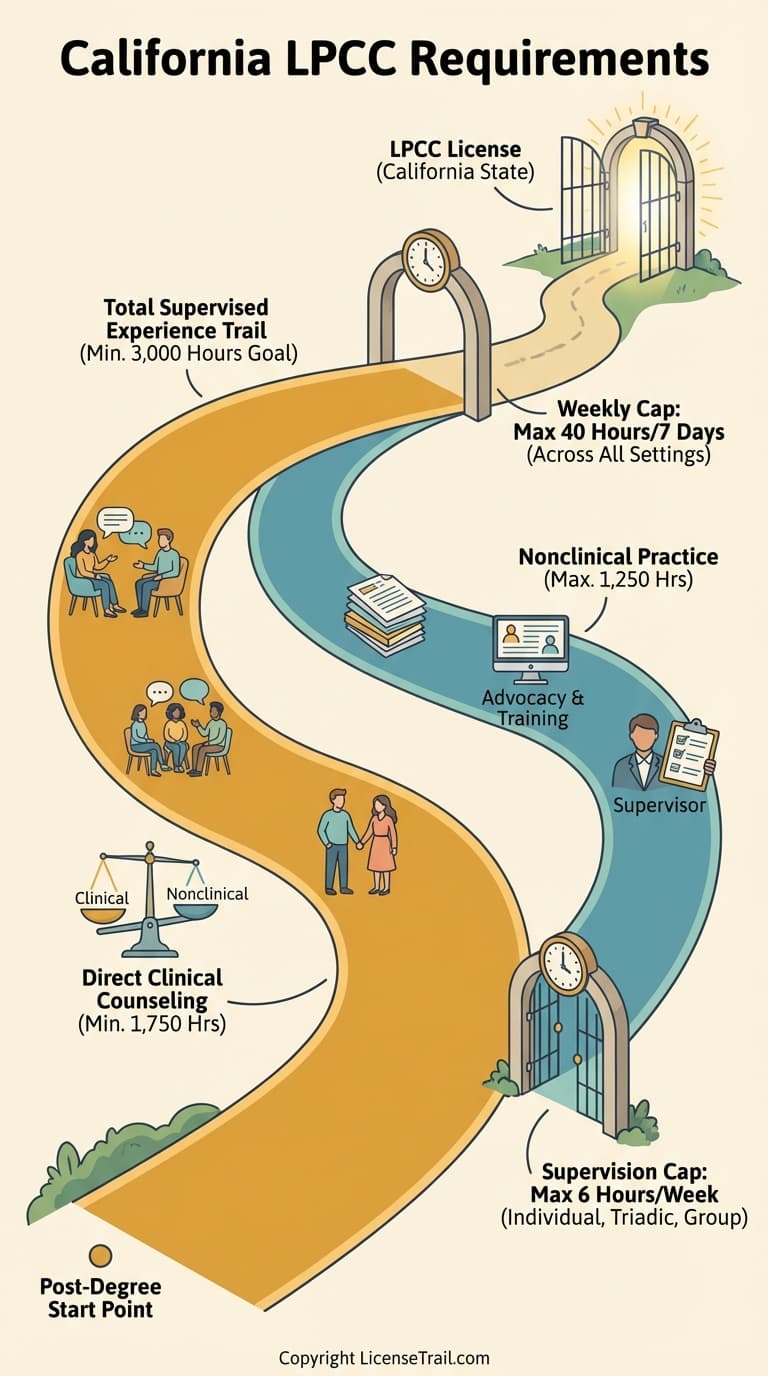
- Accrue 3,000 supervised hours within 6 years + minimum 104 weeks of supervision: ≥1,750 direct clinical counseling; ≤1,250 nonclinical
- Weekly supervision rules: at least 1 unit/week to count hours; if >10 face-to-face hours/week in a setting → 2 units; max credit 40 hrs/week experience and 6 hrs/week supervision
- Apply for LPCC licensure (in-state) with required forms/verifications/fees after education + hours + Law & Ethics pass; BBS approves to sit NCMHCE; pass NCMHCE; request initial license issuance + pay fee within 1 year of exam pass
License Details
Video Overview
Procedures
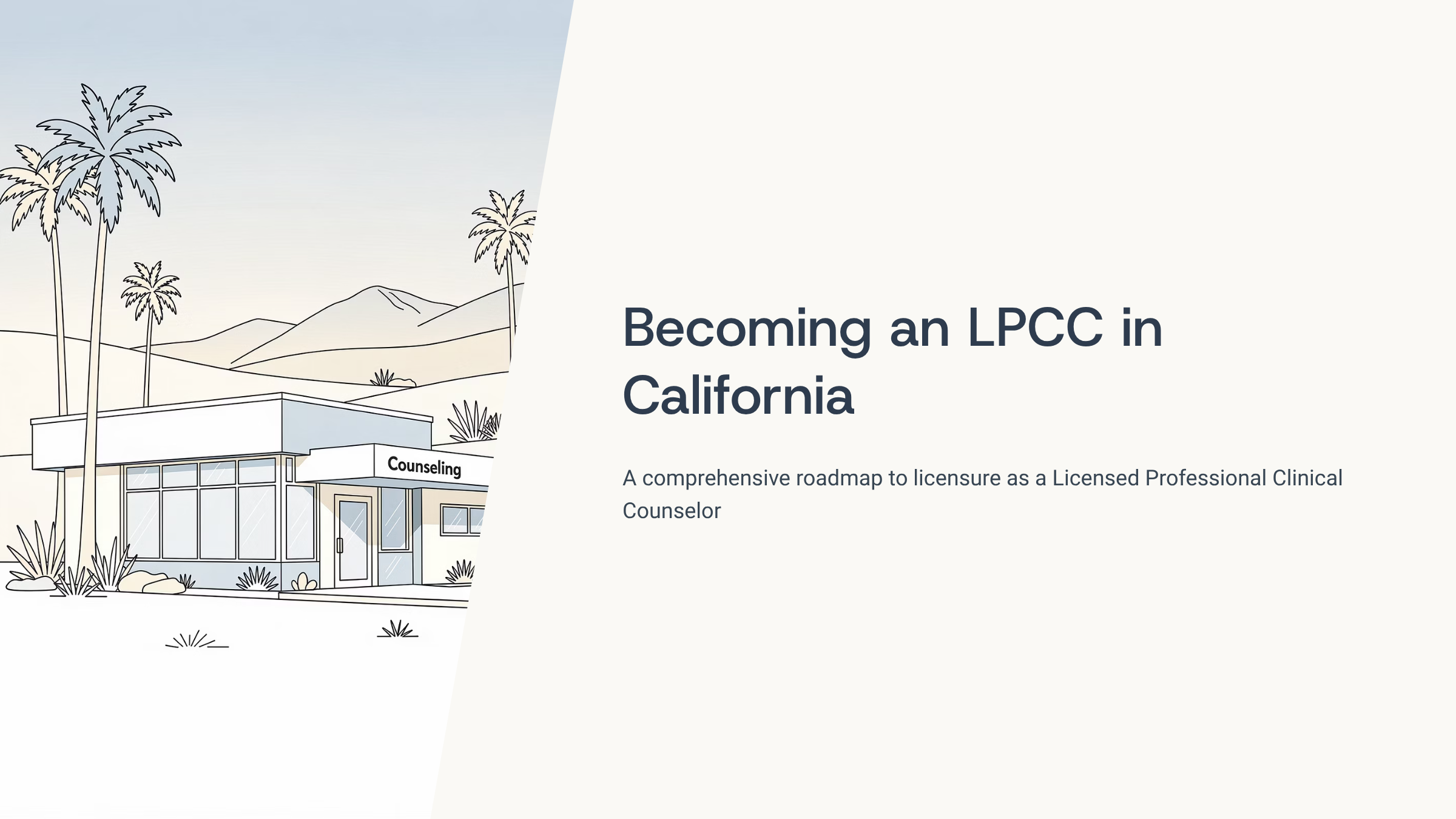
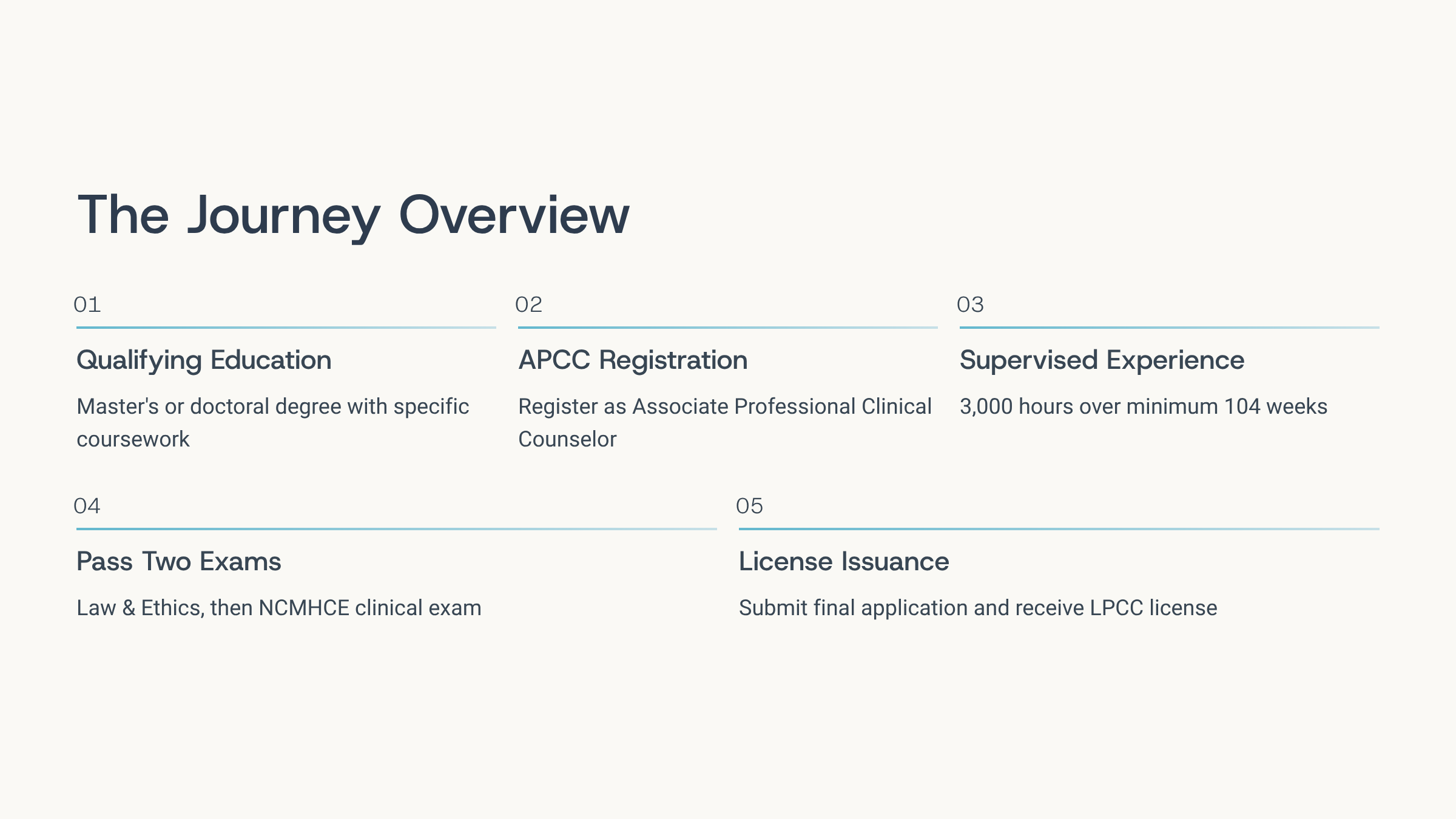
Becoming a Licensed Professional Clinical Counselor (LPCC) in California involves a defined sequence set by the California Board of Behavioral Sciences (BBS): qualifying education, registration as an associate, specific supervised experience (with clearly defined hour categories), two exams, and final license issuance.
Below is a step‑by‑step outline using the Board’s own terms and structure.
1. Educational and Practicum Requirements
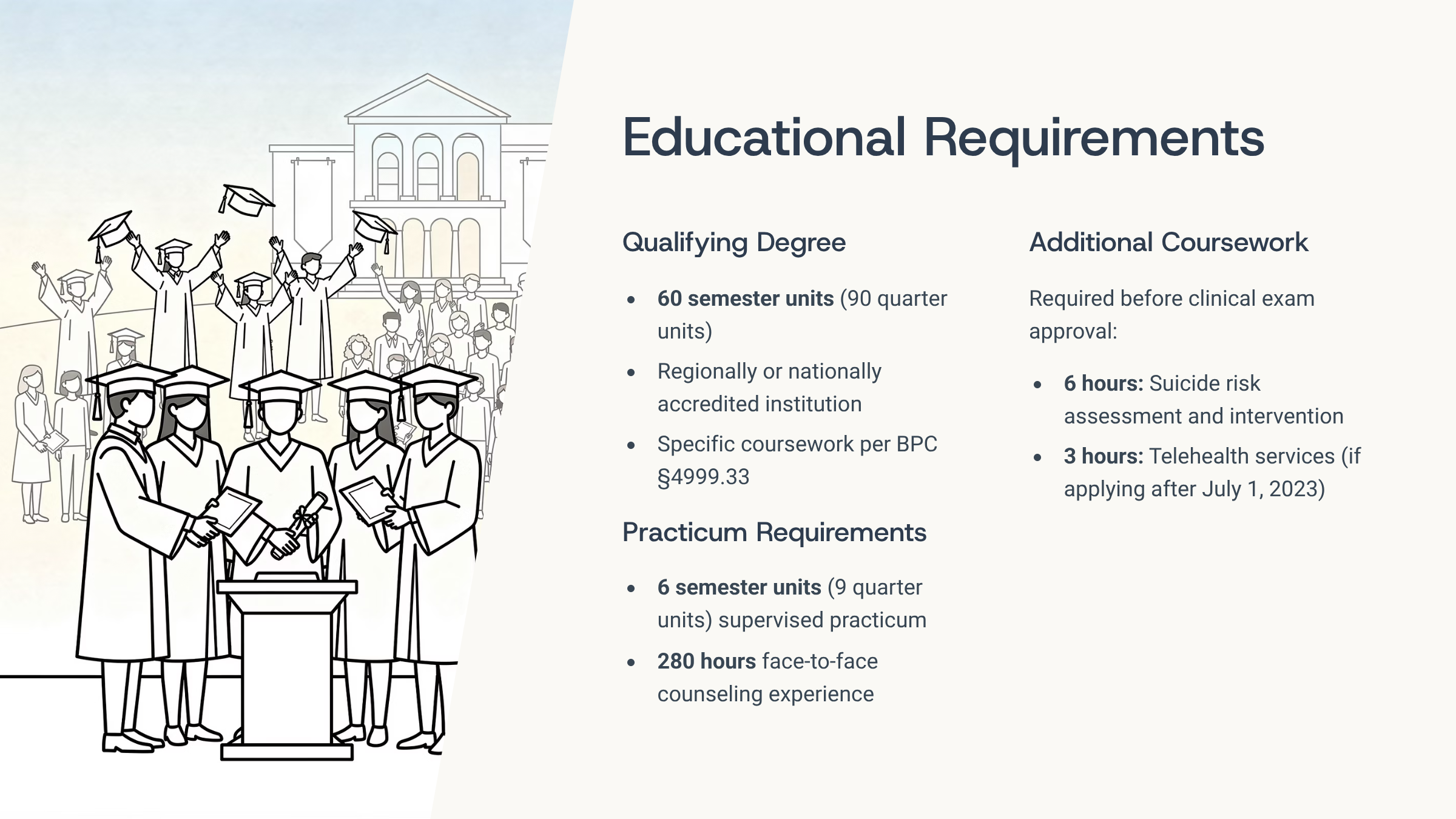
Qualifying degree
You must complete a qualifying master’s or doctoral degree in counseling or a related field from:
- A regionally or nationally accredited institution recognized by the U.S. Department of Education, or
- A school approved by the California Bureau for Private Postsecondary Education. (bbs.ca.gov)
The degree must:
- Contain at least 60 semester units (or 90 quarter units)
- Include the specific course content required in Business and Professions Code (BPC) §4999.33 (e.g., counseling theories, assessment, multicultural counseling, etc.) (bbs.ca.gov)
Practicum / field study
Your LPCC degree must also include:
- At least 6 semester units or 9 quarter units of supervised practicum or field study in a clinical setting, and
- At least 280 hours of face‑to‑face counseling experience with individuals, families, or groups during that practicum. (bbs.ca.gov)
These practicum hours are required for the degree but do not count toward the 3,000 post‑degree hours for licensure.
Additional coursework required before licensure
Before you can be approved for the clinical exam, you must complete: (bbs.ca.gov)
- 6 hours in suicide risk assessment and intervention (coursework or applied experience), and
- 3 hours in provision of mental health services via telehealth (including telehealth law and ethics) if applying on or after July 1, 2023.
2. Registering as an APCC (Associate Professional Clinical Counselor)
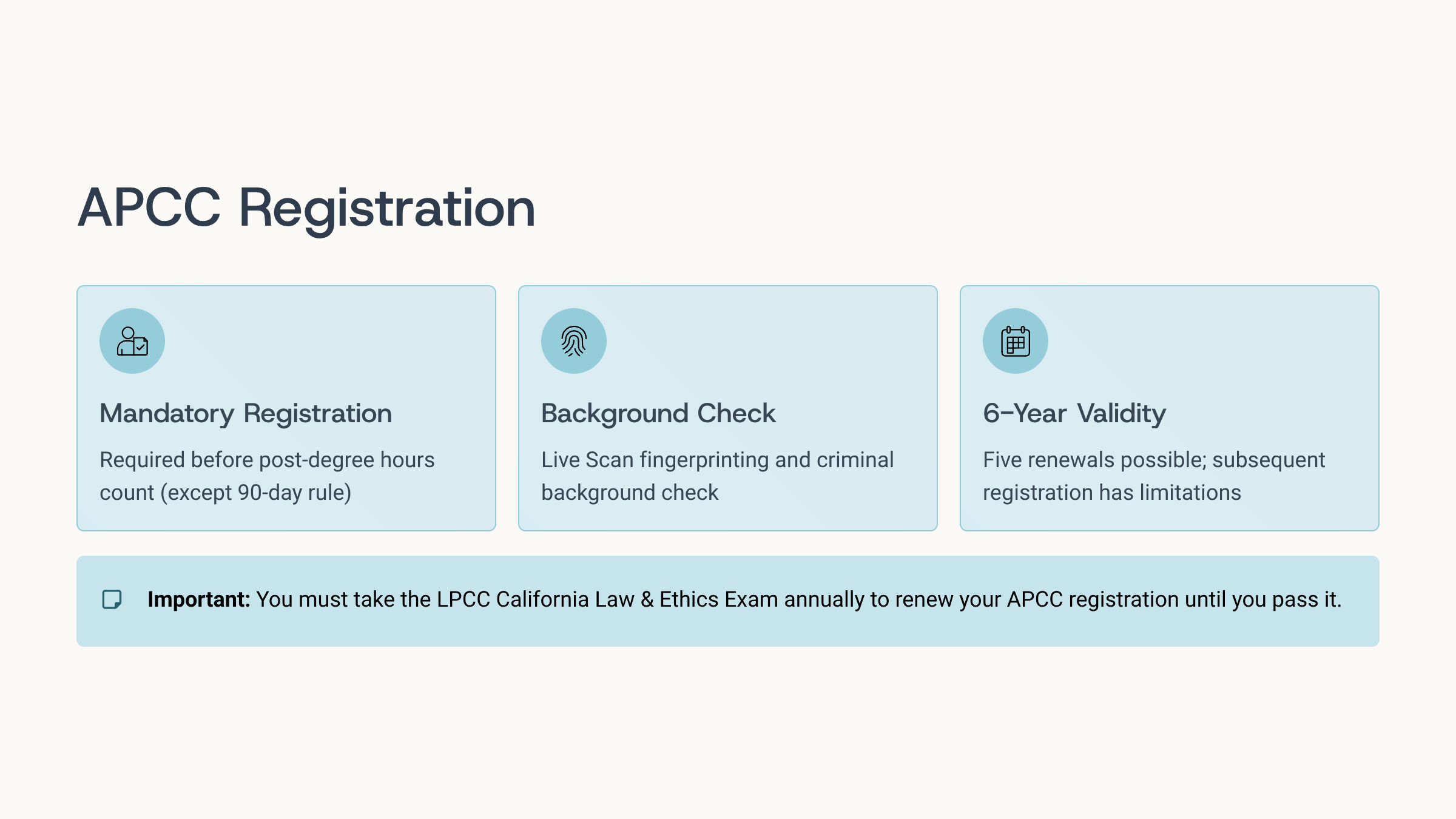
After graduation, you must register with BBS as an Associate Professional Clinical Counselor (APCC). This registration is required in order to accrue supervised experience hours in California (with a limited “90‑day rule” exception). (bbs.ca.gov)
Key points:
- APCC registration is mandatory before your post‑degree hours count, except for hours that qualify under the 90‑day rule (where you apply within 90 days of graduation and meet fingerprinting requirements). (bbs.ca.gov)
- Registrations are valid up to 6 years (five renewals). After that, you must obtain a subsequent registration number to continue toward licensure; however, subsequent registrants may not work in private practice or professional corporations. (bbs.ca.gov)
Fingerprinting and background check
As part of your initial APCC registration:
- You must complete Live Scan (in California) or submit fingerprint “hard cards” if outside the state.
- The Board conducts a criminal background check as part of the application process. (bbs.ca.gov)
California Law & Ethics Examination (LPCC version)
Once registered as an APCC, you must take the LPCC California Law and Ethics Exam:
- The exam must be taken annually in order to renew your APCC registration until you pass it.
- You must pass the LPCC Law & Ethics Exam to qualify for any subsequent APCC registration number. (bbs.ca.gov)
3. Supervised Experience Requirements and Hour Breakdown
This is the core of licensure: California is very specific about the number, type, and timing of hours.
Global supervised experience requirements
To apply for LPCC licensure, the Board requires: (bbs.ca.gov)
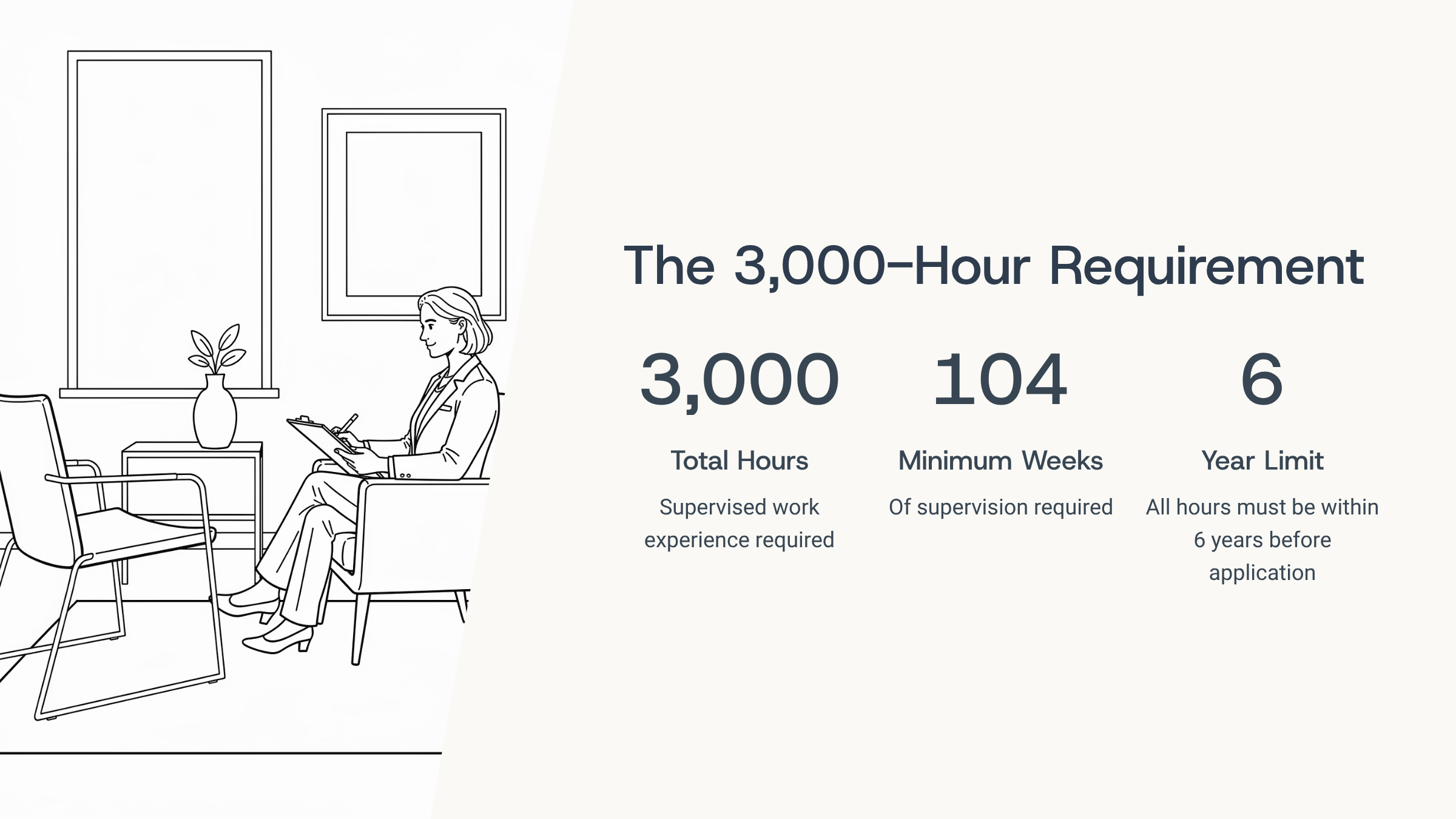
- A minimum of 104 weeks of supervision, and
- 3,000 hours of supervised work experience meeting all statutory and regulatory requirements.
Also:
- All post‑degree supervised experience must be accrued within 6 years before the date the Board receives your Application for Licensure (the “Six‑Year Rule”). (bbs.ca.gov)
- All hours in California must be gained while registered as an APCC, except those permissible under the 90‑day rule. (bbs.ca.gov)
Required types of hours (BBS terminology and numbers)
Within the 3,000 total supervised hours, the BBS defines experience categories and specific minimum/maximums using the following structure: (bbs.ca.gov)
- Direct Clinical Counseling Experience
Described by the Board as counseling work with:- Individuals
- Groups
- Couples
- Families
Requirement:
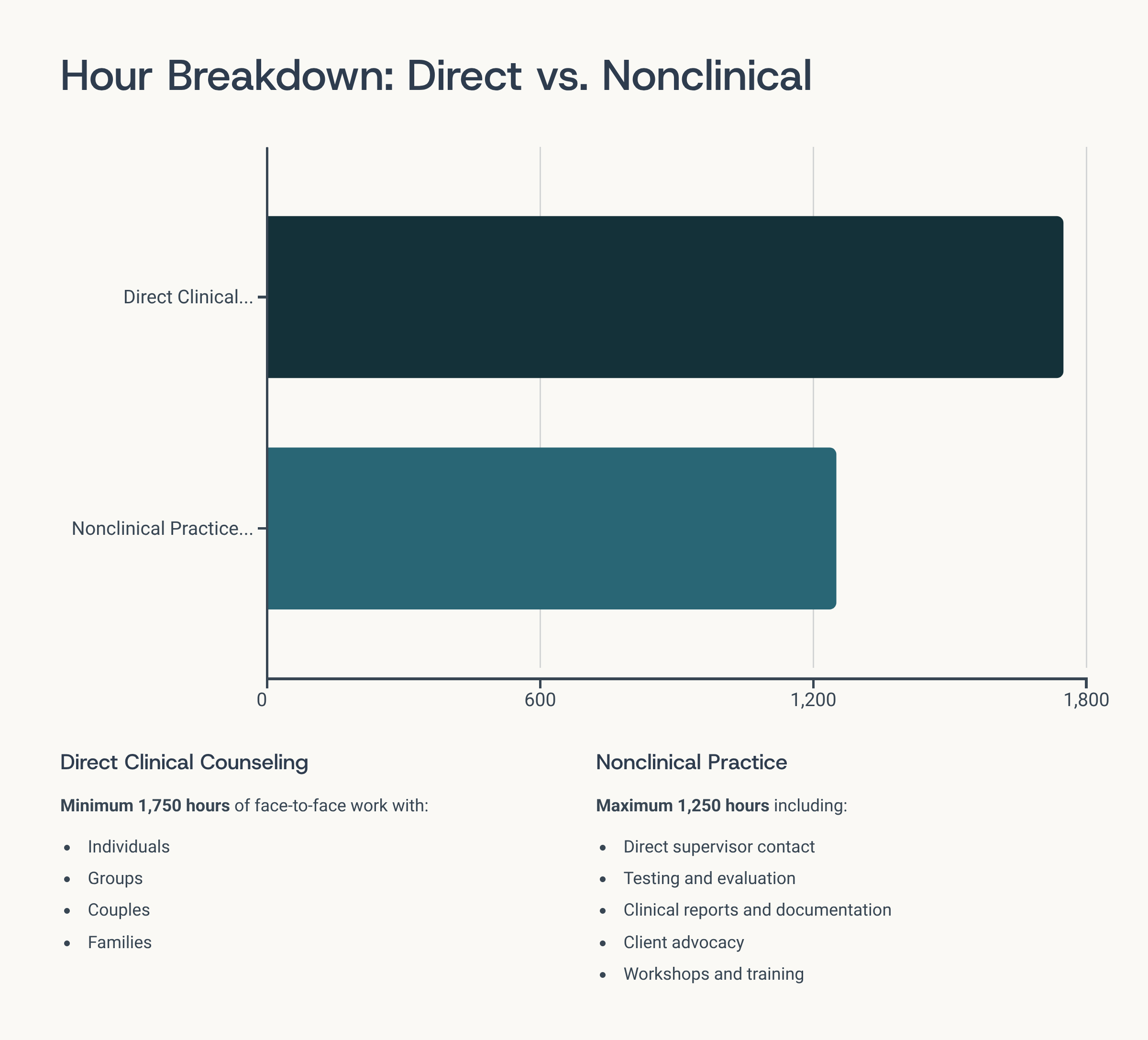
- Minimum 1,750 hours of Direct Clinical Counseling Experience.
- There is no maximum listed for this category; you can exceed 1,750 hours as long as total supervised experience stays within the 3,000‑hour cap.
In plain terms: at least 1,750 of your 3,000 hours must be direct, face‑to‑face clinical counseling with clients.
-
Nonclinical Practice
The Board lists the following activities in this category: (bbs.ca.gov)- Direct supervisor contact
- Administering and evaluating psychological tests
- Writing clinical reports, progress notes, or process notes
- Client‑centered advocacy
- Participation in workshops, seminars, training sessions, or conferences
Requirement:
- Maximum 1,250 hours of Nonclinical Practice can be counted toward the 3,000 hours.
Note: “Direct supervisor contact” is part of nonclinical practice, but supervision has additional weekly requirements addressed below.
Putting the numbers together:
Total supervised experience required: 3,000 hours
Of these 3,000 hours:
At least 1,750 hours must be Direct Clinical Counseling Experience (face‑to‑face clinical work with individuals, groups, couples, or families).
Up to 1,250 hours may be Nonclinical Practice (supervision contact, testing, documentation, advocacy, trainings, etc.).
In other words, if you think in the user’s example format:
- 1,750+ hours must be “direct experience” (BBS term: Direct Clinical Counseling Experience)
- No more than 1,250 can be “other” or nonclinical hours (BBS term: Nonclinical Practice)
- The combined total must equal 3,000 hours.
Supervision structure and weekly requirements
To have your hours accepted, weeks and supervision must be structured according to BBS rules. The Handbook’s “Breakdown of Required Experience for Licensure” uses these key concepts: (bbs.ca.gov)
Minimum weeks of supervision
- You must document at least 104 weeks of supervised experience in total.
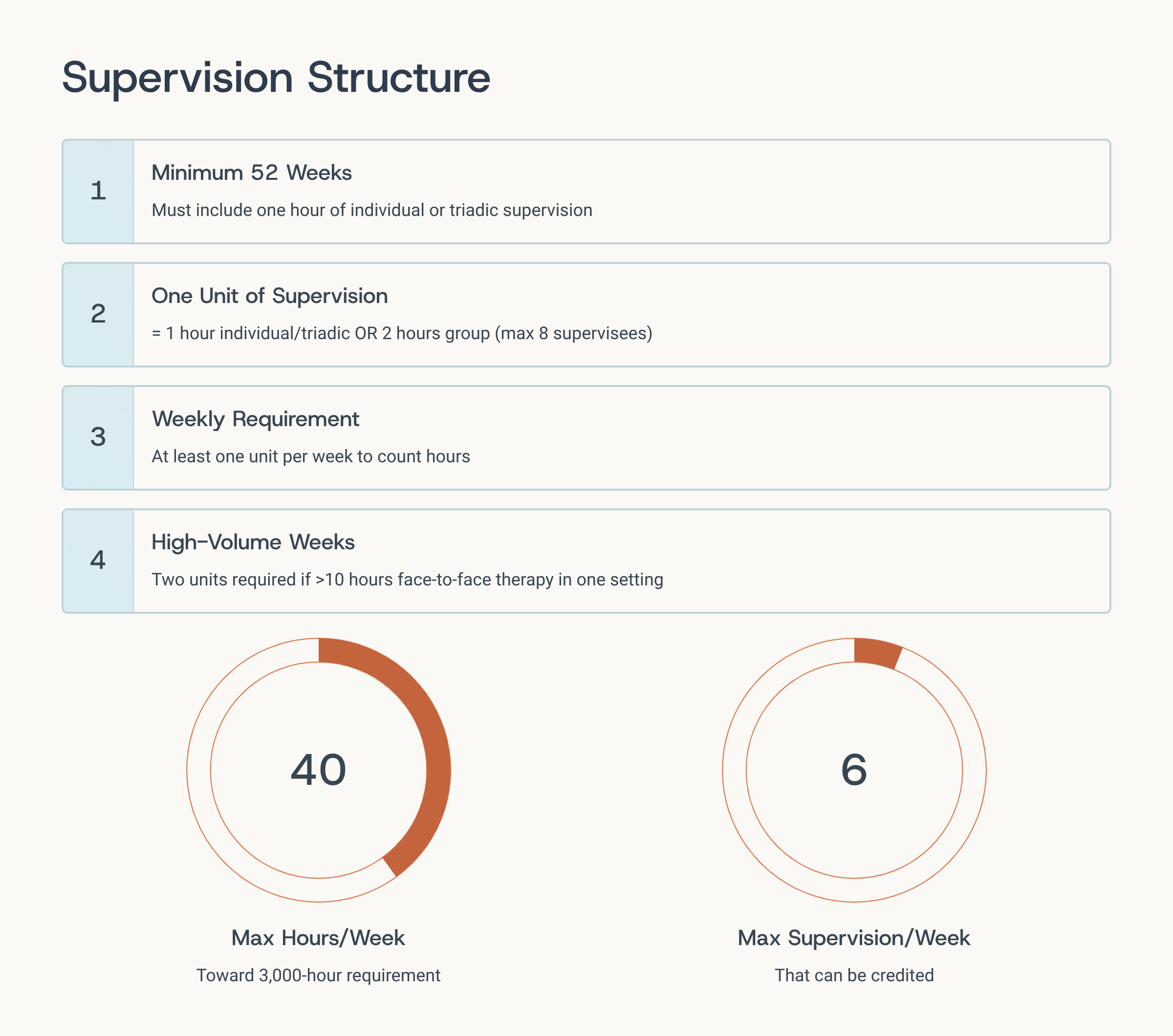
- Within those 104 weeks, there must be at least 52 weeks in which you received one hour of direct individual or triadic supervision.
Definition of a “unit” of supervision
The Board defines one unit of supervision as:
- One hour of individual or triadic supervision, or
- Two hours of group supervision (with no more than 8 supervisees in the group). (bbs.ca.gov)
Weekly supervision to count hours
To count any supervised work experience in a given week:
That week must contain at least one unit of supervision (one hour individual/triadic, or two hours group) with your qualified supervisor. (bbs.ca.gov)
If you perform more than 10 hours of face‑to‑face psychotherapy in a week in a given setting, the Board requires:
Two units of supervision for that week in that setting (for example, two hours individual/triadic; or one hour individual plus two hours group; or four hours group, etc.). (bbs.ca.gov)
Limits on weekly hours and supervision credits
- You can only credit a maximum of 40 hours of supervised experience per week toward the 3,000‑hour requirement.
- You can only credit up to 6 hours of supervision per week (even if you receive more). (bbs.ca.gov)
Supervisor qualifications (who can supervise your hours)
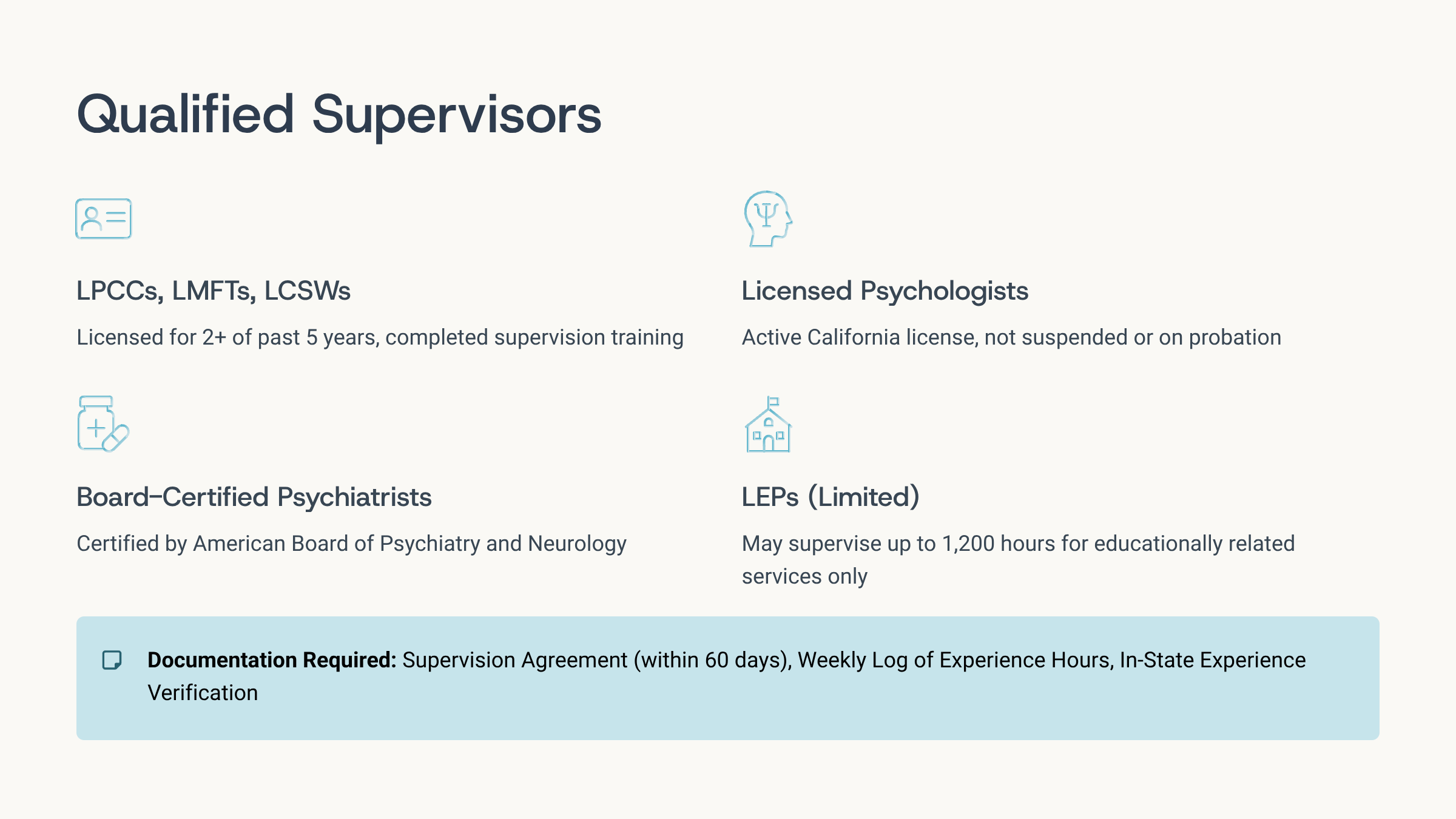
The Board allows certain licensed professionals to supervise APCCs, including: (bbs.ca.gov)
- LPCCs
- LMFTs
- LCSWs
- Licensed Psychologists
- LEPs (with limitations—LEPs may supervise up to 1,200 hours and only for educationally related mental health services)
- Physicians certified in psychiatry by the American Board of Psychiatry and Neurology
Supervisors must:
- Have been licensed and practicing for at least two of the past five years,
- Have completed required supervision training, and
- Hold a current, active California license that is not suspended or on probation. (bbs.ca.gov)
Documentation and forms while accruing hours
The BBS requires that you use specific forms (kept by you, but submitted at licensure application): (bbs.ca.gov)
- Supervision Agreement – signed within 60 days of starting supervision (for relationships beginning on or after January 1, 2022).
- Weekly Log of Experience Hours – you log hours weekly; your supervisor signs each week.
- In‑State Experience Verification – completed by each supervisor at the end of employment and submitted with your Application for Licensure.
4. Examinations
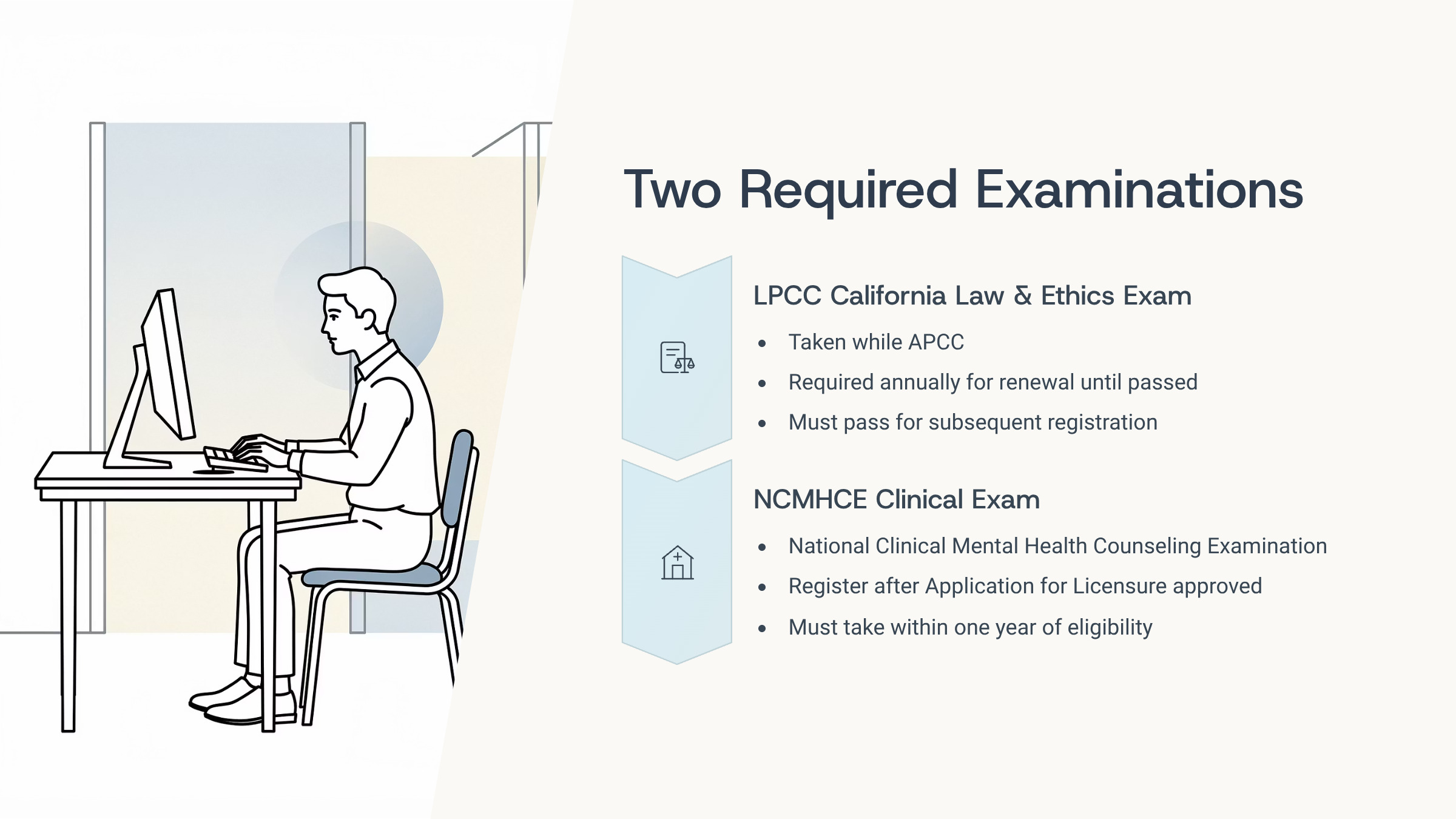
You must pass two separate exams for LPCC licensure in California:
-
LPCC California Law and Ethics Examination
- Taken while you are an APCC.
- Must be taken annually to renew the associate registration until passed.
- Must be passed to qualify for a subsequent APCC registration number. (bbs.ca.gov)
-
National Clinical Mental Health Counseling Examination (NCMHCE)
- This is the clinical exam required for LPCC licensure.
- You may register only after:
- The Board has approved your Application for Licensure, and
- You have already passed the LPCC California Law & Ethics Exam. (bbs.ca.gov)
The BBS also imposes deadlines: depending on whether you passed Law & Ethics before or after your Application for Licensure was approved, you generally must take the NCMHCE within one year of that triggering event, or your licensure file may be closed. (bbs.ca.gov)
5. Applying for Licensure and Obtaining the LPCC License
Once you have:
- Completed your qualifying degree and practicum,
- Registered and maintained good standing as an APCC,
- Accrued at least 3,000 hours of supervised work experience over a minimum of 104 weeks with the required breakdown (≥1,750 direct clinical hours; ≤1,250 nonclinical),
- Passed the LPCC California Law & Ethics Exam, and
- Met additional coursework requirements (suicide risk assessment and telehealth training), you then: (bbs.ca.gov)
-
Submit the Application for LPCC Licensure (In‑State) to the BBS, including:
- Application form
- Experience Verification forms
- Any required course certifications (suicide, telehealth, etc.)
- Applicable fees
-
Once the Board approves your Application for Licensure, it will notify NBCC that you are eligible to take the NCMHCE.
-
After you pass the NCMHCE, you must:
- Submit a Request for Initial License Issuance and
- Pay the initial license fee within one year of passing the clinical exam. (bbs.ca.gov)
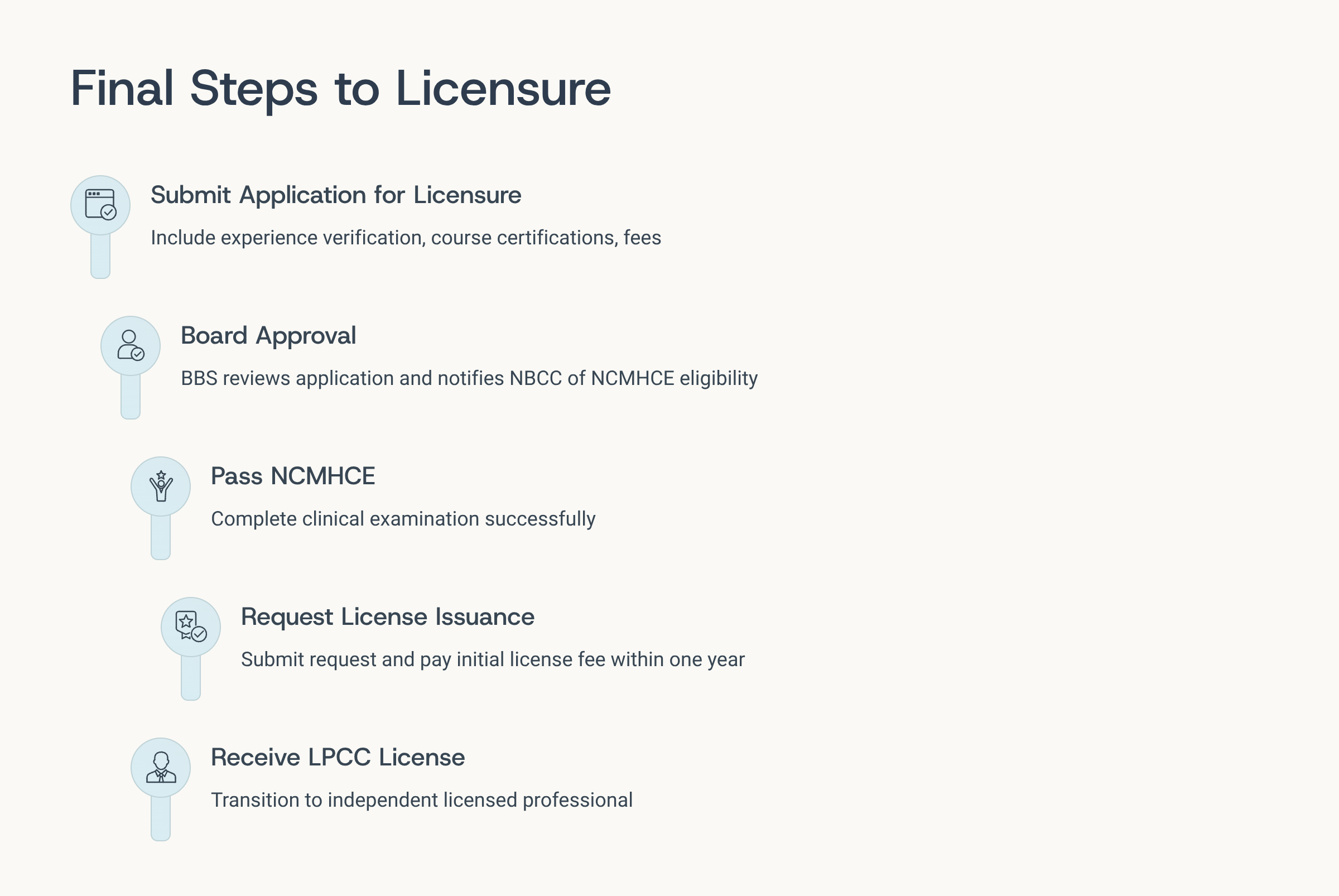
At that point, the Board issues your LPCC license, and you transition from associate to independent licensed professional, subject to ongoing renewal and continuing education requirements.
This is the current, in‑state pathway as published by the California Board of Behavioral Sciences for LPCC applicants as of late 2025. For out‑of‑state or out‑of‑country applicants, the Board has parallel “Path A / Path B” routes with separate guides, but the supervised‑experience structure (3,000 hours, 104 weeks, direct vs nonclinical hours, and supervision requirements) is essentially the same. (bbs.ca.gov)
Track your LPCC hours with confidence
License Trail checks your direct, indirect, and supervision hours against California LPCC requirements continuously and flags mismatches before you submit.
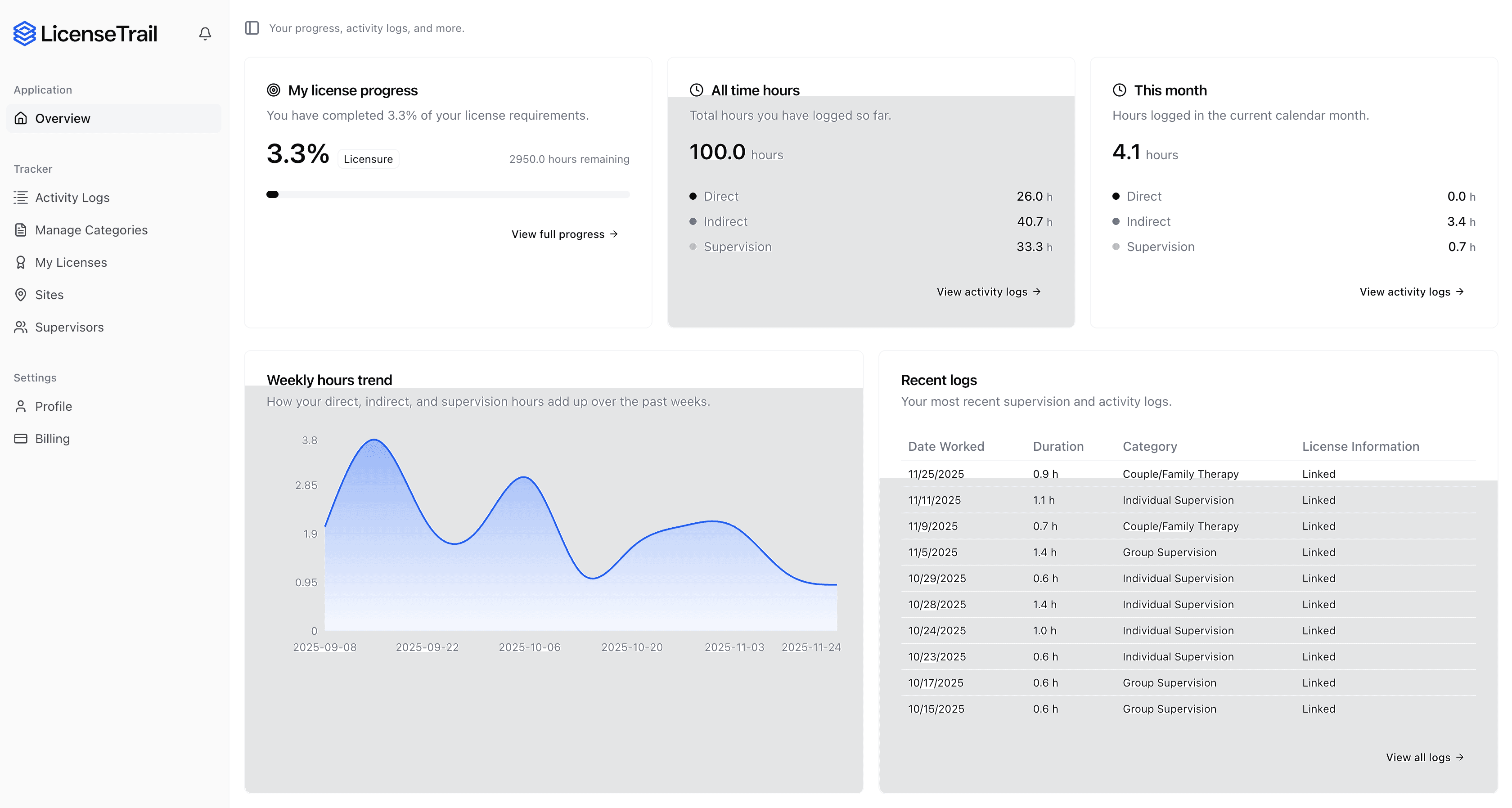 Start Tracking for Free
No credit card required · Free plan available
Is your spreadsheet hiding California LPCC risks?
Stop guessing if your categories match California Board of Behavioral Sciences requirements. License Trail checks your direct, indirect, and supervision hours continuously and flags mismatches before you submit.
Import or log
Bring your spreadsheet or start fresh
Upload your existing tracking spreadsheet and we'll map every hour into the right California Board of Behavioral Sciences categories automatically.
Verify against California
Catch mismatches before the board does
License Trail checks your direct, indirect, and supervision hours against California LPCC requirements continuously.
Export board-ready
One-click clean reports
Generate professional, board-ready reports for supervision meetings and California Board of Behavioral Sciences submissions in seconds.
No credit card required · Free plan available