
District-of-columbia GAP Requirements: Hours, Exams & Step-by-Step Guide
Stop guessing if your categories match District-of-columbia requirements. License Trail checks your direct, indirect, and supervision hours against GAP requirements continuously and flags mismatches before you submit.
No credit card required · Free plan available
Quick Requirements Overview
- License scope (GAP): Limited to evaluating/assessing/facilitating individual, group, or organizational effectiveness (not health‑services/clinical treatment or school psychology)
- Degree: Doctoral degree in psychology from an accredited institution; program must meet DC education standards (e.g., APA‑accredited / ASPPB-NR list / pre‑1981 / ABPP route)
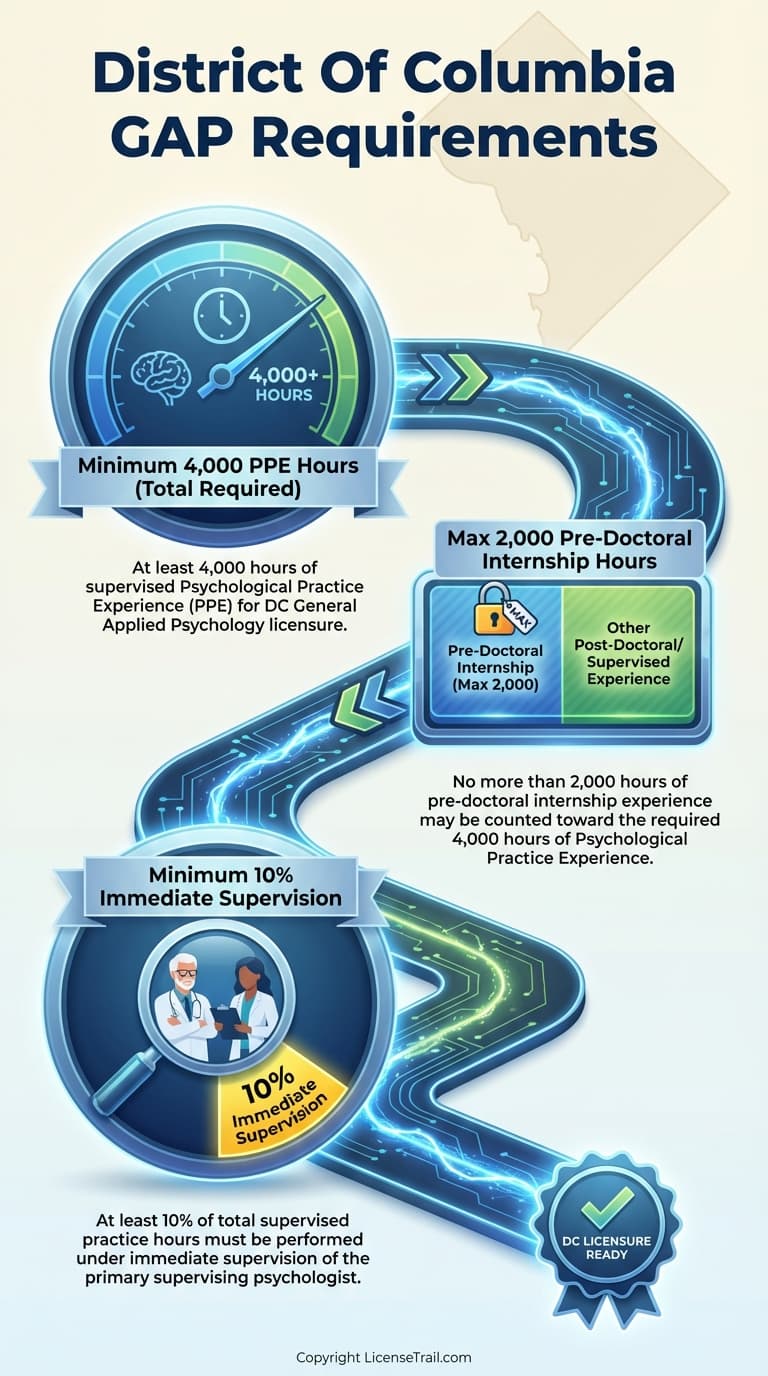
- Experience (PPE): 4,000 hours supervised Psychological Practice Experience (PPE) total
- Timing split: Up to 2,000 hours predoctoral internship; ≥2,000 hours postdoctoral (or all 4,000 postdoc over 2–3 years)
- Supervision (non‑APA/APPIC sites): Primary Supervisor = licensed psychologist; may use delegated supervisors (psychologist/psychiatrist/independent clinical social worker); ≥10% immediate (in‑person) supervision by primary supervisor
- Documentation: Supervisor attestations required (hours/dates/location, duties, supervision structure, supervisor licenses, performance rating)
- Exams: Pass EPPP (≥0.5 SD below national mean) and pass DC jurisprudence exam (DC law/rules + APA Ethics; Board-set passing score)
- Transitional window: Those practicing in DC before 7/19/2024 may continue up to 2 years while applying; possible eligibility if applying within 24 months of 7/19/2024
License Details
Procedures
Licensing as a General Applied Psychologist (GAP) in the District of Columbia
The District of Columbia created a distinct General Applied Psychology license in 2024, alongside the Health Services Psychology license and separate registrations for school psychologists and psychology associates. (code.dccouncil.gov)
A GAP license is for psychologists whose work focuses on enhancing individual, group, or organizational effectiveness (for example, I‑O, consulting, organizational development) rather than providing health‑services/clinical treatment or school psychology. By statute, a “general applied psychologist” may practice only within the portion of “practice of psychology” that covers evaluating and improving individual, group, or organizational effectiveness. (code.dccouncil.gov)
Below is a step‑by‑step description of what the DC Board of Psychology currently requires for licensure, with emphasis on supervised hours and the Board’s own terminology.
1. Basic eligibility for a GAP license
1.1 Required license category
By law, anyone practicing psychology in this “effectiveness/organizational” domain must hold a general applied psychology license, unless they fall under a narrow temporary or transitional exception. (code.dccouncil.gov)
1.2 Doctoral degree in psychology
For both health services and general applied psychology, DC statute requires that an applicant: (code.dccouncil.gov)
- Earn “a doctoral degree in psychology from an accredited college or university.” (D.C. Code § 3‑1208.82(a)(1)).
- Meet the education standards in the psychology regulations, which require that the doctoral degree come from an institution accredited by a U.S. Department of Education–recognized accreditor and that the program either is APA‑accredited, listed in ASPPB/National Register designation lists, pre‑1981, or paired with an ABPP diploma. (dchealth.dc.gov)
In regulatory language, a qualifying graduate is referred to simply as a “Graduate – an individual who has completed a doctoral program of study from a program meeting the requirements of § 6902.1.” (dchealth.dc.gov)
2. Supervised experience / hours
2.1 Statutory experience requirement
Under D.C. Code § 3‑1208.82, both health services and general applied psychology applicants must:
- “Completed at least 2 years of experience … at least one year of which shall be postdoctoral experience.” (code.dccouncil.gov)
This high‑level statutory requirement is implemented in detail in the Board’s psychology regulations.
2.2 Total hours: 4,000 hours of Psychological Practice Experience (PPE)
The Board’s regulations require that every applicant for a psychology license (which now includes GAP licenses) demonstrate: (dchealth.dc.gov)
- “At least four thousand (4,000) hours of psychological practice experience (PPE)” that meet the chapter’s requirements (17 DCMR § 6902.1(c)).
The term is defined as:
- “Psychological Practice Experience – a period of pre‑licensure supervised practice of psychology, as required pursuant to § 6902.1(c), by a student or a graduate of a doctoral program meeting the requirements of § 6902.1(a) and (b).” (dchealth.dc.gov)
In practice, this means you must document 4,000 hours of pre‑licensure, supervised psychological work in roles consistent with your intended scope of practice (for GAP, this would be general applied/organizational work, not health‑services treatment).
2.3 Predoctoral vs. postdoctoral hours
The regulations spell out how those 4,000 hours can be distributed in time: (dchealth.dc.gov)
- Up to 2,000 hours may be completed as part of a predoctoral internship.
- The remaining hours (at least 2,000) must be completed after the doctorate is conferred, within two years of degree conferral if you are using the internship credit.
- If you choose to do all 4,000 hours after the doctorate, they must be completed over no fewer than 2 years and no more than 3 years after the degree is awarded.
This structure is why most summaries (and the Board’s own guidance to training programs) describe DC’s requirement as 4,000 supervised hours with at least 2,000 postdoctoral hours. (uwyo.edu)
2.4 How you can earn the 4,000 hours
The Board allows three broad pathways for accruing Psychological Practice Experience: (dchealth.dc.gov)
-
APA‑ or APPIC‑accredited internship
- An internship program “accredited by the APA or meeting the membership criteria established by the Association of Psychology Postdoctoral and Internship Centers (APPIC)” can supply up to 2,000 of the 4,000 hours.
-
APA‑ or APPIC‑accredited postdoctoral program
- A postdoctoral program “accredited by the APA or meeting the membership criteria established by APPIC” can provide some or all of the postdoctoral PPE hours.
-
Other supervised psychological practice experience
- If your experience is not through APA/APPIC programs (common for industrial‑organizational or consulting roles), it must meet the detailed criteria of § 6902.5, summarized below.
2.5 Requirements for non‑accredited PPE sites (critical for many GAP applicants)
For experience that is not within an accredited internship/postdoc program, the Board’s regulations require: (dchealth.dc.gov)
- General supervision by a licensed psychologist in a U.S. jurisdiction, designated as the “Primary Supervisor.”
- The primary supervisor may delegate supervision to a “Delegated Supervisor” – a psychologist, psychiatrist, or independent clinical social worker – but remains responsible for the overall quality of your training.
- At least 10% of all practice hours must be under “Immediate Supervision” of the primary supervisor.
- “Immediate Supervision” is defined as supervision where the supervisor maintains direction and control over services through in‑person, face‑to‑face observation or being physically present with the supervisee. (dchealth.dc.gov)
- The primary supervisor must ensure that the PPE is consistent with the “goals and principles of the professional practice of psychology.”
- Your performance must be rated at least “satisfactory” by each supervisor.
This structure accommodates GAP‑type settings (corporate consulting, I‑O, human factors, etc.) as long as you have a properly qualified primary supervisor and meet the percentage of immediate supervision.
2.6 Documentation of hours
To prove completion of PPE, you must have each supervisor submit an attestation that includes: (dchealth.dc.gov)
- Confirmation that supervision met all regulatory requirements,
- Information on any delegated supervision,
- License numbers and jurisdictions of all supervisors,
- Location, dates, and total hours of your psychological practice experience,
- Description of duties/nature of the work, and
- A rating of your performance.
2.7 Alternative route via prior licensure
If you are already licensed as a psychologist elsewhere but do not meet the PPE requirements, you may substitute: (dchealth.dc.gov)
- At least two years of licensed, unsupervised practice in another U.S. jurisdiction to satisfy the 4,000‑hour requirement, with documentation of location, dates, hours, and nature of the practice.
3. Examinations
To obtain any psychology license in DC, including a GAP license, you must pass both a national and a local exam.
3.1 National exam – EPPP
Regulations require that you: (dchealth.dc.gov)
- Take the Examination for Professional Practice in Psychology (EPPP) or an approved successor.
- Achieve a score no lower than one‑half (0.5) standard deviation below the national mean on the EPPP (or a Board‑determined passing score on a successor exam).
DC authorizes you to sit for the EPPP after your education is complete; you may be in the process of finishing supervised experience while testing. (uwyo.edu)
3.2 DC jurisprudence exam
The Board also requires a District of Columbia jurisprudence examination that covers: (dchealth.dc.gov)
- DC statutes and regulations on the practice of psychology, and
- The APA Code of Ethics.
The passing score is set by the Board; training‑program guidance indicates a 75% passing threshold. (uwyo.edu)
You may take the DC exam only after all other licensure requirements have been met.
4. Scope of practice for a GAP license (vs. health services psychology)
The foundational statute defines “practice of psychology” broadly, then limits what each license type may do: (code.dccouncil.gov)
- The full definition includes three domains:
- Preventing or treating symptomatic/maladaptive behavior (health‑services/clinical),
- Enhancing individual, group, or organizational effectiveness (general applied), and
- Services to help children and youth succeed academically and emotionally (school).
- A health services psychologist may practice in all three domains.
- A general applied psychologist is restricted to domain (2) – “evaluating, assessing, or facilitating the enhancement of individual, group, or organizational effectiveness” (e.g., I‑O, consulting, performance, training, human factors).
- A school psychologist is restricted to domain (3).
Holding a GAP license does not authorize you to provide health‑services/clinical treatment, nor to practice school psychology, in DC.
5. Transitional provisions for existing general applied psychologists
Because GAP licensure is new, the statute provides a limited “grandparenting” window: (code.dccouncil.gov)
- Individuals already practicing general applied psychology in DC before July 19, 2024 may continue practicing without a GAP license for up to two years after that date, so long as they apply for the appropriate license or registration within that two‑year period.
- Separately, persons already practicing as general applied psychologists who do not meet the full new qualifications (for example, lacking a qualifying doctorate) “shall be eligible for licensure” if they apply within 24 months after July 19, 2024.
After these windows close (mid‑2026), anyone practicing in this domain must meet the ordinary GAP licensure requirements.
6. How this all fits together for a prospective GAP applicant
Putting the statutory and regulatory pieces together, someone seeking a General Applied Psychology license in DC should plan on:
-
Doctoral education
- Earn a doctoral degree in psychology from an appropriately accredited institution and qualifying program (APA‑accredited, ASPPB/National Register designated, or pre‑1981/ABPP route). (dchealth.dc.gov)
-
Supervised experience
- Complete 4,000 hours of Psychological Practice Experience:
- Up to 2,000 hours can be a qualifying predoctoral internship (if you have such an internship at all; many GAP‑oriented programs do not).
- At least 2,000 hours must be postdoctoral, completed in 2–3 years under appropriate supervision, in work that fits the general applied scope. (dchealth.dc.gov)
- Ensure supervision structure matches DC’s definitions of Primary Supervisor, Delegated Supervisor, General Supervision, and Immediate Supervision, including the 10% immediate‑supervision minimum. (dchealth.dc.gov)
- Complete 4,000 hours of Psychological Practice Experience:
-
Examinations
- Apply to the DC Board for authorization to take the EPPP, and pass with at least the Board‑specified minimum (0.5 SD below national mean). (dchealth.dc.gov)
- After all other requirements are complete, take and pass the DC jurisprudence exam (currently a 75% passing threshold in Board guidance). (dchealth.dc.gov)
-
Application to the Board
- Submit the online application via DC Health, including:
- Documentation of doctoral degree,
- Supervisor attestations covering the 4,000 PPE hours,
- Exam scores, references, identity documents, and criminal background check, as specified in the Board’s application materials. (dchealth.dc.gov)
- Submit the online application via DC Health, including:
-
Maintain the license
- Complete 30 hours of continuing education every two years, including at least 15 live hours, 3 hours in ethics, 2 hours in LGBTQ topics, and any Board‑designated public‑health priority hours, to renew your license. (dchealth.dc.gov)
Important caveat as of November 23, 2025
- The GAP category is created in statute (D.C. Law 25‑191, codified at D.C. Code §§ 3‑1208.81–.83) but the implementing regulations have not yet been comprehensively revised to separate health‑services and general‑applied standards. (code.dccouncil.gov)
- The Board’s posted psychology regulations still reflect the single‑license framework from 2019 and require 4,000 hours of PPE for all psychologists. At present, there is no published DC rule that gives GAP applicants a different hour count or a different breakdown (such as separate “direct” vs. “indirect” hour minimums).
Until DC issues psychology‑specific rule updates for the new license categories, the safest reading—and the one reflected in Board‑linked guidance to universities—is that GAP applicants must meet the same 4,000‑hour supervised‑experience standard as health services psychology applicants, with at least half of those hours postdoctoral, structured under the PPE rules summarized above. (uwyo.edu)
Track your GAP hours with confidence
License Trail checks your direct, indirect, and supervision hours against District-of-columbia GAP requirements continuously and flags mismatches before you submit.
 Start Tracking for Free
No credit card required · Free plan available
Is your spreadsheet hiding District-of-columbia GAP risks?
Stop guessing if your categories match District of Columbia Board of Psychology requirements. License Trail checks your direct, indirect, and supervision hours continuously and flags mismatches before you submit.
Import or log
Bring your spreadsheet or start fresh
Upload your existing tracking spreadsheet and we'll map every hour into the right District of Columbia Board of Psychology categories automatically.
Verify against District-of-columbia
Catch mismatches before the board does
License Trail checks your direct, indirect, and supervision hours against District-of-columbia GAP requirements continuously.
Export board-ready
One-click clean reports
Generate professional, board-ready reports for supervision meetings and District of Columbia Board of Psychology submissions in seconds.
No credit card required · Free plan available