
District-of-columbia HSP Requirements: Hours, Exams & Step-by-Step Guide
Stop guessing if your categories match District-of-columbia requirements. License Trail checks your direct, indirect, and supervision hours against HSP requirements continuously and flags mismatches before you submit.
No credit card required · Free plan available
Quick Requirements Overview
- Degree: Doctoral degree in psychology from an accredited institution; program must be APA-accredited or meet ASPPB/National Register designation (or degree pre‑1981/ABPP).
- Experience: 4,000 hours of supervised Psychological Practice Experience (PPE) required.
- Timeframe: Must reflect ≥2 years total experience, including ≥1 year postdoctoral (statute).
- Pre/Post split: Up to 2,000 hours may come from a predoctoral internship; remaining hours must be post-degree (or complete all 4,000 postdoc over 2–3 years).
- Supervision: All PPE under a licensed psychologist primary supervisor; delegation allowed to licensed psychologist/psychiatrist/LICSW, with primary supervisor retaining responsibility.
- Immediate supervision minimum: ≥10% of total hours under immediate supervision by the primary supervisor (e.g., ≥400 hours if completing 4,000).
- Exams: Pass EPPP + DC jurisprudence exam.
- Application: Apply via DC Health with transcripts, supervisor verifications/attestations, references/attestation, background check, and fees.
License Details

Procedures
Licensure as a Health Services Psychologist in the District of Columbia
In the District of Columbia, the doctoral-level “psychologist license” has been reclassified in law as a health services psychology license. This is now the standard license for psychologists who provide health services (assessment, diagnosis, treatment, etc.) in DC.(code.dccouncil.gov)
As of July 19, 2024, DC law provides:
- You must hold a health services psychology license (or a few related credentials) to practice psychology as defined in statute.(code.dccouncil.gov)
- All existing psychologist licenses, on renewal after that date, are reissued as health services psychology licenses.(code.dccouncil.gov)
What follows focuses on initial licensure as a health services psychologist through the DC Board of Psychology.
1. Snapshot of Requirements
To become licensed as a health services psychologist in DC, you must:
- Hold an appropriate doctoral degree in psychology from an accredited institution and program that meets specific criteria.(dcrules.elaws.us)
- Complete at least 4,000 hours of “psychological practice experience (PPE)” under supervision, with specific timeframes and supervision structure.(dcrules.elaws.us)
- Have at least two years of experience, with at least one year postdoctoral, as required by the updated statute.(code.dccouncil.gov)
- Pass the EPPP (national exam) and the DC jurisprudence exam.(dchealth.dc.gov)
- Submit a complete application package to DC Health (online application, supervised-experience verifications, references, fees, and background check).(dchealth.dc.gov)
The most detailed, binding language on hours and supervision is still in Title 17 DCMR, Chapter 69 (psychology regulations).
2. Educational Requirements (Doctoral Degree)
Under DC’s psychology regulations, an applicant must show:(dcrules.elaws.us)
- A doctoral degree in psychology from an institution accredited by a recognized accrediting body (U.S. Department of Education–recognized).
- That the doctoral program meets one of these criteria:
- Listed in the ASPPB / National Register “Doctoral Psychology Programs Meeting Designation Criteria” for the year the degree was conferred; or
- Accredited by the American Psychological Association (APA) when the degree was awarded; or
- Degree conferred before 1981; or
- Applicant holds an active diploma from the American Board of Professional Psychology (ABPP).
Programs that are APA-accredited or meet ASPPB/National Register designation standards are the most straightforward paths.(dcrules.elaws.us)
In addition, the 2024 law now states that, for a health services psychology or general applied psychology license, you must:(code.dccouncil.gov)
- Earn a doctoral degree in psychology, and
- Complete at least two years of experience, at least one year postdoctoral, in areas of practice specified by Board rules.
3. Key Definitions the DC Board Uses
DC’s regulations use specific terminology for supervised experience:(dcrules.elaws.us)
- Psychological Practice Experience (PPE) – defined as a period of unlicensed psychology practice under supervision, required to qualify for licensure (this is the 4,000-hour requirement).
- Supervised Practice – the practice of psychology by an unlicensed person as authorized by the Board under § 6911 (typically students, graduates, or those seeking relicensure).
- Primary Supervisor – the licensed psychologist who provides supervision, training, and mentoring and retains full responsibility for the quality of the supervisee’s learning and practice, including any supervision delegated to others.
These terms are what DC uses instead of “direct client hours vs. supervision hours” splits that some other states specify.
4. Supervised Experience: Hours and Structure
4.1 Total hours required
The core requirement is:
- At least 4,000 hours of psychological practice experience (PPE) meeting all requirements of Chapter 69.(dcrules.elaws.us)
This 4,000-hour requirement is the operative, detailed standard the Board uses when reviewing applications.
4.2 When and how those hours can be earned
DC allows some flexibility in when you obtain the 4,000 hours:(dcrules.elaws.us)
-
Combination of predoctoral internship + postdoctoral experience
- Up to 2,000 hours may be credited from a predoctoral internship.
- The remaining hours (at least 2,000) must be completed after the doctoral degree is conferred, within two years of the degree date (extensions for good cause are possible).
-
All hours postdoctoral
- You may choose to complete the full 4,000 hours after the doctoral degree, over a period of:
- At least two years, and
- No more than three years, starting the day after the doctoral degree is awarded.
- You may choose to complete the full 4,000 hours after the doctoral degree, over a period of:
This is effectively equivalent to requiring at least 2,000 postdoctoral hours (because even if you max out the predoctoral internship credit at 2,000 hours, you still need 2,000 additional hours post-degree).(dcrules.elaws.us)
4.3 What kinds of settings count
The regulations say the 4,000 hours of PPE must be accumulated in one or more of the following ways:(dcrules.elaws.us)
- APA-accredited internship or APPIC-member internship.
- APA-accredited postdoctoral program or APPIC-member postdoc.
- Other psychological practice experience that meets the criteria in § 6902.5—essentially, supervised practice under an appropriate primary supervisor, consistent with professional standards for psychology.
If the experience does not come from an APA/APPIC internship or postdoc, it must meet stricter structural conditions described below.
4.4 Supervision structure and “type” of hours
For PPE that is not entirely within an APA/APPIC internship or postdoc, DC requires:(dcrules.elaws.us)
-
All practice must be under the general supervision of a psychologist licensed in a U.S. jurisdiction, who serves as primary supervisor.
-
The primary supervisor may delegate supervision to another:
- Licensed psychologist,
- Psychiatrist, or
- Independent clinical social worker.
The primary supervisor remains fully responsible for the supervisee’s practice.
-
Minimum “immediate supervision” requirement:
- At least 10% of the total practice hours must be performed under immediate supervision of the primary supervisor.
- This applies both to PPE under § 6902.5(c) and to supervised practice by students/graduates under § 6911.7.
- In practical terms, if you complete the full 4,000 hours under these rules, at least 400 hours must be in this higher-intensity “immediate supervision” relationship with the primary supervisor.
The regulations do not break the 4,000 hours into categories like “direct client service vs. indirect activities” or specify a number of “face-to-face client contact” hours. Instead, they:
- Define the total PPE hours,
- Require that PPE be under proper supervision, and
- Require that at least 10% of the total hours be under immediate (more intensive) supervision by the primary supervisor.
The content of your work must be consistent with the goals and principles of professional psychological practice, and each supervisor must rate your performance at least satisfactory.(dcrules.elaws.us)
4.5 Documentation of supervised experience
To prove your 4,000 hours of PPE, you must submit attestations from each supervisor. The regulations require these attestations to include:(dcrules.elaws.us)
- A statement that the supervision met the chapter’s requirements.
- Details about any delegated supervision (names, credentials).
- Supervisors’ license numbers and jurisdictions.
- Locations, dates, and total hours of PPE.
- The specific nature of the experience and responsibilities you had.
- A rating of your performance.
DC Health’s current application packet includes separate forms for:(dchealth.dc.gov)
- Verification of Supervised Employment – Pre-Doctoral Experience, and
- Verification of Supervised Employment (postdoctoral/other PPE), plus a Supervised Practice Form.
These must be completed by supervisors and submitted directly or as the Board directs.
4.6 Alternative for some endorsement applicants
If you are already licensed in another U.S. jurisdiction but lack PPE that fits DC’s standards, DC allows one alternative:(dcrules.elaws.us)
- You may rely on at least two years of licensed, unsupervised practice to satisfy the 4,000-hour PPE requirement, if you do not qualify for licensure by endorsement through supervised-experience equivalency.
5. Examinations and Other Requirements
The Board of Psychology, under DC Health, requires:(dchealth.dc.gov)
-
EPPP (Examination for Professional Practice in Psychology)
- You must pass the national licensing exam. DC has policies regarding EPPP Part 1 and Part 2 and issues exam authorization after application review.
-
DC Jurisprudence Exam
- A written exam on DC laws and regulations governing psychology practice. DC Health posts study materials on its Psychology Licensing page.
-
Criminal Background Check
- Conducted as part of the application process.
-
Application Materials and Fees
- Online application through the DC Health portal.
- Official doctoral transcripts.
- Supervisor verification forms (pre- and postdoctoral, as applicable).
- Character references and a Board attestation statement.
- Application and license fees (amounts are listed in the current application instructions).
6. Step‑by‑Step Pathway to a DC Health Services Psychology License
-
Complete an appropriate doctoral program in psychology
- Preferably APA-accredited or meeting ASPPB/National Register designation criteria.(dcrules.elaws.us)
-
Plan your supervised experience to meet DC’s PPE rules
- Aim for 4,000 total PPE hours, ensuring:
- At least 2,000 hours postdoctoral (more if you do not have a full 2,000-hour internship).
- All hours are under appropriate supervision in acceptable settings.
- At least 10% of all hours are under “immediate supervision” by your primary supervisor.(dcrules.elaws.us)
- Aim for 4,000 total PPE hours, ensuring:
-
Track hours meticulously
- Maintain logs with:
- Dates and settings,
- Supervisors’ names and credentials,
- Hours per week, and
- Types of activities (assessment, therapy, consultation, etc.).
- Make sure primary and delegated supervisors understand DC’s attestation requirements from the outset.
- Maintain logs with:
-
Confirm you meet the statutory experience standard
- Ensure your 4,000 PPE hours also satisfy the “at least two years, including one year postdoctoral” requirement in the 2024 law.(code.dccouncil.gov)
-
Apply through DC Health’s Psychology Application package
- Use the “Psychology Application Documents” page to access:
- The online application,
- The relevant checklist (by examination or endorsement), and
- The Verification of Supervised Employment forms and Supervised Practice Form.(dchealth.dc.gov)
- Use the “Psychology Application Documents” page to access:
-
Complete exams and background check
- After the Board reviews your materials and authorizes testing:
- Take and pass the EPPP,
- Take and pass the DC jurisprudence exam, and
- Complete the criminal background check.
- After the Board reviews your materials and authorizes testing:
-
Receive your license
- Once the Board confirms all requirements are met, it issues a license.
- Under current law, this will be a health services psychology license, which is the credential authorizing full-scope practice of psychology (health services) in DC.(code.dccouncil.gov)
Direct vs. Supervision Hours: How DC Actually Frames It
To address the example you raised (e.g., “1,500 hours of direct experience and 1,500 hours of supervised experience”):
- DC does not formally divide requirements that way.
- Instead, it uses a single total figure (4,000 PPE hours) and then layers supervision structure on top of that, especially:
- The requirement that all hours be under general supervision of a qualifying primary supervisor; and
- The requirement that at least 10% of all hours be under immediate supervision by that primary supervisor.(dcrules.elaws.us)
If you are planning your training sequence, the safest approach is:
- Plan on 4,000 total supervised practice hours,
- Make sure ≥400 of those hours qualify as “immediate supervision” with your primary supervisor, and
- Keep your roles and activities squarely within professional psychological practice as recognized by DC’s regulations.
Track your HSP hours with confidence
License Trail checks your direct, indirect, and supervision hours against District-of-columbia HSP requirements continuously and flags mismatches before you submit.
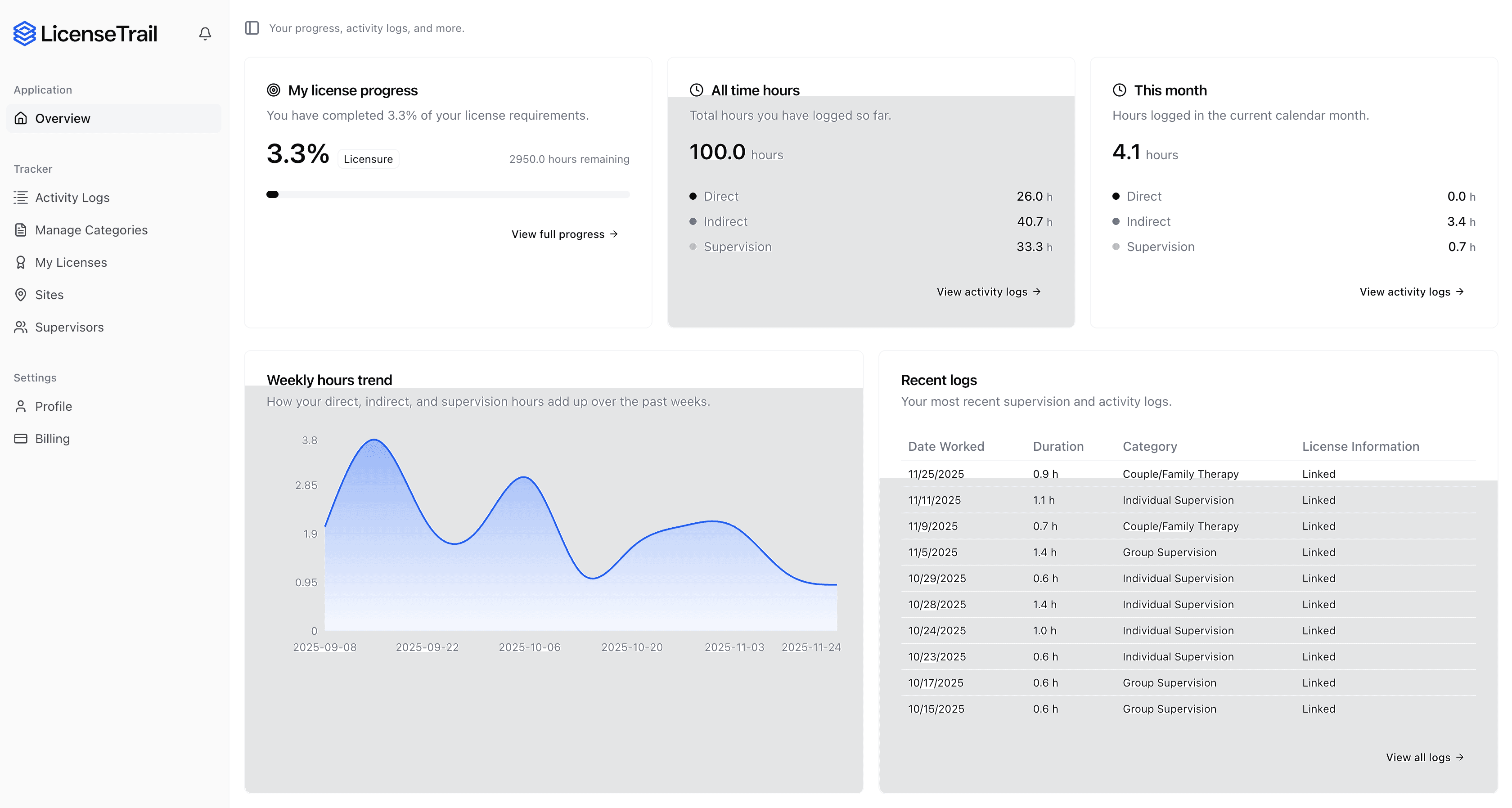 Start Tracking for Free
No credit card required · Free plan available
Is your spreadsheet hiding District-of-columbia HSP risks?
Stop guessing if your categories match District of Columbia Board of Psychology requirements. License Trail checks your direct, indirect, and supervision hours continuously and flags mismatches before you submit.
Import or log
Bring your spreadsheet or start fresh
Upload your existing tracking spreadsheet and we'll map every hour into the right District of Columbia Board of Psychology categories automatically.
Verify against District-of-columbia
Catch mismatches before the board does
License Trail checks your direct, indirect, and supervision hours against District-of-columbia HSP requirements continuously.
Export board-ready
One-click clean reports
Generate professional, board-ready reports for supervision meetings and District of Columbia Board of Psychology submissions in seconds.
No credit card required · Free plan available