
District-of-columbia SPR Requirements: Hours, Exams & Step-by-Step Guide
Stop guessing if your categories match District-of-columbia requirements. License Trail checks your direct, indirect, and supervision hours against SPR requirements continuously and flags mismatches before you submit.
No credit card required · Free plan available
Quick Requirements Overview
- SPR status: Created in 2024 law, but SPR-specific DCMR requirements (incl. hour totals) are not yet promulgated as of 11/23/2025.
- Who regulates: DC Health Board of Psychology will regulate SPR via forthcoming rulemaking; OSSE regulates educator certification for K–12 school roles.
- When SPR is required: Outside the DCPS/charter exemption, registration is required to practice as a school psychologist in DC.
- Key exemption: DCPS and public charter school-employed school psychologists working under OSSE regs are exempt from Board of Psychology regulation (no SPR needed for those roles).
- Scope limits: SPR authorizes only the school/child-focused scope; cannot practice broader health services/general applied psychology without the appropriate license.
- Transition window: Those practicing before 7/19/2024 may continue up to 2 years (through 7/19/2026) if they apply within that window.
- Only clear “hours” today (OSSE, not SPR): OSSE SSP School Psychologist requires ≥500 supervised hours in a school setting under a certified school psychologist (plus degree/coursework and exam).
License Details
Procedures
School psychology in the District of Columbia is in the middle of a significant regulatory transition. In 2024, the D.C. Council created a new “school psychology registration” category under the Health Occupations Revision Act, but as of November 23, 2025, the detailed, hour‑by‑hour requirements for that registration have not yet been written into the D.C. Municipal Regulations by the Mayor and the Board of Psychology.
This means you can identify what the law requires in broad terms, but you cannot yet find a published requirement such as “1,500 hours of direct experience and 1,500 hours of supervised experience” for a School Psychology Registration (SPR) in D.C. The statute instead delegates those details to forthcoming regulations.
Below is a structured guide to what currently exists and how to plan around it.
1. Who regulates what in D.C. school psychology?
Board of Psychology (DC Health)
The Board of Psychology (under DC Health) regulates the “practice of psychology” in most settings. After the 2024 Health Occupations Revision General Amendment Act, anyone practicing psychology in D.C. must hold one of four types of authorization: (code.dccouncil.gov)
- Health services psychology license
- General applied psychology license
- School psychology registration
- Psychology associate registration
Separate provisions also state that “registration is required to practice as … [a] school psychologist” in the District. (law.justia.com)
OSSE (Office of the State Superintendent of Education)
The Office of the State Superintendent of Education (OSSE) is the educator‑licensing agency. It issues the Standard School Service Provider (SSP) – School Psychologist certificate, which is required for working as a school psychologist in D.C. public and public charter schools. (osse.dc.gov)
OSSE’s credentialing rules currently include concrete supervised‑experience hour requirements (described in Section 4), but these are education/educator‑licensure rules, not the Board of Psychology’s school psychology registration rules.
Important exemption for DCPS and charter school employees
D.C. law explicitly carves out an exemption for: (code.dccouncil.gov)
“a school psychologist employed by District of Columbia Public Schools or a public charter school and working in accordance with regulations issued by the Office of the State Superintendent of Education.”
Those practitioners are regulated by OSSE and are excluded from the Board of Psychology’s regulation, so they do not need a school psychology registration from DC Health while they remain in those roles.
2. What is “School Psychology Registration (SPR)” in D.C. law?
Scope of practice
D.C. law defines the “practice of psychology” broadly and then breaks it into three scopes. The school‑focused scope is described as providing services that help children and youth “succeed academically, socially, behaviorally, and emotionally,” and providing educational and mental‑health services while working with parents, educators, and other professionals in learning environments. (code.dccouncil.gov)
Under these definitions:
- A person registered as a school psychologist is authorized to practice psychology within that child‑ and school‑focused scope. (code.dccouncil.gov)
- A separate section then states that a registered school psychologist may not practice psychology under the broader adult/general scopes without the appropriate license. (law.justia.com)
Statutory creation of the registration
The 2024 amendments add a new subchapter for psychology categories. The key provision is:
- No one may practice psychology in D.C. without a license or registration in one of the four categories listed above, including school psychology registration. (code.dccouncil.gov)
Another section, § 3‑1208.82, sets qualifications for these categories. For school psychology, the operative language is: (code.dccouncil.gov)
An individual applying for a registration to practice school psychology shall meet such education and training requirements as may be established by the Mayor through rulemaking.
Notice what is missing: the statute does not itself set any number of hours, any specific type of practica or internship, or any particular examination for the school psychology registration.
3. What does the law currently require for SPR — and what does it not specify?
3.1 Requirements that are clearly established
From the D.C. Code, as of July 19, 2024: (law.justia.com)
-
You must hold some authorization
To practice psychology in D.C., you must hold a health services psychology license, a general applied psychology license, a school psychology registration, or a psychology associate registration. -
Registration is required to practice as a school psychologist
School psychologists (except those specifically exempted as DCPS/charter employees under OSSE regulations) must hold a registration rather than a full license. -
Education and training will be set by regulation, not statute
For the school psychology registration, the law says only that applicants must meet “education and training requirements” to be established later by rule. It does not set degree levels, credit hours, supervision ratios, or clock‑hour totals in the statute itself. -
Limits on practice
A registered school psychologist:- Can practice only in the school‑focused scope of psychology (children/youth; school‑related services).
- May not practice in the broader health‑services or general‑applied scopes without the appropriate additional license. (code.dccouncil.gov)
-
Transition/waiver period for existing practitioners
For two years after July 19, 2024, someone who was already practicing school psychology in D.C. before that date may continue to practice without registration if they apply for the relevant license or registration within that two‑year window. (law.justia.com)In practical terms, that window runs until July 19, 2026, unless extended by rule.
3.2 What is not yet specified: no hour counts in law or current regulations
The D.C. Code provisions governing school psychology registration do not currently state:
- A minimum number of total supervised hours
- Separate requirements for direct client contact vs. supervision hours
- Requirements for pre‑degree practica vs. post‑degree experience
Instead, the law leaves all of that to future regulations: “education and training requirements as may be established by the Mayor through rulemaking.” (code.dccouncil.gov)
As of late 2025:
- The Psychology Licensing page on DC Health’s website lists application checklists and regulations only for psychologists and psychology associates. There is no separate checklist or application form for a school psychology registration. (dchealth.dc.gov)
- The current Psychology regulations chapter in the D.C. Municipal Regulations (Title 17, Chapter 69) shows sections effective from 1988 to 2019 and addresses psychologists and psychology associates, but does not yet contain a section on school psychology registration with numerical hour requirements. (dcregs.dc.gov)
Taken together, the best reading as of November 23, 2025 is:
D.C. has created the school psychology registration category in statute, but has not yet promulgated detailed rules spelling out specific hour requirements for SPR applicants.
So there is no official D.C. wording today that says anything like “1,500 hours of direct experience and 1,500 hours of supervised experience” for an SPR.
4. Related requirements that do specify hours (but are not SPR rules)
Because SPR regulations aren’t out yet, the most concrete “hours” language you will find for school‑psychology work in D.C. is in OSSE’s educator‑licensure rules, not in the Board of Psychology’s rules.
OSSE’s Standard School Service Provider – School Psychologist
OSSE’s standard credential for a school psychologist currently requires: (osse.dc.gov)
- A completed master’s degree from an approved program in school or educational psychology, or a master’s in clinical psychology plus at least 42 graduate hours of applicable school psychology coursework; and
- Successful completion of “at least 500 hours of supervised field, practicum, or internship experience in a school setting under the supervision of a certified school psychologist”; and
- A passing score on the D.C.‑required school psychologist content examination (or a comparable exam in another state, with an active school psychologist credential there).
Those 500 supervised hours are therefore OSSE’s minimum supervised school‑based experience for K–12 school psychologist certification; they are not yet codified as the Board of Psychology’s requirement for school psychology registration, though they are very likely to influence whatever the Board and Mayor eventually adopt.
5. Planning guide for someone aiming at School Psychology Registration (SPR)
Even though the final SPR rules are not yet issued, you can still plan using what is already in place and what the statute strongly implies.
Step 1 – Determine whether you actually need SPR
You do not need SPR if:
- You are a school psychologist employed by DCPS or a D.C. public charter school, and
- You are working in accordance with OSSE’s regulations (i.e., you hold or are eligible for OSSE’s school psychologist credential). (code.dccouncil.gov)
You will likely need SPR if you intend to:
- Provide school‑psychology‑type services outside of employment directly by DCPS or a charter school (e.g., in private practice, as an independent contractor to schools, or in community/clinical settings focused on school‑aged children), and
- Practice within the statutory definition of “practice of psychology” for children and youth. (code.dccouncil.gov)
Step 2 – Build an educational foundation consistent with likely SPR rules
Based on the statutory framework and OSSE’s existing educator requirements, a conservative preparation path would be:
- Earn a master’s, specialist (Ed.S.), or doctoral degree in school psychology or educational psychology from a program aligned with school psychology practice.
- Ensure your program includes at least 42 graduate credits in school‑psychology‑relevant coursework, mirroring OSSE’s current requirement if possible. (osse.dc.gov)
Although SPR rules are not yet written, it would be surprising if the Board adopted standards below this level.
Step 3 – Accumulate robust, supervised school‑based experience
To be competitive when SPR rules arrive:
- Make sure you complete at least the OSSE‑required 500 hours of supervised field, practicum, or internship experience in a K–12 school setting under a certified school psychologist.
- If possible, exceed that minimum and structure your experience to demonstrate:
- Direct assessment and intervention with children and youth
- Consultation with teachers, parents, and school teams
- Work in multi‑tiered systems of support and special education evaluations
Many states and the National Association of School Psychologists (NASP) model standards use a 1,200‑hour internship benchmark; while D.C. has not adopted that number in statute or regulation for SPR, treating it as a practical target (even if not strictly required yet) is prudent.
Step 4 – Obtain OSSE’s School Psychologist credential (if working in K–12)
If your practice will involve DCPS or charter schools at all, plan to obtain:
- The Standard School Service Provider – School Psychologist certificate from OSSE, meeting:
- The degree/coursework
- The 500 supervised hours requirement
- The required content exam. (osse.dc.gov)
This satisfies the educator‑licensure side and also provides a strong experiential foundation likely to be recognized by the Board when SPR rules are issued.
Step 5 – Monitor DC Health and D.C. Register for SPR regulations
Because SPR does not yet have published regulations, your next step is to monitor for rulemaking:
- Periodically check DC Health’s Psychology Licensing page for:
- New checklists labeled “School Psychology Registration” or similar
- Updated links to D.C. Municipal Regulations specific to school psychologists. (dchealth.dc.gov)
- Watch for D.C. Register notices of proposed and final rules implementing:
- Education level required for SPR
- Specific supervised‑experience hour requirements
- Any examination or jurisprudence‑exam requirements
Once those rules are issued, they will spell out the precise “X hours of direct experience and Y hours of supervised experience” (if D.C. chooses to define it in those terms at all).
Step 6 – Use the statutory transition window if you are already practicing
If you were already practicing school psychology in D.C. before July 19, 2024, the law lets you continue that practice for up to two years without SPR, provided you apply for registration within that period. (law.justia.com)
- Mark July 19, 2026 on your calendar as the current end of that window.
- Use the time to:
- Gather transcripts and verification of supervised experience
- Make sure your education and practice are well‑documented in anticipation of the SPR application process.
6. Key takeaways on hours and wording
-
There is no published D.C. Board of Psychology rule right now that sets a specific number of hours (e.g., “1,500 hours direct, 1,500 hours supervised”) for School Psychology Registration (SPR).
- The controlling statute simply says SPR applicants must meet “education and training requirements” established later by rule. (code.dccouncil.gov)
-
What is specific in current law
- To practice psychology in D.C. at all, you must hold one of four authorizations; school psychologists (outside the DCPS/charter‑OSSE exemption) must hold a school psychology registration. (code.dccouncil.gov)
- A registered school psychologist may practice only within the child‑ and school‑focused scope of psychology and may not expand into the broader health‑services or general‑applied scopes without another license. (code.dccouncil.gov)
-
Hours you can rely on today come from OSSE, not from SPR regulations
- OSSE currently requires at least 500 hours of supervised field, practicum, or internship experience in a school setting under a certified school psychologist as part of its educator credential for school psychologists. (osse.dc.gov)
-
Expect the future SPR rules to reference degree level and supervised school‑psychology experience, but the exact hour counts are pending
- Until the Mayor and Board of Psychology adopt those rules and DC Health posts an SPR‑specific application and regulation, any precise hour breakdown for SPR would be speculative.
In short, you can prepare now by aligning your education and supervised school‑based experience with OSSE’s existing standards and typical NASP‑aligned training, but the District of Columbia has not yet defined, in regulation, a specific number or type of hours required for School Psychology Registration (SPR) under the Board of Psychology.
Track your SPR hours with confidence
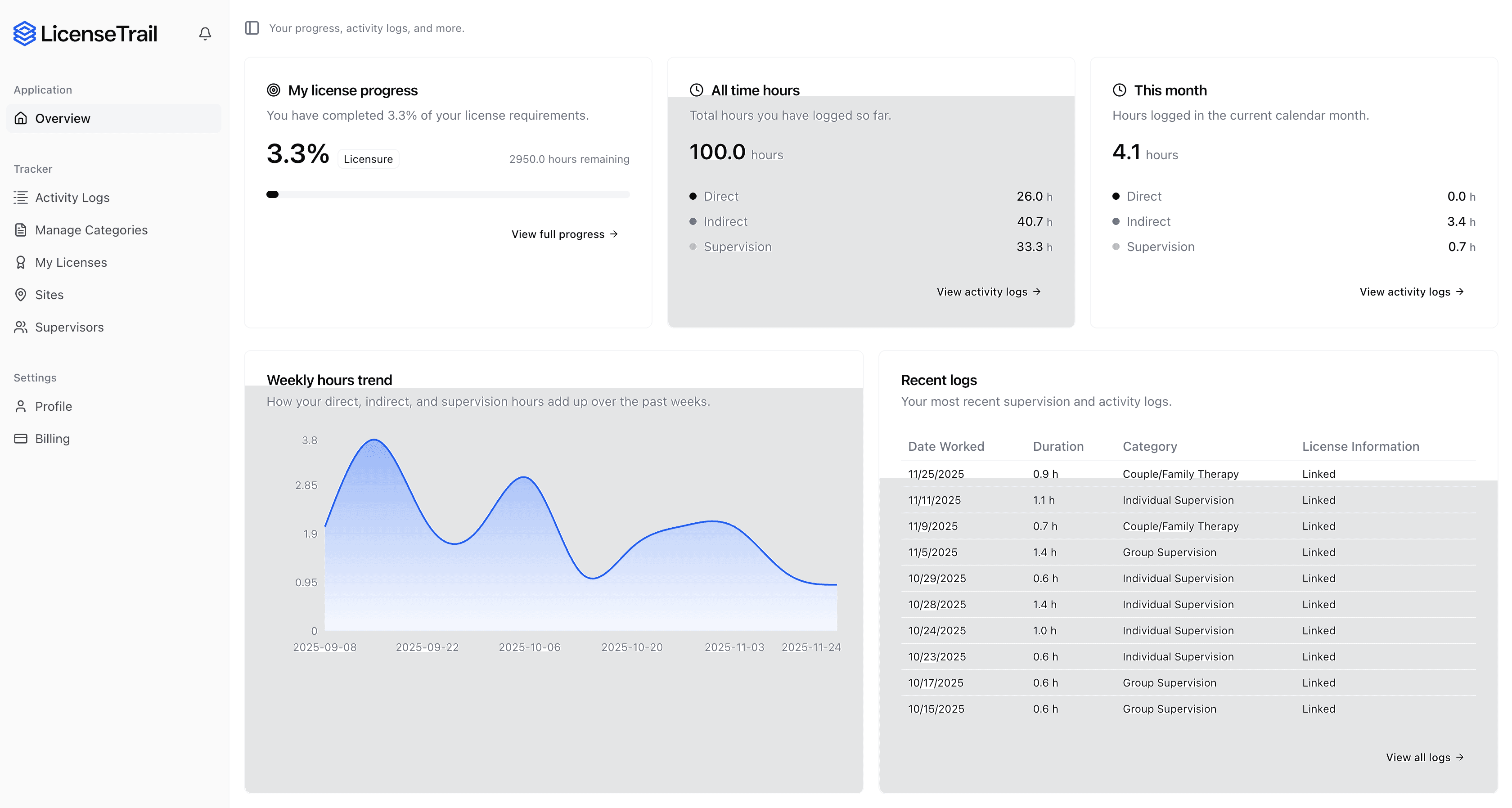
License Trail checks your direct, indirect, and supervision hours against District-of-columbia SPR requirements continuously and flags mismatches before you submit.
 Start Tracking for Free
No credit card required · Free plan available
Is your spreadsheet hiding District-of-columbia SPR risks?
Stop guessing if your categories match District of Columbia Board of Psychology requirements. License Trail checks your direct, indirect, and supervision hours continuously and flags mismatches before you submit.
Import or log
Bring your spreadsheet or start fresh
Upload your existing tracking spreadsheet and we'll map every hour into the right District of Columbia Board of Psychology categories automatically.
Verify against District-of-columbia
Catch mismatches before the board does
License Trail checks your direct, indirect, and supervision hours against District-of-columbia SPR requirements continuously.
Export board-ready
One-click clean reports
Generate professional, board-ready reports for supervision meetings and District of Columbia Board of Psychology submissions in seconds.
No credit card required · Free plan available