
Georgia PSY-CPQ Requirements: Hours, Exams & Step-by-Step Guide
Stop guessing if your categories match Georgia requirements. License Trail checks your direct, indirect, and supervision hours against PSY-CPQ requirements continuously and flags mismatches before you submit.
No credit card required · Free plan available
Quick Requirements Overview
- Apply via GOALS using “Psychologist by CPQ Designation”; results in a standard GA psychologist license
- Must hold ASPPB CPQ and a current, unencumbered psychologist license (verified to GA Board)
- Request ASPPB to send complete CPQ file/official certification directly to the GA Board
- Must pass GA Jurisprudence Exam (timed, closed-book, multiple-choice on GA laws/rules)
- Must pass an Oral Exam based on a work sample/case study from the last 6 months
- Complete fingerprint-based criminal background check
- Submit Secure & Verifiable ID + Affidavit of Citizenship (and immigration docs if applicable)
- After licensure: renew biennially (Dec 31 even-numbered years); 40 CE hours/biennium incl. 6 ethics (live/synchronous)
License Details
Procedures
Psychologists who already hold the Association of State and Provincial Psychology Boards’ Certificate of Professional Qualification in Psychology (CPQ) can obtain full Georgia licensure through the “Psychologist by CPQ Designation” pathway. In Georgia’s online system this is treated as a distinct application type, but the end result is a standard psychologist license issued by the Georgia State Board of Examiners of Psychologists. (sos.ga.gov)
Below is a structured guide that focuses on the specific hours and board-defined terms you asked about.
1. Baseline Georgia Experience Requirements for Psychologist Licensure
Even though CPQ holders do not have to re‑document all their training, Georgia’s own rules are the baseline standard the Board is assuming you meet or exceed.
1.1 Internship (Predoctoral) – 2,000 hours with direct client contact
Georgia’s licensure rules require completion of a formal internship that meets detailed criteria in Rule 510‑2‑.05. (rules.sos.ga.gov)
Key hour requirements and definitions:
- Total internship hours
- Must be at least 2,000 hours of organized training experiences in your academic specialty (clinical, counseling, school, I/O, MR/DD). (rules.sos.ga.gov)
- Direct client/patient contact
- Within those 2,000 hours, you must complete at least 500 hours in direct contact with clients/patients (I/O interns are exempt from the direct-contact requirement). (rules.sos.ga.gov)
- Time frame
- Internship must be completed in no less than 11 months and no more than 24 months after it begins (up to 48 months for I/O internships, with possible hardship exceptions). (rules.sos.ga.gov)
The Board defines an internship as an “organized, coherent set of training experiences” at an approved site (hospital, school, agency, private practice, etc.), with specific supervision ratios and learning activities (weekly individual supervision and additional didactic/learning time). (rules.sos.ga.gov)
1.2 Postdoctoral Supervised Work Experience (SWE) – 1,500 hours with client involvement
Georgia then requires a distinct postdoctoral supervised experience, described in Rule 510‑2‑.01 and 510‑2‑.05. (rules.sos.ga.gov)
The Board’s core definitions and hour requirements:
- Definition and total hours
- A Postdoctoral Supervised Work Experience (SWE) is “1500 hours of individually supervised experience following the internship and the completion of the doctoral degree.” (rules.sos.ga.gov)
- Minimum client/patient involvement
- The SWE must include a minimum of 500 hours of client/patient involvement, defined to include:
- face‑to‑face client contact
- document review
- test scoring
- note/report writing
- other professional activities directly related to treatment or services for the client/patient. (rules.sos.ga.gov)
- The SWE must include a minimum of 500 hours of client/patient involvement, defined to include:
- Time frame for SWE
- The 1,500 hours must be completed in no less than 11 months and no more than 24 months after the SWE begins. (rules.sos.ga.gov)
- Supervision intensity
- At least 1 hour of individual supervision for each 30 hours of SWE, delivered in-person or via real‑time, face‑to‑face videoconference (I/O fellows are exempt from this specific ratio). (rules.sos.ga.gov)
In short, the Georgia baseline that CPQ is standing in for is:
- 2,000 internship hours, including 500+ direct client/patient contact hours, and
- 1,500 postdoctoral SWE hours, including 500+ hours of defined client/patient involvement.
2. CPQ Requirements: Supervised Experience and Hours
CPQ is issued by ASPPB, not by Georgia, but Georgia explicitly accepts it as evidence that you have met appropriate standards of education, supervised experience, and examination performance. (asppb.net)
The 2025 CPQ Quick Guide sets out the supervised-experience requirements: (asppb.net)
- Total supervised hours and structure
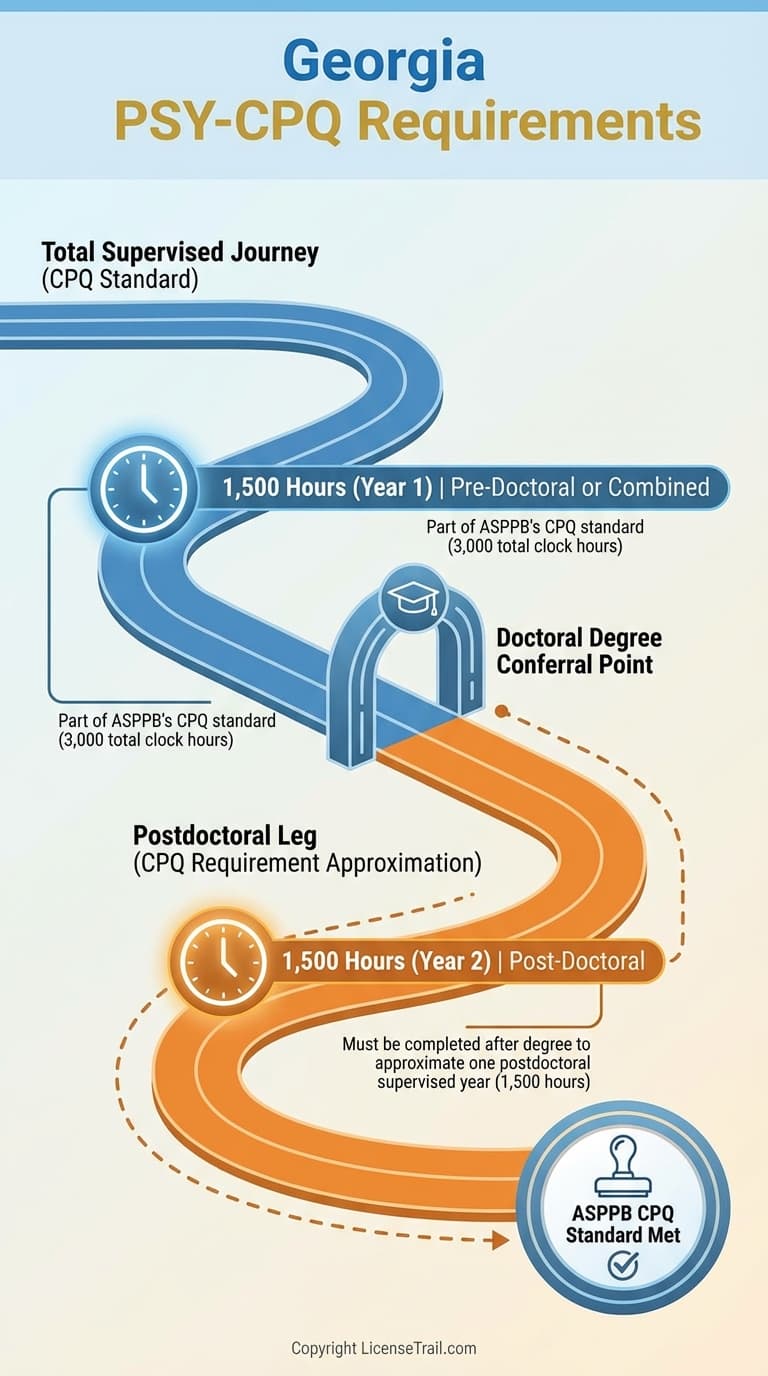
- You must have two years of supervised experience, at least one of which is after doctoral degree conferral, for a minimum of 3,000 total clock hours.
- Each “year” (or equivalent) must:
- Span at least 10 months and no more than 24 months, and
- Contain at least 1,500 hours of professional service, which includes direct client contact, supervision, and didactic training.
- Supervision intensity
- Minimum 1 hour per week of individual, face‑to‑face supervision by a licensed doctoral psychologist throughout these supervised years.
In addition to supervised experience, CPQ requires that you: (asppb.net)
- Hold a current, active psychology license (doctoral level) in an ASPPB member jurisdiction with no disciplinary history,
- Have a qualifying doctoral degree (APA/CPA accredited or Joint Designated, or a long‑standing pre‑2000 doctoral degree under specified conditions),
- Have passed the EPPP at or above the ASPPB recommended passing score,
- And have at least 5 years of post‑licensure independent practice verified by other licensed psychologists.
These CPQ standards are what Georgia relies on when it decides that a CPQ holder has already met all underlying education, supervision, and exam requirements for licensure.
3. How Georgia Legally Treats CPQ Holders
Georgia’s Board rules on qualification of applicants, Rule 510‑3‑.02, include a specific alternative for CPQ holders. The rule states that any person holding a CPQ is “deemed as having met all requirements for licensure in Georgia” provided certain conditions are satisfied. (law.cornell.edu)
Those conditions are:
-
License verification
- An information/verification form from your jurisdiction of current licensure must be sent to the Georgia Board, showing that your license is current and in good standing. (law.cornell.edu)
-
Georgia jurisprudence examination
- You must obtain a passing score on the Georgia jurisprudence exam, a timed, closed‑book, multiple‑choice exam on Georgia laws, rules, and regulations. (rules.sos.ga.gov)
-
Oral examination based on recent work sample
- You must pass an oral examination before the Board (or its representatives), based on a work sample generated within the previous six months (or within six months of your most recent professional practice). (rules.sos.ga.gov)
-
CPQ file submission
- You must provide the Board with your entire CPQ file from ASPPB for review. (law.cornell.edu)
Taken together, this means:
For a CPQ holder, Georgia does not create a separate, new hours requirement. Instead, the Board accepts that you have already satisfied its expectations for education, internship, and supervised postdoctoral work through the CPQ credential, and then adds Georgia-specific public‑protection steps (background check, jurisprudence exam, oral exam).
4. Georgia “Psychologist by CPQ Designation” – Practical Application Steps
The Georgia Secretary of State’s “How to Guide: Psychologist” has a dedicated section titled “Psychologist by CPQ Designation”, which outlines how to apply. (sos.ga.gov)
4.1 Eligibility Snapshot
You must:
- Already hold the CPQ issued by ASPPB.
- Hold a current, unencumbered psychologist license in at least one jurisdiction.
- Have no disqualifying disciplinary history (your CPQ would not be in good standing if you did).
4.2 Documents Georgia requires for a CPQ application
The Board’s checklist for a Psychologist by CPQ Designation application includes: (sos.ga.gov)
-
Completed, signed, notarized Georgia application with fee
- Submitted via the GOALS online portal, selecting the “Psychologist by CPQ Designation” application type.
-
Complete CPQ file with official certification
- You must request that ASPPB send your CPQ file and official certification directly to the Georgia Board.
-
Case study / work sample for the oral exam
- A case study or work sample from your intended area of practice, generated within the last six months, which the Board will use in the oral exam.
-
Fingerprint-based criminal background check registration
- You must register for a fingerprint background check using the process described on the Board’s website and in the How‑to Guide.
-
Secure & Verifiable Document and Affidavit of Citizenship
- Typically a government‑issued photo ID (passport, driver’s license, etc.) plus the Affidavit of Citizenship, and immigration documents if you are not a U.S. citizen.
-
Disciplinary documentation (if applicable)
- If you have ever had sanctions or legal issues, you must submit any required court documents, explanatory letter, and evidence of any alternative‑to‑discipline program enrollment, as prompted by the application.
The Board’s own instructions emphasize that CPQ applicants do not have to complete the ASPPB PLUS application process, but they must still take and pass the Georgia jurisprudence and oral examinations. (sos.ga.gov)
4.3 Application submission and processing
- File online through GOALS after assembling all items in the checklist. (sos.ga.gov)
- Processing time is generally within 20 business days once the Board has a complete application; incomplete files trigger deficiency letters and reset the 20‑day clock when corrections arrive. (sos.ga.gov)
5. Georgia Exams for CPQ Applicants
CPQ applicants are excused from documenting their internship and postdoctoral hours again, but they are not excused from Georgia’s own exams.
5.1 Georgia Jurisprudence Examination
- Format: timed, multiple‑choice, closed‑book.
- Content: current Georgia psychology law, rules, regulations, and general provisions. (rules.sos.ga.gov)
- Scheduling: Once your CPQ application is approved for exam eligibility, you will be authorized to sit for it. If you fail, you must wait 30 days before re‑registering. (rules.sos.ga.gov)
5.2 Oral Examination
- You personally appear before a Board subcommittee (with potential escalation to full Board if needed). (rules.sos.ga.gov)
- The oral exam is based on:
- Your submitted work sample/case study, and
- Your intended area of practice.
- You must demonstrate:
- Competent clinical or applied reasoning,
- Knowledge of ethics and Georgia law, and
- Appropriate professional judgment and boundaries.
Passing both exams is required before the Board will issue your Georgia psychologist license under the CPQ pathway.
6. Licensure Outcome and Renewal Context
Once you have:
- A CPQ in good standing,
- Submitted the Georgia “Psychologist by CPQ Designation” application and supporting materials,
- Cleared your background check, and
- Passed the Georgia jurisprudence and oral exams,
the Board will issue a full psychologist license. From that point forward, you are a Georgia‑licensed psychologist subject to the same renewal cycle and continuing education requirements as any other psychologist:
- Licenses renew every two years on December 31 of even‑numbered years. (sos.ga.gov)
- Current Board rules require 40 CE hours per biennium, including 6 hours in professional ethics in an approved live or synchronous format. (onlinepsychologyprograms.org)
Summary of the Hour Requirements You Asked About
To put the numbers cleanly side‑by‑side:
-
Georgia’s own baseline licensure standards (which CPQ holders are presumed to meet or exceed):
- 2,000‑hour doctoral internship, including at least 500 hours of direct client/patient contact. (rules.sos.ga.gov)
- 1,500‑hour postdoctoral Supervised Work Experience (SWE), including at least 500 hours of client/patient involvement (direct contact plus closely related professional activities). (rules.sos.ga.gov)
-
CPQ supervised‑experience standards (external to Georgia but relied upon by the Board):
- Two years of supervised experience totaling at least 3,000 clock hours,
- Each supervised “year” must include at least 1,500 hours of professional service,
- At least one of those supervised years must be post‑doctoral, and
- Minimum 1 hour per week of individual, face‑to‑face supervision by a licensed doctoral psychologist. (asppb.net)
For a PSY‑CPQ applicant, Georgia does not re‑impose separate numerical hour requirements at the time of application; instead, the Board accepts the CPQ as evidence that those underlying internship and supervised‑experience standards have already been met and focuses its own review on character, legal compliance, and current competence through background checks, the jurisprudence exam, and the oral exam.
Track your PSY-CPQ hours with confidence
License Trail checks your direct, indirect, and supervision hours against Georgia PSY-CPQ requirements continuously and flags mismatches before you submit.
 Start Tracking for Free
No credit card required · Free plan available
Is your spreadsheet hiding Georgia PSY-CPQ risks?
Stop guessing if your categories match Georgia State Board of Examiners of Psychologists requirements. License Trail checks your direct, indirect, and supervision hours continuously and flags mismatches before you submit.
Import or log
Bring your spreadsheet or start fresh
Upload your existing tracking spreadsheet and we'll map every hour into the right Georgia State Board of Examiners of Psychologists categories automatically.
Verify against Georgia
Catch mismatches before the board does
License Trail checks your direct, indirect, and supervision hours against Georgia PSY-CPQ requirements continuously.
Export board-ready
One-click clean reports
Generate professional, board-ready reports for supervision meetings and Georgia State Board of Examiners of Psychologists submissions in seconds.
No credit card required · Free plan available