
Georgia PSY-END Requirements: Hours, Exams & Step-by-Step Guide
Stop guessing if your categories match Georgia requirements. License Trail checks your direct, indirect, and supervision hours against PSY-END requirements continuously and flags mismatches before you submit.
No credit card required · Free plan available
Quick Requirements Overview
- Hold a current out-of-state psychologist license in good standing; if licensed <10 years, that jurisdiction’s standards must be not lower than GA’s (education + training + supervised experience).
- Doctoral degree: APA/CPA-accredited applied psychology doctorate (or qualifying equivalent) meeting GA residency requirements.
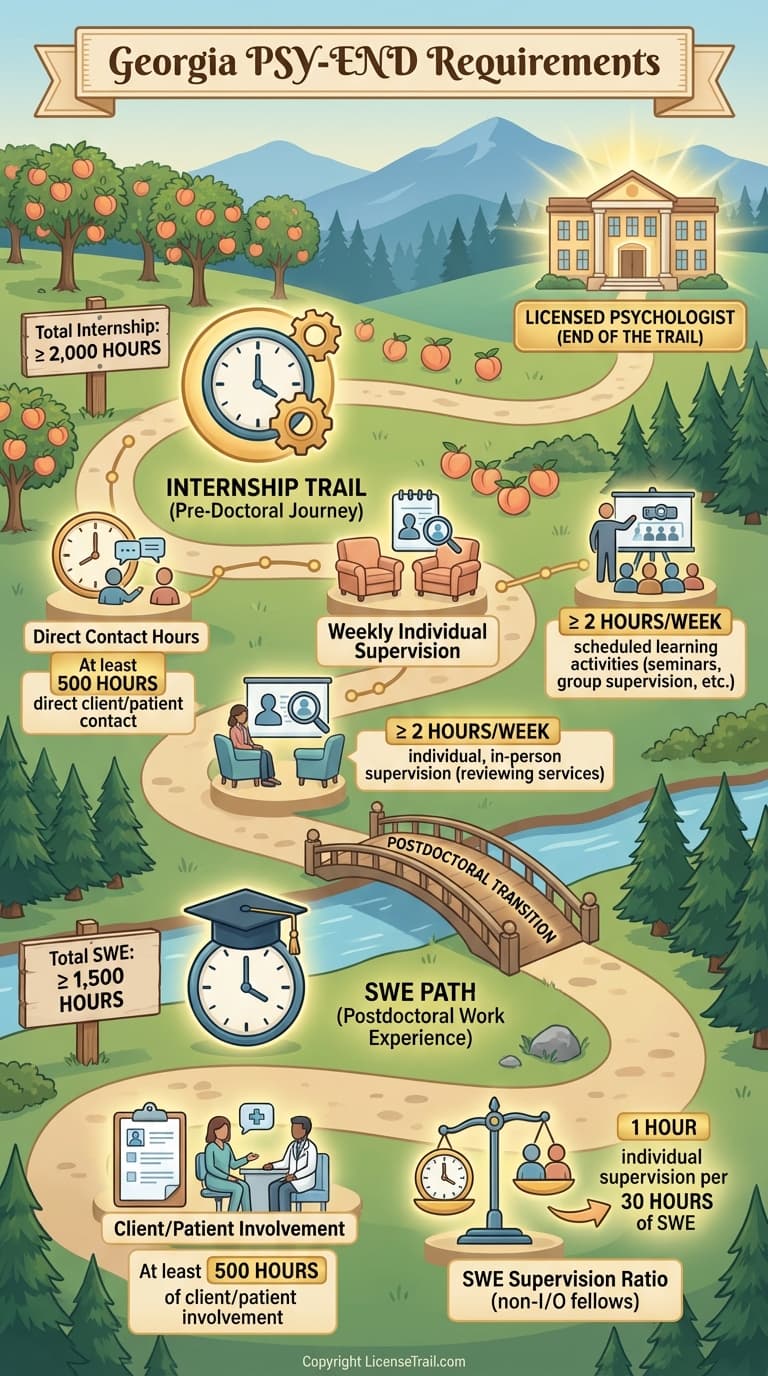
- Predoctoral internship: 2,000 hours total; ≥500 hours direct client/patient contact (I/O exempt from direct-contact minimum); APA/CPA-accredited or Board-equivalent.
- Postdoc SWE (baseline standard): 1,500 hours individually supervised postdoctoral experience; ≥500 hours client/patient involvement; completed in 11–24 months with weekly logs; supervisor verification.
- SWE equivalency (endorsement): either 3 years full-time practice (≥30 hrs/week, 50 weeks/yr, organized setting with supervision/collaboration) or ≥5 years licensed in another jurisdiction.
- Exams: EPPP passing score (if originally licensed on/after 11/1/2020, must have Part I & Part II), plus GA jurisprudence exam and GA oral exam (recent work sample within ~6 months).
- Application items: submit Application Initiation Form + fee, complete criminal background check, and use ASPPB PLUS to document credentials/experience.
- After licensure (CE): 40 CE/2 years incl. 6 ethics (special first-renewal reductions for endorsement licensees depending on biennium timing).
License Details
Procedures
Licensure as a psychologist “by endorsement” in Georgia (license type often labeled PSY‑END) is controlled by the Georgia State Board of Examiners of Psychologists under Rules Chapter 510‑3 (Licensure by Endorsement) and, by reference, Chapter 510‑2 (Licensure by Examination). The endorsement rules assume that your existing licensure is built on training and experience at least as strong as Georgia’s own requirements.
Below is a step‑by‑step description of what Georgia requires, with emphasis on the specific hours and the Board’s terminology.
1. Baseline Georgia training and experience standards
Even though you are applying by endorsement, Georgia compares your original licensure to its own standards. For psychologists licensed less than 10 years, the other state’s standards “must not be lower than those of Georgia including the requirements set forth in Board rules 510‑2‑.01, 510‑2‑.04, 510‑2‑.05 and 510‑3‑.02.” (rules.sos.georgia.gov)
Those referenced rules require:
1.1 Doctoral degree
Georgia requires “a doctoral degree from an American Psychological Association (APA) or Canadian Psychological Association (CPA) accredited doctoral program in applied psychology,” or a qualifying I/O or international program. (rules.sos.ga.gov)
Your original license must be based on such an “earned doctoral degree in applied psychology which met the residency requirement” in Rule 510‑2‑.04. (rules.sos.georgia.gov)
1.2 Predoctoral internship
Georgia’s internship requirement is defined in Rule 510‑2‑.05:
- The internship must be an organized program in the specialty area (clinical, counseling, school, MR/DD, or I/O) that is either APA/CPA‑accredited or meets Board‑defined equivalency. (regulations.justia.com)
- “The internship consists of 2000 hours of organized training experiences appropriate to the academic program specialty area.” (rules.sos.georgia.gov)
- “The intern must spend at least 500 hours in direct contact with clients/patients.” (I/O interns are exempt from this direct‑contact minimum.) (rules.sos.georgia.gov)
So, for a standard applied practice area (e.g., clinical), Georgia’s underlying expectation is:
- 2,000 total internship hours, of which
- at least 500 hours must be direct client/patient contact.
1.3 Postdoctoral Supervised Work Experience (SWE)
Postdoctoral experience is also set in Rule 510‑2‑.05:
- “A Postdoctoral Supervised Work Experience (SWE) is 1500 hours of individually supervised experience following the internship and the completion of the doctoral degree.” (regulations.justia.com)
- Rule 510‑2‑.05 further states: “Licensure requires 1500 hours of SWE that is deemed acceptable to the Board which comply with the guidelines set forth below.” (law.cornell.edu)
Key content and hour requirements for SWE include: (law.cornell.edu)
- Total hours: 1,500 hours of supervised work experience.
- Client involvement: At least 500 hours of client/patient involvement, defined to include:
- face‑to‑face contact,
- document review,
- test scoring,
- note/report writing,
- or other professional activity “which directly relates to the treatment of or services provided for the client/patient.”
- Timeframe: Must be completed in no less than 11 months and no more than 24 months from the start of SWE.
- Documentation: All SWE hours must be recorded on a weekly log co‑signed by fellow and supervisor, with at least:
- professional activities performed that week,
- total hours worked,
- hours of client/patient involvement,
- hours of individual supervision.
Taken together, Georgia’s baseline experiential standard for entry‑level licensure is:
- 2,000 internship hours, with
- ≥ 500 hours direct client contact, and
- 1,500 postdoctoral SWE hours, with
- ≥ 500 hours client/patient involvement under individual supervision, within an 11–24 month window.
These are the benchmarks Georgia uses when judging whether your out‑of‑state training and licensure are equivalent for endorsement.
2. Application process for licensure by endorsement (PSY‑END)
Rule 510‑3‑.01 defines “licensure by endorsement” and sets the basic application steps. Licensure by endorsement is for applicants “who hold current licenses in psychology in other states and are applying for licensure in Georgia.” (rules.sos.georgia.gov)
To apply, you must:
-
Submit the Application Initiation Form and fee
- A completed Application Initiation Form “including all supporting documents and the fee made payable to the Georgia Board.” (rules.sos.georgia.gov)
-
Complete a criminal background check
- You must complete registration as required by the Board to submit a criminal background check under O.C.G.A. §§ 43‑39‑6 and 43‑39‑8(b)(6); you pay the fees. (rules.sos.georgia.gov)
-
Participate in ASPPB PLUS
- Once registered with the Board, ASPPB notifies you to register for their Psychology Licensure Universal System (PLUS) application process, which is used to document your education, internship, and postdoc/SWE for Georgia. (rules.sos.georgia.gov)
-
Meet exam requirements (details depend on your pathway, below, but for most endorsement applicants this includes):
- A passing EPPP score (Part 1 and Part 2 for those originally licensed on or after November 1, 2020), (rules.sos.georgia.gov)
- A passing score on the Georgia jurisprudence examination, and
- Passing a Georgia oral examination based on a recent work sample.
The Board may deny licensure if there has been disciplinary action or other issues calling competency into question. (rules.sos.georgia.gov)
3. Endorsement eligibility paths and how hours are evaluated
Rule 510‑3‑.02 sets out five alternatives. You must qualify under at least one.
3.1 Psychologists licensed for less than 10 years (primary PSY‑END path)
This is the core route for many applicants.
To qualify, you must: (rules.sos.georgia.gov)
-
Comparable licensure standards in your current state
- The “overall licensure standards in the jurisdiction where the applicant is currently licensed must not be lower than those of Georgia,” specifically including compliance with Rules 510‑2‑.01, 510‑2‑.04, 510‑2‑.05, and 510‑3‑.02.
- Practically, this means Georgia expects your original licensure to rest on:
- APA/CPA‑type doctoral training,
- a 2,000‑hour internship with at least 500 direct client hours, and
- a 1,500‑hour postdoctoral supervised work experience (or its defined equivalent).
-
License verification
- An information/verification form from your licensing jurisdiction must show that your license is current and in good standing.
-
Doctoral degree and internship verification
- Your original license must be based on an earned doctoral degree in applied psychology that met Georgia’s residency requirement in Rule 510‑2‑.04(4)(a), and
- “The program’s internship must be verified by the internship supervisor.” (rules.sos.georgia.gov)
-
National exam (EPPP)
- You must have “attained a score on the national licensing examination equal to or greater than the standard passing score set by ASPPB.”
- Those licensed in another jurisdiction on or after November 1, 2020 must have passed both EPPP Part I (Knowledge) and EPPP Part II (Skills). (rules.sos.georgia.gov)
-
Georgia jurisprudence exam
- You must pass the Georgia jurisprudence exam on state law, rules, and ethical standards. (docslib.org)
-
Georgia oral examination
- You must pass an oral exam “based on a work sample, which was generated in the six months prior to the examination or within six months of the most recent professional practice.” (rules.sos.georgia.gov)
-
Postdoctoral Supervised Work Experience or its equivalent
This is where your hours are specifically evaluated for endorsement purposes.
- Rule 510‑3‑.02(a)(7) requires that “the applicant must have completed a postdoctoral supervised work experience (SWE), as previously defined, or its equivalent.” The SWE “must be verified by the post‑doctoral supervisor.” (rules.sos.georgia.gov)
- “As previously defined” points back to Rule 510‑2‑.05, which defines SWE as:
- 1,500 hours of individually supervised experience after internship and after all doctoral requirements, with at least 500 hours of client/patient involvement and completed in 11–24 months, documented by a weekly log. (regulations.justia.com)
Equivalent work experience option. If you did not complete a formal postdoctoral SWE exactly in Georgia’s manner, the Board allows two forms of SWE equivalence for endorsement:
-
(i) Three years of full‑time practice
- Defined as at least 30 hours per week for 50 weeks per year, in “an organized setting where supervision and collaboration were provided.”
- That is effectively about 1,500 hours per year for three years (≈ 4,500 hours total) under ongoing professional oversight. (rules.sos.georgia.gov)
-
(ii) Licensure in another jurisdiction for at least five years
- Licensure as a psychologist elsewhere for five or more years is expressly deemed equivalent to the postdoctoral SWE requirement. (rules.sos.georgia.gov)
In practice, a typical applicant under this path demonstrates either:
- A documented 1,500‑hour postdoc SWE (with 500 client hours, 11–24 months, logs, etc.), or
- Sufficient “equivalent work experience” – either three years of full‑time, supervised/collaborative practice (≈ 4,500 hours) or at least five years of psychologist licensure elsewhere.
3.2 Senior Psychologist (licensed 10+ years)
If you have been licensed for 10 or more years, Georgia offers a somewhat streamlined alternative: (rules.sos.georgia.gov)
- At least 10 years licensed in a U.S. or Canadian jurisdiction.
- Original licensure based on an earned doctoral degree in applied psychology meeting Georgia’s residency requirement.
- License verification showing your current license is in good standing.
- Passing the Georgia jurisprudence exam.
- Passing the Georgia oral examination based on a recent work sample.
- Submission of application and required fees.
This path does not re‑specify hours, relying instead on your long‑term licensed practice as evidence of equivalent experience.
3.3 Industrial/Organizational (I/O) Psychologist alternative
For applicants with an I/O or related doctoral degree in psychology, Rule 510‑3‑.02(c) provides a specialized endorsement route: (rules.sos.georgia.gov)
- At least five years of practiced Industrial/Organizational psychology.
- Three references from psychologists about your expertise, work experience, and quality of work (at least one reference from a licensed psychologist).
- Appropriate fees and application.
- EPPP with a passing score (Parts I and II for those originally licensed on or after November 1, 2020).
- Georgia jurisprudence exam.
- Oral exam based on a recent work sample.
The rule specifies years of I/O practice, but not a precise hour count per year. The underlying internship/SWE rules still inform what Georgia considers adequate training.
3.4 CPQ holders (Certificate of Professional Qualification in Psychology)
If you hold the ASPPB CPQ, Georgia largely accepts that credential as demonstrating equivalency: (rules.sos.georgia.gov)
- CPQ holders “will be deemed as having met all requirements for licensure in Georgia” if:
- License verification shows your current license is in good standing.
- You obtain a passing score on the Georgia jurisprudence exam.
- You pass the Georgia oral exam based on a recent work sample.
- You provide the Board with your complete CPQ file.
The hours are effectively embedded in the CPQ’s underlying requirements (which must at least match Georgia’s standards).
3.5 Military spouses and transitioning service members
Georgia offers an expedited endorsement path for service members, transitioning service members, and military spouses: (rules.sos.georgia.gov)
- You must hold a license in good standing from another state where the training, experience, and testing substantially meet or exceed Georgia’s psychologist requirements.
- You submit license verification and documentation of your military status.
- You file the endorsement application and fee.
- You must still pass the Georgia jurisprudence and oral examinations.
Again, hours are evaluated through equivalence with Georgia’s baseline internship and SWE standards.
4. Continuing education (after you receive PSY‑END)
Once licensed (whether by examination or endorsement), psychologists must meet Georgia’s continuing education (CE) requirements in Rule 510‑8‑.01: (rules.sos.ga.gov)
- 40 CE credits every two years, including 6 credits in professional ethics obtained at an in‑person or synchronous webinar workshop.
- For those licensed by endorsement during:
- the first year of the biennium: 20 CE credits, with at least 3 in ethics.
- the second year of the biennium: no CE required for the initial renewal.
5. Practical hour‑based summary for a PSY‑END applicant
While the endorsement rules are framed in terms of equivalence rather than re‑creating your training, the hour‑based expectations can be summarized as follows:
Baseline Georgia expectations for an entry‑level psychologist
-
Internship:
- 2,000 hours total;
- at least 500 hours direct client/patient contact.
-
Postdoctoral SWE (standard route):
- 1,500 hours of individually supervised postdoctoral experience;
- at least 500 hours client/patient involvement;
- completed in 11–24 months;
- documented weekly with hours and supervision.
Endorsement‑specific experience expectations
For psychologists licensed <10 years, Georgia expects you to document one of:
- A formal postdoctoral SWE that meets the 1,500‑hour/500‑client‑hour/11–24 month standard, verified by a postdoctoral supervisor; or
- Equivalent work experience, defined as either:
- Three years of full‑time practice (≥ 30 hours/week for 50 weeks/year) in an organized, supervised/collaborative setting – roughly 4,500 hours of supervised/collaborative practice; or
- ≥ 5 years licensed as a psychologist in another jurisdiction.
Senior psychologists (10+ years licensed), CPQ holders, I/O specialists meeting the five‑year practice requirement, and qualifying military‑connected applicants are assessed under their own alternatives, but always with reference back to these underlying Georgia standards for education, internship, supervised hours, and examinations.
Because rules can be amended, it is wise to confirm the current text of Chapters 510‑2 and 510‑3 on the Georgia Secretary of State/Rules and Regulations site, and to follow any instructions in the Board’s most recent application materials when you initiate your PSY‑END application.
Track your PSY-END hours with confidence
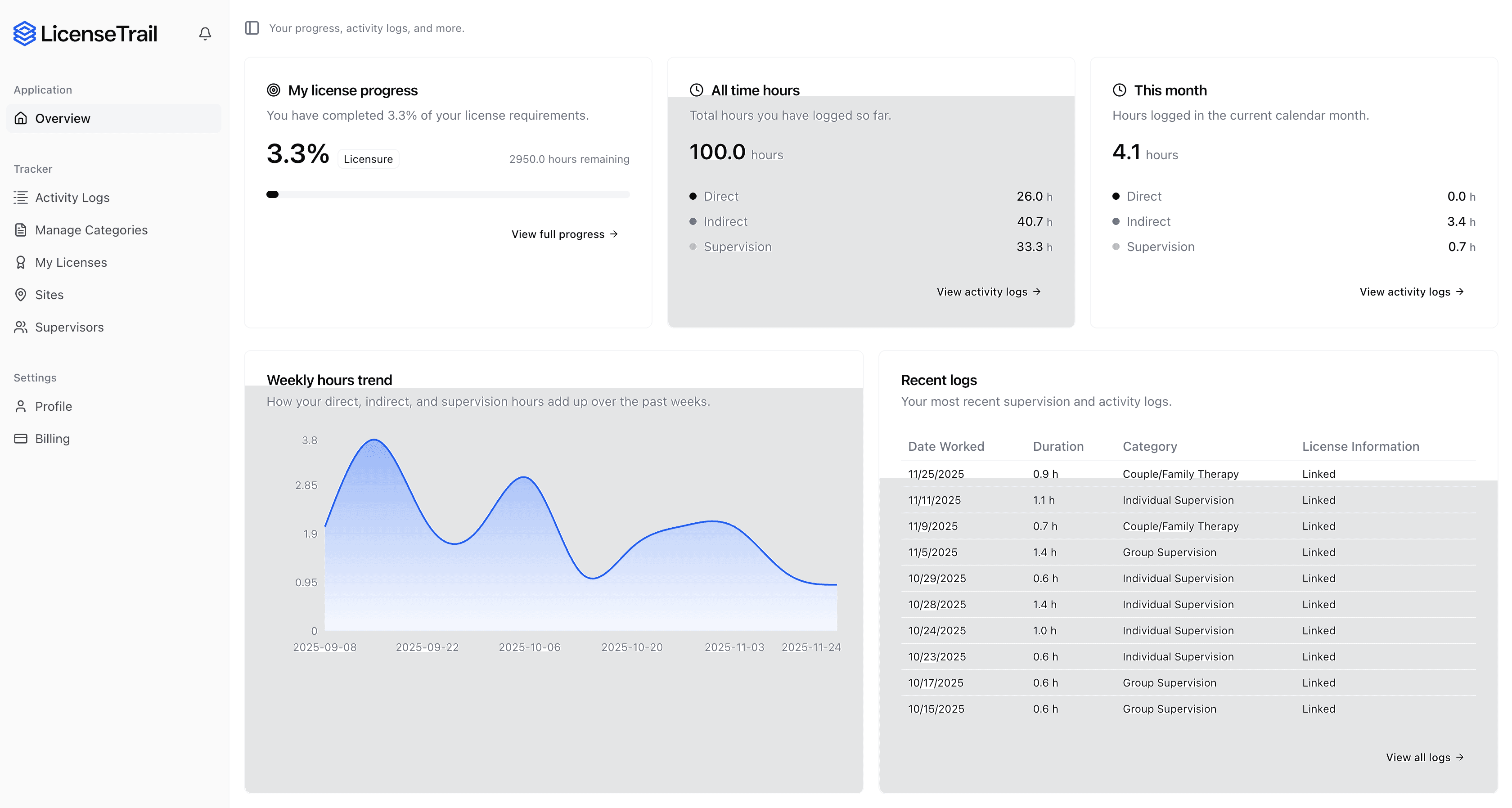
License Trail checks your direct, indirect, and supervision hours against Georgia PSY-END requirements continuously and flags mismatches before you submit.
 Start Tracking for Free
No credit card required · Free plan available
Is your spreadsheet hiding Georgia PSY-END risks?
Stop guessing if your categories match Georgia State Board of Examiners of Psychologists requirements. License Trail checks your direct, indirect, and supervision hours continuously and flags mismatches before you submit.
Import or log
Bring your spreadsheet or start fresh
Upload your existing tracking spreadsheet and we'll map every hour into the right Georgia State Board of Examiners of Psychologists categories automatically.
Verify against Georgia
Catch mismatches before the board does
License Trail checks your direct, indirect, and supervision hours against Georgia PSY-END requirements continuously.
Export board-ready
One-click clean reports
Generate professional, board-ready reports for supervision meetings and Georgia State Board of Examiners of Psychologists submissions in seconds.
No credit card required · Free plan available