
Georgia PSY-EXAM Requirements: Hours, Exams & Step-by-Step Guide
Stop guessing if your categories match Georgia requirements. License Trail checks your direct, indirect, and supervision hours against PSY-EXAM requirements continuously and flags mismatches before you submit.
No credit card required · Free plan available
Quick Requirements Overview
- Doctoral degree: Qualifying psychology doctorate (APA/CPA applied program or approved I/O/international); includes required residency/years of study + internship
- Practicum: No set hour minimum in rules; practicum for course credit cannot count toward internship hours
- Internship: ≥2,000 hours (APA/CPA-accredited or APPIC member, or Board-approved equivalent); typically completed 11–24 months (I/O up to 48)
- Internship direct service: ≥500 hours direct client/patient contact (I/O exempt)
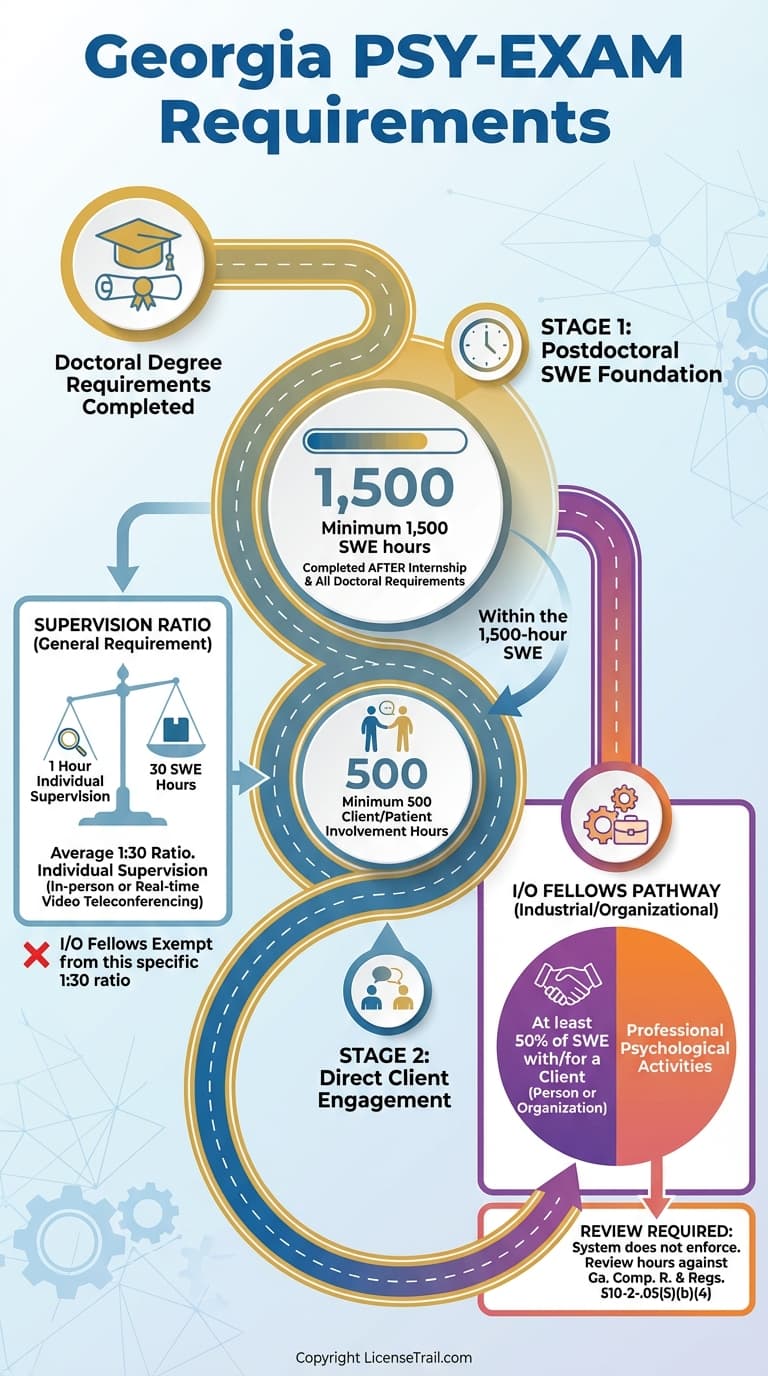
- Postdoc SWE: 1,500 hours of individually supervised postdoctoral experience after internship/degree; completed 11–24 months
- SWE client involvement: ≥500 hours client/patient involvement within the 1,500
- SWE supervision/docs: Written contract; ≥1 hour individual supervision per 30 SWE hours (I/O exempt); weekly logs co-signed unless in APA/APPIC postdoc fellowship
- Exams & process: Apply via ASPPB PLUS + background check; pass EPPP Part 1 & 2 → GA jurisprudence → oral exam (remediation required after repeated EPPP failures)
License Details
Procedures
Psychologist licensure in Georgia through the PSY‑EXAM (Licensure by Examination) route is tightly defined in the Board’s rules (Ga. Comp. R. & Regs. Chapter 510‑2). The Board is very specific about the type and number of hours you must complete at each stage, especially for internship and postdoctoral supervised work experience (SWE).
Below is a structured guide, using the Board’s own terminology, with emphasis on the hour requirements and how they break down.
1. Big picture: what Georgia requires for PSY‑EXAM
To be licensed as a psychologist by examination in Georgia, an applicant must, at minimum:
- Hold a qualifying doctoral degree in psychology (APA/CPA‑accredited applied program or approved I/O or international program). (rules.sos.georgia.gov)
- Complete an APA/CPA‑accredited or APPIC‑member internship (or an approved equivalent) that is at least 2,000 hours, with a specified amount of direct client contact. (rules.sos.georgia.gov)
- Complete 1,500 hours of postdoctoral Supervised Work Experience (SWE), defined in Board rule as “1500 hours of individually supervised experience” after internship and after the doctoral degree is complete. (rules.sos.georgia.gov)
- Pass three examinations in sequence: the national EPPP (Part 1 knowledge, Part 2 skills), a Georgia jurisprudence exam, and an oral exam. (rules.sos.georgia.gov)
- Submit an application through ASPPB’s PLUS system, undergo a criminal background check, and meet other procedural requirements. (rules.sos.georgia.gov)
Georgia does not use a “1,500 direct + 1,500 supervised” model. Instead:
- Internship: 2,000 total hours, of which at least 500 hours must be “direct contact with clients/patients.” (regulations.justia.com)
- Postdoctoral SWE: 1,500 supervised hours total, of which at least 500 hours must be “client/patient involvement” as defined by the Board. (regulations.justia.com)
All 1,500 SWE hours are supervised; the 500 is a minimum portion that must be direct client/patient–related activity.
2. Educational foundation (doctoral degree & practicum)
2.1 Doctoral degree
Rule 510‑2‑.01 specifies that an applicant must have:
“A doctoral degree from an American Psychological Association (APA) or Canadian Psychological Association (CPA) accredited doctoral program in applied psychology … or from an I/O or international program (as defined below under Education).” (rules.sos.georgia.gov)
Under Rule 510‑2‑.04, the program must:
- Be APA/CPA accredited in applied psychology (for non‑I/O and non‑international routes). (rules.sos.georgia.gov)
- Provide at least three full‑time academic years of graduate study plus an internship before awarding the degree, with residency requirements (2 years in the degree‑granting program; 1 full‑time in‑person year). (rules.sos.georgia.gov)
2.2 Doctoral practicum
The Board expects “adequate and appropriate practicum experiences” as part of the doctoral program, following APA/CPA accreditation standards, but it does not set a specific practicum hour minimum in the licensure rules. (rules.sos.georgia.gov)
Key points:
- Practicum settings must be committed to training and provide sufficient supervision and breadth of experiences. (rules.sos.georgia.gov)
- Practicum hours do not count toward internship hours. The rules explicitly say “supervised program activities (practica) for which course credit is awarded may not be used to satisfy any internship hours.” (regulations.justia.com)
3. Predoctoral internship: 2,000 hours with 500+ direct client contact
Internship requirements live in Rule 510‑2‑.05(4).
3.1 Acceptable types of internship
You can meet the internship standard in either of two ways:
- APA/CPA‑accredited or APPIC‑member internship that is “at least 2000 hours.” (regulations.justia.com)
- A non‑accredited/non‑APPIC internship that meets detailed Board criteria, including specific hour and supervision standards (summarized below). (regulations.justia.com)
3.2 Total internship hours and timeframe
For a non‑accredited/non‑APPIC internship, the rules specify:
- “The internship must be completed in no less than 11 months and no more than 24 months after its inception.” (regulations.justia.com)
- “The internship consists of 2000 hours of organized training experiences appropriate to the academic program specialty area.” (regulations.justia.com)
So, for licensure by examination, you should plan on 2,000 internship hours completed over roughly 11–24 months (longer only for I/O internships, which may run up to 48 months). (regulations.justia.com)
3.3 Direct client/patient contact requirement during internship
Within those 2,000 hours, the Board requires a minimum of 500 hours of direct service:
- “The intern must spend at least 500 hours in direct contact with clients/patients. I/O Interns are exempt from this requirement.” (regulations.justia.com)
The rules do not give a separate “supervised” vs “unsupervised” hour count because all internship hours are supervised training, but they isolate the 500‑hour minimum of direct client/patient contact as a key threshold.
3.4 Other structural details about internship activities
Selected requirements (for any Board‑approved internship): (regulations.justia.com)
- Prerequisite coursework: The intern must have completed at least 60 semester hours of graduate coursework in psychology before starting internship.
- No double counting: Practicum activities that carry course credit cannot be counted toward the 2,000 internship hours.
- Range of activities: The internship must include a range of assessment and treatment/intervention activities conducted directly with persons or organizations receiving psychological services.
- Supervision mix: At least 80% of internship supervision must be provided by one or more licensed psychologists; final evaluations must show satisfactory completion.
- Identification as trainee: The intern must use a title that indicates trainee status (e.g., “intern” or “resident”).
- Written internship agreement: Before starting, the intern, supervisor(s), and doctoral program training director (or designee) must sign a written internship agreement specifying goals and the nature of experiences; at completion, all sign again to confirm successful completion.
Specialty‑specific internship standards (clinical, counseling, school, MR/DD, I/O) also impose supervision minima such as at least 2 hours per week of individual in‑person supervision and 2 hours per week of scheduled learning activities for many health‑service specialties. (regulations.justia.com)
4. Postdoctoral Supervised Work Experience (SWE): 1,500 supervised hours
After internship and after all doctoral requirements are complete, Georgia requires a postdoctoral supervised work experience.
4.1 Basic definition and total hours
Rule 510‑2‑.05 defines SWE as:
- “A Postdoctoral Supervised Work Experience (SWE) is 1500 hours of individually supervised experience following the internship and the completion of the doctoral degree.” (rules.sos.georgia.gov)
Rule 510‑2‑.01 also states that applicants must show:
- “Successful completion of a 1500‑hour postdoctoral supervised work (SWE) experience.” (rules.sos.georgia.gov)
In other words, the entire 1,500 hours are postdoctoral and supervised.
4.2 Timeframe for completing SWE
The Board sets strict timing parameters:
- “The SWE must be completed in no less than 11 months and no more than 24 months after its inception. Supervision begins on the date the contract is signed by the supervisor(s) and fellow.” (regulations.justia.com)
So you must complete the 1,500 supervised hours over approximately 11–24 months.
4.3 Required “client/patient involvement” hours within SWE
Within the 1,500 total supervised hours, there is a specific direct service component:
- “The content of the SWE must include a minimum of 500 hours of client/patient involvement” defined as face‑to‑face contact, document review, test scoring, note/report writing, or other professional activity directly related to treatment or services for the client/patient. (regulations.justia.com)
Important distinctions:
- The Board does not say 1,500 hours of direct client time; it says 1,500 total supervised hours, at least 500 of which are direct client/patient involvement.
- The remaining up to 1,000 hours can include non‑client/patient professional activities (e.g., program development, supervision of others under supervision, teaching, research) so long as they are consistent with the fellow’s intended area of practice and the supervisor’s competence. (regulations.justia.com)
For postdoctoral experiences in academic settings, the rules clarify that non‑client/patient hours can be met through activities that transmit psychological knowledge or apply psychological principles (teaching, research, service, administration). (regulations.justia.com)
4.4 Logging and documentation of SWE
The Board requires detailed weekly logging:
- “All SWE hours must be documented on a weekly log which is co‑signed by the fellow and supervisor.” (regulations.justia.com)
- The log must at minimum record:
- Professional activities/tasks performed that week
- Total hours worked that week
- Number of hours of client/patient involvement that week
- Number of hours of individual supervision that week (regulations.justia.com)
For fellows in formal APA‑accredited or APPIC‑member postdoctoral fellowships, the Board allows an alternative: completing 1,500 hours of supervised experience in 11–24 months in one of those programs deems the SWE requirement met and no SWE log is required. (regulations.justia.com)
4.5 Supervision requirements during SWE
The supervision structure is also tightly defined:
- Written supervision contract: Before SWE begins, supervisor(s) and fellow must sign a contract stating goals, content, and criteria for evaluating the experience. (regulations.justia.com)
- Supervision ratio:
- “The fellow must meet with the supervisor individually … at least one hour for each 30 hours of SWE.”
- The meeting must occur during the week services are provided or the following week.
- Supervision must be individual and can be in person or real‑time face‑to‑face video; I/O fellows are exempt from this ratio requirement. (regulations.justia.com)
- Attestation at completion: At the end of SWE, all supervisors must attest to the adequacy of experience and supervision on the Board’s “postdoctoral supervised work experience affidavit of supervisor form (Form G).” (regulations.justia.com)
For industrial/organizational (I/O) SWE, additional provisions apply; for example, at least one‑half of SWE hours must be spent in professional psychological activities with or on behalf of a client (person or organization), and supervisors must at minimum review and comment on research or intervention designs and resulting reports or recommendations. (regulations.justia.com)
5. Application and examination sequence
Once your education, internship, and SWE are aligned with the Board rules, the PSY‑EXAM pathway involves a formal application and three examinations.
5.1 Application components
Under Rule 510‑2‑.01, to apply for licensure by examination you must submit: (rules.sos.georgia.gov)
- Documentation of your qualifying doctoral degree.
- Documentation of completion of a qualifying internship (APA/CPA‑accredited or APPIC‑member, or equivalent meeting the Board criteria).
- Documentation of 1,500‑hour postdoctoral SWE.
- A completed Application Initiation Form plus all supporting documents and required fee.
- Registration and completion of a criminal background check as specified by O.C.G.A. §§ 43‑39‑6 and 43‑39‑8(b)(6).
- Participation in ASPPB’s PLUS application process when directed by the Board.
Once ASPPB submits your completed application and the Board approves you as a candidate, you are authorized to begin the examination sequence.
5.2 Examination requirements and order
Georgia requires you to pass three exams in this order: (rules.sos.georgia.gov)
-
EPPP (Part 1 & Part 2) – National Licensing Exam
- Developed by ASPPB.
- Part 1 (knowledge) may be taken after all coursework is completed (even before internship and SWE).
- Part 2 (skills) may be taken after all doctoral degree and internship requirements are completed.
- The Board accepts the standard passing scores set by ASPPB.
-
Georgia Jurisprudence Examination
- Timed, multiple‑choice, closed‑book exam on Georgia law, rules, regulations, and general provisions.
- You may take it after passing the two‑part national exam, and while SWE is still being completed.
- If you fail, you must wait 30 days before re‑registering.
-
Oral Examination
- Conducted by the Board or its representatives.
- May be scheduled after you have passed the written exams and are within two months of satisfactorily completing SWE.
- Based on a work sample from your intended practice area and may involve review of your SWE logs.
- If you fail a subcommittee oral exam, you move to a Full Board oral exam; failure of the second Full Board oral exam results in denial of licensure, requiring a new application if you wish to try again in the future.
5.3 Additional education if EPPP is repeatedly failed
If you repeatedly fail either part of the EPPP, the Board requires remedial coursework or continuing education before additional attempts:
- After three unsuccessful attempts on a part of the EPPP, you must earn either 3 graduate semester hours in Board‑approved coursework or 15 hours of Board‑approved CE in psychology prior to each subsequent retake (attempts 4–6). (rules.sos.georgia.gov)
- After six unsuccessful attempts on a part, you must earn 9 graduate semester hours or 45 CE hours before each retake starting with the seventh attempt. (rules.sos.georgia.gov)
6. Hour requirements at a glance
For quick reference, here is how Georgia’s PSY‑EXAM requirements translate into hours and categories:
| Stage | Total Hours Required | Key “Direct” / Client‑Related Component | Supervision Structure |
|---|---|---|---|
| Doctoral practicum | Determined by APA/CPA‑accredited program (no fixed number in Board rules) | Not counted toward internship or SWE hours | Must be supervised by licensed psychologists; details largely governed by APA/CPA standards. (rules.sos.georgia.gov) |
| Internship | 2,000 hours (APA/CPA or APPIC internship must be “at least 2000 hours”; non‑accredited internships must be exactly 2,000 hours and meet other criteria). (regulations.justia.com) | Minimum 500 hours of “direct contact with clients/patients” (I/O interns exempt). (regulations.justia.com) | At least 80% of supervision by licensed psychologists; typically ≥2 hrs/week individual supervision + ≥2 hrs/week structured learning in health‑service specialties. Internship must be completed in 11–24 months (up to 48 months for I/O). (regulations.justia.com) |
| Postdoctoral SWE | 1,500 hours of “individually supervised experience” after internship and doctoral degree. (rules.sos.georgia.gov) | Minimum 500 hours of “client/patient involvement” (face‑to‑face contact, document review, test scoring, reports, or other activities directly tied to treatment/services). (regulations.justia.com) | Supervision contract required. At least 1 hour of individual supervision for every 30 hours of SWE (real‑time in‑person or video). Completed in 11–24 months. Weekly logs required unless in an APA/APPIC postdoc fellowship. (regulations.justia.com) |
These requirements are based on Georgia’s rules as compiled through at least mid‑2025 (Ga. Comp. R. & Regs. 510‑2‑.01, 510‑2‑.04, and 510‑2‑.05). For any application, it is crucial to compare your training plan and documentation point‑by‑point with those rules, because the Board evaluates internships and SWE on whether they match this specific language and structure.
Track your PSY-EXAM hours with confidence
License Trail checks your direct, indirect, and supervision hours against Georgia PSY-EXAM requirements continuously and flags mismatches before you submit.
 Start Tracking for Free
No credit card required · Free plan available
Is your spreadsheet hiding Georgia PSY-EXAM risks?
Stop guessing if your categories match Georgia State Board of Examiners of Psychologists requirements. License Trail checks your direct, indirect, and supervision hours continuously and flags mismatches before you submit.
Import or log
Bring your spreadsheet or start fresh
Upload your existing tracking spreadsheet and we'll map every hour into the right Georgia State Board of Examiners of Psychologists categories automatically.
Verify against Georgia
Catch mismatches before the board does
License Trail checks your direct, indirect, and supervision hours against Georgia PSY-EXAM requirements continuously.
Export board-ready
One-click clean reports
Generate professional, board-ready reports for supervision meetings and Georgia State Board of Examiners of Psychologists submissions in seconds.
No credit card required · Free plan available