
Idaho LAMFT Requirements: Hours, Exams & Step-by-Step Guide
Stop guessing if your categories match Idaho requirements. License Trail checks your direct, indirect, and supervision hours against LAMFT requirements continuously and flags mismatches before you submit.
No credit card required · Free plan available
Quick Requirements Overview
- Authority: Idaho Code Title 54, Ch. 34 and IDAPA 24.15.01 (Idaho Licensing Board of Professional Counselors & MFTs)
- Scope: LAMFT may practice only under supervision (no independent practice)
- Education: Master’s or higher in MFT/related field from COAMFTE or CACREP-MCFC program, or substantially similar Board-approved program
- Practicum timeframe: Supervised practicum/clinical experience must span ≥ 12 months
- Clinical hours (initial LAMFT): 300 hours direct client contact required
- Conjoint requirement: Within the 300 hours, ≥ 100 hours with two or more clients conjointly who have an ongoing relationship (e.g., couples/families)
- Exam: Pass AMFTRB National MFT Exam (or other Board-approved exam)
- Application items: Board application + fee + exam proof + fingerprint-based criminal history background check (Idaho Code 67-9411A)
License Details
Procedures
Idaho regulates Licensed Associate Marriage and Family Therapists (LAMFTs) under Title 54, Chapter 34 of the Idaho Code and IDAPA 24.15.01, the Rules of the Idaho Licensing Board of Professional Counselors and Marriage and Family Therapists.(law.justia.com)
Below is a step‑by‑step guide focused on what the Board itself requires, with an emphasis on clinical hour types and the Board’s terminology.
1. What a LAMFT Is Allowed to Do
Idaho law defines a “licensed associate marriage and family therapist” as someone licensed to practice marriage and family therapy only under supervision as established in statute and Board rules.(codes.findlaw.com)
Key Board terminology you will see:
- “Marriage and family therapy” – evaluation and treatment of mental and emotional disorders within the context of marriage and family systems, using family systems and psychotherapeutic theories with individuals, couples, and families.(codes.findlaw.com)
- “Practice of marriage and family therapy” – rendering those services to individuals, couples, and families, directly or through organizations.(codes.findlaw.com)
- LAMFTs must practice under supervision; they do not practice independently.
2. Educational Requirement
To qualify for LAMFT, you must hold an approved graduate degree:
- Degree level: A master’s degree or higher in marriage and family therapy or a related field of study approved by the Board.(law.justia.com)
- Program accreditation (Board terms): The degree must be from:
- A program in marriage and family therapy or a related field accredited by:
- The Commission on Accreditation for Marriage and Family Therapy Education (COAMFTE), or
- The Council for Accreditation of Counseling and Related Educational Programs – Marriage, Couple, and Family Counseling (CACREP‑MCFC),
- Or a substantially similar program approved by the Board.(law.cornell.edu)
- A program in marriage and family therapy or a related field accredited by:
The Board’s rules describe this as an “Approved Graduate Program” for an Associate Marriage and Family Therapist.(law.cornell.edu)
3. Practicum / Clinical Hour Requirements for LAMFT
The only specific hour requirement to obtain the LAMFT license itself is the Board‑defined practicum (or equivalent supervised clinical experience). The hours are framed in terms of “direct client contact” and “conjoint” work.
3.1. Required Practicum Duration
The Board requires that the practicum:
- “occur over a period of twelve (12) months or longer”.(law.cornell.edu)
In practice, this can be a one‑year graduate practicum or an equivalent span of supervised clinical experience that meets the Board’s criteria.
3.2. Total Direct Client Contact Hours
The Board specifies:
- A minimum of 300 hours of direct client contact.(law.cornell.edu)
In Board language, this is “three hundred (300) hours of direct client contact.” These are hours where you are directly providing therapy to clients, not doing paperwork, trainings, or non‑clinical tasks.
3.3. Required “Conjoint” Relationship Hours
Within those 300 direct hours, the Board requires that:
- At least 100 hours must be with “two or more individuals conjointly who share an ongoing relationship” beyond the therapy setting.(law.cornell.edu)
Key points about this requirement:
- The Board’s wording underscores relational work:
- “Two or more individuals conjointly” – you are in session with more than one person at the same time.
- These individuals must “share an ongoing relationship beyond that which occurs in the therapeutic experience itself” – in other words, couples, families, or other natural relationship systems, not just any group of unrelated individuals in a therapy group.(law.cornell.edu)
- Practically, you can think of this as 100+ hours with couples, families, or other ongoing relationship systems, within your 300 direct‑contact hours.
3.4. Where and How These Hours Can Be Earned
The Board allows flexibility in how you accrue these hours. The rule states that the 300 hours (including the 100 conjoint hours):
- “may be completed as part of a practicum, registered intern supervised experience, or supervised experience in another jurisdiction.”(law.cornell.edu)
So, for LAMFT eligibility, Idaho recognizes qualifying hours if they:
- Were part of your graduate practicum, or
- Were gained as a registered post‑graduate intern in Idaho, or
- Were gained as supervised experience in another jurisdiction, provided the hours meet Idaho’s definitions and are accepted by the Board.
3.5. What Is Not Required at the LAMFT Stage
The Idaho Board does not require, for LAMFT licensure:
- Thousands of post‑master’s hours before issuing the LAMFT.
- A split such as “1,500 hours direct experience and 1,500 hours of other supervised experience” – that kind of large post‑degree hour breakdown applies in some other states, not Idaho. Idaho’s large post‑graduate hour requirements apply when you seek the full LMFT license, not the LAMFT.(law.cornell.edu)
4. Examination Requirement
Both the statute and the rules require that LAMFT applicants pass a Board‑approved examination:
- The Board’s licensure rule identifies the exam as the National Marital and Family Therapy Examination approved by the Association of Marital and Family Therapy Regulatory Boards (AMFTRB), or another Board‑approved competency exam in marriage and family therapy.(law.cornell.edu)
- Idaho Code § 54‑3405B requires the applicant to **“provide evidence” of having successfully passed an examination approved by the Board and defined by rule.(law.justia.com)
In practice, this means passing the AMFTRB national MFT exam unless and until the Board designates a different equivalent exam.
5. Application, Fees, and Background Check
Idaho Code § 54‑3405B lays out the application‑level requirements, in addition to the practicum/degree and exam:
A LAMFT applicant must:(law.justia.com)
- Submit an application in the form prescribed by the Board.
- Pay the fee determined by the Board by rule.
- Provide evidence of having passed the Board‑approved examination.
- Submit to a fingerprint‑based criminal history background check conducted under Idaho Code section 67‑9411A.
The Board can also require “such other information” as it deems necessary by rule (for example, verification of supervision, transcripts, etc.).(law.justia.com)
6. Supervision and Practice Status Once You Are a LAMFT
6.1. Supervision Requirement for LAMFT Practice
Idaho’s definition section makes clear that:
- A LAMFT “shall only practice marriage and family therapy under supervision” as established in Chapter 34 and Board rules.(codes.findlaw.com)
In other words, even after you are licensed as a LAMFT, you must remain under an approved supervisor when you are delivering psychotherapy or marriage and family therapy services.
Other Idaho rules (e.g., Medicaid/health services rules) likewise specify that a “licensed associate marriage and family therapist” providing psychotherapy must be supervised under the Board’s rules (IDAPA 24.15.01).(law.cornell.edu)
6.2. Relationship to “Registered Post‑Graduate Intern”
The Board also has a “Registered Post‑Graduate Intern” designation, which is required “to engage in the supervised practice of counseling or marriage and family therapy while completing supervised experience hours or while awaiting examination results.”(law.cornell.edu)
- To register as a post‑graduate intern, you must have an approved graduate degree and designate a Board‑approved supervisor.
- You may not practice as an intern for more than four years from the original registration date, unless the Board finds good cause.(law.cornell.edu)
Depending on your path, you may accrue the Board‑required practicum hours either:
- During your graduate program practicum, or
- As a registered intern, or
- Via approved supervised experience in another jurisdiction – so long as it aligns with the Board’s definitions.
7. Hours Required Later for Full LMFT Licensure (For Context)
After you hold the LAMFT (or meet its equivalent education/practicum requirements), Idaho’s rules specify the postgraduate supervised experience needed for a full Licensed Marriage and Family Therapist (LMFT):
- 2,000 hours of direct client contact over at least two years, which must include:
- 1,000 direct client contact hours with two or more individuals conjointly in an ongoing relationship (i.e., couples/families/relational systems).
- 200 hours of supervision, at least 100 of which must be individual (not group).
- 100 of those supervision hours must be provided by a licensed marriage and family therapist; the other 100 may be provided by a supervisor with at least two years of MFT practice experience.(law.cornell.edu)
These 2,000 hours of direct client contact plus 200 hours of supervision are not required just to become a LAMFT, but they are central if your goal is to progress to full LMFT licensure in Idaho.
8. Continuing Education (After You Are Licensed)
Once you hold a license regulated by the Board (including LAMFT), current Board rules require, in each 24‑month period before renewal:(law.cornell.edu)
- 6 hours in ethics,
- 3 hours in boundaries,
- 3 hours in suicide assessment or intervention,
- Plus compliance with the continuing‑education and competence provisions of the relevant ethical code for your license.
These are renewal requirements, not initial licensure requirements, but they apply to LAMFTs after you are licensed.
Summary of Hour Types for Idaho LAMFT
For initial LAMFT licensure, the Idaho Board’s hour‑related requirements are:
- 300 hours of direct client contact (Board term: “direct client contact”).
- Within those, at least 100 hours of conjoint work with “two or more individuals conjointly who share an ongoing relationship” (Board term: “conjointly” and “ongoing relationship”).
- Practicum/experience must span at least 12 months.
- These hours may be met through practicum, registered intern supervised experience, or supervised experience in another jurisdiction, so long as they meet the Board’s definitions and are documented.(law.cornell.edu)
No multi‑thousand‑hour supervised experience is required at the LAMFT stage; those larger totals apply later when you seek the full LMFT license.
Track your LAMFT hours with confidence
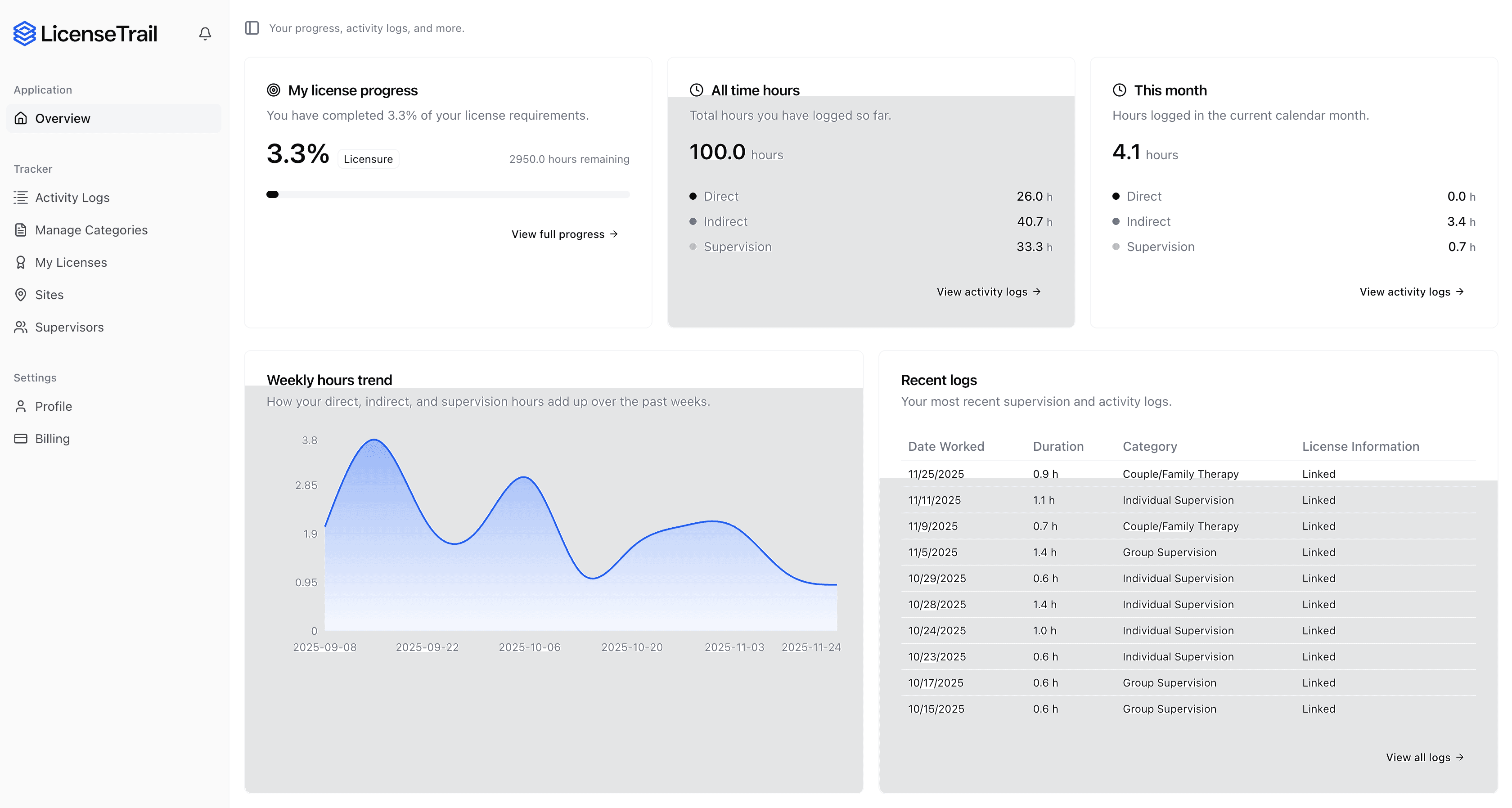
License Trail checks your direct, indirect, and supervision hours against Idaho LAMFT requirements continuously and flags mismatches before you submit.
 Start Tracking for Free
No credit card required · Free plan available
Is your spreadsheet hiding Idaho LAMFT risks?
Stop guessing if your categories match Idaho Licensing Board of Professional Counselors and Marriage and Family Therapists requirements. License Trail checks your direct, indirect, and supervision hours continuously and flags mismatches before you submit.
Import or log
Bring your spreadsheet or start fresh
Upload your existing tracking spreadsheet and we'll map every hour into the right Idaho Licensing Board of Professional Counselors and Marriage and Family Therapists categories automatically.
Verify against Idaho
Catch mismatches before the board does
License Trail checks your direct, indirect, and supervision hours against Idaho LAMFT requirements continuously.
Export board-ready
One-click clean reports
Generate professional, board-ready reports for supervision meetings and Idaho Licensing Board of Professional Counselors and Marriage and Family Therapists submissions in seconds.
No credit card required · Free plan available