
Iowa T-LMFT Requirements: Hours, Exams & Step-by-Step Guide
Stop guessing if your categories match Iowa requirements. License Trail checks your direct, indirect, and supervision hours against T-LMFT requirements continuously and flags mismatches before you submit.
No credit card required · Free plan available
Quick Requirements Overview
- Eligibility: Meets all LMFT requirements except post‑graduate supervised clinical experience; practice is under supervision only
- Education: Master’s/doctoral degree; COAMFTE MFT transcript or non‑COAMFTE degree + CCE content‑equivalency evaluation (official docs sent directly)
- Exam: Pass AMFTRB MFT Exam (required before temporary license issuance)
- Pre‑license: Submit supervision plan to the Board prior to licensure
- License term: Valid 3 years; renewable at Board discretion
- Practice limits: Only in agency/group practice with oversight and ≥1 independently licensed mental health provider; no solo practice / not solely with other temporary licensees
- Supervised experience (post‑grad): Minimum 2 years; 3,000 total hours incl. 1,500 direct client hours
- Supervision hours: 110 direct supervision hours incl. 24 live/recorded observation; ≤50 hours group supervision; supervision continues until full license issued
License Details
Procedures
In Iowa, the Temporary Licensed Marital and Family Therapist (T‑LMFT) credential is designed for graduates who have met all educational and exam requirements for full licensure but have not yet completed the required supervised clinical experience. The temporary license lets you practice under supervision while you accrue those hours.
Below is a step‑by‑step outline of what the Iowa Board of Behavioral Science (through the Department of Inspections, Appeals & Licensing, DIAL) requires, with the Board’s own terminology and hour counts.
1. What “temporary licensed marital and family therapist” means in Iowa
The Iowa Code defines:
- “Temporary license” as a license to practice marital and family therapy or mental health counseling “under direct supervision of a qualified supervisor … to fulfill the postgraduate supervised clinical experience requirement.” (law.justia.com)
- “Temporary licensed marital and family therapist” as “a person licensed to practice marital and family therapy under supervision in accordance with section 154D.7.” (law.justia.com)
Iowa Code § 154D.7 adds that anyone who has fulfilled all requirements for licensure under § 154D.2, “except for having completed the postgraduate supervised clinical experience requirement,” may apply for a temporary license. The license:
- Is designated “temporary license in marital and family therapy”
- Authorizes practice “under the supervision of a qualified supervisor”
- Is valid for three years and may be renewed at the discretion of the board (codes.findlaw.com)
2. Educational requirement for a T‑LMFT
You must already meet the degree requirement for full LMFT licensure before a temporary license will be issued.
The Board’s licensure rule states that no application is considered until the Board has official transcripts or a CCE equivalency evaluation. For marital and family therapists, the documentation of education must be one of: (law.cornell.edu)
- COAMFTE‑accredited MFT program
- An official transcript verifying completion of a marital and family therapy program accredited by the Commission on Accreditation for Marriage and Family Therapy Education (COAMFTE); or
- Content‑equivalent non‑COAMFTE program
- An equivalency evaluation of the applicant’s educational credentials completed by the Center for Credentialing and Education (CCE).
DIAL’s application page restates this:
- Educational requirement – Official transcripts conferring a master’s or doctoral degree sent directly from the institution, either from:
- A COAMFTE‑accredited MFT program (degree in marital and family therapy), or
- A non‑COAMFTE program in mental health, behavioral science, or a counseling‑related field, from a regionally accredited institution, plus a CCE content‑equivalency evaluation showing the degree is equivalent to a graduate degree in marital and family therapy. (dial.iowa.gov)
3. Examination requirement
Iowa requires the Association of Marital and Family Therapy Regulatory Boards (AMFTRB) Examination in Marital and Family Therapy.
- Rule 645‑31.3 states that, to qualify for a marital and family therapist license, the applicant will take and pass “the Association of Marital and Family Therapy Regulatory Boards (AMFTRB) Examination in Marital and Family Therapy.” (rules.iowa.gov)
The temporary license is only issued after you have passed this exam; the DIAL T‑LMFT application page lists:
- Examination Requirement – Proof of passing the AMFTRB Examination in Marital and Family Therapy. (dial.iowa.gov)
4. Supervision plan requirement (before the T‑LMFT is issued)
For temporary licensure, the Board requires a supervision plan before it will issue the license.
Rule 645‑31.2 provides: (law.cornell.edu)
- “The applicant for temporary licensure must submit a supervision plan to the board prior to licensure.”
- Within 30 days of completing the supervised clinical experience, the attestation forms must be submitted.
- “The temporary licensee shall remain under supervision until a permanent license is issued.”
- “A temporary license is only valid for the purpose of fulfilling the postgraduate supervised clinical experience requirement. It is valid for three years and may be renewed at the discretion of the board.”
DIAL operationalizes this as:
- Supervision Requirement – Completed supervision plan form, with the note that a list of approved behavioral health supervisors is available from the department. (dial.iowa.gov)
5. Practice setting limits for T‑LMFTs
Iowa’s rule on temporary licensees tightly restricts how you may practice while you hold a T‑LMFT:
- “A temporary licensee shall engage only in the practice of marital and family therapy or mental health counseling as part of an agency or group practice with oversight over the temporary licensee.”
- The agency or group practice must have at least one independently licensed mental health provider.
- A temporary licensee may not practice as a solo practitioner or solely with other temporary licensees. (law.cornell.edu)
This means that, even though you can bill services (through a supervisor/agency), you cannot set up a solo practice or work only with peers who are also temporary licensees.
6. The supervised clinical experience you must complete while T‑LMFT
The core “hours” requirement comes from the Board’s supervised clinical experience rule, 645‑31.7. This rule applies to both mental health counselors and marital and family therapists.
6.1 Timing and duration
Rule 645‑31.7(1) states that the supervised clinical experience must: (law.cornell.edu)
- Not begin until after all graduate coursework is completed (except the thesis).
- Be for a minimum of two years.
This is a post‑graduate supervised experience; hours from your practicum or internship do not count toward the post‑degree requirement.
6.2 Total hours and direct client hours
The same rule sets precise hour minimums:
- Minimum number of hours:
- “The supervised clinical experience must consist of at least 3,000 hours of practice.”
- Minimum number of direct client hours:
- “The supervised clinical experience will consist of at least 1,500 hours of direct client contact.” (law.cornell.edu)
So, under the current rule:
- You must complete 3,000 total hours of supervised practice.
- Of those, at least 1,500 hours must be direct client contact (face‑to‑face or equivalent therapeutic work with clients).
- The remaining up to 1,500 hours can be other qualifying practice activities (e.g., case documentation, consultations, treatment planning) as allowed by the rule’s description of content (see below).
Earlier Iowa rules required 3,000 hours with 1,500 direct and 200 supervision hours; that older language has now been replaced by the 3,000/1,500/110 structure in 645‑31.7 and corresponding joint rules. (ecpc-personnel-standards.dev.i3.uconn.edu)
6.3 Supervision hours
The same rule defines the supervision hour minimums:
- Minimum direct supervision hours:
- The supervised experience must include “at least 110 hours of direct supervision equitably distributed throughout the supervised clinical experience, including at least 24 hours of live or recorded direct observation of client interaction.”
- No more than 50 hours of this supervision may be group supervision.
- Direct supervision can occur in person or via videoconferencing.
- After the 110 hours are complete, ongoing direct supervision must continue for the remainder of the supervised experience. (law.cornell.edu)
So, in concrete terms, the current Board‑defined minimums you must complete (typically while holding a T‑LMFT) are:
- 3,000 hours of supervised clinical practice, including:
- 1,500 hours of direct client contact, and
- At least 110 hours of direct supervision, of which:
- 24 hours must involve live or recorded direct observation of your client work, and
- Up to 50 hours may be group supervision.
6.4 Content of the supervised experience
Rule 645‑31.7 also spells out what the supervised experience must involve:
- Performing psychosocial assessments
- Diagnostic practice using the current DSM‑5‑TR
- Providing treatment, including
- Establishing treatment goals
- Using evidence‑based therapeutic modalities
- Differential treatment planning
- Preparing the supervisee for independent practice, including training on:
- Practice management
- Ethical standards
- Legal and regulatory requirements
- Documentation
- Coordination of care
- Self‑care (law.cornell.edu)
7. Supervisor qualifications and limits
The Board’s rule also defines who may supervise your T‑LMFT hours and under what conditions.
Under 645‑31.7(2): (law.cornell.edu)
A supervisor must:
- Hold an active license as an independent level social worker, mental health counselor, or marital and family therapist in Iowa.
- Have a minimum of three years of independent practice.
- Have completed at least a six‑hour continuing education course in supervision or one graduate‑level course in supervision.
- Be knowledgeable of the ethical code and licensing rules governing the supervisee.
Other supervision structure requirements:
- You may have no more than four supervisors at any given time, and you must notify each supervisor if another supervisor is also being used.
- Each supervisor must ensure they are not supervising more supervisees than they can safely and competently oversee. (law.cornell.edu)
8. Step‑by‑step path to T‑LMFT and full LMFT
Putting the statutory and rule language into sequence:
-
Complete an appropriate graduate degree
- Master’s or doctoral degree in marital and family therapy (COAMFTE) or a related mental health/counseling degree deemed content‑equivalent via CCE. (law.cornell.edu)
-
Pass the AMFTRB exam
- Obtain proof of passing the AMFTRB Examination in Marital and Family Therapy. (rules.iowa.gov)
-
Secure a qualified supervisor and complete a supervision plan
- Choose a supervisor who meets the independent‑practice and supervision‑training requirements.
- Complete the Board’s supervision plan form and submit it to the Board/DIAL before applying for the temporary license. (law.cornell.edu)
-
Apply for the T‑LMFT (temporary license)
- Submit an online application and fee.
- Have your official transcripts and, if needed, CCE evaluation sent directly to the Board.
- Attach proof of passing the AMFTRB exam and your completed supervision plan form. (dial.iowa.gov)
-
Practice under your T‑LMFT within an approved setting
- Work only within an agency or group practice that has at least one independently licensed mental health provider.
- Do not practice as a solo practitioner or solely with other temporary licensees. (law.cornell.edu)
-
Accumulate the Board‑required supervised clinical experience
- Over at least two years, complete:
- 3,000 hours of supervised practice, including
- 1,500 hours of direct client contact, and
- At least 110 hours of direct supervision, including
- 24 hours of direct observation (live or recorded). (law.cornell.edu)
- 3,000 hours of supervised practice, including
- Over at least two years, complete:
-
Convert to full LMFT licensure
- When the supervised experience is complete, your supervisor(s) must submit the attestation of completed supervised experience to the Board within 30 days.
- You then apply for permanent LMFT licensure, attaching supervision attestations (or, if applicable, proof of AAMFT clinical membership, which Iowa accepts as verification of meeting education and experience requirements). (law.cornell.edu)
9. Quick hour summary (current rule)
For clarity, this is the structure of hours the Iowa Board requires for a T‑LMFT on the path to full LMFT:
- Post‑graduate supervised clinical experience (must be completed after graduation, typically while holding a T‑LMFT):
- Total practice hours: at least 3,000 hours of practice
- Direct client hours: at least 1,500 hours of direct client contact
- Supervision hours: at least 110 hours of direct supervision, including
- 24 hours of live or recorded observation of client interaction, and
- No more than 50 hours counted as group supervision
All of this must be spread across a minimum of two years and completed under a supervisor who meets Board standards, in an approved agency or group‑practice setting. (law.cornell.edu)
Track your T-LMFT hours with confidence
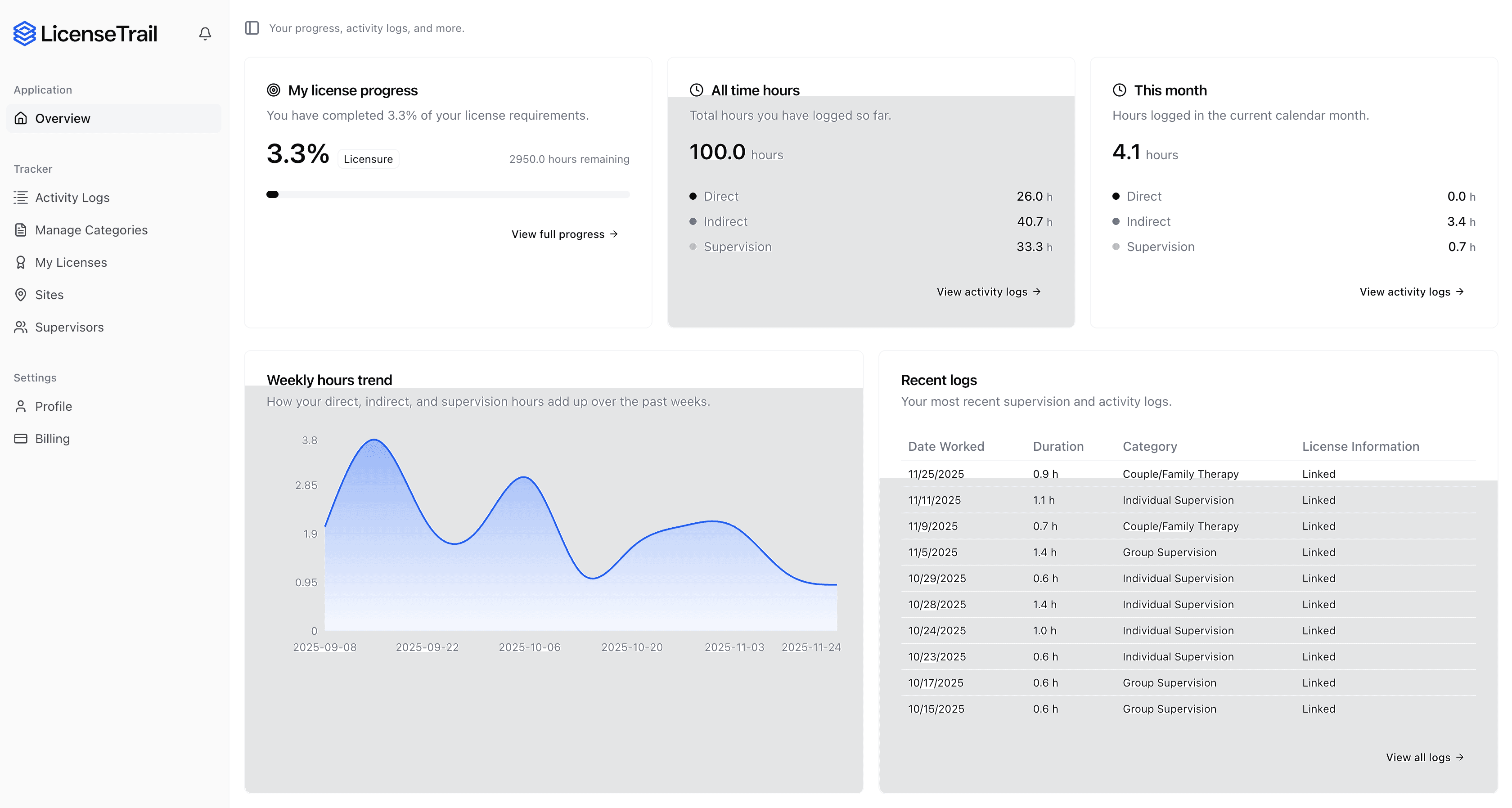
License Trail checks your direct, indirect, and supervision hours against Iowa T-LMFT requirements continuously and flags mismatches before you submit.
 Start Tracking for Free
No credit card required · Free plan available
Is your spreadsheet hiding Iowa T-LMFT risks?
Stop guessing if your categories match Iowa Board of Behavioral Science requirements. License Trail checks your direct, indirect, and supervision hours continuously and flags mismatches before you submit.
Import or log
Bring your spreadsheet or start fresh
Upload your existing tracking spreadsheet and we'll map every hour into the right Iowa Board of Behavioral Science categories automatically.
Verify against Iowa
Catch mismatches before the board does
License Trail checks your direct, indirect, and supervision hours against Iowa T-LMFT requirements continuously.
Export board-ready
One-click clean reports
Generate professional, board-ready reports for supervision meetings and Iowa Board of Behavioral Science submissions in seconds.
No credit card required · Free plan available