
Iowa T-LMHC Requirements: Hours, Exams & Step-by-Step Guide
Stop guessing if your categories match Iowa requirements. License Trail checks your direct, indirect, and supervision hours against T-LMHC requirements continuously and flags mismatches before you submit.
No credit card required · Free plan available
Quick Requirements Overview
- Temporary T‑LMHC = practice only under direct supervision while completing post‑graduate supervised clinical experience (not independent practice).
- Prereqs before T‑LMHC: Master’s/doctoral in MHC/equivalent; CACREP or CCE content equivalency if non‑CACREP; 45 hrs (pre‑7/1/2012 start) or 60 hrs (on/after 7/1/2012 start).
- Exam for T‑LMHC: NCE or NCMHCE (NBCC scores sent directly to Board); NCMHCE ultimately required for permanent LMHC.
- Application: online via DIAL + $120 fee; transcripts/evaluation and exam scores sent directly; out‑of‑state license verifications if applicable; application active 2 years.
- Practice setting limits: must be in an agency/group practice with oversight and an independently licensed provider; no solo practice and not only with other temporary licensees.
- Temporary license term: valid 3 years, renewable at Board discretion; supervision required until permanent LMHC issued.
- Supervised experience minimums for full LMHC: 2 years, 3,000 total practice hrs, 1,500 direct client contact hrs, plus 110 direct supervision hrs (max 50 group; supervision separate from practice hours).
- Supervisor qualifications/limits: Iowa independent license (LISW/LMHC/LMFT), 3 years independent practice, 6‑hr supervision CE or grad course; max 4 supervisors at one time.
License Details
Procedures
Iowa’s “T‑LMHC” is the state’s temporary mental health counselor license. It allows you to practice under supervision while you complete the post‑graduate supervised clinical experience required for full LMHC licensure.
Below is a structured overview of what the Iowa Board of Behavioral Science / Board of Behavioral Health Professionals requires, with emphasis on the hours and the Board’s own terminology.
1. What a T‑LMHC / Temporary Mental Health Counselor License Is
Under Iowa Code §154D.7, a temporary license is available to any person who has met all requirements for licensure except the postgraduate supervised clinical experience. The statute says such a person “may apply to the board for a temporary license” which authorizes practice “under the supervision of a qualified supervisor as determined by the board by rule.” (legis.iowa.gov)
The Board’s rules define a “temporary license” (for MFTs and MHCs) as a license to practice under direct supervision of a qualified supervisor “to fulfill the postgraduate supervised clinical experience requirement.” (rules.iowa.gov)
Key points:
- You must already meet the education and exam requirements for licensure.
- The temporary license exists only so you can complete the required supervised clinical experience hours.
- You must remain under supervision until a permanent license is issued. (rules.iowa.gov)
2. Baseline Eligibility Before You Can Get a T‑LMHC
2.1 Education
The Board requires an official transcript showing a master’s or doctoral degree in mental health counseling (or equivalent) from a regionally accredited institution: (dial.iowa.gov)
-
CACREP‑accredited programs
- Degree must be in mental health counseling.
- Transcript must show school seal, degree earned, and date of graduation.
- Transcript must be sent directly from the institution to the Board.
-
Non‑CACREP programs
- Degree must have an emphasis in mental health counseling.
- You must obtain a content equivalency evaluation from the Center for Credentialing and Education (CCE); the report goes to the Board. (dial.iowa.gov)
-
Credit‑hour minimums
- If you started your program before July 1, 2012: at least 45 semester hours (or equivalent quarter hours).
- If you started on or after July 1, 2012: at least 60 semester hours. (dial.iowa.gov)
2.2 Examination
For a temporary mental health counselor license, Iowa requires proof that you have passed either: (dial.iowa.gov)
- The National Counselor Examination (NCE), or
- The National Clinical Mental Health Counselor Examination (NCMHCE),
both administered by the National Board for Certified Counselors (NBCC).
Exam scores must be sent directly from NBCC to the Board. (dial.iowa.gov)
Note: A Board rule change specifies that, for the permanent mental health counselor license, the NCMHCE is the required exam as of January 1, 2022. The Board still accepts either exam when you apply for the temporary license, but you will ultimately need the NCMHCE for full LMHC licensure. (dial.iowa.gov)
3. How to Apply for the Temporary License (T‑LMHC)
You apply through the Iowa Department of Inspections, Appeals, & Licensing (DIAL), which houses the Iowa Board of Behavioral Science / Board of Behavioral Health Professionals:
- Submit an online application for a Mental Health Counselor Temporary License via the professional licensure portal.
- Pay the application fee – currently $120, non‑refundable. (dial.iowa.gov)
- Arrange for transcripts to be sent directly from your school (or CCE evaluation if non‑CACREP). (dial.iowa.gov)
- Have NBCC send your exam scores (NCE or NCMHCE) directly to the Board. (dial.iowa.gov)
- If you were licensed in another state, provide license verification for each state and meet the relevant endorsement rules. (dial.iowa.gov)
The general licensure rule states that an application for temporary or permanent licensure is considered active for two years from the date received; after that, incomplete applications are destroyed and you must reapply and repay fees. (rules.iowa.gov)
4. What You Can (and Cannot) Do Under a T‑LMHC
Board rules and supervision documents emphasize that temporary licensees must not practice independently:
- A temporary licensee “shall engage only in the practice of … mental health counseling as part of an agency or group practice with oversight over the temporary licensee.” (rules.iowa.gov)
- The agency or group practice must include at least one independently licensed mental health provider.
- “A temporary licensee shall not practice as a solo practitioner or solely with other temporary licensees.” (rules.iowa.gov)
- The Board’s current supervision form reiterates: “Supervisees are not permitted to operate their own private practice or to operate a group practice consisting solely of supervisees.” (dial.iowa.gov)
In short: you must work under recognized supervision in an established practice setting, not in your own independent practice.
5. How Long the Temporary License Lasts
Under the Board’s licensure rule:
- A temporary license is only valid “for the purpose of fulfilling the postgraduate supervised clinical experience requirement.”
- It is valid for three years and may be renewed at the discretion of the board. (rules.iowa.gov)
- You must remain under supervision until the permanent license is issued. (rules.iowa.gov)
6. The Supervised Clinical Experience You Must Complete
The entire purpose of the T‑LMHC is to allow you to complete the supervised clinical experience required by Iowa Code §154D.2 (at least two years of supervised clinical experience) and detailed in Board rules. (legis.iowa.gov)
6.1 Overall Structure and Timing
Under the Board’s joint supervision rules (now codified for mental health counselors, MFTs, and independent social workers), the supervised clinical experience must meet all of the following minimum requirements: (rules.iowa.gov)
-
Timing
- Supervision cannot begin until after all graduate coursework is completed, except possibly the thesis.
-
Duration
- At least two years of supervised clinical experience (minimum two calendar years).
-
Total practice hours
- At least 3,000 hours of total practice.
-
Direct client contact hours
- At least 1,500 hours of direct client contact.
-
Direct supervision hours
- At least 110 hours of direct supervision, equitably distributed throughout the supervised clinical experience.
- Up to 50 of those 110 hours may be group supervision; the rest must be individual.
- Direct supervision can occur in person or via videoconferencing. (rules.iowa.gov)
These are the core numbers the Board uses:
- 3,000 hours of total practice, including
- 1,500 hours of direct client contact, plus
- 110 hours of direct supervision.
6.2 Direct vs. Indirect Practice Hours
The Board’s Supervision Report form (revised October 2025) shows how they expect hours to be tracked: (dial.iowa.gov)
- Direct client contact hours – hours in which you are providing mental health services directly to clients (in person or via telehealth).
- Indirect practice hours – other clinical work such as documentation, treatment planning, collateral contacts, case consultation, team meetings, training directly related to client care, etc.
- Total practice hours = direct client contact hours + indirect practice hours.
- Supervision hours (individual and group) are tracked separately and do not substitute for the 3,000 practice hours.
In practical terms:
- You must accumulate at least 1,500 hours of direct client contact.
- The remaining up to 1,500 hours of the 3,000 may be indirect practice so long as it is part of your supervised clinical experience.
- In addition, you must complete at least 110 hours of direct supervision (documented separately).
6.3 Content of the Supervised Experience
The joint supervision rule specifies the type of work your supervised practice must involve. The supervised clinical experience must: (rules.iowa.gov)
- Involve psychosocial assessments and diagnostic practice using the current DSM.
- Include providing treatment, such as:
- Establishing treatment goals,
- Providing psychosocial therapy using evidence‑based modalities,
- Developing differential treatment plans.
- Prepare you for independent practice, including training on:
- Practice management,
- Ethical standards,
- Legal and regulatory requirements,
- Documentation,
- Coordination of care,
- Self‑care.
This content standard applies to the hours you complete under your T‑LMHC.
7. Requirements for Supervisors and Supervision Structure
Under the joint rule for supervised clinical experience, a supervisor must: (rules.iowa.gov)
- Hold an active license as an:
- Independent level social worker, mental health counselor, or marital and family therapist in Iowa.
- Have at least three years of independent practice.
- Have completed either:
- At least a six‑hour continuing education course in supervision, or
- One graduate‑level course in supervision.
- Be knowledgeable about the ethical code and licensing rules governing you as the supervisee.
Structure limitations:
- You may have no more than four supervisors at any one time. (rules.iowa.gov)
- Supervisors must ensure they are not supervising more supervisees than they can supervise safely and competently. (rules.iowa.gov)
Your supervision arrangement must also comply with the rule that temporary licensees work in an agency or group practice with oversight and not in solo practice. (rules.iowa.gov)
8. Moving from T‑LMHC to Full LMHC Licensure
Once you have:
- Completed at least 3,000 hours of total practice, including
- 1,500 hours of direct client contact, plus
- 110 hours of direct supervision over at least two years, (rules.iowa.gov)
- Met the content requirements for the supervised experience, and
- Passed the NCMHCE (if you had not already),
your supervisor(s) will complete the Supervision Report form documenting your hours and attesting to your competence and readiness for independent practice. (dial.iowa.gov)
You then:
- Apply for the permanent Mental Health Counselor license via DIAL’s portal (a separate application from the temporary license). (dial.iowa.gov)
- Ensure the Board has:
- Your official transcripts,
- Your exam scores (NCMHCE for permanent LMHC),
- Your completed supervision documentation.
Only after the Board approves your application and issues a permanent LMHC license may you stop practicing under supervision.
Summary of the Key Hour Requirements for Iowa T‑LMHCs
While holding a T‑LMHC (temporary mental health counselor license) in Iowa, you are expected to complete, at minimum:
- 3,000 hours of supervised clinical practice,
- including 1,500 hours of direct client contact, and
- up to 1,500 hours of indirect practice, and
- 110 hours of direct supervision, with no more than 50 of those hours in group supervision,
- over at least two years of supervised practice,
- all while practicing under a qualified supervisor in an agency or group practice, not independently. (rules.iowa.gov)
Those are the core, Board‑defined hour and structure requirements you must satisfy in order to transition from a T‑LMHC to a fully licensed mental health counselor in Iowa.
Track your T-LMHC hours with confidence
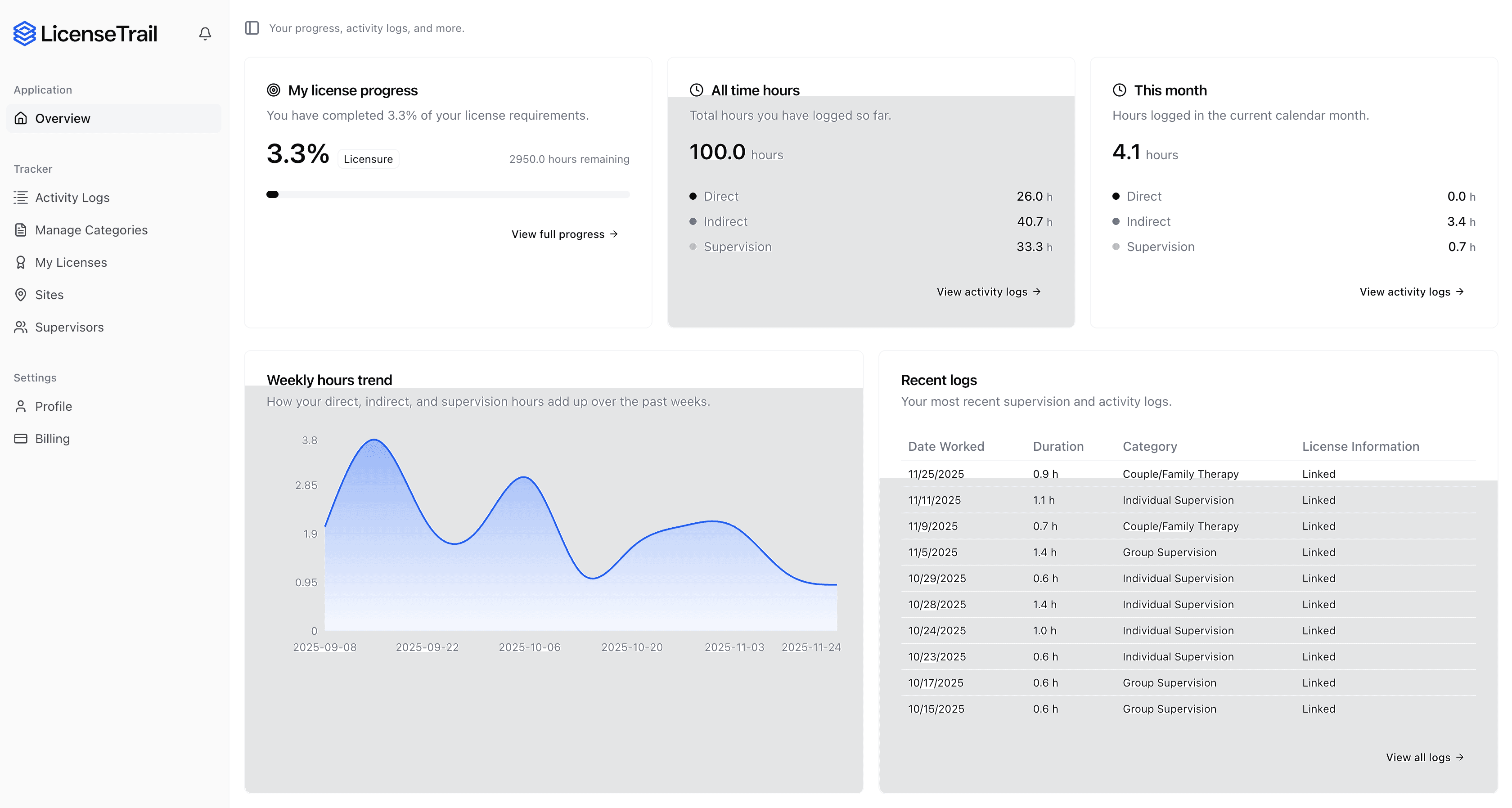
License Trail checks your direct, indirect, and supervision hours against Iowa T-LMHC requirements continuously and flags mismatches before you submit.
 Start Tracking for Free
No credit card required · Free plan available
Is your spreadsheet hiding Iowa T-LMHC risks?
Stop guessing if your categories match Iowa Board of Behavioral Science requirements. License Trail checks your direct, indirect, and supervision hours continuously and flags mismatches before you submit.
Import or log
Bring your spreadsheet or start fresh
Upload your existing tracking spreadsheet and we'll map every hour into the right Iowa Board of Behavioral Science categories automatically.
Verify against Iowa
Catch mismatches before the board does
License Trail checks your direct, indirect, and supervision hours against Iowa T-LMHC requirements continuously.
Export board-ready
One-click clean reports
Generate professional, board-ready reports for supervision meetings and Iowa Board of Behavioral Science submissions in seconds.
No credit card required · Free plan available