
Minnesota Alcohol and Drug Counseling - Temporary Permit Requirements: Hours, Exams & Step-by-Step Guide
Stop guessing if your categories match Minnesota requirements. License Trail checks your direct, indirect, and supervision hours against Alcohol and Drug Counseling - Temporary Permit requirements continuously and flags mismatches before you submit.
No credit card required · Free plan available
Quick Requirements Overview
- Credential (MN): Alcohol and Drug Counselor–Trainee (ADC‑T) temporary permit issued by MN BBHT (Minn. Stat. §148F.035)
- Education minimum (to get ADC‑T): Associate degree or 60 semester credits (accredited program)
- Required A&D coursework (to get ADC‑T): 18 semester credits or 270 clock hours in statutorily defined content areas (incl. core functions)
- Required practicum (to get ADC‑T): 880 clock hours of supervised alcohol & drug counseling practicum/internship (documented via official school record)
- Practice rules (ADC‑T): Must practice under supervision of an MN LADC or other qualifying licensed professional; in licensed treatment settings supervision must be weekly and documented
- Title/use & compliance: Must use “ADC‑T/Alcohol and Drug Counselor‑Trainee”; subject to LADC statutes/rules (CE not required while on temp permit)
- Application/admin: Apply + fee; official transcripts sent directly to BBHT verifying degree/credits, 270 hrs/18 credits, and 880‑hr practicum; supervisor affirmation required once supervised practice begins
- Duration/renewal limits: Renew annually; renewable no more than 5 times (max ~6 years total); terminates if not renewed, supervision changes (until updated), or LADC application granted/denied
License Details
Procedures
In Minnesota, the Alcohol and Drug Counselor–Trainee (ADC‑T) temporary permit is the credential that allows you to practice alcohol and drug counseling while you finish the requirements for full Licensed Alcohol and Drug Counselor (LADC) licensure. It is issued by the Minnesota Board of Behavioral Health and Therapy (BBHT) under Minnesota Statutes §148F.035.(revisor.mn.gov)
Below is a structured guide to the requirements, with emphasis on the types and amounts of hours Minnesota specifies.
1. Core eligibility for the ADC‑T temporary permit
Minnesota law and the BBHT require that, before you can receive an ADC‑T temporary permit, you must already have all of the following:
1.1 Academic degree
- Degree level: At least an associate degree
- Equivalent option: Or “an equivalent number of credit hours”, which the Board operationalizes as 60 semester credits from an accredited school or educational program. (revisor.mn.gov)
1.2 Alcohol and drug counseling coursework hours
You must document:
- 18 semester credits, or 270 clock hours, of academic coursework in alcohol and drug counseling. (revisor.mn.gov)
The coursework must come from an accredited school or educational program and must cover specific content areas defined in statute and summarized by the Board:
Required content areas (paraphrased from statute and Board guidance):(revisor.mn.gov)
-
Foundations of alcohol and drug counseling
- Theories of chemical dependency
- The continuum of care
- The process of change
-
Pharmacology and the dynamics of addiction
- Pharmacology of substance use disorders
- Dynamics of addiction
- Medication‑assisted treatment / medications for opioid use disorder
-
Professional and ethical responsibilities
-
Multicultural aspects of chemical dependency
-
Co‑occurring disorders
-
The “core functions” of alcohol and drug counseling as defined in Minnesota Statutes §148F.01, subdivision 10 (screening, intake, assessment, treatment planning, counseling, case management, crisis intervention, client education, referral, reports and record keeping, and consultation with other professionals). (revisor.mn.gov)
In other words: Minnesota does not just count a raw number of class hours; the 270 clock hours / 18 credits must clearly map onto these statutory content areas.
1.3 Practicum / internship hours
You must complete a substantial, supervised practicum before you can obtain the temporary permit:
- Practicum requirement:
- 880 clock hours of supervised alcohol and drug counseling practicum (sometimes described as “880‑hour alcohol and drug counseling practicum/internship”). (revisor.mn.gov)
Key points about these hours:
- They must be in alcohol and drug counseling, not just general human services.
- They must be documented on an official transcript or similar official school record sent directly from the accredited program to BBHT.(mn.gov)
- They are counted as “clock hours” (actual hours of practicum work), not credit hours.
There is no additional numeric “field experience” requirement (for example, “1,500 hours of direct experience”) to qualify for the temporary permit itself beyond this 880‑hour practicum requirement.
2. Supervision requirements while practicing under a temporary permit
Once the Board issues the ADC‑T temporary permit, you are allowed to practice alcohol and drug counseling only under supervision.
2.1 Who can supervise you
Statute and the Board specify that an ADC‑T must:(revisor.mn.gov)
- Be supervised by a Minnesota Licensed Alcohol and Drug Counselor (LADC)
or - Be supervised by “another licensed professional practicing alcohol and drug counseling under Minnesota Statutes section 148F.11” (these are professionals whose primary license is in another discipline but who are allowed to perform alcohol and drug counseling under specific statutory exceptions).
2.2 Nature and documentation of supervision in practice settings
When you are working in a licensed substance use disorder treatment program, Minnesota’s treatment licensing statutes add more detail. Under Minn. Stat. §245G.11, subdivision 11, an individual with a temporary permit:
- Must be supervised by an LADC or by a board‑approved clinical supervisor.
- The supervising LADC or clinical supervisor must document the amount and type of supervision on at least a weekly basis, and this supervision must relate to your clinical practice. (revisor.mn.gov)
This statute does not set a numeric total (e.g., “X hours of supervision per year”) for temporary permit holders. Instead, it focuses on ongoing, clinically relevant, weekly‑documented supervision.
2.3 Title and scope of practice under the permit
While you hold the temporary permit:
- You must use the professional title “Alcohol and Drug Counselor‑Trainee” or the letters “ADC‑T” in your professional activities.(revisor.mn.gov)
- You are subject to the same statutes and rules as a fully licensed LADC, except that you are not subject to continuing education requirements while on the temporary permit.(revisor.mn.gov)
In licensed treatment programs, individuals with a temporary permit are explicitly allowed to:(revisor.mn.gov)
- Provide substance use disorder treatment services; and
- Complete comprehensive assessments, individual treatment plans, treatment plan reviews, and discharge summaries, as long as the required supervision conditions are met.
3. How supervised professional practice hours fit in (for later full licensure)
The ADC‑T permit itself does not require additional practice hours beyond the 880‑hour practicum. However, if you intend to move from ADC‑T to full LADC licensure, you need to understand how Minnesota defines postdegree supervised professional practice and its hour requirements.
Under Minn. Stat. §148F.025 (Requirements for Licensure) and §148F.04 (Supervised Postdegree Professional Practice):(revisor.mn.gov)
3.1 Education and practicum for licensure (already satisfied or in progress)
To become an LADC, you ultimately need:
- A bachelor’s or master’s degree from an accredited program; and
- The same 18 semester credits / 270 clock hours of coursework and 880 clock hours of supervised alcohol and drug counseling practicum described above (these do not have to be part of the bachelor’s degree).(revisor.mn.gov)
Many people obtain the ADC‑T permit after completing an associate degree and the required practicum, then complete the bachelor’s degree and exam/experience requirements while working under supervision.
3.2 Option that uses postdegree supervised hours
For one of the exam pathways to licensure, statute allows this combination:(revisor.mn.gov)
- Pass a written examination approved by the Board, and
- Complete 2,000 hours of postdegree supervised professional practice, under §148F.04.
How Minnesota defines and structures those hours:
- “Postdegree professional practice” is paid or volunteer work after graduation from the qualifying degree, involving professional oversight by an approved supervisor.(revisor.mn.gov)
- You must complete 2,000 hours of supervised professional practice.
- Supervision must occur at a rate of 1 hour of supervision for every 40 hours of professional practice, for a total of 50 hours of supervision.(revisor.mn.gov)
- At least 75% of those 50 supervision hours must be in person; the remaining up to 25% may be by phone or audio/video.(revisor.mn.gov)
- At least 50% of supervision hours must be individual; up to 50% may be in a group format.(revisor.mn.gov)
- The supervised practice must be completed in no fewer than 12 consecutive months and no more than 36 consecutive months.(revisor.mn.gov)
These 2,000 hours of supervised professional practice (plus 50 hours of supervision) are licensure requirements, not preconditions for the temporary permit. But in practice, many ADC‑T holders accumulate these hours while working under their permit.
4. Application process and documentation for the ADC‑T permit
The BBHT’s “Apply for a Temporary Permit” page lays out practical steps. In brief:(mn.gov)
4.1 Submit the application and fee
- Complete the Temporary Permit Application form (downloaded from the Board’s site).
- Submit the application with the non‑refundable application fee (currently listed as $100 for the initial temporary permit).(mn.gov)
- You may submit by mail or in person to:
- 335 Randolph Avenue, Suite 290, St. Paul, MN 55102.
4.2 Have your school send official transcripts
You must arrange for an official transcript to be sent directly from your accredited school to the Board (by mail or secure certified PDF), verifying:
- Your associate degree (or 60 semester credits equivalent);
- Your 270 clock hours / 18 semester credits of alcohol and drug counseling coursework; and
- Your 880‑hour alcohol and drug counseling practicum/internship. (mn.gov)
The Board will not process your application without this documentation.
4.3 Supervisor affirmation (after the permit is issued)
Once you have an employer and supervisor:
- You and your supervisor must complete the Temporary Permit Applicant and Supervisor Affirmation form, and later use the ADC‑T Change/Add Supervisor Application Form any time your supervision arrangement changes.(mn.gov)
5. Duration, renewal, and limits of the ADC‑T permit
Minnesota sets clear limits on how long you can remain in temporary status.
Under Minn. Stat. §148F.035 and the Board’s renewal guidance:(revisor.mn.gov)
- The ADC‑T temporary permit must be renewed annually.
- You must file a renewal application each year with the required fee (currently $150 for renewal and an additional $37 for late renewal, if applicable).
- A temporary permit “may be renewed no more than five times.” This effectively caps ADC‑T status at six years total (original permit plus up to five renewals).
- The permit is automatically terminated if:
- It is not renewed;
- There is a change in supervision (until a new supervisor is properly documented); or
- The Board grants or denies your full LADC license application.(revisor.mn.gov)
6. Summary of key hour‑based requirements for Minnesota ADC‑T
For the temporary permit itself (ADC‑T):
- Coursework hours:
- 270 clock hours (18 semester credits) of specific alcohol and drug counseling coursework from an accredited school.
- Practicum hours:
- 880 clock hours of supervised alcohol and drug counseling practicum/internship.
- Supervision in practice:
- Must work under supervision of an LADC or qualifying licensed professional, with weekly, documented clinical supervision in licensed treatment settings; no fixed total number of supervised‑practice hours is imposed for the permit itself.(revisor.mn.gov)
For later full licensure as an LADC (if you choose the supervised‑practice‑plus‑exam path):
- Postdegree supervised practice:
- 2,000 hours of postdegree supervised professional practice.
- Supervision during those 2,000 hours:
- 1 hour of supervision per 40 hours of practice, for a total of 50 hours of supervision, with specific requirements for in‑person and individual vs. group supervision.(revisor.mn.gov)
Minnesota’s framework is therefore built around defined clock‑hour practicum and coursework plus, for full licensure, 2,000 hours of supervised professional practice, rather than a split like “1,500 hours direct experience and 1,500 hours supervised experience” for the temporary permit stage.
Track your Alcohol and Drug Counseling - Temporary Permit hours with confidence
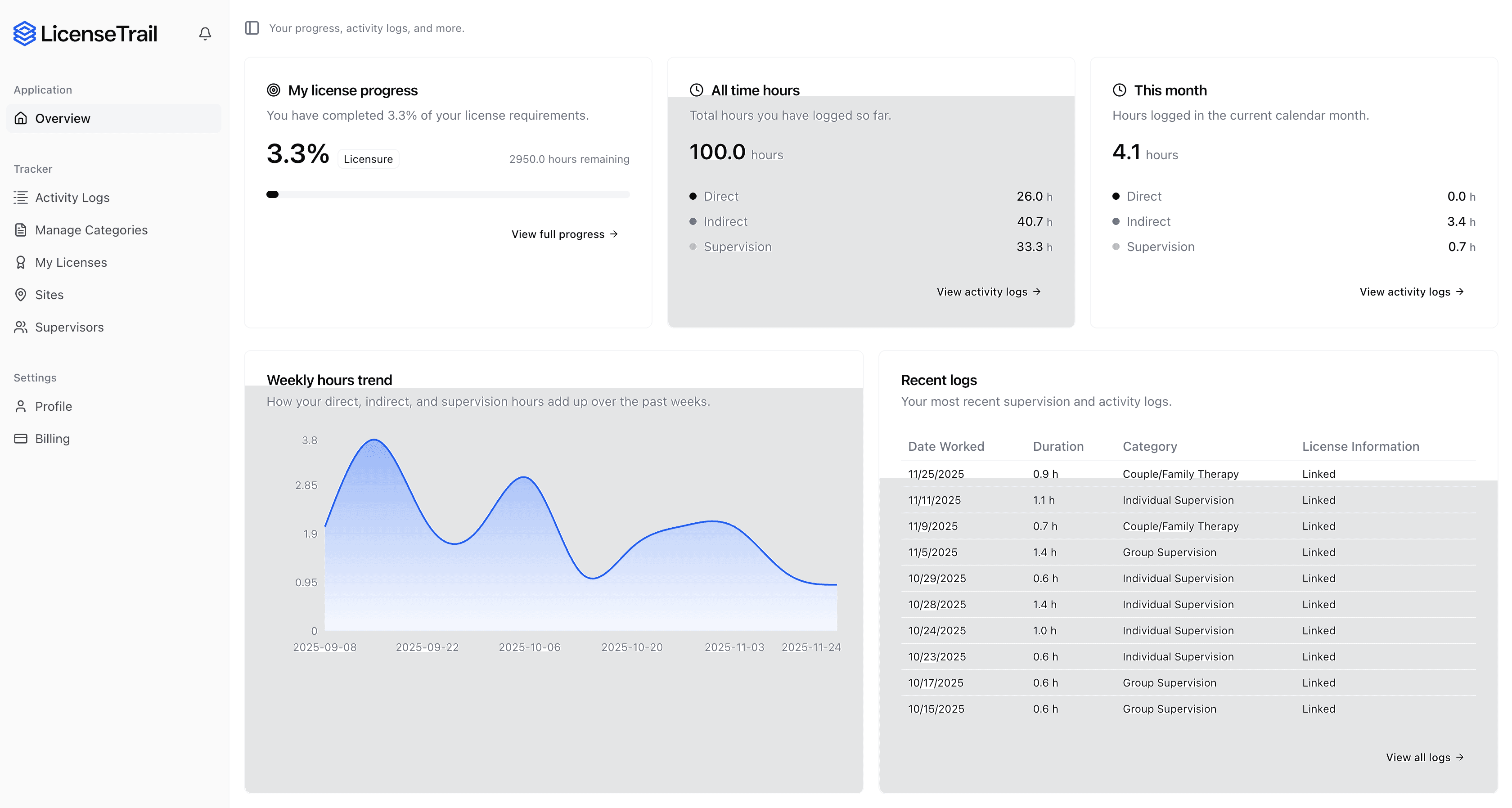
License Trail checks your direct, indirect, and supervision hours against Minnesota Alcohol and Drug Counseling - Temporary Permit requirements continuously and flags mismatches before you submit.
 Start Tracking for Free
No credit card required · Free plan available
Is your spreadsheet hiding Minnesota Alcohol and Drug Counseling - Temporary Permit risks?
Stop guessing if your categories match Minnesota Board of Behavioral Health and Therapy requirements. License Trail checks your direct, indirect, and supervision hours continuously and flags mismatches before you submit.
Import or log
Bring your spreadsheet or start fresh
Upload your existing tracking spreadsheet and we'll map every hour into the right Minnesota Board of Behavioral Health and Therapy categories automatically.
Verify against Minnesota
Catch mismatches before the board does
License Trail checks your direct, indirect, and supervision hours against Minnesota Alcohol and Drug Counseling - Temporary Permit requirements continuously.
Export board-ready
One-click clean reports
Generate professional, board-ready reports for supervision meetings and Minnesota Board of Behavioral Health and Therapy submissions in seconds.
No credit card required · Free plan available