
New-mexico LAMFT Requirements: Hours, Exams & Step-by-Step Guide
Stop guessing if your categories match New-mexico requirements. License Trail checks your direct, indirect, and supervision hours against LAMFT requirements continuously and flags mismatches before you submit.
No credit card required · Free plan available
Quick Requirements Overview
- Minimum age: 21+
- Education: Master’s/doctoral degree (MFT/counseling/related) + MFT core curriculum: 45 semester hrs (67.5 quarter hrs) incl. MFT studies 9, MFT therapy 9, human development 9, multicultural 3, professional/ethics 3
- Supervision arranged: Must have a Board‑approved clinical supervisor & postgraduate experience plan before/for practice
- Exam: Pass Board‑prescribed MFT exam
- Ethics: Sign/agree to follow Board Code of Ethics
- Supervision ratio (while LAMFT): 1 hour face‑to‑face supervision per 5 hours client contact (virtual allowed)
- Weekly cap: Supervised clinical client contact ≤ 40 hours/week
- Fees: $75 initial LAMFT application/licensure fee
License Details
Procedures
In New Mexico, the Licensed Associate Marriage and Family Therapist (LAMFT) credential is the supervised, post‑degree license you hold while you accumulate the experience needed for full Licensed Marriage and Family Therapist (LMFT) licensure.
New Mexico’s requirements are defined in statute (Chapter 61, Article 9A NMSA 1978) and in the New Mexico Administrative Code (NMAC), Title 16, Chapter 27. What follows walks through those requirements step by step, with emphasis on the specific hour requirements and the Board’s own wording.
1. How New Mexico Defines the LAMFT Role
The Counseling and Therapy Practice Board describes the LAMFT license this way:
“LAMFT is intended as a transition between the required degree and the completion of supervised training required for licensure as a marriage and family therapist. Work must be under appropriate clinical supervision… There is no time limit as a licensed associate marriage and family therapist, but all work at this level must be done under clinical supervision.” (law.cornell.edu)
Key implications:
- LAMFT is always supervised.
- There is no maximum number of years you can hold LAMFT status, but you cannot practice independently at this level.
- While you are LAMFT, you are working toward the postgraduate experience requirements for LMFT.
2. Baseline Legal Requirements for LAMFT Licensure
Under New Mexico statute and rule, to be licensed as an associate marriage and family therapist, you must provide evidence that you: (law.justia.com)
- Are at least 21 years of age.
- Hold an appropriate graduate degree.
- A master’s or doctoral degree with a focus in marriage and family therapy or counselor (or another counseling‑related field) from an accredited institution.
- You must meet the marriage and family therapy core curriculum defined by Board rule (see Section 3 below). (law.justia.com)
- Have arranged appropriate clinical supervision.
- Statute requires that you have “arranged for appropriate clinical supervision, as defined by rule, to meet the requirements for a licensed associate marriage and family therapist.” (law.justia.com)
- Pass the Board‑prescribed examination in your discipline. (law.justia.com)
- Agree to the Board’s Code of Ethics.
- You must sign a Board form stating that you have read the code of ethics and agree to be “bound and governed” by it, and statute requires that you “observe[] the code of ethics.” (law.cornell.edu)
The Board also charges an application fee of $75 for licensure; its fee schedule lists Licensed Associate Marriage and Family Therapist (LAMFT) initial licensure at $75. (rld.nm.gov)
3. Educational / Core Curriculum Requirements
New Mexico defines a marriage and family therapy core curriculum in rule. In summary, you must complete at least 45 semester hours (or 67.5 quarter hours) of graduate‑level coursework that “embraces a family systems perspective” and includes the following areas: (srca.nm.gov)
- Marriage and family studies – minimum 9 semester hours
- Marriage and family therapy – minimum 9 semester hours
- Human development – minimum 9 semester hours
- Multicultural studies – minimum 3 semester hours
- Professional studies (ethics, law, professional issues) – minimum 3 semester hours
These curriculum requirements are part of what you must “meet” to qualify for both LAMFT and, later, LMFT licensure.
4. Supervision and Hour Requirements at the LAMFT Level
4.1. Supervision‑to‑Client‑Contact Ratio
The central, explicit hour requirement that applies while you are licensed as LAMFT is a ratio requirement written directly into the LAMFT rule:
You must have:
“a postgraduate experience plan, which includes one hour of face‑to‑face supervision for every five hours of client contact.” (law.cornell.edu)
In practical terms:
- For every 5 hours of client contact, you must receive at least 1 hour of supervision.
- If you accrue 50 client‑contact hours in a period, you need 10 hours of supervision for those hours to comply.
- “Face‑to‑face” supervision can be in person or virtual; the Board’s supervisor rule notes that electronic and telephonic supervision is treated as subject to the same supervision requirements as in‑person supervision. (srca.nm.gov)
4.2. What Counts as “Client Contact” and “Supervision”
Board rules repeatedly use the term “clinical client contact” and “supervision” without giving a single‑sentence definition, but they make clear that:
- Client contact refers to clinical encounters with clients/families in “applied counseling settings” such as community agencies, hospitals, schools, or private practices. (srca.nm.gov)
- Supervision must be clinical supervision, focused on developing your skills and ensuring client welfare—not just administrative oversight. (srca.nm.gov)
The Board further caps how intensively you can accrue those hours:
- “Supervised clinical client contact hours shall not exceed 40 hours per week.” (srca.nm.gov)
So even if you have many opportunities to see clients, the Board will not recognize more than 40 supervised client‑contact hours in any given week.
4.3. Who May Supervise You
Under the Approved Supervisors rule, your supervisor must: (srca.nm.gov)
- Hold an independent license such as:
- LMFT, LPCC, LPAT, LADAC, LCSW, licensed psychologist, or psychiatrist (earlier LMFT rule also listed LPCC, LMFT, LPAT, psychologist, psychiatrist, LISW as “appropriate supervisors”) and
- Have completed required continuing education units in supervision and hold supervisor designation from the Board.
LAMFTs themselves are explicitly listed as “supervisees” under this rule. (srca.nm.gov)
Supervisors must:
- Meet regularly with you in face‑to‑face or virtual sessions.
- Review work samples and provide ongoing written and verbal evaluations.
- Instruct you not to present yourself as an independently licensed practitioner to clients. (srca.nm.gov)
5. The Post‑Degree Hour Requirements You Are Working Toward (LMFT)
While the LAMFT rules give you the supervision‑to‑hours ratio, the actual numerical hour requirements for independent practice come from the LMFT rule. LAMFT practice is specifically intended to bridge you from graduation to these LMFT requirements. (law.cornell.edu)
Under 16.27.6 NMAC – Requirements for Licensure as a Marriage and Family Therapist (LMFT), applicants must show:
- A minimum of two years of postgraduate marriage and family therapy experience. (srca.nm.gov)
- 1,000 hours of postgraduate clinical client contact.
- The rule requires evidence of “at least 1,000 hours of postgraduate marriage and family clinical client contact.” (srca.nm.gov)
- 200 hours of postgraduate supervision, with at least 100 hours individual.
- The rule requires “200 hours of appropriate postgraduate marriage and family supervision, including at least 100 hours of individual supervision.” (srca.nm.gov)
These hours:
- Are postgraduate – they must be accrued after you complete your qualifying degree.
- Are normally accumulated while you hold the LAMFT license and are under Board‑approved supervision.
- Must be completed over at least two years from graduation; there is no upper time limit imposed by New Mexico on completing them. (srca.nm.gov)
Putting the numbers together:
- Client contact requirement:
- 1,000 hours of postgraduate marriage and family clinical client contact.
- Supervision requirement:
- 200 hours of appropriate postgraduate marriage and family supervision,
- Of which at least 100 hours must be individual supervision (i.e., one‑on‑one with your supervisor).
Your ongoing LAMFT ratio (1 hour supervision per 5 hours client contact) will, if followed, cause you to accrue more than enough supervision hours by the time you reach 1,000 client hours. The Board’s rules do not forbid accruing more than 200 supervision hours; they set a minimum, not a maximum.
6. Step‑by‑Step Path to LAMFT Licensure in New Mexico
Step 1: Complete Your Graduate Education
- Earn a master’s or doctoral degree focused in marriage and family therapy, counseling, or a related field, from an accredited institution. (law.justia.com)
- Ensure your coursework meets the marriage and family therapy core curriculum areas (at least 45 semester hours with the required distributions). (srca.nm.gov)
Step 2: Secure an Approved Supervisor and Experience Plan
Before applying for LAMFT, you must: (law.cornell.edu)
- Identify a Board‑approved supervisor (LMFT, LPCC, LPAT, LADAC, LCSW, licensed psychologist, etc.) who:
- Holds Board supervisor designation, and
- Has education and experience in marriage and family therapy.
- Develop a postgraduate experience plan that:
- Lays out your practice setting(s) and expected client populations.
- Explicitly complies with the required 1:5 supervision‑to‑client‑contact ratio.
Step 3: Apply for LAMFT Licensure
Submit a complete application to the New Mexico Counseling and Therapy Practice Board that includes: (srca.nm.gov)
- The Board’s LAMFT application form, signed and notarized.
- Official transcripts (in sealed envelopes) from all graduate institutions used to meet requirements.
- Documentation (if required) showing how your coursework meets the marriage and family core curriculum.
- A signed statement indicating you have read and agree to be bound by the Board’s Code of Ethics.
- Any required passport‑type photo and personal identification.
- The $75 application fee for licensure. (rld.nm.gov)
The Board will review your education, planned supervision, and eligibility, and then issue a LAMFT license if you meet all requirements.
Step 4: Accrue Postgraduate Hours as a LAMFT
Once licensed as LAMFT, you:
- Begin accruing postgraduate clinical client contact hours counted toward LMFT, under supervision.
- Must maintain at least 1 hour of face‑to‑face supervision for each 5 hours of client contact, with supervised client‑contact hours not exceeding 40 hours per week. (law.cornell.edu)
- Ensure that your supervisor is documenting:
- Total client‑contact hours,
- Total supervision hours, and
- A breakdown of individual vs. group supervision, so you can demonstrate the required 100 individual supervision hours later.
You continue at this level until you can document:
- At least two years of postgraduate marriage and family therapy practice,
- 1,000 hours of postgraduate clinical client contact, and
- 200 hours of appropriate postgraduate supervision (100+ individual). (srca.nm.gov)
7. Transitioning from LAMFT to LMFT
When you have met the LMFT requirements, you then:
- Apply to the Board for LMFT licensure by examination, providing:
- Documentation of your 1,000 clinical client contact hours and 200 supervision hours.
- Verification from each supervisor using Board forms. (srca.nm.gov)
- Demonstrate that you have:
- Passed the Board‑approved marital and family therapy examination (the National MFT Exam). (srca.nm.gov)
- Pay the LMFT initial licensure fee (listed by the Board as $220). (rld.nm.gov)
Once approved as an LMFT, you no longer practice under LAMFT supervision requirements, though the Board “strongly recommends” that independently licensed therapists maintain ongoing consultation or peer review. (srca.nm.gov)
8. Summary of Key Hour Requirements in New Mexico
For clarity, here are the central, Board‑defined hour requirements tied to the LAMFT‑to‑LMFT path:
-
While LAMFT (associate level):
- Supervision ratio:
- At least 1 hour of face‑to‑face supervision for every 5 hours of client contact. (law.cornell.edu)
- Intensity cap:
- Supervised clinical client contact hours shall not exceed 40 hours per week. (srca.nm.gov)
- Supervision ratio:
-
To qualify for LMFT (independent level):
- Postgraduate client‑contact hours:
- 1,000 hours of postgraduate marriage and family clinical client contact. (srca.nm.gov)
- Postgraduate supervision hours:
- 200 hours of appropriate postgraduate marriage and family supervision,
- Of which at least 100 hours must be individual supervision. (srca.nm.gov)
- Time frame:
- A minimum of two years of postgraduate marriage and family therapy experience; no maximum time limit. (srca.nm.gov)
- Postgraduate client‑contact hours:
All of these requirements are established in the New Mexico Administrative Code and the Counseling and Therapy Practice Act, as administered by the New Mexico Counseling and Therapy Practice Board. Because there have been recent and proposed rule updates (including 2023 amendments and 2025 proposed changes to 16.27.22 and 16.27.19), it is wise to confirm details directly against the Board’s current rules and forms at the time you apply. (srca.nm.gov)
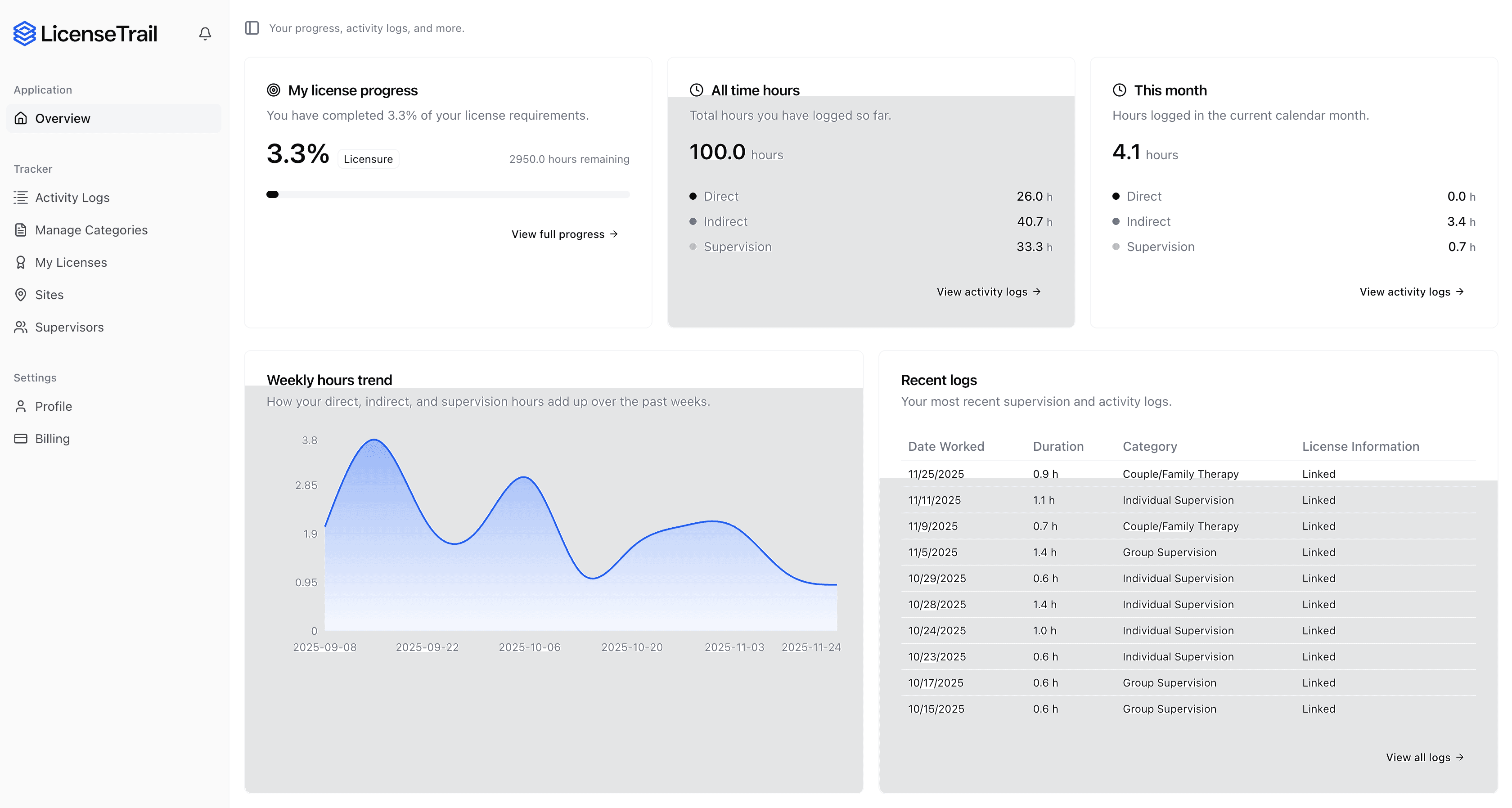
Track your LAMFT hours with confidence
License Trail checks your direct, indirect, and supervision hours against New-mexico LAMFT requirements continuously and flags mismatches before you submit.
 Start Tracking for Free
No credit card required · Free plan available
Is your spreadsheet hiding New-mexico LAMFT risks?
Stop guessing if your categories match New Mexico Counseling and Therapy Practice Board requirements. License Trail checks your direct, indirect, and supervision hours continuously and flags mismatches before you submit.
Import or log
Bring your spreadsheet or start fresh
Upload your existing tracking spreadsheet and we'll map every hour into the right New Mexico Counseling and Therapy Practice Board categories automatically.
Verify against New-mexico
Catch mismatches before the board does
License Trail checks your direct, indirect, and supervision hours against New-mexico LAMFT requirements continuously.
Export board-ready
One-click clean reports
Generate professional, board-ready reports for supervision meetings and New Mexico Counseling and Therapy Practice Board submissions in seconds.
No credit card required · Free plan available