
New-mexico LPP Requirements: Hours, Exams & Step-by-Step Guide
Stop guessing if your categories match New-mexico requirements. License Trail checks your direct, indirect, and supervision hours against LPP requirements continuously and flags mismatches before you submit.
No credit card required · Free plan available
Quick Requirements Overview
- Hold an active, unrestricted New Mexico psychologist license before entering/finishing the prescribing track
- Complete ≥450 classroom hours in psychopharmacology-related didactics (within 5 years of applying; ≥75% from one program)
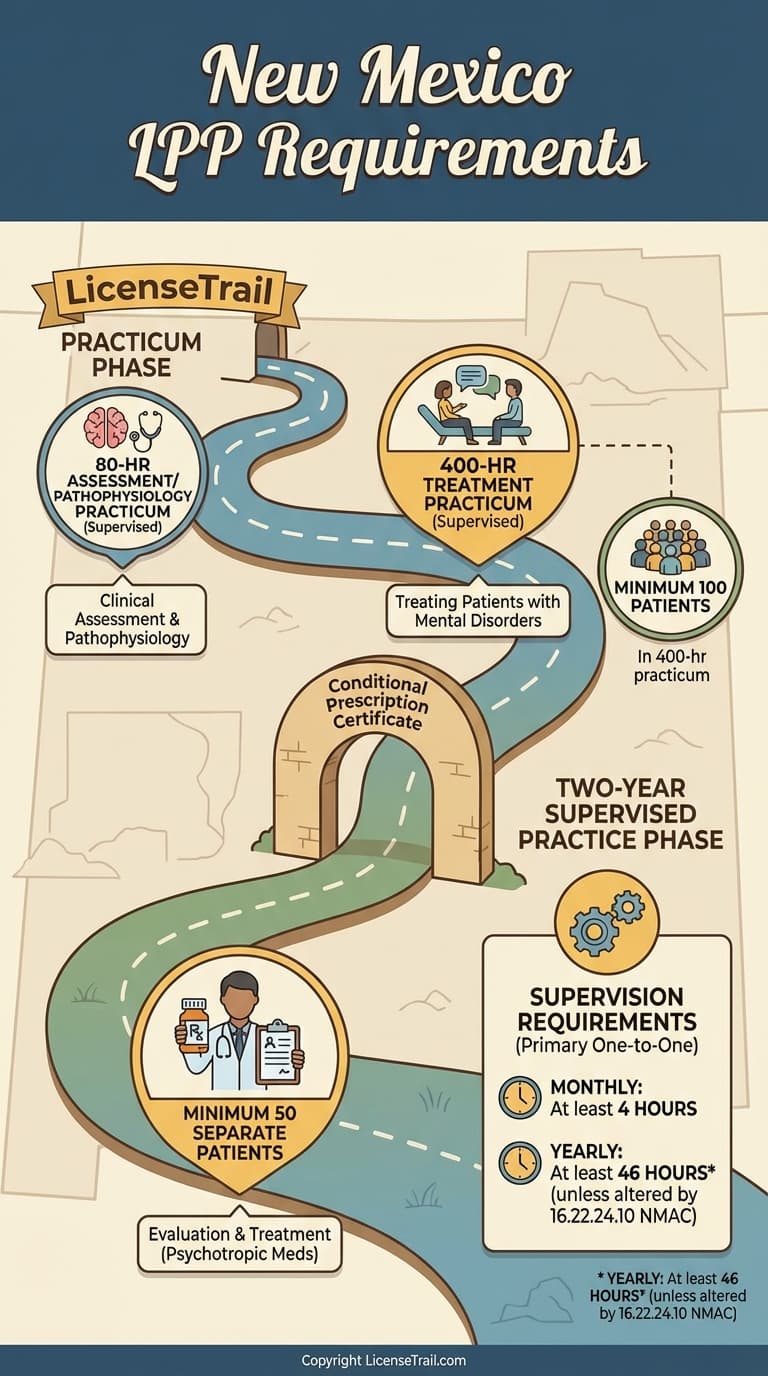
- Complete an 80-hour practicum in clinical assessment & pathophysiology in a medical setting under physician supervision
- Complete a 400 face-to-face hour practicum treating ≥100 separate patients with mental disorders, incl. collaboration with other treating providers (6 months–3 years)
- During the 400-hour practicum: 1:1 supervision ≥1 hour per 8 patient hours (≥50 supervision hours) with a qualified physician/psychiatrist
- Pass the PEP exam and complete 3-hour NM prescribing laws/rules training (SPA or NMPA) to obtain a Conditional Prescription Certificate
- Complete a non-reducible 2-year conditional prescribing period with ≥4 hours/month 1:1 supervision (≈46 hrs/year) and ≥50 unique medication-evaluation/treatment patients, with required logs
- Apply for the unrestricted Prescription Certificate (LPP) during the specified window and pass peer review; maintain with 60 CPE/2 years (incl. 40 hrs psychopharm, plus ethics/diversity/equity minimums)
License Details
Procedures
Pathway to Licensure as a Prescribing Psychologist (LPP) in New Mexico
New Mexico grants prescriptive authority to psychologists through a two‑step process overseen by the New Mexico Board of Psychologist Examiners:
- Conditional Prescription Certificate – you practice as a conditional prescribing psychologist under supervision.
- Prescription Certificate – after successful supervision and peer review, you become a prescribing psychologist (what many call an “LPP” or Licensed Prescribing Psychologist).
The requirements are laid out in the New Mexico Administrative Code (NMAC), primarily 16.22.23, 16.22.24 and 16.22.25. The sections below highlight the specific hours and experience required, using the Board’s own terminology.
1. Baseline: You must already be a licensed psychologist
Before you enter the prescribing track, you must hold an active, unrestricted New Mexico psychologist license. This is assumed throughout the prescriptive authority rules and is explicitly required when you later apply for the full prescription certificate. (srca.nm.gov)
(The usual supervised practice for general psychologist licensure is separate from, and in addition to, the prescribing‑specific hours described below.)
2. Education and Training for a Conditional Prescription Certificate
To start prescribing under supervision, you must qualify for a conditional prescription certificate. New Mexico calls these the “qualifications and education requirements for conditional prescriptive certificate.” (law.cornell.edu)
2.1 Didactic instruction – 450 classroom hours
Within the five years before you apply for a conditional prescription certificate, you must complete “didactic instruction of no fewer than 450 classroom hours” in core areas of clinical psychopharmacology. (law.cornell.edu)
The Board specifies the content areas:
- Neuroscience
- Pharmacology
- Psychopharmacology
- Physiology
- Pathophysiology
- Appropriate and relevant physical and laboratory assessment
- Clinical pharmacotherapeutics
- Cultural competence (law.cornell.edu)
At least three‑fourths of the 450 classroom hours must come from a single degree, certificate, or continuing‑education program. (law.cornell.edu)
Type of hours: These are didactic “classroom hours” – formal instructional hours, not clinical or supervision time.
2.2 80‑hour practicum in clinical assessment and pathophysiology
You must complete an “eighty hour practicum in clinical assessment and pathophysiology.” Key Board language: (law.cornell.edu)
- The 80‑hour practicum must be part of the psychopharmacology training program from which you obtain your certificate or degree.
- It must give you the opportunity to observe and demonstrate competence in physical and health‑assessment techniques within a medical setting under the supervision of a physician.
- It must be completed over a period ranging from full‑time over two weeks to up to 30 weeks.
The supervising physician and the training director must certify in writing that you:
- Worked with a diverse and significantly medically ill patient population
- Observed progression of illness and continuity of care
- Adequately assessed vital signs
- Demonstrated competent laboratory assessment
- Successfully completed the 80‑hour practicum (srca.nm.gov)
Type of hours: This is an 80‑hour clinical practicum focused on physical/medical assessment and pathophysiology, under physician supervision.
2.3 400‑hour / 100‑patient practicum in treating mental disorders
You also must complete a “four‑hundred hour practicum” that involves “treating a minimum of 100 patients with mental disorders.” (law.cornell.edu)
Key requirements:
- The 400‑hour practicum must be part of the same psychopharmacology training program from which you obtain the certification, degree, or completion certificate.
- “One‑hundred patients” is defined as 100 separate patients.
- The 400 hours are “400 face‑to‑face hours.” Only time spent:
- providing evaluation and treatment for medical psychopharmacotherapy, and
- collaboration with the patient’s treating health care practitioner(s)
can be counted toward the 400 hours. (law.cornell.edu)
- The practicum must be completed in no less than six months and no more than three years. (law.cornell.edu)
Supervision requirements within the 400‑hour practicum:
- A psychiatrist or other appropriately trained physician, licensed and in good standing, must be the primary supervising physician, though training activities can be assigned to other licensed physicians (secondary supervisors). (law.cornell.edu)
- One‑to‑one supervision must be provided either face‑to‑face or via live video.
- You must receive a minimum of one hour of supervision for every eight hours of patient time, and you must keep a log of the dates and times of supervision. (law.cornell.edu)
Type of hours:
- 400 face‑to‑face clinical hours with patients and collaborating providers
- Plus at least 50 hours of one‑to‑one supervision within that practicum (1 hour of supervision per 8 clinical hours).
2.4 Examination and state‑specific training
In addition to the hour‑based requirements:
- You must pass the Psychopharmacology Examination for Psychologists (PEP), with the passing score defined by ASPPB. (law.cornell.edu)
- You must complete a three‑hour training in New Mexico rules and laws applicable to prescribing psychologists, offered by the State Psychologist Association of New Mexico (SPA) or the New Mexico Psychological Association (NMPA). (law.cornell.edu)
3. Applying for the Conditional Prescription Certificate
Once the education, practicum hours, and exam are complete, you apply to the Board for a conditional prescription certificate under NMAC 16.22.24.8. (law.cornell.edu)
The application must include (among other items):
- Proof of completion of a post‑doctoral psychopharmacology training program
- Certification of successful completion of the 80‑hour practicum in clinical assessment and pathophysiology
- Certification of successful completion of the 400‑hour practicum treating a minimum of 100 patients with mental disorders
- Evidence of passing the PEP
- Proof of malpractice insurance
- Evidence of the three‑hour NM laws/rules training
- A proposed supervisory plan signed by the supervising clinician (law.cornell.edu)
Once the Board approves this application and plan, it issues the conditional prescription certificate, allowing you to prescribe psychotropic medication only under supervision.
4. Two‑Year Supervised Practice as a Conditional Prescribing Psychologist
With the conditional certificate, you enter a two‑year supervised practice phase (NMAC 16.22.24.10). This period is where most of the remaining hour‑ and case‑based requirements occur. (law.cornell.edu)
4.1 Duration and scope
- The rules refer to a “two‑year supervised practice” and a “two‑year conditional prescribing period.” (law.cornell.edu)
- The Board states that “the duration of the two‑year supervisory period shall not be accelerated or reduced.” (law.cornell.edu)
- Your conditional prescription certificate expires two years after issuance unless extended in limited circumstances; you may not prescribe after expiration without extension. (srca.nm.gov)
4.2 Ongoing supervision – at least 4 hours per month / 46 hours per year
Supervision standards are given in hour terms:
- “Supervision by the primary supervising clinician shall be provided on a one‑to‑one basis for at least four hours a month and should total at least forty‑six (46) hours of one‑to‑one supervision per year,” unless the Board approves an amendment. (law.cornell.edu)
Over the standard two‑year conditional period, this equates to:
- Minimum one‑to‑one supervision:
- 4 hours/month × 12 months ≈ 48 hours/year
- The rule also uses 46 hours/year as the yearly target; in practice, your plan is expected to meet or exceed that threshold each year.
- Across two years, at least ~92 hours of one‑to‑one supervision focused on prescribing practice.
Supervision may be in person, by telephone, or by live tele‑video, but it must be one‑to‑one with the primary supervising clinician (and sometimes secondary supervisors) and documented in logs. (law.cornell.edu)
4.3 Patient volume – at least 50 unique patients
The Board sets a specific patient‑care requirement:
- “The conditional prescribing psychologist shall see a minimum of 50 separate patients within the two‑year period who are seen for the purpose of evaluation and treatment with psychotropic medication.” (law.cornell.edu)
The Board further requires the primary supervising clinician to certify that you have “successfully completed two years of evaluating for or prescribing psychotropic medication to at least 50 unique patients.” (law.cornell.edu)
Type of requirement: This is case‑based, not additional hour‑counting beyond the monthly supervision. You must accumulate a caseload of at least 50 distinct patients for whom medication evaluation/treatment is a central focus.
4.4 Documentation and logs
During the two‑year supervised practice, you must maintain detailed records:
- Supervision logs: The conditional prescribing psychologist keeps a supervision log; each supervising clinician must attest to its contents. (law.cornell.edu)
- Supervisor logs: The primary supervising clinician must keep a log of contacts with secondary supervisors, including dates and brief outcomes. (law.cornell.edu)
These logs later form part of the documentation when you apply for the full prescription certificate.
5. Applying for the Full Prescription Certificate (Unrestricted Prescribing / LPP Stage)
After you complete the two‑year supervised period, you can apply for the prescription certificate – this is what the Board calls the “unrestricted prescription certificate,” and it is the status typically referred to as a Licensed Prescribing Psychologist (LPP). (srca.nm.gov)
5.1 Timing and baseline criteria
Under NMAC 16.22.25.8, “Application for Prescription Certificate,” you must: (law.cornell.edu)
- File a complete application on a Board‑approved form.
- Apply no sooner than 60 days and no later than 10 days before your conditional certificate expires.
- Submit evidence that you:
- “Has been issued a conditional prescription certificate and has successfully completed or anticipates successfully completing two years of prescribing psychotropic medication, as certified by the primary supervising clinician” under 16.22.24 NMAC.
- Hold an active and unrestricted license to practice psychology in New Mexico.
- Have malpractice insurance as required in 16.22.24 NMAC and provide the declaration page of your policy.
5.2 Required logs – documenting your supervised practice
You must also submit detailed logs: (law.cornell.edu)
-
Log of patients seen, including for each case:
- Coded patient ID
- Age, gender
- Diagnosis
- Whether pharmacological intervention was considered or implemented
- Date of service
- Amount of time spent on psychopharmacotherapy or management of care
- The log must contain the name and signature of the supervising clinician.
-
Log of supervision, including:
- Date of supervision
- Time spent in supervision
- Topics covered
- Name of the primary or secondary supervising clinician providing supervision
- Signed by the primary supervising clinician.
These logs concretely document:
- Your two years of prescribing psychotropic medication, and
- Your supervision hours (minimum 4 hours/month; ~46 hours/year).
No new numeric hour requirement is imposed at this stage; instead, the Board checks that you have fulfilled the two‑year, 50‑patient, and supervision standards established for conditional prescribing psychologists.
5.3 Peer review and issuance of the unrestricted certificate
Before issuing the full prescription certificate, you must pass a peer review process (NMAC 16.22.25.9–.10): (srca.nm.gov)
- A three‑member peer review panel (from professions such as prescribing psychologists, psychiatrists/physicians, nurse practitioners, or pharmacists) reviews your charts and materials and evaluates your competence to prescribe independently.
- Following peer review, “the board shall issue an unrestricted prescription certificate to the applicant or inform the applicant of deficiencies” within 60 days. (srca.nm.gov)
If deficiencies are found, the panel can prescribe a remedial period (up to 6 months) and additional peer reviews; after three unsuccessful reviews, you must re‑enter psychopharmacology training and start over at the conditional level. (srca.nm.gov)
Once the unrestricted prescription certificate is issued, you are recognized as a prescribing psychologist in New Mexico – effectively the LPP stage.
6. Ongoing Continuing Education Hours as a Prescribing Psychologist
After you hold an unrestricted prescription certificate, you must maintain it through continuing professional education (CPE). The Board specifies:
- 60 hours of CPE every two years for conditional prescribing and unrestricted prescribing psychologists (compared with 40 hours for non‑prescribing psychologists). (rld.nm.gov)
- Within those 60 hours:
- At least 40 hours every two years must be in psychopharmacology or psychopharmacotherapy.
- At least 4 hours in ethics.
- At least 2 hours in cultural diversity or health disparities.
- At least 4 hours in equity and inclusion topics (race, ethnicity, systemic racism, structural inequality, poverty, etc.). (srca.nm.gov)
Type of hours: These are continuing education hours post‑licensure, separate from the initial 450/80/400 practicum and supervision hours.
Summary of Key Hour‑Based Requirements
For clarity, the prescribing‑specific requirements in New Mexico can be summarized as:
-
Didactic training:
- ≥ 450 classroom hours in specified psychopharmacology‑related content areas. (law.cornell.edu)
-
Pre‑conditional practica (within the training program):
- 80‑hour practicum in clinical assessment and pathophysiology, supervised by a physician. (law.cornell.edu)
- 400‑hour practicum treating a minimum of 100 separate patients with mental disorders, all 400 hours being face‑to‑face clinical hours, with ≥1 hour of supervision per 8 hours of patient work. (law.cornell.edu)
-
Conditional prescribing phase (two‑year supervised practice):
- Two full years as a conditional prescribing psychologist (not shortenable). (law.cornell.edu)
- At least 4 hours/month of one‑to‑one supervision with the primary supervising clinician, should total at least 46 hours of one‑to‑one supervision per year (≈ 92 hours across two years). (law.cornell.edu)
- Minimum of 50 separate patients seen over the two years specifically for evaluation and treatment with psychotropic medication. (law.cornell.edu)
-
Post‑licensure continuing education (once fully licensed as a prescribing psychologist):
- 60 CPE hours every two years, including 40 hours in psychopharmacology or psychopharmacotherapy, and specified minimums in ethics, cultural diversity, and equity/inclusion. (srca.nm.gov)
Together, these didactic, practicum, supervised‑practice, and continuing‑education hours form the Board‑defined pathway from licensed psychologist to conditional prescribing psychologist and finally to fully licensed prescribing psychologist (LPP) in New Mexico.
Track your LPP hours with confidence
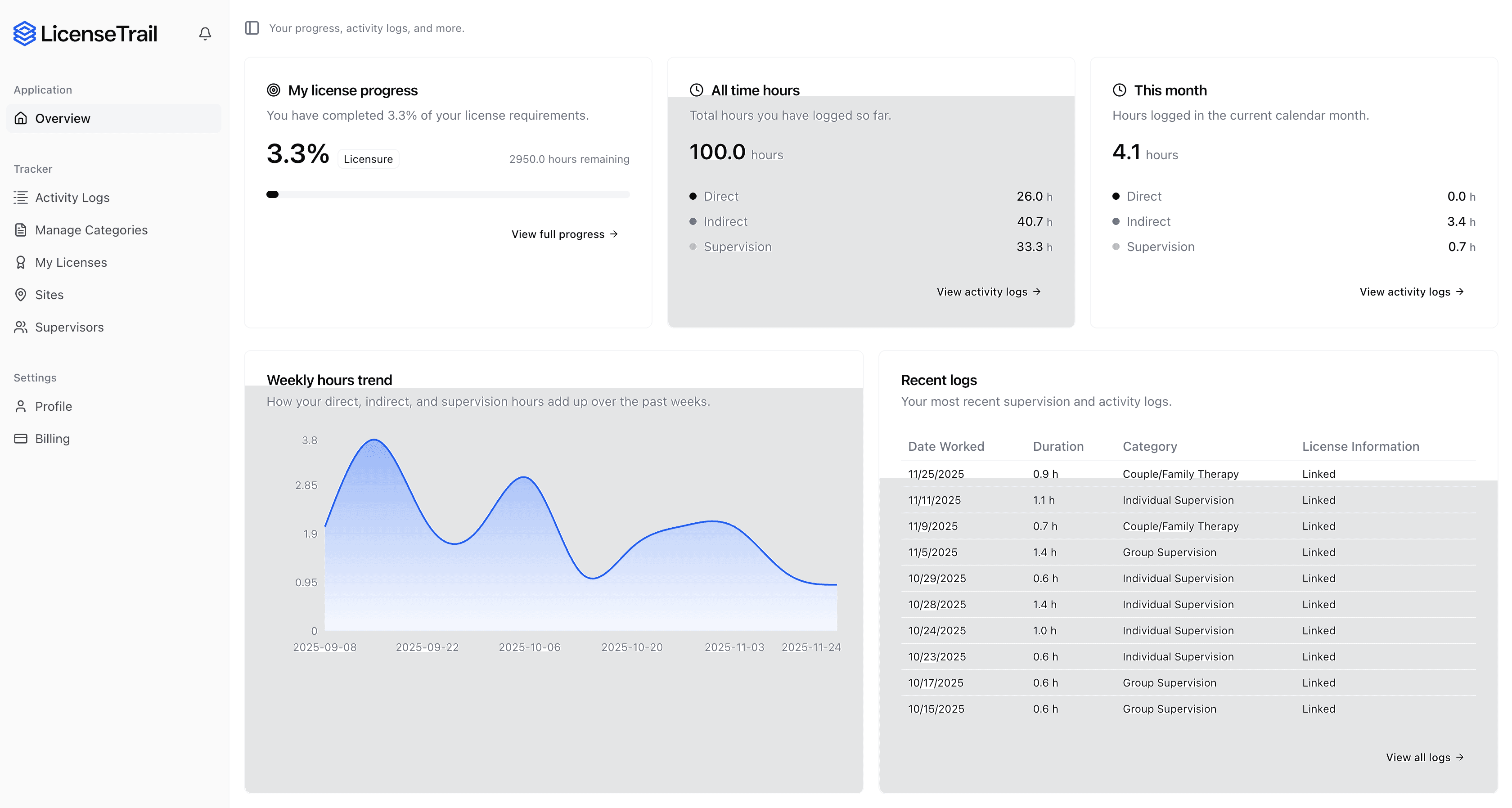
License Trail checks your direct, indirect, and supervision hours against New-mexico LPP requirements continuously and flags mismatches before you submit.
 Start Tracking for Free
No credit card required · Free plan available
Related Licenses
Is your spreadsheet hiding New-mexico LPP risks?
Stop guessing if your categories match New Mexico Board of Psychologist Examiners requirements. License Trail checks your direct, indirect, and supervision hours continuously and flags mismatches before you submit.
Import or log
Bring your spreadsheet or start fresh
Upload your existing tracking spreadsheet and we'll map every hour into the right New Mexico Board of Psychologist Examiners categories automatically.
Verify against New-mexico
Catch mismatches before the board does
License Trail checks your direct, indirect, and supervision hours against New-mexico LPP requirements continuously.
Export board-ready
One-click clean reports
Generate professional, board-ready reports for supervision meetings and New Mexico Board of Psychologist Examiners submissions in seconds.
No credit card required · Free plan available