
New-mexico LP Requirements: Hours, Exams & Step-by-Step Guide
Stop guessing if your categories match New-mexico requirements. License Trail checks your direct, indirect, and supervision hours against LP requirements continuously and flags mismatches before you submit.
No credit card required · Free plan available
Quick Requirements Overview
- Doctorate in psychology required: Doctoral program nationally designated/accredited; major in clinical, counseling, or school psychology (official transcripts/program proof).
- Supervised experience: 3,000 hours (2 years) total supervised psychology experience.
- Hour sources allowed: Up to 1,500 practicum (program‑overseen) + up to 1,500 APA‑accredited internship; if internship non‑APA, only up to 750 counts; remainder must be postdoctoral supervised work.
- Activity mix within hours: Minimum 50% service‑related activities and 25% face‑to‑face client/patient contact.
- Supervision rules/documentation: Supervision must meet board frequency standards; all supervisors/hours documented on board forms; NM postdoc requires board‑submitted supervisory plan before starting.
- Exams: Pass EPPP (ASPPB passing score standard) and NM online jurisprudence exam (board‑set passing score).
- Cultural requirement: Provide evidence of awareness/knowledge of New Mexico cultures.
- Application items: Online application + fees; 3 references (2 from licensed psychologists, recent); fingerprints & nationwide criminal background check.
License Details
Procedures
Licensure as a psychologist in New Mexico (what many people informally call an “LP” license) is governed by the New Mexico State Board of Psychologist Examiners under Title 16, Chapter 22 of the New Mexico Administrative Code (NMAC). The board does not use the term “LP”; the credential is simply “licensed psychologist.”
The core requirements fall into four main areas: education, supervised experience hours, examinations (EPPP and jurisprudence), and application/background documentation. The supervised‑experience rules are very specific about the types and sources of hours.
1. Educational requirement
New Mexico requires a doctoral degree in psychology that meets specific accreditation/designation standards.
Under 16.22.4.8 NMAC, the Board will issue a psychologist license to an otherwise qualified applicant who:
- Is a graduate of a doctoral program in psychology that is either:
- “designated as a doctoral program in psychology by a nationally recognized designation system,” or
- “accredited by a nationally recognized accreditation body”; and
- Holds a degree with a major in clinical, counseling, or school psychology from a university offering a full‑time course of study in psychology. (srca.nm.gov)
The applicant is responsible for proving that the program meets these requirements at the time of application (usually via official transcripts and, if needed, program documentation). (srca.nm.gov)
2. Supervised experience: total hours and allowed sources
The Board’s hour requirements are set out in 16.22.6.8 NMAC (“Practicum, Doctoral Internship, and Postdoctoral Supervised Experience”). This is where the precise hour breakdown and the language about hour types appear.
2.1 Total hours required
The regulation states that:
- “Two years (3,000 hours) of supervised experience are required for licensure.” (law.cornell.edu)
All of these 3,000 hours must be supervised experience in psychology that meets the Board’s standards; there is no separate, additional “unsupervised” hour requirement for initial licensure.
2.2 How the 3,000 hours can be assembled
Within those 3,000 supervised hours, the Board allows specific portions to come from different training stages:
From 16.22.6.8(A)(1): (law.cornell.edu)
- Up to 1,500 hours may be from doctoral practicum hours:
- These must be “practicum hours overseen by the doctoral training program” and consistent with ASPPB guidelines on practicum experience for licensure.
- Up to 1,500 hours may be from an APA‑accredited doctoral internship.
- If the internship is not APA‑accredited, up to 750 hours of the 3,000 may come from that internship.
- Whatever portion of the 3,000 hours is not covered by approved practicum/internship must be obtained as “supervised postdoctoral psychological work.”
In more concrete terms, common patterns look like:
-
Path A (all hours before and during APA‑accredited internship):
- 1,500 hours practicum (max allowed)
- 1,500 hours APA‑accredited internship
- 0 additional postdoc hours required (you would still need appropriate documentation and supervision, but you’ve technically met the 3,000 hours).
-
Path B (less practicum, full APA internship):
- 1,000 hours qualifying practicum
- 1,500 hours APA internship
- 500 hours supervised postdoctoral work
-
Path C (non‑APA internship):
- 1,500 hours practicum
- 750 hours qualifying non‑APA internship
- 750 hours supervised postdoctoral work
The regulation explicitly requires that all doctoral and postdoctoral experience from all supervisors be documented on board forms. (law.cornell.edu)
2.3 Definition and structure of practicum hours
The Board gives detailed verbiage about what counts as qualifying practicum experience. Key points from 16.22.6.8(B): (law.cornell.edu)
- Practicum training is defined as an “organized, sequential series of supervised experiences of increasing complexity” that:
- Prepares the student for internship; and
- Partially meets the licensure requirements.
- Training must:
- Follow “appropriate academic preparation.”
- Be overseen by the doctoral training program.
- Be in psychological service settings that have as part of their mission the training of professional psychologists.
- Not all supervised experience accumulated during graduate training may count; only practicum that meets the Board’s quality and structure requirements is eligible.
- A licensed psychologist or clinical faculty member (allowed to practice psychology under state law) must provide:
- At least one hour of supervision per week for all experiences that count toward licensure; and
- For “experienced students,” at least one hour of supervision for each day (eight hours) of supervised experience (telesupervision is treated as equivalent to face‑to‑face).
- The doctoral program must certify that practicum hours meet the Board’s specifications regarding:
- Type of clinical activities, and
- Level and nature of supervision.
2.4 Required types of activities within supervised hours
Within the supervised hours (especially practicum), New Mexico specifies minimum proportions of certain types of clinical work. The Board’s rule requires that, across settings: (law.cornell.edu)
- At least 50% of total supervised experience hours be “service‑related activities,” defined to include:
- Treatment/intervention
- Assessment
- Interviews
- Report writing
- Case presentations
- Consultations
- At least 25% of total supervised hours must be face‑to‑face patient/client contact.
These are effectively your “direct” clinical hours for licensure purposes, even though the Board uses the language “service‑related activities” and “face‑to‑face patient/client contact” rather than the term “direct hours.”
2.5 Postdoctoral supervised practice
If you have not met the 3,000‑hour requirement through practicum and internship alone, the remainder must be completed as postdoctoral supervised practice.
Key language from 16.22.6.8(E): (law.cornell.edu)
- The applicant may complete up to 1,500 hours of doctoral practicum and up to 1,500 hours of doctoral internship before the doctorate.
- “Depending on the number of hours of doctoral supervised experience, the applicant shall complete the remainder of the required 3,000 hours through postdoctoral supervision.”
If you complete postdoctoral hours in New Mexico, you are required to:
- Submit a postdoctoral supervisory plan to the Board before beginning supervised practice.
- Wait for the Board’s written response regarding acceptability; once approved, you are “registered as participating in an approved supervision program.” (law.cornell.edu)
If you complete postdoctoral hours outside New Mexico, a supervisory plan is optional, but:
- If you do not have a pre‑approved plan, you submit documentation at the end; if the Board does not approve it, you may be required to repeat part or all of the postdoctoral supervised experience. (law.cornell.edu)
3. Examination requirements: EPPP and New Mexico jurisprudence
Examination requirements are set in 16.22.7.8 NMAC (“Demonstration of Competence”). To qualify for licensure, you must demonstrate competence by passing:
-
The Examination for Professional Practice in Psychology (EPPP)
- The Board adopts the Association of State and Provincial Psychology Boards (ASPPB) EPPP.
- If the EPPP was taken before January 1, 1993, the passing score is 140 (70%).
- If taken on or after January 1, 1993, you must obtain a score equal to or greater than ASPPB’s recommended passing score in effect at the time. (law.cornell.edu)
-
New Mexico online jurisprudence examination
- All applicants “shall take and pass an online jurisprudence examination on ethical standards, New Mexico laws, and board regulations as they apply to psychologists and their clients or patients.”
- The passing score is set by the Board and can be changed by rule. (law.cornell.edu)
Additional exam‑related provisions:
- If you pass one exam (EPPP or jurisprudence) but not the other, you do not have to retake the one you passed; you only retake the failed exam. (law.cornell.edu)
- You may retake either exam by paying the applicable examination fee; fees are non‑refundable. (law.cornell.edu)
Cultural knowledge requirement
In the same rule, the Board requires that:
- “An applicant shall furnish evidence to the board that demonstrates an awareness and knowledge of New Mexico cultures.” (law.cornell.edu)
This may be met through coursework, training, or documentation specified by the Board (often reviewed together with your application and jurisprudence exam performance).
4. Application and documentation process
The procedural requirements appear mainly in 16.22.5.8 and 16.22.5.9 NMAC (“Psychologists: Application Procedures”). (srca.nm.gov)
4.1 When you are eligible to apply
Under 16.22.5.8(B):
- You may be considered for licensure if you fulfill conditions of:
- 16.22.4 NMAC (education requirements),
- 16.22.6 NMAC (practicum, internship, and postdoctoral supervised experience), and
- 16.22.7 NMAC (examination requirements).
4.2 Core application components
Per 16.22.5.9 NMAC, all applicants must submit, to the Board or a designated agency, at least the following: (srca.nm.gov)
- Completed and signed application (submitted through the Board’s online system).
- Application fee set by the Board (non‑refundable).
- Verification of educational requirements, typically:
- Official doctoral transcripts sent directly from the institution’s registrar.
- Verification of pre‑doctoral and post‑doctoral supervision:
- As defined in 16.22.6 NMAC, using Board forms.
- Three letters of reference:
- Dated within the last two years.
- At least two letters must be from licensed practicing psychologists familiar with your clinical work and able to attest to your competence.
Additional process elements from 16.22.5.8: (regulations.justia.com)
- Criminal background check and fingerprints:
- All initial applicants must undergo a nationwide criminal history screening at their own expense.
- You submit two full sets of fingerprints, a completed fingerprint certificate form, and a signed authorization for criminal background screening with your application.
- Examination fees:
- Additional fees may be charged for the administration of the EPPP and jurisprudence exam.
If you hold an ASPPB CPQ, National Register HSPP, or ABPP credential and have been licensed in another jurisdiction in good standing for at least two years, there is a separate, somewhat streamlined path under 16.22.5.11 NMAC, but you still must meet EPPP and other statutory minimums. (srca.nm.gov)
5. After licensure: cultural competence and continuing education (briefly)
Although your question focuses on getting licensed, the Board links initial licensure to ongoing competency requirements, especially in ethics and culture.
5.1 Cultural competence
Beyond the initial requirement to demonstrate awareness and knowledge of New Mexico cultures at licensure, psychologists must continue to complete cultural competence coursework as part of their continuing professional education (CPE) under 16.22.2 and 16.22.9 NMAC. (law.cornell.edu)
5.2 Continuing professional education hours
Under 16.22.9.8 NMAC: (law.cornell.edu)
- Licensed psychologists and psychologist associates must complete 40 hours of continuing professional education every two years.
- Psychologists with prescribing authority must complete 60 hours every two years.
- A portion of CPE must be in ethics and cultural diversity.
While this comes into play after you become licensed, it is helpful to know that your initial training and early‑career activities should support ongoing competence in these areas.
Summary of hour requirements in Board language
To synthesize the specific hour requirements, using the Board’s own framework:
-
Total supervised experience required for licensure
- 3,000 hours of supervised experience over at least two years. (law.cornell.edu)
-
Allowable pre‑doctoral hours (all must meet Board criteria): (law.cornell.edu)
- Up to 1,500 hours from doctoral practicum, overseen and certified by the doctoral program.
- Up to 1,500 hours from an APA‑approved doctoral internship; if the internship is not APA‑approved, only up to 750 hours may count.
-
Required postdoctoral hours:
- Whatever portion of the 3,000 hours is not covered by qualifying practicum and internship must be completed as supervised postdoctoral psychological work, under a Board‑approved or Board‑acceptable supervisory plan. (law.cornell.edu)
-
Types of activities within those hours (for hours that count toward licensure): (law.cornell.edu)
- At least 50% of supervised hours must be “service‑related activities” (treatment, assessment, interviews, report‑writing, case presentations, consultations).
- At least 25% must be face‑to‑face client/patient contact.
- Supervision must meet minimum frequency standards (e.g., at least one hour of supervision per week and, for experienced students, at least one hour for each eight‑hour day of supervised experience).
Together with the doctoral‑degree and exam requirements, meeting these hour and activity specifications is what qualifies you for licensure as a psychologist with the New Mexico Board of Psychologist Examiners.
Track your LP hours with confidence
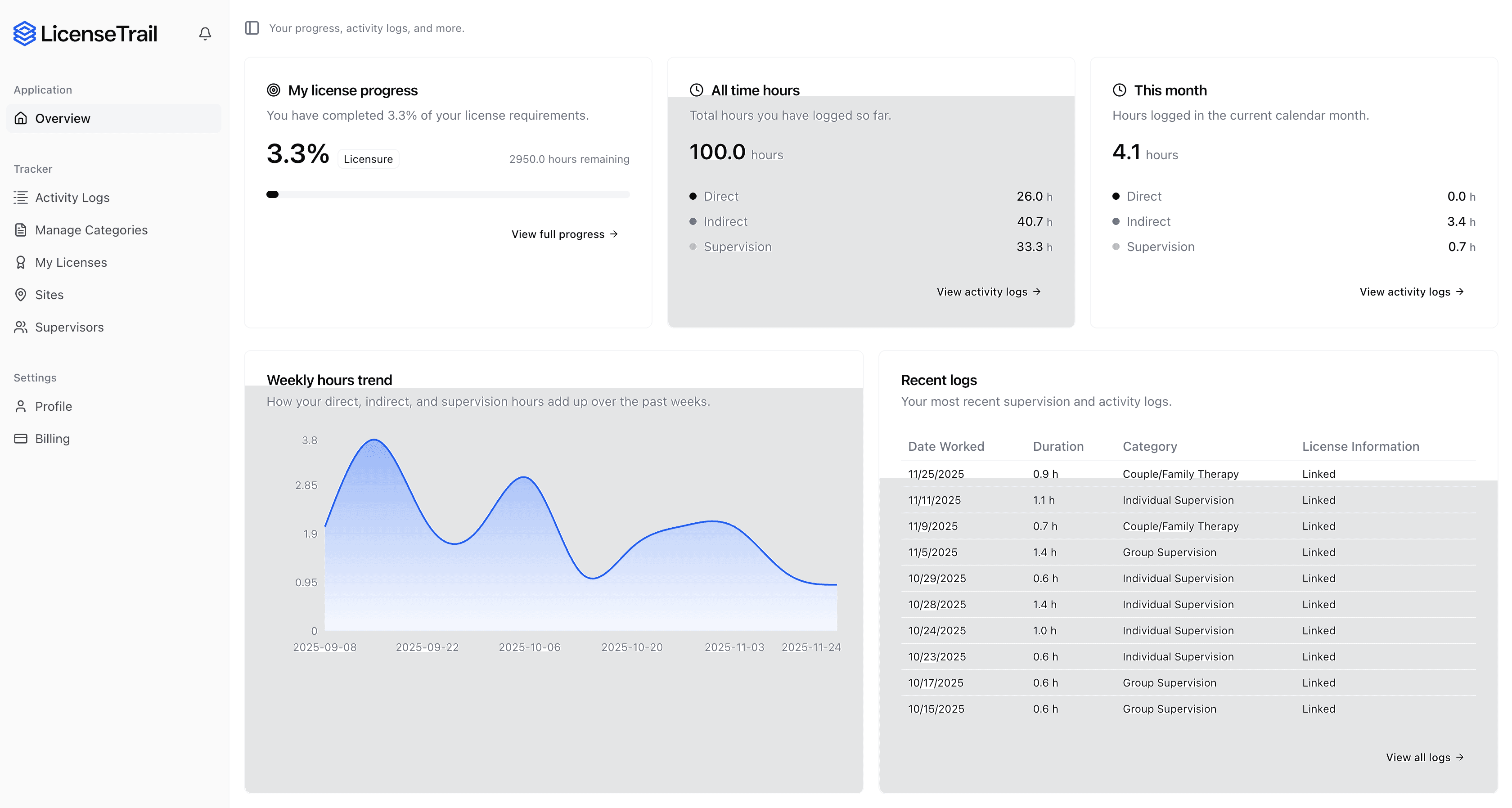
License Trail checks your direct, indirect, and supervision hours against New-mexico LP requirements continuously and flags mismatches before you submit.
 Start Tracking for Free
No credit card required · Free plan available
Is your spreadsheet hiding New-mexico LP risks?
Stop guessing if your categories match New Mexico Board of Psychologist Examiners requirements. License Trail checks your direct, indirect, and supervision hours continuously and flags mismatches before you submit.
Import or log
Bring your spreadsheet or start fresh
Upload your existing tracking spreadsheet and we'll map every hour into the right New Mexico Board of Psychologist Examiners categories automatically.
Verify against New-mexico
Catch mismatches before the board does
License Trail checks your direct, indirect, and supervision hours against New-mexico LP requirements continuously.
Export board-ready
One-click clean reports
Generate professional, board-ready reports for supervision meetings and New Mexico Board of Psychologist Examiners submissions in seconds.
No credit card required · Free plan available