
New-mexico LP Requirements: Hours, Exams & Step-by-Step Guide
Stop guessing if your categories match New-mexico requirements. License Trail checks your direct, indirect, and supervision hours against LP requirements continuously and flags mismatches before you submit.
No credit card required · Free plan available
Quick Requirements Overview
- Doctoral degree in psychology (clinical/counseling/school) from a designated/accredited program
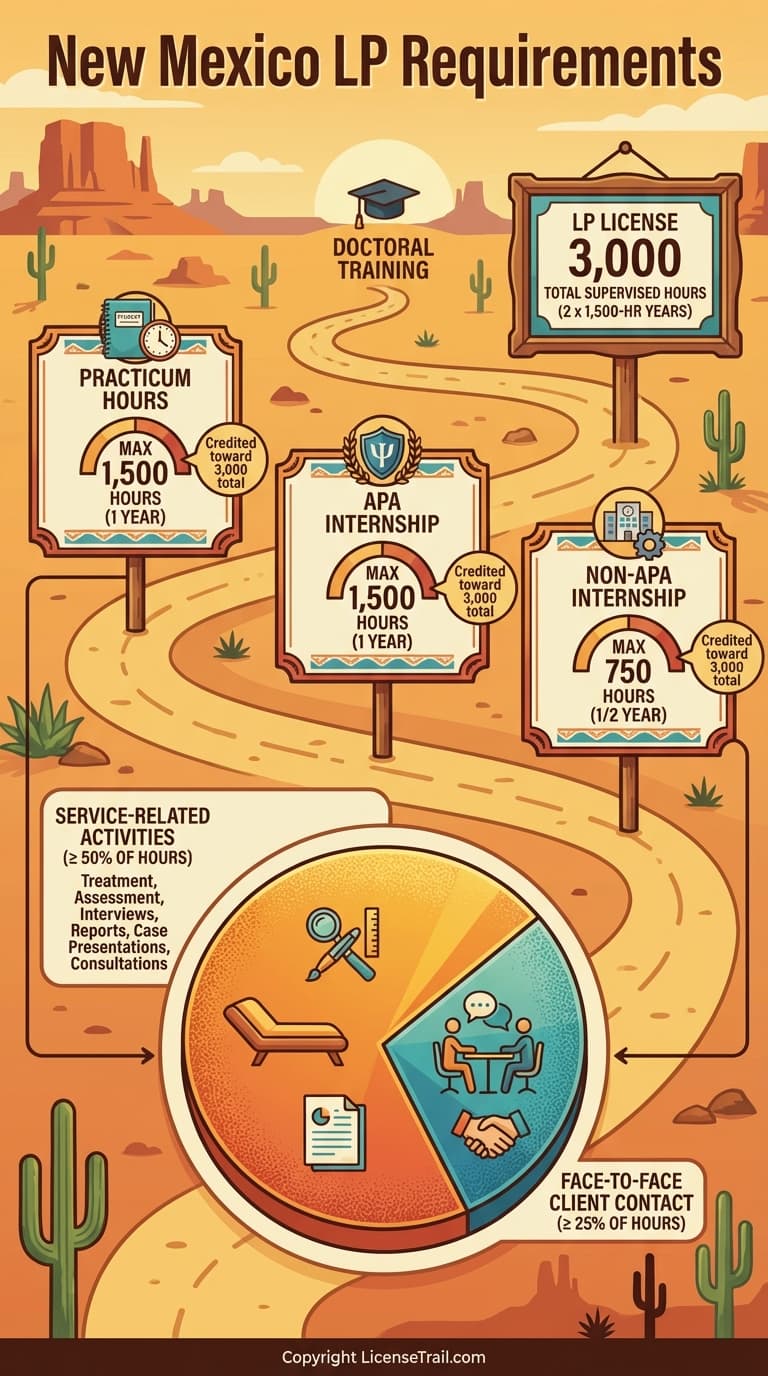
- 3,000 hours (2 years) supervised experience; may include up to 1,500 hrs practicum and up to 1,500 hrs APA internship (non‑accredited internship max 750 hrs); remainder postdoc
- Hour content minimums: ≥50% service-related activities; ≥25% face-to-face client contact; supervision documented on Board forms (telesupervision allowed)
- If postdoc hours are in NM: submit Board supervisory plan before starting (approval typically within 60 days)
- Pass EPPP + NM online jurisprudence exam
- Apply with fees, official transcripts, supervision verification, and 3 references (2+ from licensed psychologists)
- Biometric federal criminal background check (fingerprints/ORI via Board after online application)
- First year after licensure: NM cultures awareness + Board cultural-competence coursework (8 hrs first year; then ongoing cultural CE as required)
License Details
Procedures
New Mexico regulates the independent practice of psychology through the New Mexico State Board of Psychologist Examiners. The independent doctoral-level license is issued under that board and is referred to in current state materials as a “Licensed Psychologist Examiner” (LP).(rld.nm.gov)
Below is a structured, board-based description of what you must do to obtain this license.
1. Snapshot of Core Requirements
To become a Licensed Psychologist Examiner in New Mexico, you must, at minimum:
- Hold a qualifying doctoral degree in psychology (clinical, counseling, or school) from an appropriately designated or accredited program. (srca.nm.gov)
- Complete two years (3,000 hours) of supervised experience that meet detailed board conditions on type of work and supervision. (regulations.justia.com)
- Pass the EPPP (national exam) and a New Mexico online jurisprudence examination. (law.cornell.edu)
- Submit a full license application with supervision verification, references, and fees. (law.cornell.edu)
- Complete a biometric federal criminal history background check as a Licensed Psychologist Examiner applicant. (rld.nm.gov)
- Within the first year of licensure, demonstrate “awareness and knowledge of New Mexico cultures” and complete specific cultural-competence coursework. (law.cornell.edu)
The rest of this guide unpacks those points in the board’s own terms.
2. Educational Requirements
The Board “shall issue a license as a psychologist” to an otherwise qualified applicant who proves that they:(srca.nm.gov)
- Are a graduate of a doctoral program in psychology that is:
- designated as a psychology doctoral program by a nationally recognized designation system, or
- accredited by a nationally recognized accreditation body; and
- Hold a degree with a major in clinical, counseling, or school psychology from a university offering a full-time course of study in psychology.
This doctoral program is your “doctoral training program” for all supervised-experience calculations.(law.cornell.edu)
3. Supervised Experience: The 3,000-Hour Requirement
3.1 How many hours and how “years” are defined
The Board states that “two years (3,000 hours) of supervised experience are required for licensure.”(regulations.justia.com)
Separately, the Board defines a “year of supervised experience” as 1,500 hours of psychological work conducted under supervision satisfactory to the board, accumulated within:(law.cornell.edu)
- 1–2 consecutive calendar years for an internship,
- up to 3 consecutive years for postdoctoral experience, or
- across graduate training in the case of doctoral experience.
So the required 3,000 hours = two “years” of 1,500 supervised hours each, in the Board’s terminology.
3.2 Where those 3,000 hours can come from
Under 16.22.6.8 NMAC, supervised experience leading toward licensure must be arranged as follows:(regulations.justia.com)
-
Total required:
- 3,000 hours of supervised experience (two “years”).
-
Doctoral practicum (pre‑internship):
- You may count up to one year (1,500 hours) of practicum hours overseen by your doctoral training program, if they comply with Association of State and Provincial Psychology Boards (ASPPB) practicum guidelines and all the quality and structure requirements in Part 6.
-
Doctoral internship (APA-accredited):
- You may count up to one year (1,500 hours) of supervised experience in a doctoral internship approved by the American Psychological Association (APA).
-
Doctoral internship (not APA-accredited):
- If your internship is not accredited by a nationally recognized body, it can count for up to one‑half year (750 hours) of the 3,000 hours, if it meets specific criteria in the rule, including:
- It is a formal internship in psychology whose goal includes preparing applicants for professional practice.
- It is sponsored by an institution or agency whose primary functions include providing services to a sufficient number and variety of recipients.
- It is completed within 24 consecutive months at a minimum of 20 hours per week (less than 20 hours/week will not be accepted).
- The doctoral program’s director of clinical training certifies that the internship was approved as part of the degree requirements. (regulations.justia.com)
- If your internship is not accredited by a nationally recognized body, it can count for up to one‑half year (750 hours) of the 3,000 hours, if it meets specific criteria in the rule, including:
-
Postdoctoral supervised work:
- After adding together accepted practicum hours and allowable internship hours, the remainder of the 3,000 hours must be obtained in supervised postdoctoral psychological work. (regulations.justia.com)
In practice, common combinations are:
- 1,500-hour APA internship + 1,500 hours postdoctoral, or
- Some mix of practicum hours (up to 1,500), plus internship, plus enough postdoc hours to total 3,000.
3.3 Required content and distribution of supervised hours
For supervised experience to count toward licensure, the Board specifies both the types of activities and minimum proportions. Across qualifying practicum settings (and effectively for supervised experience counted toward licensure generally), the Board requires:(regulations.justia.com)
-
Service‑related activities:
At least 50% of the total hours of supervised experience must be in service-related activities, explicitly defined to include:- treatment/intervention
- assessment
- interviews
- report-writing
- case presentations
- consultations
-
Face‑to‑face client contact:
At least 25% of the total hours must be face‑to‑face patient/client contact. -
Supervision intensity:
- For practicum: supervision by a licensed psychologist or qualified clinical faculty at least one hour for each day of supervised experience (i.e., one hour of supervision for each 8-hour day, about 12.5% of total hours).
- Telesupervision (synchronous audio and video) is considered equivalent to face‑to‑face supervision.
- All supervision time (individual or group), including amounts beyond the minimum, may be counted as part of the supervised-experience hours.
The Board also requires that:(regulations.justia.com)
- Practicum experiences be organized, sequential, and of increasing complexity.
- They occur in psychological service settings with a training mission for professional psychologists.
- Each site has an identified licensed psychologist responsible for the quality and integrity of the trainee’s experience (or one assigned by the doctoral program if none is on-site).
- Supervisors are appropriately qualified by education, licensure, and experience.
3.4 Documentation of supervised experience
For both doctoral and postdoctoral experience, all supervisors must document the hours on forms provided by the Board.(regulations.justia.com)
4. Postdoctoral Supervised Practice Requirements
Postdoctoral supervised practice is specifically governed by 16.22.6.8(E) NMAC:(regulations.justia.com)
- You may complete:
- up to 1,500 hours of practicum, and
- up to 1,500 hours of internship,
before the doctorate is awarded.
- Whatever part of the 3,000 hours remains after those doctoral experiences must be completed as postdoctoral supervised practice.
4.1 Supervisory plan (especially if training in New Mexico)
-
If you are earning postdoctoral hours in New Mexico, you must submit a written postdoctoral supervisory plan to the Board before beginning supervised practice.
-
The Board (or a designated member) will respond in writing within 60 days, either:
- approving the plan, which guarantees that, if completed as proposed, the hours will count; or
- identifying deficiencies that must be corrected.(regulations.justia.com)
-
If you complete postdoctoral hours outside New Mexico, a supervisory plan is optional. But if you skip pre‑approval and the Board later rejects part of the experience, you may be required to repeat some or all of those hours, this time with a Board‑approved plan.(regulations.justia.com)
5. Examinations
Under 16.22.7.8 NMAC, you must demonstrate competence through two exams:(law.cornell.edu)
-
EPPP (Examination for Professional Practice in Psychology)
- You must pass the national EPPP exam, with:
- a historical minimum score specified for exams taken before January 1, 1993, and
- for exams on or after that date, a score equal to or greater than the passing standard recommended by ASPPB.
- You must pass the national EPPP exam, with:
-
New Mexico Jurisprudence Examination
- An online jurisprudence exam on:
- ethical standards,
- New Mexico laws, and
- Board regulations as they apply to psychologists and their clients/patients.
- The Board sets the passing score.
- An online jurisprudence exam on:
If you pass one of these exams but not the other, you only have to retake the one you failed. Both exams may be retaken with payment of the required exam fee.(law.cornell.edu)
Additionally, under the application rule, you must show evidence of awareness and knowledge of New Mexico cultures during your first year of licensure.(law.cornell.edu)
6. Application Package and Background Check
6.1 Core application items
Under 16.22.5.9 NMAC, all applicants for psychologist licensure must submit to the Board (or its designee):(law.cornell.edu)
- Completed and signed application.
- Application fee as set by the Board.
- Verification of educational requirements, via official transcripts sent directly from the registrar, documenting that you meet 16.22.4 NMAC (doctoral program in psychology). (srca.nm.gov)
- Verification of pre‑doctoral and post‑doctoral supervision as defined in 16.22.6 NMAC (i.e., your 3,000 hours of supervised experience). (law.cornell.edu)
- Three letters of reference, dated within the last two years:
- At least two must be from licensed practicing psychologists familiar with your clinical work and able to attest to your competency.(law.cornell.edu)
- Examination materials, either:
- verification of a passing EPPP score (for applicants licensed elsewhere), or
- a request to be permitted to take the EPPP in New Mexico.(law.cornell.edu)
- For applicants holding certain national mobility credentials (CPQ or National Register HSPP), a copy of that credential, and for licensees from other jurisdictions, verification of an out‑of‑state license in good standing (no recent or pending discipline).(law.cornell.edu)
Once your application is complete, the Board reviews it and issues written notice of approval, denial, or request for more information. When all requirements are met (including passing exams and cultural knowledge evidence), the Board issues your license.(law.cornell.edu)
6.2 Criminal background check
The Board’s own “Background Report Instructions” page specifies that, under the Professional Psychologist Act, the following must submit to a biometric federal criminal history background check as part of initial licensure:(rld.nm.gov)
- Licensed Psychologist Examiner
- Licensed Prescribing Psychologist
- Psychologist Associate
Instructions are provided only after you successfully complete the online initial application, and the Board supplies the required ORI number and other details for the fingerprint process.(rld.nm.gov)
7. After Licensure: Cultural Competence and Continuing Education
7.1 Cultural competence requirements
Under the Board’s Rules of Competence, psychologists with restricted or unrestricted licenses (and psychologist associates) must:(law.cornell.edu)
- Complete 8 hours of cultural competence coursework promulgated by the Board during the first year of licensure; and
- Complete an additional 4 hours in cultural competence every two years thereafter, as part of continuing education, in accordance with 16.22.9 NMAC.
This is in addition to the first‑year obligation in the application rule to furnish evidence of “awareness and knowledge of New Mexico cultures.”(law.cornell.edu)
7.2 Continuing Professional Education (CPE)
The Board’s continuing‑education rule and its official guidance specify:(law.cornell.edu)
-
Total hours:
- 40 hours of CPE every two years for licensed psychologists and psychologist associates.
- 60 hours every two years for conditional prescribing and unrestricted prescribing psychologists.
-
Content requirements (within those hours):
- At least 15 of the 40 hours must be Category I (more strictly controlled and monitored activities); the rest may be Category I or II.
- Minimum topic-specific hours every two years:
- 2 hours in cultural diversity or health disparities.
- 4 hours in equity and inclusion topics (race, ethnicity, systemic racism, structural inequality, poverty, or related intersections).
- 4 hours in ethics.
- For prescribing psychologists, 40 of the required 60 hours must be in psychopharmacology or psychopharmacotherapy.
Licenses are renewed biennially on or before July 1, and late renewals incur a fee.(rld.nm.gov)
8. How the “hours” break down in practice
Putting the Board’s language together, a common pathway to Licensed Psychologist Examiner status in New Mexico looks like this:
-
Doctorate:
APA‑accredited or similarly recognized doctoral program in clinical, counseling, or school psychology. -
Supervised experience (3,000 hours total):
- Year 1 (1,500 hours): often an APA‑accredited predoctoral internship.
- Year 2 (1,500 hours): often postdoctoral supervised practice (especially if no practicum hours are used toward licensure).
- Alternatively, some portion of the 3,000 hours may come from qualifying doctoral practicum (up to 1,500) and/or a properly structured non‑APA internship (up to 750), with the rest as postdoc.(regulations.justia.com)
-
Within those 3,000 hours, the Board expects:
- At least 1,500 hours (50%) in service-related activities (treatment, assessment, interviews, report writing, case presentations, consultations).
- At least 750 hours (25%) in direct face-to-face client contact.
- Supervision occurring at minimum at 1 hour per 8 hours of activity for practicum-level work, and supervised by licensed psychologists or qualified clinical faculty, with telesupervision allowed.(regulations.justia.com)
Combined with the education requirements, exams, background check, and ongoing cultural-competence and CPE obligations, these are the specific elements that define the LP / Licensed Psychologist Examiner pathway under the New Mexico State Board of Psychologist Examiners’ current rules.
Track your LP hours with confidence
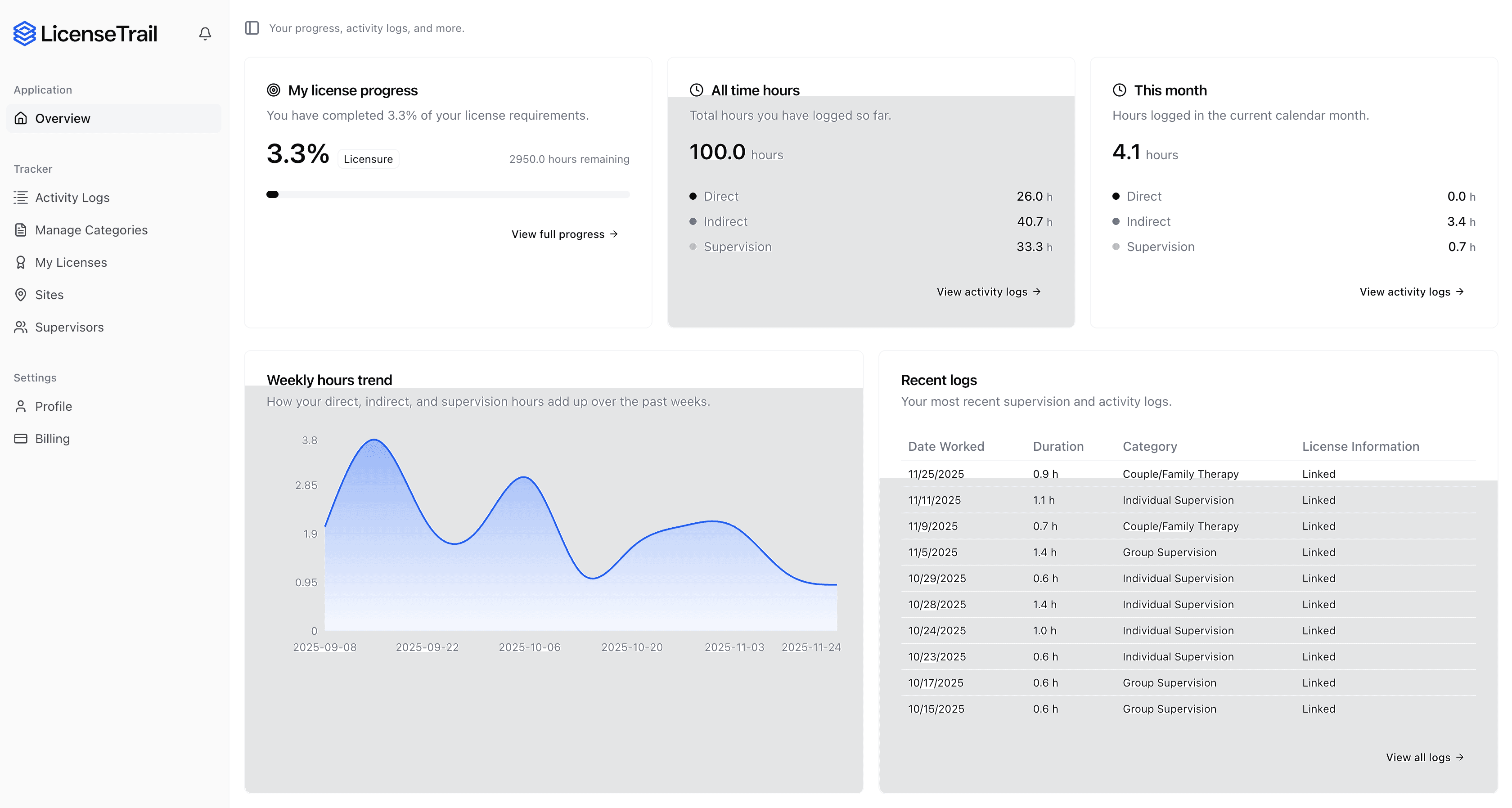
License Trail checks your direct, indirect, and supervision hours against New-mexico LP requirements continuously and flags mismatches before you submit.
 Start Tracking for Free
No credit card required · Free plan available
Related Licenses
Is your spreadsheet hiding New-mexico LP risks?
Stop guessing if your categories match New Mexico Board of Psychologist Examiners requirements. License Trail checks your direct, indirect, and supervision hours continuously and flags mismatches before you submit.
Import or log
Bring your spreadsheet or start fresh
Upload your existing tracking spreadsheet and we'll map every hour into the right New Mexico Board of Psychologist Examiners categories automatically.
Verify against New-mexico
Catch mismatches before the board does
License Trail checks your direct, indirect, and supervision hours against New-mexico LP requirements continuously.
Export board-ready
One-click clean reports
Generate professional, board-ready reports for supervision meetings and New Mexico Board of Psychologist Examiners submissions in seconds.
No credit card required · Free plan available