
New-mexico LSAA Requirements: Hours, Exams & Step-by-Step Guide
Stop guessing if your categories match New-mexico requirements. License Trail checks your direct, indirect, and supervision hours against LSAA requirements continuously and flags mismatches before you submit.
No credit card required · Free plan available
Quick Requirements Overview
- Minimum age: 21+
- Degree: At least an accredited associate degree in counseling/counseling-related/substance-abuse-related field (exceptions may be approved case-by-case)
- Training hours: 90 clock hours of substance abuse counseling education/training (only quantified pre-licensure hours requirement)
- Ethics: Sign attestation to read/abide by the Board’s code of ethics
- Supervision required: Must arrange qualified supervision + an “experience plan” before applying and practice under supervision at all times as an LSAA
- No pre-licensure experience hours: No minimum client-contact or supervised practice hours required for initial LSAA licensure
- Application documentation: Completed application + official transcripts + proof of 90 hours + supervisor/experience plan verification
- Fees (per schedule): $75 application fee (nonrefundable) + $75 initial licensure fee
License Details
Procedures
In New Mexico, the Licensed Substance Abuse Associate (LSAA) is the entry‑level, restricted addiction‑counseling license regulated by the Counseling and Therapy Practice Board under the Regulation and Licensing Department. The controlling rules are in the New Mexico Administrative Code (NMAC), Title 16, Chapter 27, Part 13: “Requirements for Licensure as a Substance Abuse Associate (LSAA).” (srca.nm.gov)
A key point for planning: the LSAA license itself does not require any minimum number of client-contact or supervised experience hours for initial licensure. The only quantitative “hours” requirement is 90 clock hours of education and training in substance abuse counseling. (srca.nm.gov)
1. Core eligibility to become an LSAA
The Board’s LSAA rule (16.27.13.9 NMAC) lays out the minimum qualifications. To qualify, an applicant must: (srca.nm.gov)
-
Age
- Be at least 21 years of age.
-
Ethics attestation
- Sign a statement, on the Board’s application, that the applicant has read the code of ethics and agrees to be bound by it.
-
Education (degree requirement)
- Hold at minimum an associate degree from an accredited institution:
- in counseling, or
- a counseling‑related field, or
- a substance abuse–related field.
- The Board may, on a case‑by‑case basis, approve applicants whose degree is not in those fields. (srca.nm.gov)
- Hold at minimum an associate degree from an accredited institution:
-
Education (training hours requirement)
- Have a total of 90 clock hours of education and training in the areas of substance abuse counseling. (srca.nm.gov)
-
Supervision arranged in advance (“experience plan”)
- Before applying, the applicant must:
- Arrange appropriate supervision, and
- Have an “experience plan” in place with a qualified supervisor. (srca.nm.gov)
- Before applying, the applicant must:
2. The “hours” that are required – and those that are not
2.1 Required hours for LSAA licensure
For LSAA, the Board’s rules specify only one type of hour requirement for initial licensure:
- 90 clock hours of education and training “in the areas of substance abuse counseling.” (srca.nm.gov)
These 90 hours can be met through:
- Academic coursework (college/university), and/or
- Continuing‑education style trainings, workshops, or seminars that are clearly substance‑abuse‑counseling focused (the Board’s application uses a specific attachment—currently “Attachment D”—to document these hours). (law.cornell.edu)
2.2 Hours not required for LSAA
The Board does not require any fixed number of:
- Pre‑licensure client‑contact hours, or
- Pre‑licensure supervised experience hours
to obtain the LSAA. Outside guidance for New Mexico explicitly notes that LSAA applicants are not required to have any experience prior to application; supervised experience-hour requirements attach later if/when you move up to the higher LADAC license. (publichealthonline.org)
That means you do not see language like “1,500 hours of direct experience and 1,500 hours of supervised experience” in the LSAA rule. The only quantified requirement in Part 13 is the 90 clock hours of education/training.
3. Supervision and the “experience plan”
Although there is no numeric hour minimum, supervision is central to LSAA licensure and practice.
3.1 Who can supervise an LSAA
Under 16.27.13.8 NMAC, supervision for an LSAA must be provided by one of the following licensed professionals, each of whom must have experience in alcohol and drug abuse counseling: (law.cornell.edu)
- Licensed Professional Clinical Mental Health Counselor (LPCC)
- Licensed Marriage and Family Therapist (LMFT / LFMT in the rule text)
- Licensed Professional Art Therapist (LPAT)
- Psychologist
- Psychiatrist
- Licensed Alcohol and Drug Abuse Counselor (LADAC) with three years of post‑licensure alcohol and drug abuse experience
- Clinical Nurse Specialist in psychiatry
- Licensed Independent or Clinical Social Worker (LISW or LCSW)
Key Board language you must account for:
- An LSAA “must practice under supervision at all times.”
- Even if an LSAA later completes the requirements for LADAC, they must continue to practice under supervision until the LADAC license is actually issued. (law.cornell.edu)
3.2 Required “experience plan”
The LSAA rule requires that, at the time of application, you have “arranged for appropriate supervision, including an experience plan.” (srca.nm.gov)
Documented on current forms as:
- Attachment C – Supervisor verification and experience plan
- Confirms:
- A qualified supervisor has been obtained, and
- An experience plan has been established, and
- The supervisor agrees the associate will only participate in alcohol and drug abuse counseling sessions. (law.cornell.edu)
- Confirms:
The Board does not define, in rule, a minimum number of supervised hours that must be in that experience plan for LSAA. It is a qualitative plan and ongoing supervisory arrangement, not a quantified hour requirement.
4. Documentation and application components
Under 16.27.13.9(E) NMAC, an LSAA applicant must submit: (srca.nm.gov)
-
Completed application form
- As specified in 16.27.3.8 NMAC (general application rule).
-
Official transcripts
- Official transcripts from each institution contributing to your qualifying degree (associate, bachelor’s, master’s, or doctorate).
- Transcripts must be sent directly to the Board office from the institution; electronic submission is permitted if sent from the institution.
-
Verification of 90 clock hours
- Documented on the Board’s designated attachment (currently “Attachment D”) showing 90 clock hours of education and training in substance abuse.
-
Verification of supervision and experience plan
- The Board’s supervision attachment (currently “Attachment C”), signed by your supervisor, confirming:
- An appropriate supervisor has been obtained,
- An experience plan has been established, and
- You will only engage in alcohol and drug abuse counseling sessions under that supervision. (law.cornell.edu)
- The Board’s supervision attachment (currently “Attachment C”), signed by your supervisor, confirming:
In addition, the Board’s fee schedule lists for LSAA: (rld.nm.gov)
- Application fee for licensure: $75 (non‑refundable)
- Initial LSAA licensure fee: $75
(These are separate: one is the application processing fee, one is the license-issuance fee.)
5. How LSAA “tiers” relate to education
In practice, New Mexico recognizes three “tiers” of LSAA based on degree level:
- Tier 1 LSAA – Associate’s degree
- Tier 2 LSAA – Bachelor’s degree
- Tier 3 LSAA – Master’s degree
External guidance summarizes that the Board licenses “three tiers of Licensed Substance Abuse Associate (LSAA)” with degree level determining the tier. (counselingschools.com)
However, the underlying legal requirement for any LSAA tier remains:
- Minimum associate degree in an approved area, and
- 90 clock hours of substance‑abuse‑counseling education, plus arranged supervision and experience plan. (srca.nm.gov)
Higher degrees upgrade the LSAA tier but do not, by themselves, introduce extra pre‑licensure hour requirements for LSAA beyond the 90 clock hours.
6. After licensure: renewal and continuing‑education hours
Once licensed as an LSAA, you fall under the Board’s continuing education rule (16.27.16 NMAC), which applies to “substance abuse associates” along with other counseling and therapy license types. (srca.nm.gov)
The current Board and rule language requires: (rld.nm.gov)
- 40 contact hours of continuing education every two‑year renewal period, and
- Within that 40 hours:
- 12 hours must be in ethics related to counseling/mental health.
- If you are an approved supervisor, 9 hours must be in supervision (this piece matters if you later become independently licensed and designated as a supervisor).
A “contact hour” is defined as 60 minutes of continuing education. (law.cornell.edu)
7. Distinguishing LSAA from LADAC (where large experience-hour requirements do exist)
Many secondary sources discussing New Mexico addiction counseling combine LSAA and LADAC information, which can cause confusion about hours.
For the Licensed Alcohol and Drug Abuse Counselor (LADAC) credential—not the LSAA—the Board does require substantial supervised client-contact hours before licensure, for example: (addiction-counselor.org)
- With an associate’s degree:
- 3,000 supervised hours of client contact (over at least 3 years), including 200 hours of face‑to‑face supervision.
- With a bachelor’s degree:
- 2,000 supervised hours (over at least 2 years), including 100 hours of face‑to‑face supervision.
- With a master’s or doctorate:
- 1,000 supervised hours (over at least 1 year), including 50 hours of face‑to‑face supervision.
Those large hour requirements belong to LADAC, not to LSAA. The LSAA is specifically designed as a supervised, restricted license with:
- No pre‑licensure practice‑hour minimum,
- A 90‑hour education/training requirement, and
- A requirement to practice under ongoing supervision at all times according to an approved experience plan. (srca.nm.gov)
Practical summary of LSAA hour requirements
For the LSAA, as defined by the New Mexico Counseling and Therapy Practice Board’s rules:
-
Education hours required for licensure
- 90 clock hours of substance‑abuse‑counseling education/training.
-
Supervised practice hours required for licensure
- Zero hours specified in rule for initial LSAA licensure.
- Instead, you must:
- Secure a qualified supervisor, and
- File an experience plan under that supervisor,
- Then practice under supervision at all times once licensed.
All other major hour counts you may see—1,000, 2,000, 3,000 hours of supervised experience—belong to the LADAC license, not to the LSAA.
Track your LSAA hours with confidence
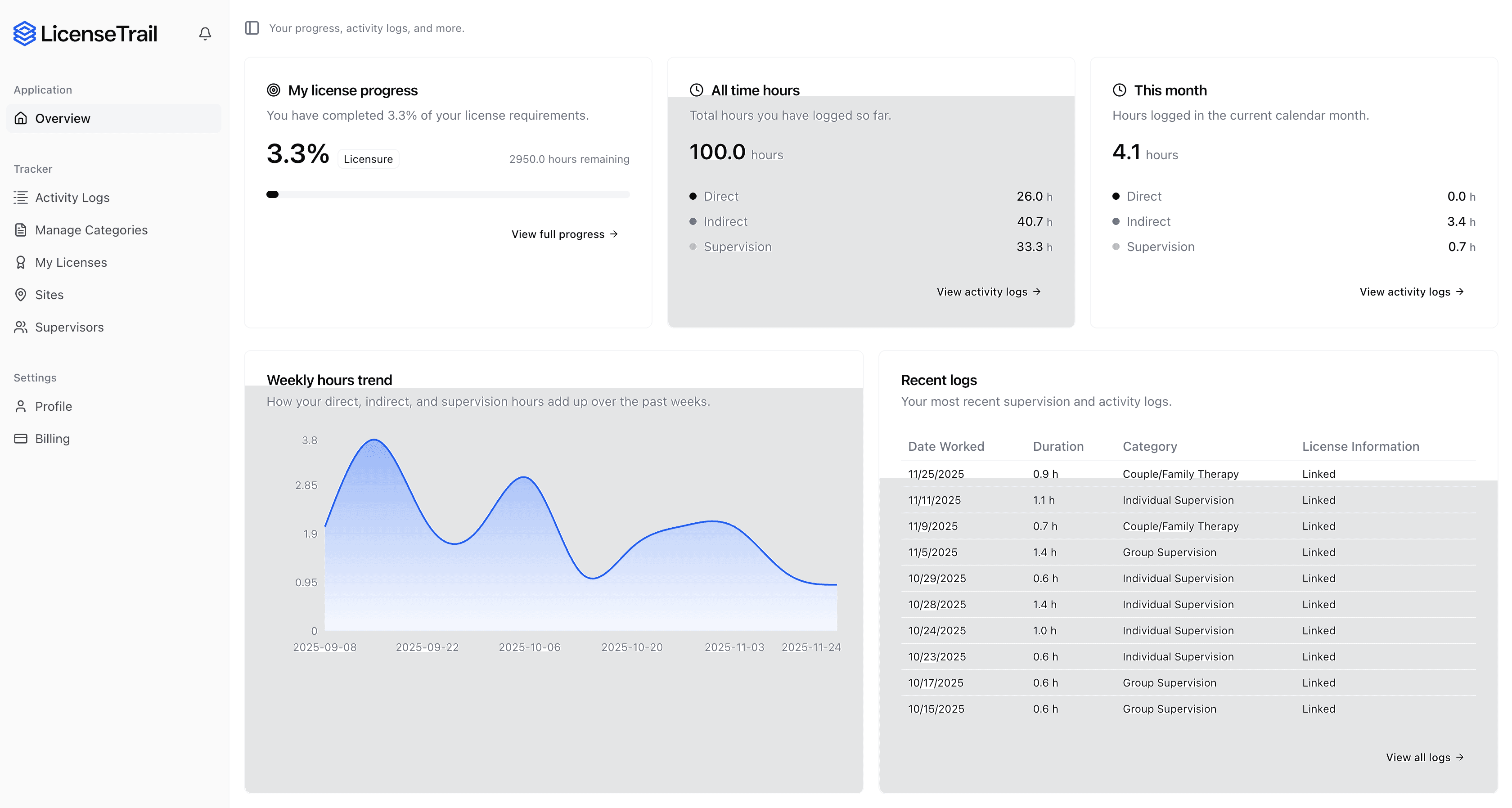
License Trail checks your direct, indirect, and supervision hours against New-mexico LSAA requirements continuously and flags mismatches before you submit.
 Start Tracking for Free
No credit card required · Free plan available
Is your spreadsheet hiding New-mexico LSAA risks?
Stop guessing if your categories match New Mexico Counseling and Therapy Practice Board requirements. License Trail checks your direct, indirect, and supervision hours continuously and flags mismatches before you submit.
Import or log
Bring your spreadsheet or start fresh
Upload your existing tracking spreadsheet and we'll map every hour into the right New Mexico Counseling and Therapy Practice Board categories automatically.
Verify against New-mexico
Catch mismatches before the board does
License Trail checks your direct, indirect, and supervision hours against New-mexico LSAA requirements continuously.
Export board-ready
One-click clean reports
Generate professional, board-ready reports for supervision meetings and New Mexico Counseling and Therapy Practice Board submissions in seconds.
No credit card required · Free plan available