
New-york LCAT Requirements: Hours, Exams & Step-by-Step Guide
Stop guessing if your categories match New-york requirements. License Trail checks your direct, indirect, and supervision hours against LCAT requirements continuously and flags mismatches before you submit.
No credit card required · Free plan available
Quick Requirements Overview
- Age/character: 21+ and “good moral character”
- Education: Master’s (or higher) in Creative Arts Therapy from NYSED-registered program or “substantially equivalent” (min 48 semester credits with required CAT content)
- Practicum/internship (pre-degree): 500 supervised clock hours in Creative Arts Therapy
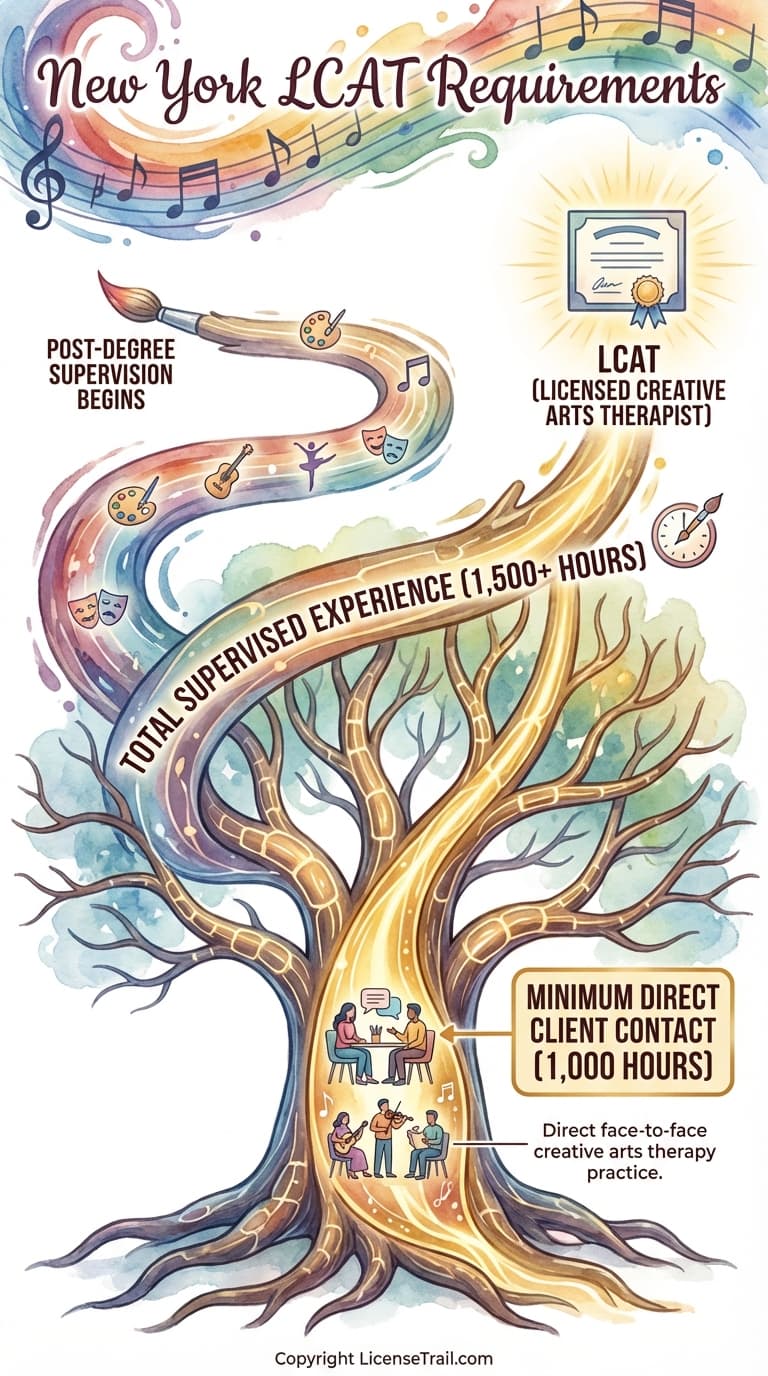
- Post-degree supervised experience: 1,500 supervised clock hours in an acceptable setting (≥1,000 direct client contact; ≤500 indirect activities)
- Supervision: “General supervision” with ≥1 hr/week or 4 hrs/month in-person individual/group supervision; supervisor must be NY-licensed/registered (e.g., LCAT, MD/PA, Psychologist, LCSW, RN/NP) and competent in CAT
- Exam: Pass ATCB or CBMT board exam, or NYSED Case Narrative Exam
- Mandated training: NYS-approved child abuse identification/reporting course (required for license and limited permit)
- Limited permit (typical to earn hours): Apply after Form 1 + education approval; valid 24 months, extendable up to 48 months total
License Details
Procedures
Becoming a Licensed Creative Arts Therapist (LCAT) in New York State
New York regulates the title and practice of “Creative Arts Therapist” and “Licensed Creative Arts Therapist (LCAT)” under the State Education Department, Office of the Professions, State Board for Mental Health Practitioners. To practice as an LCAT in New York, you must meet specific requirements in education, supervised experience, examination, and mandated training, and then be licensed and registered with the state. (op.nysed.gov)
Below is a step‑by‑step guide, with particular focus on the types and number of hours required and the state’s own terminology.
1. Core eligibility
New York requires that an LCAT applicant: (op.nysed.gov)
- Is at least 21 years old.
- Is of “good moral character,” as determined by the Department.
- Meets education, experience, and examination requirements.
- Completes coursework or training in the identification and reporting of child abuse from a NYS‑approved provider.
These are in addition to submitting the formal application and fees.
2. Education requirement
Degree level and field
You must complete a master’s or higher degree in creative arts therapy from either: (op.nysed.gov)
- A program registered by NYSED as leading to licensure in Creative Arts Therapy, or
- A program judged by the Department to be “substantially equivalent.”
A counseling, psychology, social work, or “related” degree does not, by itself, meet this education requirement; such applications are individually evaluated for equivalence and any missing coursework or practicum. (op.nysed.gov)
Minimum graduate credits and required content
To be considered substantially equivalent, your graduate study must include at least 48 semester hours (or equivalent), with coursework that includes, at minimum, content in: (op.nysed.gov)
- Preparation in one or more creative arts therapies (art, music, dance, drama, psychodrama, poetry, etc.)
- Human growth and development
- Theories in Creative Arts Therapy
- Group dynamics
- Assessment and appraisal of individuals and groups
- Research and program evaluation
- Professional orientation and ethics
- Foundations of Creative Arts Therapy and psychopathology
- Clinical instruction
Internship / practicum hours (pre‑degree)
Your degree program must include a supervised internship or supervised practicum in Creative Arts Therapy of at least 500 clock hours. (op.nysed.gov)
These 500 clock hours are part of your educational requirement and are separate from the post‑degree supervised experience described below.
3. Supervised post‑degree experience: exact hour breakdown
Total hours and terminology
For licensure, New York requires “a supervised experience of at least 1,500 clock hours providing creative arts therapy in a setting acceptable to the department.” (op.nysed.gov)
Key points:
- The state uses the term “clock hours” and “contact hours”; 1 clock hour = 60 minutes of practice time.
- All 1,500 hours are supervised; there is not a separate or additional 1,500‑hour requirement.
- This experience must be post‑degree—completed after you finish the required master’s (or higher) program. (op.nysed.gov)
Direct vs. indirect hours
The regulations are explicit on the type of hours:
- You must complete not less than 1,000 clock hours of direct contact with clients.
- The remaining up to 500 clock hours may consist of “other activities that do not involve direct client contact, including but not limited to, recordkeeping, case management, supervision, and professional development.” (op.nysed.gov)
So in practice, the standard breakdown is:
- 1,500 total supervised clock hours, of which
- ≥ 1,000 hours = direct client contact (therapy, assessment, etc.)
- ≤ 500 hours = indirect activities (documentation, case coordination, supervision meetings, training, etc.)
This means New York does not require “1,500 hours of direct experience and 1,500 hours of supervised experience.” Instead:
- There is one supervised experience requirement of 1,500 clock hours total, and
- Within that, at least 1,000 hours must be direct client contact.
Nature of the clinical work
Your experience must involve providing creative arts therapy, defined in law as assessment, evaluation, and therapeutic intervention/treatment of mental, emotional, developmental, and behavioral disorders through use of the arts, along with use of assessment instruments, mental health counseling, and psychotherapy as needed within the creative arts therapy scope. (op.nysed.gov)
Timeframe and pacing
The Department notes:
- Hour calculations assume a typical 40–45 hour work week so that you receive appropriate supervision and feedback.
- Completing the full 1,500 hours in an “unreasonable amount of time” is considered educationally unsound and may not be accepted. (op.nysed.gov)
You cannot simply piece together indirect activities from one setting and direct activities from another and combine them as if they formed a single placement; the Department expects the hours in a given setting to reflect an integrated supervised experience. (op.nysed.gov)
4. Supervision requirements (who can supervise and how)
Who qualifies as a supervisor
Your supervisor must be licensed and registered in New York as one of the following, and be competent in Creative Arts Therapy, or have equivalent qualifications as determined by the Department: (op.nysed.gov)
- Licensed Creative Arts Therapist (LCAT)
- Physician or physician assistant
- Psychologist
- Licensed clinical social worker (LCSW)
- Registered professional nurse or nurse practitioner
“General supervision” and required supervision hours
The state uses the term “general supervision”, which means: (op.nysed.gov)
- The supervisor is available for consultation, assessment, and evaluation whenever you are providing services.
- The supervisor exercises a level of oversight appropriate to the circumstances and is responsible for services you provide under a limited permit.
The Board specifies supervision frequency:
- The supervisor must provide at least one hour per week or four hours per month of in‑person individual or group supervision. (op.nysed.gov)
During supervision, the supervisor must:
- Review your assessment, evaluation, and treatment of each client under their general supervision.
- Provide oversight, guidance, and direction to support your development as a Creative Arts Therapist. (op.nysed.gov)
No supervisor may supervise more than five limited permit holders at one time. (op.nysed.gov)
Documentation of hours
All supervised experience must be documented and verified on Certification of Supervised Experience (Form 4B), completed and sent directly by the supervisor (or, in rare cases, by another licensed colleague when direct supervisor attestation is unavailable). (op.nysed.gov)
5. Settings where hours can be earned
The setting must: (op.nysed.gov)
- Be legally authorized to provide services that constitute the practice of Creative Arts Therapy under NY law.
- Be responsible for the services provided by you as an applicant under supervision.
- Employ or contract with appropriately licensed professionals who can serve as your supervisors.
Examples of typical acceptable settings (if authorized and appropriately staffed):
- Hospitals, clinics, and behavioral health agencies
- Schools and community programs
- Nursing homes and residential facilities
- Private or group practices authorized to employ licensed professionals (op.nysed.gov)
6. Limited permit: how you legally accrue hours in New York
In New York State, you normally cannot earn licensure‑qualifying experience without a limited permit.
Purpose and timing
A limited permit allows an individual who has met all requirements except the examination and/or experience to practice Creative Arts Therapy under supervision while completing those requirements. (op.nysed.gov)
You may apply for a limited permit:
- After filing Application for Licensure (Form 1) and fee,
- After the Department has determined that your education is satisfactory, and
- When you have a qualifying supervisor and setting identified and listed on Application for Limited Permit (Form 5). (op.nysed.gov)
Validity period
- A limited permit is initially valid for 24 months (2 years).
- It may be extended for up to two additional 12‑month periods at the Department’s discretion, provided you have made “good faith efforts” to complete the experience and/or pass the examination.
- The maximum total time authorized under a limited permit (including extensions) is 48 months (4 years). (op.nysed.gov)
If you leave a job, the employer must return the permit to the State Board; the “clock stops,” and you may later apply for a new permit for the remaining time. (op.nysed.gov)
7. Examination requirement
To meet the exam requirement for LCAT licensure in New York, you must pass one of the following: (op.nysed.gov)
- Board Certification exam administered by the Art Therapy Credentials Board (ATCB); or
- Board Certification exam administered by the Certification Board for Music Therapists (CBMT); or
- The New York State Case Narrative Examination for Creative Arts Therapy (administered by Meazure Learning).
New York does not accept examinations from other professions (e.g., counseling, social work, psychology) to meet the LCAT exam requirement. (op.nysed.gov)
You must have your education approved and an application on file before being admitted to an exam for New York licensure.
8. Child abuse identification and reporting course
All applicants for LCAT licensure (and for a limited permit) must complete NY‑approved coursework or training in the identification and reporting of child abuse in accordance with Education Law §6507(3)(a). (op.nysed.gov)
The course must be taken from a provider specifically approved by the New York State Education Department.
9. Application process and forms (overview)
From the Board’s perspective, a typical initial licensure pathway looks like this: (op.nysed.gov)
- Complete education (including the 500‑hour internship/practicum) in an approved or equivalent Creative Arts Therapy graduate program.
- File Application for Licensure (Form 1) with fee.
- Have your program send Certification of Professional Education (Form 2) (and, if needed for non‑registered programs, Form 2INT documenting internship/practicum details).
- Apply for a limited permit (Form 5) once education is approved and you have a qualifying site and supervisor.
- Under the limited permit, complete at least 1,500 supervised clock hours, including ≥1,000 hours of direct client contact. Your supervisor submits Form 4B documenting these hours.
- Pass an approved examination (ATCB, CBMT, or NYS Case Narrative).
- Submit any remaining documents; once all requirements are verified, the Department issues your LCAT license and registration.
10. Summary of hour‑based requirements for LCAT in New York
Putting the hours into one place for clarity:
Educational (pre‑degree) clinical hours
- ≥ 500 clock hours of supervised internship/practicum in Creative Arts Therapy, as part of the graduate degree. (op.nysed.gov)
Post‑degree supervised professional experience
- ≥ 1,500 clock hours of supervised experience providing Creative Arts Therapy in an acceptable setting, after the degree is complete.
- Of these 1,500 hours:
- At least 1,000 clock hours must be direct client contact.
- Up to 500 clock hours may be indirect tasks (recordkeeping, case management, supervision, professional development, other non‑direct activities). (op.nysed.gov)
Supervision contact
- At least 1 hour per week or 4 hours per month of in‑person individual or group supervision by a qualified supervisor, throughout the period you are accruing your 1,500 hours. (op.nysed.gov)
These are the current New York State Board for Mental Health Practitioners requirements as of late 2025. For actual application, always cross‑check with the NYSED Office of the Professions Creative Arts Therapy pages, since regulations and forms can be updated.
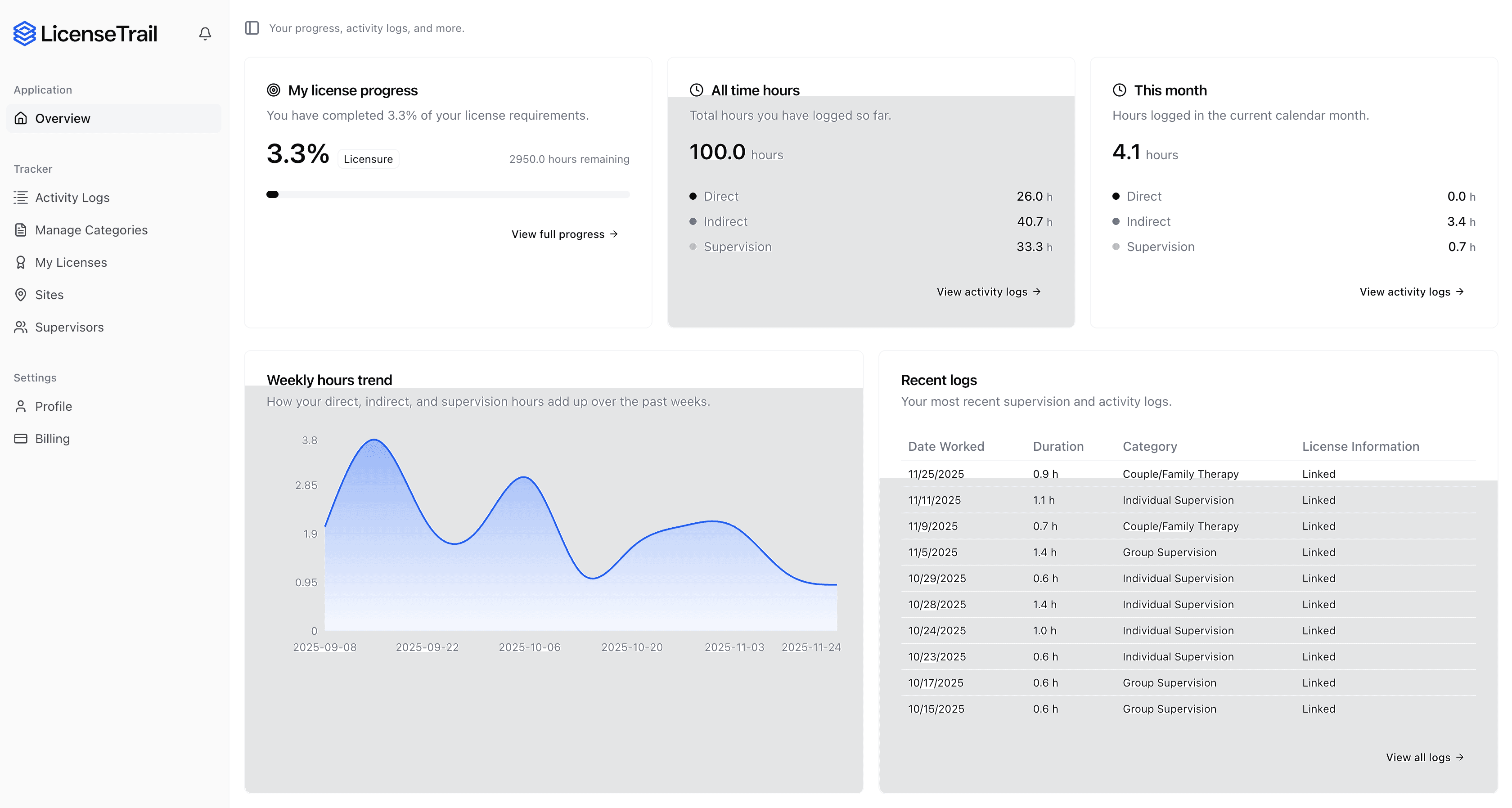
Track your LCAT hours with confidence
License Trail checks your direct, indirect, and supervision hours against New-york LCAT requirements continuously and flags mismatches before you submit.
 Start Tracking for Free
No credit card required · Free plan available
Is your spreadsheet hiding New-york LCAT risks?
Stop guessing if your categories match New York State Board for Mental Health Practitioners requirements. License Trail checks your direct, indirect, and supervision hours continuously and flags mismatches before you submit.
Import or log
Bring your spreadsheet or start fresh
Upload your existing tracking spreadsheet and we'll map every hour into the right New York State Board for Mental Health Practitioners categories automatically.
Verify against New-york
Catch mismatches before the board does
License Trail checks your direct, indirect, and supervision hours against New-york LCAT requirements continuously.
Export board-ready
One-click clean reports
Generate professional, board-ready reports for supervision meetings and New York State Board for Mental Health Practitioners submissions in seconds.
No credit card required · Free plan available