
New-york LMHC Requirements: Hours, Exams & Step-by-Step Guide
Stop guessing if your categories match New-york requirements. License Trail checks your direct, indirect, and supervision hours against LMHC requirements continuously and flags mismatches before you submit.
No credit card required · Free plan available
Quick Requirements Overview
- Age/character/training: 21+; good moral character; NY child abuse identification & reporting training required
- Application: Submit NYSED licensure application (Form 1) + required forms/fees
- Education: Master’s/doctoral counseling degree ≥60 graduate semester hours (NYSED licensure‑qualifying, CACREP CMHC, or NYSED “substantially equivalent”)
- Degree practicum/internship: ≥1 academic year = ≥600 clock hours supervised practicum/internship (in-program)
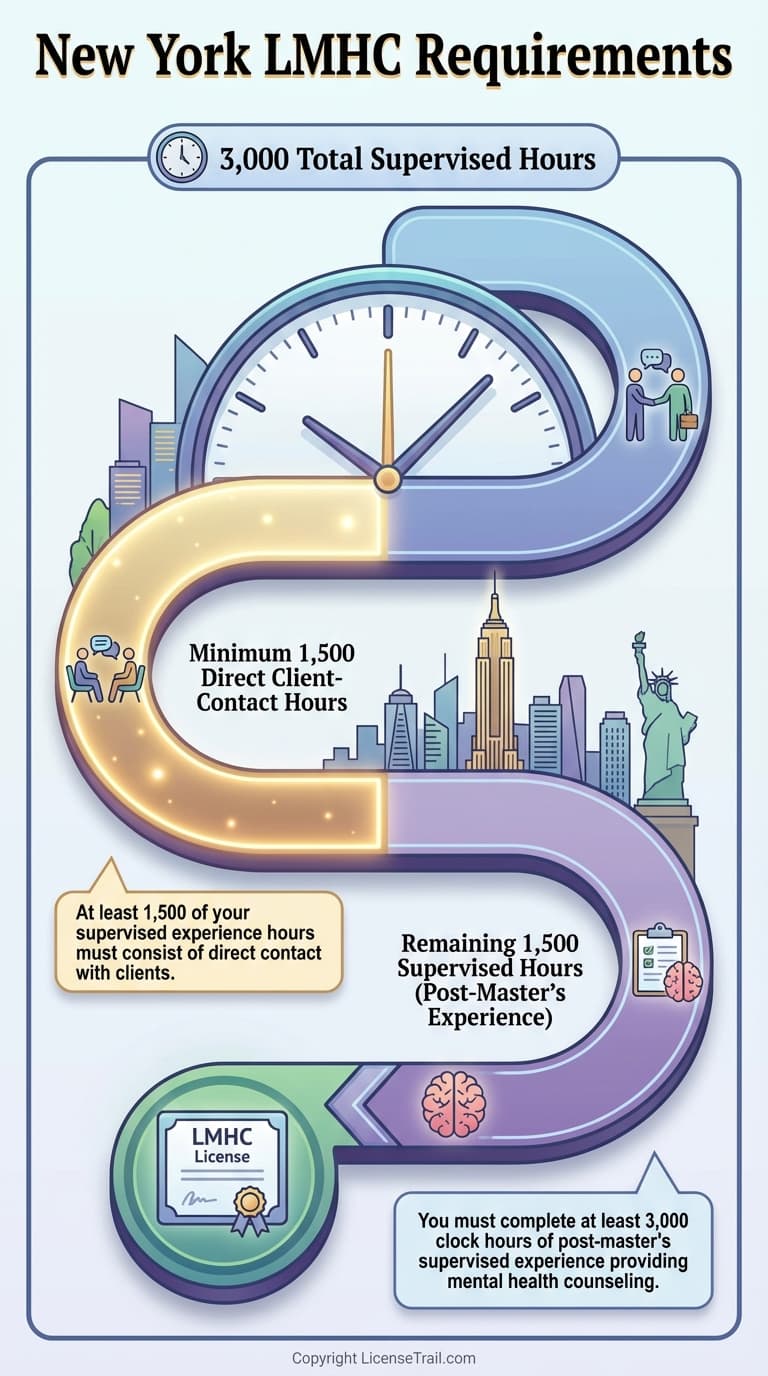
- Post‑degree experience: 3,000 supervised clock hours after degree awarded
- Direct client minimum: ≥1,500 hours must be direct client contact; up to 1,500 may be indirect (e.g., notes, case mgmt, research, PD)
- Supervision/setting rules: Authorized setting; NY‑licensed qualified supervisor; avg ≥1 hr/week (or 2 hrs biweekly) in‑person individual/group supervision; if <3,000 hours at a site, ≥50% direct at that site; supervisor verifies (Form 4B)
- Exam: State‑approved exam required; can sit only after degree is awarded (no pre‑degree testing)
License Details
Procedures
Becoming a Licensed Mental Health Counselor (LMHC) in New York State is governed by the New York State Education Department (NYSED), Office of the Professions, under the State Board for Mental Health Practitioners. The process combines specific graduate education, defined internship hours, and tightly regulated post‑degree supervised experience.
Below is a structured guide, with emphasis on the exact types and amounts of hours New York requires.
1. General eligibility
New York State requires that an LMHC applicant:(op.nysed.gov)
- Be at least 21 years old.
- Be of good moral character.
- Meet the education requirement (qualifying counseling degree).
- Meet the experience requirement (defined post‑master’s hours).
- Meet the examination requirement (state‑approved licensing exam, taken after the degree is awarded).
- Complete New York‑approved training in the identification and reporting of child abuse.
You also must submit the Application for Licensure (Form 1) and associated forms/fees to the Office of the Professions.(op.nysed.gov)
2. Required graduate education
2.1 Type of degree and program
To qualify educationally as an LMHC in New York, you must complete a master’s or doctoral degree in counseling from a program that is one of the following:(op.nysed.gov)
- Registered by NYSED as licensure‑qualifying in Mental Health Counseling; or
- Accredited by CACREP (or another acceptable accreditor) specifically as a clinical mental health counseling program of 60 semester hours; or
- Determined by NYSED to be “substantially equivalent” to such a program.
“Substantially equivalent” means at least 60 graduate semester hours including specific content areas such as: human growth and development, counseling theory and practice, psychopathology, group dynamics, assessment and appraisal, research and program evaluation, professional orientation and ethics, foundations of mental health counseling and consultation, and clinical instruction.(op.nysed.gov)
2.2 Required internship/practicum hours (during the degree)
New York requires that the qualifying degree program include a supervised internship or practicum in mental health counseling that meets all of the following:(op.nysed.gov)
- It must be at least one academic year in length.
- For New York’s purposes, one year is defined as at least 600 clock hours in the internship/practicum.
This internship/practicum is part of the required graduate education. It is separate from and in addition to the post‑master’s supervised experience described below.
3. Post‑master’s supervised experience: 3,000 clock hours
After your qualifying degree is completed, New York requires a substantial period of supervised practice before you can be fully licensed as an LMHC.
3.1 Total hours and timing
The statute and regulations require:(op.nysed.gov)
- At least 3,000 clock hours of post‑master’s supervised experience in Mental Health Counseling.
- These hours must be obtained after completion of the master’s degree required for licensure.
This experience must be “providing Mental Health Counseling” in a setting the Department finds acceptable, under supervision that meets state criteria.
3.2 Direct vs. indirect hours (very specific breakdown)
New York is explicit about how those 3,000 hours must be composed:(op.nysed.gov)
- Minimum 1,500 clock hours must be direct contact with clients.
- The remaining up to 1,500 hours may be indirect activities that do not involve direct client contact.
In the State Board’s language:
- The 3,000 hours are all supervised experience.
- Not less than 1,500 hours of that experience must be direct client contact.
- The remainder may be “other activities that do not involve direct client contact,” which the Department describes as including (but not limited to):
- Record‑keeping
- Case management
- Research
- Supervision (i.e., participating as the supervisee)
- Professional development activities(op.nysed.gov)
A common way to phrase this, consistent with the state’s definitions, is:
3,000 supervised clock hours total, of which at least 1,500 must be supervised direct client contact, and up to 1,500 may be supervised indirect clinical activities.
All 3,000 hours are supervised experience; the 1,500 direct hours are not separate from supervision—they are a subset of the supervised hours.
3.3 Rules when you don’t complete all 3,000 in one setting
If you complete fewer than 3,000 hours in a given setting, then at least half of the hours in that setting must be direct client contact (e.g., if you do 1,000 hours at Site A, at least 500 must be direct client hours at Site A). It is not acceptable to piece together direct hours from one setting and only indirect hours from another to try to reach the total.(op.nysed.gov)
4. Nature of the supervised experience
4.1 What counts as “practice of Mental Health Counseling”
For purposes of these hours, New York defines the practice of Mental Health Counseling to include:(op.nysed.gov)
- Evaluation, assessment, and treatment (using verbal or behavioral methods) of problems or disorders of behavior, character, development, emotion, personality, or relationships, with individuals, couples, families, or groups; and
- Use of assessment instruments and counseling/psychotherapy to identify, evaluate, and treat dysfunctions and disorders in order to provide appropriate mental health counseling services.
Activities within this scope—when done in an authorized setting under a qualified supervisor—can count toward the 3,000 hours, with the direct vs. indirect distinctions as outlined above.
4.2 Supervision requirements
For your 3,000 post‑master’s hours to be accepted, New York requires that:(op.nysed.gov)
- The experience be completed “in a legal manner” in a setting authorized to provide professional services.
- You be supervised by a qualified supervisor, who must be licensed and registered in New York in one of the following professions (and competent in Mental Health Counseling):
- Mental Health Counseling
- Medicine (physician)
- Physician Assistant
- Psychology
- Licensed Clinical Social Work
- Registered Professional Nurse or Nurse Practitioner
- The supervisor:
- Is responsible for assessment, evaluation, and treatment of each patient.
- Delegates to you only those functions you are competent to perform.
- Provides an average of at least 1 hour per week or 2 hours every other week of in‑person individual or group supervision.
- Reviews your assessment and treatment of each client under their “general supervision.”
New York also limits each supervisor to no more than five limited permit holders at one time and requires that supervisors complete a Certification of Supervised Experience (Form 4B) to verify your hours.(op.nysed.gov)
5. Acceptable practice settings
The supervised experience must occur in an acceptable setting as defined in the Commissioner’s regulations and on the NYSED site. The setting must:(op.nysed.gov)
- Be a location where legally authorized individuals provide services that fall within the scope of practice of Mental Health Counseling;
- Take responsibility for services provided by persons gaining licensure experience; and
- Provide appropriate supervision.
Examples of acceptable settings include:
- A professional corporation, registered limited liability partnership, or professional service limited liability company authorized to provide mental health counseling services;
- A sole proprietorship or professional partnership owned by licensed professionals providing services within the mental health counseling scope;
- Hospitals or clinics authorized under Article 28 of the Public Health Law;
- Programs or facilities authorized under the Mental Hygiene Law or under federal law to provide mental health counseling‑type services;
- Other entities that are exempt or otherwise authorized under New York law (or the law of the jurisdiction where located) to provide such services.(op.nysed.gov)
The setting cannot be a private practice owned or operated by you as the applicant.
6. Limited permit while accruing hours
In New York State, the 3,000 supervised hours are normally gained while you hold a limited permit issued by NYSED. Key points:(op.nysed.gov)
- You must apply for the LMHC license and have your education approved before you are eligible for a limited permit.
- The permit is issued for a specific setting and specific supervisor(s).
- Your supervised hours must be accrued under the conditions of that permit (or under legally acceptable supervised experience in another jurisdiction, if you are coming from out of state, which NYSED then evaluates for equivalence).
7. Licensing examination
New York requires an examination satisfactory to the Board, consistent with regulations.(op.nysed.gov)
For LMHC candidates:
- You must have completed your graduate program and been awarded the degree before New York will approve you to sit for the licensing exam; no pre‑degree testing is permitted.(op.nysed.gov)
(New York has historically used the National Clinical Mental Health Counseling Examination (NCMHCE) or an equivalent exam designated by the Department; current specifics are confirmed through NYSED’s exam information and application forms.)
8. Post‑licensure: diagnostic privilege (separate additional requirement)
As of recent regulatory changes, New York distinguishes the base LMHC license from an added diagnostic privilege. For that privilege (beyond basic licensure), the regulations require, among other things:(op.nysed.gov)
- Evidence of at least 2,000 hours of supervised, direct client contact specifically including diagnosis, psychotherapy, and assessment‑based treatment planning;
- Or, for LMHCs licensed prior to June 24, 2024, a separate experience pathway involving at least three years of qualifying direct client contact.
This is not part of the initial 3,000‑hour requirement for basic LMHC licensure, but it is important if you plan to obtain the authority to diagnose under New York’s “diagnostic privilege” framework.
9. Summary of hour requirements
Putting the numbers together as New York’s Board defines them:
-
Graduate internship/practicum (during your degree)
- At least 1 academic year, defined as a minimum of 600 clock hours of supervised internship or practicum in mental health counseling as part of a 60‑credit counseling degree that meets NYSED standards.(op.nysed.gov)
-
Post‑master’s supervised experience (after your degree, for licensure)
- Total supervised experience: at least 3,000 clock hours providing Mental Health Counseling.
- Direct contact requirement: not less than 1,500 clock hours of those 3,000 hours must be direct client contact.
- Indirect activities: up to 1,500 clock hours may be indirect, such as record‑keeping, case management, research, supervision participation, and professional development, all under appropriate supervision in an acceptable setting.(op.nysed.gov)
All of these hours must be documented and verified by your supervisor(s) using NYSED’s prescribed forms and must comply with the Board’s rules regarding supervision and acceptable settings.
This summary reflects the New York State Education Department, Office of the Professions, requirements for LMHC licensure and related regulations as available on November 23, 2025. Because laws and regulations can change, applicants should always confirm details directly with NYSED’s Office of the Professions before applying.
Track your LMHC hours with confidence
License Trail checks your direct, indirect, and supervision hours against New-york LMHC requirements continuously and flags mismatches before you submit.
 Start Tracking for Free
No credit card required · Free plan available
Is your spreadsheet hiding New-york LMHC risks?
Stop guessing if your categories match New York State Board for Mental Health Practitioners requirements. License Trail checks your direct, indirect, and supervision hours continuously and flags mismatches before you submit.
Import or log
Bring your spreadsheet or start fresh
Upload your existing tracking spreadsheet and we'll map every hour into the right New York State Board for Mental Health Practitioners categories automatically.
Verify against New-york
Catch mismatches before the board does
License Trail checks your direct, indirect, and supervision hours against New-york LMHC requirements continuously.
Export board-ready
One-click clean reports
Generate professional, board-ready reports for supervision meetings and New York State Board for Mental Health Practitioners submissions in seconds.
No credit card required · Free plan available