
New-york LMFT Requirements: Hours, Exams & Step-by-Step Guide
Stop guessing if your categories match New-york requirements. License Trail checks your direct, indirect, and supervision hours against LMFT requirements continuously and flags mismatches before you submit.
No credit card required · Free plan available
Quick Requirements Overview
- Age 21+, good moral character; complete NYSED application/forms and fees
- Education: Master’s+ in MFT (or NYSED-determined equivalent), minimum 45 semester hours incl. required content areas + 300 direct client-contact practicum hours
- Exam: Pass AMFTRB Examination in Marital and Family Therapy (NY does not accept CA exam)
- Training: NYSED-approved child abuse identification/reporting coursework required (for license/limited permit)
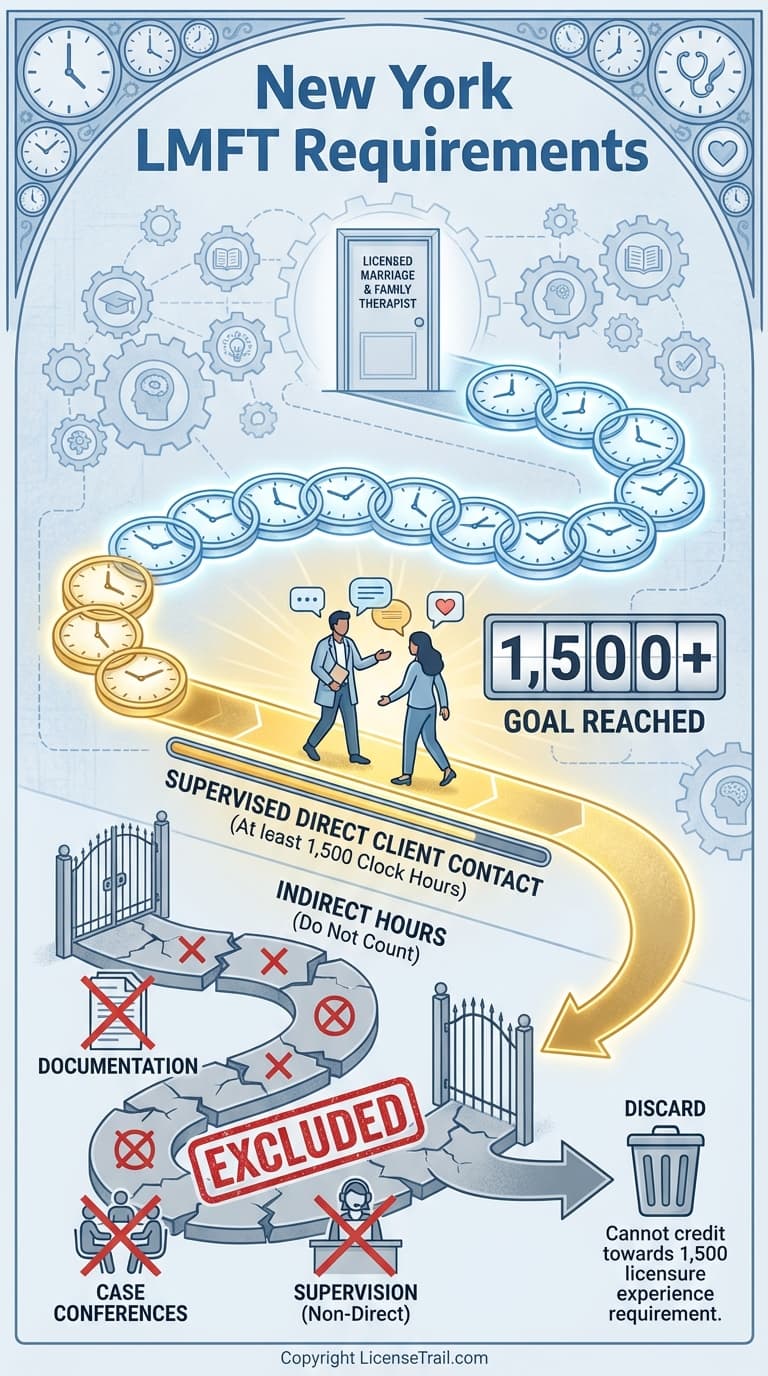
- Experience: 1,500 clock hours supervised clinical experience—all 1,500 must be direct client contact providing MFT in an acceptable setting
- Timing rules: If MFT program is licensure-qualifying/equivalent, hours may be in-program and/or post-degree; if allied-field degree route, all 1,500 hours post-degree
- Supervision: “General supervision” + minimum 1 hr/week (or 2 hrs every other week) face-to-face individual/group; supervisor must be NY-licensed (LMFT/MD/PA/psychologist/LCSW/RN/NP) and competent in MFT; max 5 permit holders per supervisor; document on Form 4B
- NY practice hours generally require a NYSED limited permit (site/supervisor-specific; typically 2 years + possible extensions); separate post-licensure diagnostic privilege may require 2,000 additional supervised direct-contact hours (for those licensed on/after 6/24/2024)
License Details
Procedures
Becoming a Licensed Marriage and Family Therapist (LMFT) in New York State involves meeting detailed requirements set by the New York State Education Department (NYSED), Office of the Professions, under the State Board for Mental Health Practitioners. The Board is very specific about how many hours you need, what counts as “client contact,” what “supervised experience” means, and how the work must be structured.
Below is a structured guide based directly on NYSED’s own language and current regulations as of late 2025.
1. Big-picture requirements for LMFT licensure in New York
To be licensed as an LMFT in New York State, you must: (op.nysed.gov)
- Be at least 21 years old.
- Be of good moral character.
- Meet the education requirements (specific graduate-level degree and coursework).
- Meet the experience requirements (1,500 supervised client contact hours—details below).
- Pass the AMFTRB “Examination in Marital and Family Therapy” (administered by PTC).
- Complete coursework in the identification and reporting of child abuse from a NYSED-approved provider.
This all happens through an application process using NYSED forms (Form 1, Form 2, etc.), but the crucial parts for most applicants are education and experience.
2. Education requirements (what your degree must include)
New York requires a master’s or higher degree in Marriage and Family Therapy or the educational equivalent from an acceptable institution. The degree must be at least 45 semester hours, with specific content areas. (op.nysed.gov)
The curriculum must include at least:
- Human development – at least 3 semester hours (including individual, child, and family development).
- Marriage and family therapy clinical knowledge – at least 12 semester hours, including psychopathology.
- Marriage and family therapy theoretical knowledge – at least 6 semester hours.
- Family law.
- Research – at least 3 semester hours.
- Professional ethics – at least 3 semester hours.
- A supervised practicum in marriage and family therapy of at least 300 client contact hours.
NYSED recognizes:
- Programs registered by NYSED as “licensure qualifying” in MFT, or
- Programs accredited by COAMFTE under its 2005 Standards (45 credits or more). (op.nysed.gov)
If your degree is in an allied field (e.g., counseling, psychology, social work) or from a non-licensure-qualifying program, NYSED conducts an individual transcript evaluation. They may require additional graduate coursework and documentation via Form 2INT (Certification of Supervised Internship and Practicum). (op.nysed.gov)
3. Core clinical experience requirement: 1,500 supervised, direct client contact hours
New York’s regulations are very explicit about the type and number of hours required.
3.1 Exact hour requirement and board language
The regulation states: (op.nysed.gov)
“An applicant for licensure as a licensed marriage and family therapist shall meet the supervised experience requirement… by submitting sufficient documentation of having completed supervised experience of at least 1,500 clock hours providing marriage and family therapy in a setting acceptable to the department… All 1,500 clock hours of the supervised experience shall consist of direct contact with clients in the practice of marriage and family therapy.”
Key points drawn directly from the regulation and NYSED guidance: (op.nysed.gov)
- You must complete at least 1,500 clock hours of experience.
- All 1,500 hours must be “direct contact with clients” in the practice of marriage and family therapy.
- These hours must be part of a “supervised clinical experience” under a qualified supervisor in an acceptable setting.
NYSED’s consumer information page reinforces this: each LMFT has “completed at least 1,500 client contact hours of clinical experience under supervision of a qualified, licensed mental health professional.” (op.nysed.gov)
So, unlike some states that separate “direct” and “indirect” hours, New York’s core licensure standard is essentially:
- 1,500 hours of supervised experience = 1,500 hours of direct client contact.
- There is not an additional, separate number of “supervision-only” or “indirect” hours beyond what is embedded in the supervision requirement described below.
3.2 When those 1,500 hours can be completed
The rules distinguish two pathways, depending on how you meet the education requirement. (op.nysed.gov)
Pathway A: NYSED-registered or equivalent MFT program (master’s/doctoral)
If your degree is a NYSED licensure-qualifying MFT program or a determined equivalent MFT program:
- You must complete at least 1,500 client contact hours of supervised clinical experience.
- Those 1,500 hours may include supervised client contact hours completed as part of your MFT program and/or after the program, as long as they meet the regulatory standards and are in acceptable settings.
Pathway B: Allied mental health degree plus additional coursework
If your education requirement is met via:
- A graduate degree in an allied mental health field, plus
- Any additional required graduate-level MFT coursework,
then:
- You must complete at least 1,500 client contact clock hours of supervised clinical experience,
- And all of those hours must be completed after completing the graduate degree program in the allied field. (op.nysed.gov)
3.3 “Direct contact” and scope of practice
The practice of Marriage and Family Therapy in New York is defined as, among other things: (op.nysed.gov)
- Assessment and treatment of nervous and mental disorders that result in dysfunctional interpersonal family relationships (familial, marital/couple, parent–child, premarital, and other personal relationships).
- Use of mental health counseling, psychotherapy and therapeutic techniques to evaluate and treat marital, relational and family systems, and individuals in relation to these systems.
- Use of these techniques to treat mental, emotional and behavioral disorders within marital, relational and family systems to prevent and ameliorate dysfunction.
- Use of assessment instruments and psychotherapy to identify and evaluate dysfunctions and disorders for purposes of providing marriage and family therapy services.
Your direct client contact hours must involve providing services that fall within this definition—e.g., conducting relational assessments, providing couple/family therapy, doing psychotherapeutic work with individuals in a relational/systemic context, developing treatment plans, and implementing interventions within those relational systems.
4. Supervision requirements: what “supervised” experience means
New York uses precise terms such as “general supervision” and sets minimum supervision time.
4.1 “General supervision” and supervisor’s role
The regulations define the nature of the supervision as follows: (op.nysed.gov)
- You must obtain your experience “while under the general supervision of a qualified supervisor.”
- “General supervision” means:
- The supervisor is available for consultation, assessment and evaluation when professional services are being rendered; and
- The supervisor “exercises the degree of supervision appropriate to the circumstances.”
The supervisor must provide at least:
“an average of one hour per week or two hours every other week of face-to-face individual or group supervision wherein the supervisor shall:
– review your assessment, evaluation and treatment of each client under his or her general supervision; and
– provide oversight, guidance and direction to you in developing skills as a Marriage and Family Therapist.” (op.nysed.gov)
The supervisor also has “responsibility for appropriate oversight of all services provided by a limited permit holder under his or her general supervision”, and:
- No supervisor may supervise more than five limited permit holders at one time. (op.nysed.gov)
4.2 Who qualifies as a supervisor
Your supervisor must meet specific licensure and competence criteria. New York states that a supervisor must be: (op.nysed.gov)
- Licensed and registered in New York as one of the following:
- Licensed Marriage and Family Therapist, or
- Physician (medicine), or
- Physician assistant, or
- Psychologist, or
- Licensed clinical social worker (LCSW), or
- Registered professional nurse or nurse practitioner
- And “competent in the practice of Marriage and Family Therapy”, or must have equivalent qualifications as determined by NYSED for experience completed in another jurisdiction.
4.3 Supervision documentation
All supervised experience must be verified on NYSED forms. For standard licensure, this is done via Certification of Supervised Experience (Form 4B), completed by your supervisor(s). (op.nysed.gov)
- The verification must include attestation by the actual supervisor.
- If that is not possible, NYSED may accept an attestation from a licensed colleague regarding:
- The duration and frequency of the supervised experience, and
- The supervisor’s qualifications.
5. Where you can earn the hours: “acceptable settings” and limited permits
5.1 Acceptable settings
Your 1,500 hours must occur in: (op.nysed.gov)
- A setting where legally authorized individuals provide services that constitute the practice of Marriage and Family Therapy, and
- A setting that is responsible for the services provided by those gaining experience for licensure.
Examples (not exhaustive) include clinics, hospitals, community mental health agencies, group practices, and other organized facilities legally authorized to provide restricted mental health services in New York.
5.2 Limited permit requirement in New York
For experience gained within New York State, the law is strict: (op.nysed.gov)
- Experience “must be performed by an applicant under a limited permit issued by the department,”
- Except in limited circumstances where NYSED allows credit for experience not under a limited permit, if:
- It was done in an authorized setting, and
- Under a qualified supervisor.
A limited permit:
- Is issued only to applicants who have:
- Filed Application for Licensure (Form 1) and fee, and
- Had their education approved (i.e., they have met the educational requirement except exam/experience). (op.nysed.gov)
- Is site- and supervisor-specific (each practice setting and supervisor must be approved).
- Is generally valid for two years, with up to two one-year extensions at the Department’s discretion if you have made “good faith efforts” to complete the exam and/or experience but have not yet done so. (op.nysed.gov)
For experience completed in another jurisdiction, NYSED can accept it if: (law.cornell.edu)
- The setting was authorized to provide marriage and family therapy in that jurisdiction, and
- The work was under a qualified supervisor (as determined by NYSED).
6. Examination requirement
New York requires you to pass the “Examination in Marital and Family Therapy” developed by the Association of Marital and Family Therapy Regulatory Boards (AMFTRB) and administered by Professional Testing Corporation (PTC). (op.nysed.gov)
Important exam-related points:
- New York does not accept the California MFT exam in lieu of the AMFTRB exam. (op.nysed.gov)
- You must have completed your graduate program and received the degree before New York will approve you to sit for the exam.
- You must:
- Submit Form 1 (Application for Licensure) and fee to NYSED, and
- Have your school submit Form 2 (Certification of Professional Education) directly to NYSED.
The passing score is determined by the State Board for Mental Health Practitioners. (op.nysed.gov)
7. Child abuse reporting coursework
Every applicant for LMFT licensure or a limited permit must complete coursework or training in the identification and reporting of child abuse in accordance with Education Law §6507(3)(a). (op.nysed.gov)
- The training must be from a NYSED-approved provider.
- Proof of completion must be submitted to NYSED as part of your application.
8. Additional “diagnostic privilege” experience requirement (post-licensure)
New York law now includes a separate experience requirement tied to a diagnostic and psychotherapy privilege under Article 163.
For marriage and family therapists licensed on or after June 24, 2024, to obtain the diagnostic privilege, an applicant must: (op.nysed.gov)
- Complete “at least two thousand hours of supervised, direct client contact” that includes, but is not limited to:
- Diagnosis,
- Psychotherapy, and
- Development of assessment-based treatment plans,
- With supervision and in settings consistent with the commissioner’s regulations.
There is a grandparenting provision for LMFTs licensed prior to June 24, 2024:
- Instead of the 2,000 hours, they may satisfy the diagnostic experience requirement by submitting an attestation from a supervisor that they have at least three years of experience engaged in direct client contact that includes diagnosis, psychotherapy, and assessment-based treatment planning, provided they apply within the specified timeframe. (op.nysed.gov)
This 2,000-hour requirement is separate from and in addition to the initial 1,500 hours needed for LMFT licensure.
9. Summary of hour and supervision requirements in plain terms
Putting the Board’s verbiage into a concise outline:
-
For basic LMFT licensure:
- 1,500 clock hours of supervised experience providing marriage and family therapy. (op.nysed.gov)
- All 1,500 hours must be direct client contact in the practice of marriage and family therapy.
- Hours may be partly completed during a licensure-qualifying MFT program and partly after graduation (if you’re in a NYSED-registered or equivalent MFT program).
- If your degree is in an allied field, all 1,500 hours must be earned after the degree in that allied field. (op.nysed.gov)
- Experience in New York must be done under a limited permit, in an acceptable setting, and under a qualified supervisor.
-
Supervision structure:
- You must be under “general supervision” of a qualified supervisor, who is:
- Licensed (LMFT, MD, PA, psychologist, LCSW, RN, NP) and competent in MFT (or equivalent, if out-of-state). (op.nysed.gov)
- Supervisor provides at least one hour/week or two hours every other week of face-to-face individual or group supervision reviewing your assessment, evaluation, and treatment of each client.
- Supervisor is responsible for oversight of all services you provide under a limited permit and may supervise no more than five permit holders at once. (op.nysed.gov)
- You must be under “general supervision” of a qualified supervisor, who is:
-
For the diagnostic/psychotherapy privilege (beyond initial licensure):
- 2,000 additional hours of supervised, direct client contact that includes diagnosis, psychotherapy, and assessment-based treatment planning (for those licensed on or after June 24, 2024). (op.nysed.gov)
If you are planning your path in New York, the practical implications are:
- Choose a NYSED-registered, licensure-qualifying MFT program or a program that can be evaluated as equivalent.
- Ensure your program includes the 300-hour supervised practicum and the required course content.
- After or during the program (depending on your pathway), plan for 1,500 supervised direct client hours in acceptable settings under qualified supervisors, obtained under a limited permit if done in New York.
- Build sufficient ongoing supervision (minimum one hour/week or two hours every other week, face-to-face) and keep good documentation for Form 4B.
- Complete the child abuse reporting course and pass the AMFTRB exam as approved by New York.
- If you intend to perform diagnosis and psychotherapy independently under the new privilege, plan on 2,000 additional supervised hours focused specifically on diagnosis, psychotherapy, and assessment-based treatment plans once you are licensed.
Track your LMFT hours with confidence
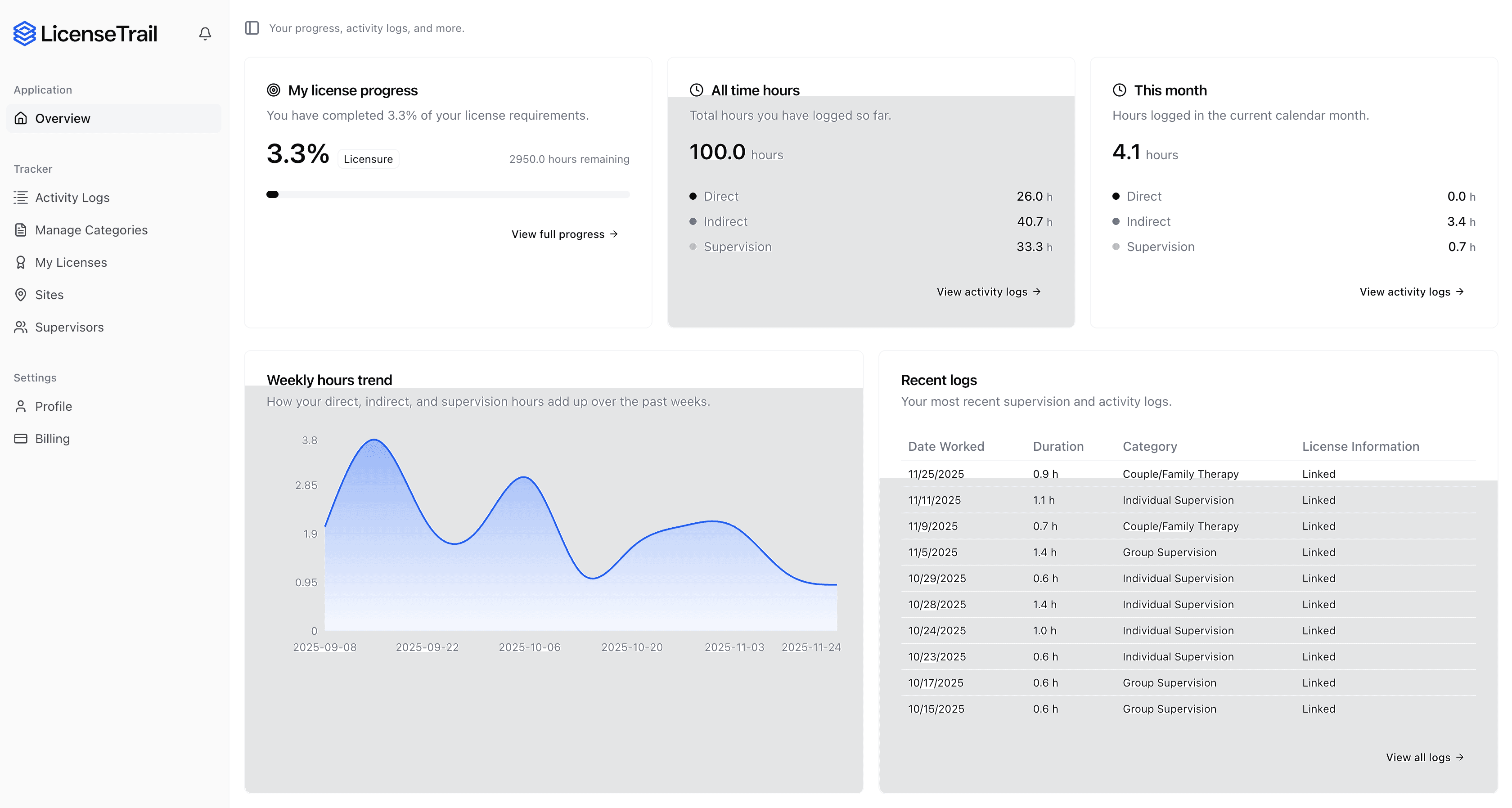
License Trail checks your direct, indirect, and supervision hours against New-york LMFT requirements continuously and flags mismatches before you submit.
 Start Tracking for Free
No credit card required · Free plan available
Is your spreadsheet hiding New-york LMFT risks?
Stop guessing if your categories match New York State Board for Mental Health Practitioners requirements. License Trail checks your direct, indirect, and supervision hours continuously and flags mismatches before you submit.
Import or log
Bring your spreadsheet or start fresh
Upload your existing tracking spreadsheet and we'll map every hour into the right New York State Board for Mental Health Practitioners categories automatically.
Verify against New-york
Catch mismatches before the board does
License Trail checks your direct, indirect, and supervision hours against New-york LMFT requirements continuously.
Export board-ready
One-click clean reports
Generate professional, board-ready reports for supervision meetings and New York State Board for Mental Health Practitioners submissions in seconds.
No credit card required · Free plan available