
New-york LP Requirements: Hours, Exams & Step-by-Step Guide
Stop guessing if your categories match New-york requirements. License Trail checks your direct, indirect, and supervision hours against LP requirements continuously and flags mismatches before you submit.
No credit card required · Free plan available
Quick Requirements Overview
- Eligibility: Age 21+, good moral character, complete NYS child abuse identification/reporting training
- Degree: Master’s or higher from NYSED-registered (or equivalent) program
- Psychoanalytic licensure program: NYSED-registered (or substantially equivalent) psychoanalysis program required
- Psychoanalytic study minimum (for equivalence): 1,350 clock hours including 405 coursework (≥45 hrs in each required content area), 300 personal analysis, 150 supervised analysis (50+100 split across supervisors), and 300 supervised clinical psychoanalysis
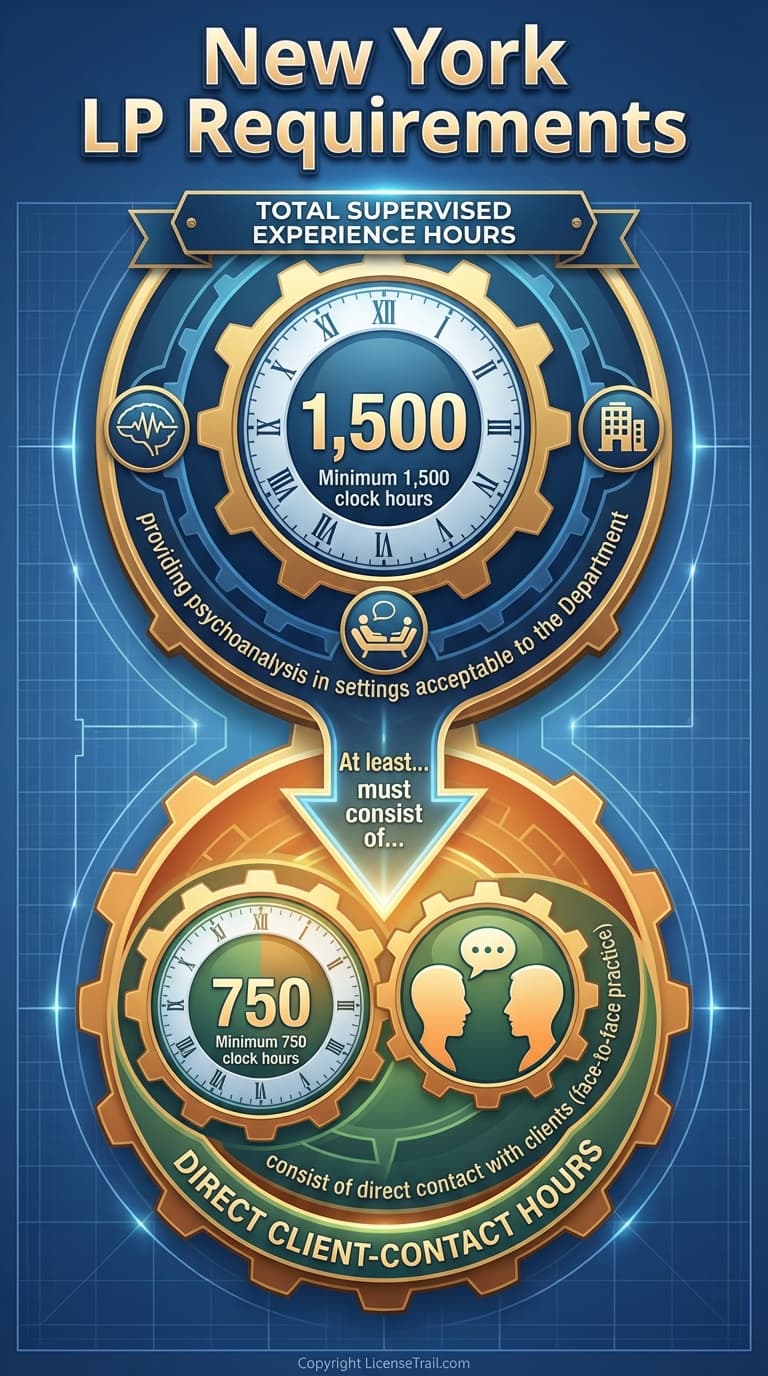
- Supervised experience: 1,500 clock hours providing psychoanalysis in acceptable setting; ≥750 hours direct client contact (remaining may be indirect activities such as supervision/personal analysis/professional development)
- Supervision rules: Qualified NYS-licensed supervisor; general supervision; avg ≥1 hr/week or 4 hrs/month individual/group supervision with case review
- Limited permit: Required for NY practice while accruing hours outside a registered program; typically 24 months, extendable up to 48 months total
- Exam: Pass NYS Case Narrative Examination for psychoanalysts
License Details
Procedures
New York Licensure as a “Licensed Psychoanalyst” (LP): Requirements and Hours
In New York, the profession of psychoanalysis is regulated by the State Education Department’s Office of the Professions under the State Board for Mental Health Practitioners. The protected title is “Licensed Psychoanalyst” (LP), and both the law and regulations lay out detailed education, experience, and examination requirements.
Below is an organized guide with the key statutory and regulatory language highlighted and the hour requirements spelled out.
1. Core Legal/Regulatory Framework
Licensure requirements for psychoanalysts are set out in:
- Education Law, Title 8, Article 163, §8405, and
- Commissioner’s Regulations, Section 52.35 and Subpart 79‑12, especially §79‑12.1 (education) and §79‑12.3 (experience). (op.nysed.gov)
The Office of the Professions also maintains a “License Requirements for Psychoanalysts” page that synthesizes these rules. (op.nysed.gov)
To qualify, you must:
- be at least 21 years old;
- be of good moral character;
- meet education, experience, and examination requirements; and
- complete New York‑approved child abuse identification and reporting coursework. (op.nysed.gov)
2. Education and Psychoanalytic Training
2.1 Overall Educational Structure
The Department requires:
- A master’s or higher degree from a Department‑registered program (or equivalent), and
- Completion of a psychoanalysis licensure program registered by the Department (or a substantially equivalent psychoanalytic institute program). (op.nysed.gov)
Where a program is not explicitly registered as licensure‑qualifying, the Department individually evaluates transcripts and psychoanalytic training (“substantial equivalence”). (op.nysed.gov)
2.2 Clock‑Hour Requirements for Psychoanalytic Study
For substantial equivalence, the psychoanalytic course of study must total at least 1,350 clock hours of study, distributed as follows: (op.nysed.gov)
-
Coursework – at least 405 clock hours of classroom instruction, including at least 45 clock hours in each of these areas:
- personality development
- psychoanalytic theory of psychopathology
- psychoanalytic theory of psychodiagnosis
- sociocultural influence on growth and psychopathology
- practice technique (including dreams and symbolic processes)
- analysis of resistance, transference, and countertransference
- case seminars on clinical practice
- practice in psychopathology and psychodiagnosis
- professional ethics and psychoanalytic research methodology
-
Personal psychoanalysis – at least 300 clock hours of personal psychoanalysis.
-
Supervised analysis – at least 150 clock hours of supervised analysis of the student’s psychoanalytic cases, allocated as:
- 50 clock hours of individual supervision with one supervisor on one case; and
- at least 100 clock hours of individual supervision with another supervisor on one or more additional cases.
-
Clinical experience – at least 300 clock hours of supervised clinical experience in the practice of psychoanalysis, which also counts toward the experience requirements (see below). (op.nysed.gov)
These 1,350 hours are separate from, but can overlap with, the 1,500 clock hours of supervised experience required for licensure (see Section 3).
3. Required Supervised Experience (Post‑ or In‑Program)
3.1 Total Hours and Direct‑Contact Requirement
The regulations state that an applicant must complete:
- “a supervised experience of at least 1,500 clock hours providing psychoanalysis in a setting acceptable to the department.” (op.nysed.gov)
Within those 1,500 clock hours:
- Not less than 750 clock hours must consist of direct contact with clients (also referred to as “face‑to‑face practice”). (op.nysed.gov)
- The remaining hours (up to 750) may consist of indirect activities that do not involve direct client contact, including but not limited to:
- supervision,
- personal analysis, and
- professional development. (op.nysed.gov)
So, conceptually:
- 1,500 total supervised hours of psychoanalysis, of which:
- 750+ hours = direct client contact, and
- up to 750 hours = indirect activities (supervision, personal analysis, etc.).
There is not a separate “1,500 hours of direct experience and 1,500 hours of supervised experience”; instead, the single 1,500‑hour requirement must be both supervised and include at least 750 hours of direct client work.
3.2 Relationship to Your Education Program
The Board explicitly allows these hours to be accumulated:
- “All or part of the supervised experience may be obtained within the education program required for licensure as a psychoanalyst.” (op.nysed.gov)
If your licensure‑qualifying psychoanalytic program includes 300 or more supervised clinical hours (as most do), those hours can count toward the 1,500‑hour supervised experience, provided they are properly documented on the Department’s forms (e.g., Form 4B). (op.nysed.gov)
3.3 Definition of the “Practice of Psychoanalysis”
For experience to count, it must fall within the state’s definition of the practice of psychoanalysis, which includes: (op.nysed.gov)
- “the observation, description, evaluation, and interpretation of dynamic unconscious mental processes that contribute to the formation of personality and behavior in order to identify and resolve unconscious psychic problems… and to develop adaptive functioning”; and
- “the use of assessment instruments and mental health counseling and psychotherapy to identify, evaluate and treat dysfunctions and disorders for purposes of providing appropriate psychoanalytic services.”
Your documented hours must reflect these types of activities, not just general counseling or administrative tasks.
3.4 Supervision Standards
For experience completed in New York, it must be under a limited permit or as part of your registered program, and meet these supervision rules: (op.nysed.gov)
-
Qualified supervisor:
The supervisor must be licensed and registered in New York as a psychoanalyst, physician, physician assistant, psychologist, licensed clinical social worker, or registered professional nurse or nurse practitioner, and competent in psychoanalysis (or equivalent qualifications for experience outside NY). -
General supervision:
You must work under “general supervision,” meaning a qualified supervisor is available for consultation, assessment, and evaluation when services are being rendered and exercises the degree of supervision appropriate to the circumstances. -
Minimum supervision time:
The supervisor must provide an average of at least one hour per week or four hours per month of in‑person individual or group supervision that includes review of your assessment, evaluation, and treatment of each client under supervision. -
Content of supervision:
Supervision must include oversight and guidance in developing psychoanalytic skills, including analysis of resistance, transference, counter‑transference, and unconscious processes. -
Single setting / combined activities:
The Board specifies that it is not acceptable to combine direct hours from one setting with indirect hours from another and “attempt to combine these hours to meet the experience requirement.” Your 1,500 hours must be documented as a coherent supervised experience in approved settings. (op.nysed.gov)
4. Limited Permit to Practice While Gaining Hours
Once your education is approved and you have applied for licensure, you may obtain a limited permit to practice psychoanalysis while accruing required experience. (op.nysed.gov)
Key points:
- The permit specifies one or more particular settings and named supervisors.
- It is generally valid for 24 months and may be extended for up to two additional 12‑month periods, with an overall maximum of 48 months. (op.nysed.gov)
- All supervised experience in New York outside your registered program must be performed under this permit, unless the Department makes a specific exception.
5. Examination Requirement
New York’s exam for psychoanalysts is a state‑approved case narrative examination, commonly referred to as the New York State Case Narrative Examinations. (op.nysed.gov)
You must:
- complete education requirements,
- usually complete (or be near completing) your supervised experience, and
- then sit for and pass this examination for licensure.
(The Office of the Professions provides current exam format and registration procedures separately.)
6. Child Abuse Reporting Coursework
All applicants must complete coursework or training in “the identification and reporting of child abuse and maltreatment” from a New York State‑approved provider. (op.nysed.gov)
You submit documentation (certificate) of this training as part of your application packet.
7. Diagnostic Privilege (Optional, Post‑Licensure)
Effective June 24, 2024, certain licensed mental health practitioners, including licensed psychoanalysts, may apply for a 3‑year diagnostic privilege that formally authorizes diagnosis and development of assessment‑based treatment plans. (op.nysed.gov)
For psychoanalysts, among the key requirements are:
- Current NY psychoanalyst license and registration;
- An acceptable psychoanalytic program of study; and
- Verification of 2,000 hours of supervised, direct client contact that includes diagnosis, psychotherapy, and assessment‑based treatment planning
or, for those licensed before June 24, 2024, an attestation of three years of direct client experience meeting similar criteria, submitted by June 24, 2027. (op.nysed.gov)
This is separate from the 1,500 hours needed for initial licensure.
8. Step‑by‑Step Summary of the Path to LP in New York
-
Earn your graduate degree
- Complete a master’s or higher degree in a field and at an institution acceptable to NYSED (often in a mental health‑related area).
-
Complete psychoanalytic training (minimum 1,350 clock hours)
- 405+ hours coursework (with at least 45 hours in each required content area).
- 300 hours of personal psychoanalysis.
- 150 hours of supervised analysis of your own cases, with the specified distribution between supervisors.
- 300+ hours of supervised clinical experience in psychoanalysis.
-
Apply for licensure (Form 1) and have your institutions submit verification (Forms 2 / 2A)
- Your psychoanalytic institute program and degree institution send transcripts and certification forms directly to NYSED.
-
Obtain a limited permit (if needed) and complete supervised experience
- Under your permit and/or within your program, complete:
- 1,500 clock hours of supervised psychoanalysis, of which
- at least 750 hours are direct client contact, and
- up to 750 hours are supervision, personal analysis, and other indirect professional activities.
- 1,500 clock hours of supervised psychoanalysis, of which
- Ensure supervision meets NY’s requirements (qualified supervisor, weekly or monthly supervision, psychoanalytic focus).
- Under your permit and/or within your program, complete:
-
Complete child abuse identification and reporting training
- Take the NY‑approved course and have the provider submit proof or give you a certificate to include.
-
Pass the New York State Case Narrative Examinations
- Register through the Office of the Professions’ process and pass the exam.
-
Receive your LP license and maintain registration
- Once all requirements and fees are satisfied, you are granted the title “Licensed Psychoanalyst” and must periodically renew your registration in accordance with NYSED requirements.
-
(Optional) Apply later for diagnostic privilege
- After accumulating sufficient supervised diagnostic and treatment hours, apply for the separate 3‑year diagnostic privilege if you wish to formally add diagnostic authority under Education Law.
In New York, the crucial quantitative requirement is one integrated supervised experience of at least 1,500 clock hours providing psychoanalysis, with a minimum of 750 clock hours of direct client contact. This supervised experience may be partly or fully embedded in your psychoanalytic training program, and must always meet the supervision, setting, and documentation standards defined by the New York State Education Department.
Track your LP hours with confidence
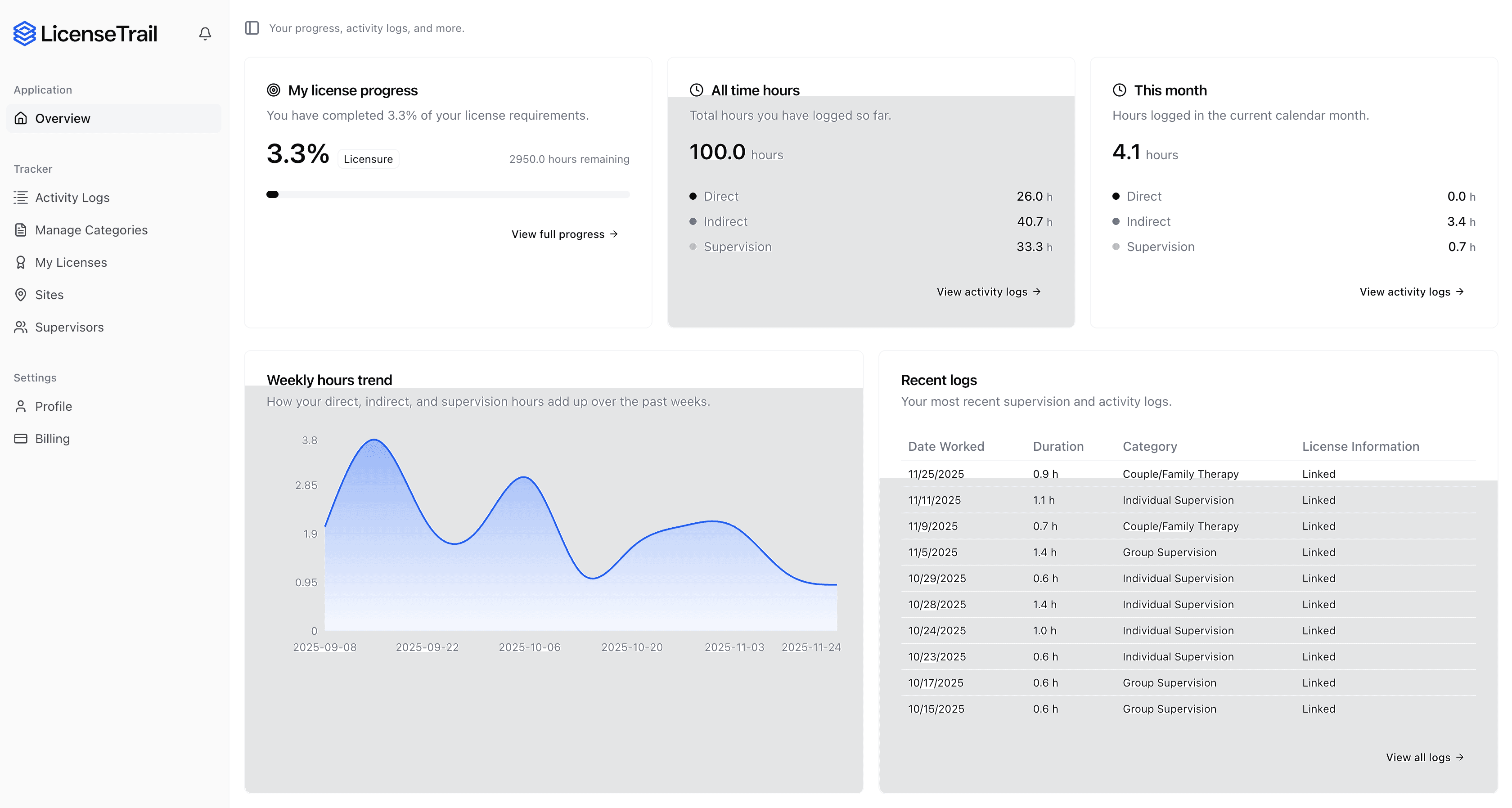
License Trail checks your direct, indirect, and supervision hours against New-york LP requirements continuously and flags mismatches before you submit.
 Start Tracking for Free
No credit card required · Free plan available
Is your spreadsheet hiding New-york LP risks?
Stop guessing if your categories match New York State Board for Mental Health Practitioners requirements. License Trail checks your direct, indirect, and supervision hours continuously and flags mismatches before you submit.
Import or log
Bring your spreadsheet or start fresh
Upload your existing tracking spreadsheet and we'll map every hour into the right New York State Board for Mental Health Practitioners categories automatically.
Verify against New-york
Catch mismatches before the board does
License Trail checks your direct, indirect, and supervision hours against New-york LP requirements continuously.
Export board-ready
One-click clean reports
Generate professional, board-ready reports for supervision meetings and New York State Board for Mental Health Practitioners submissions in seconds.
No credit card required · Free plan available