
Oklahoma LBP Candidate Requirements: Hours, Exams & Step-by-Step Guide
Stop guessing if your categories match Oklahoma requirements. License Trail checks your direct, indirect, and supervision hours against LBP Candidate requirements continuously and flags mismatches before you submit.
No credit card required · Free plan available
Quick Requirements Overview
- Education: Master’s in psychology (regionally accredited) + 60 graduate semester hours behavioral-science coursework (45 hrs only for older statutory track) + practicum/internship with 300 clock hours of behavioral health services
- Baseline eligibility: Age 21+; meet Board character/discipline standards; comply with Board rules
- Apply: Online application + OSBI/FBI fingerprints (processed within 30 days of application date) + official transcripts + practicum verification + nonrefundable fee
- Before hours can count: Application on file + pass jurisprudence exam + pass national exam + Board-approved Supervision Agreement + W‑4 confirming employee status
- Supervised experience requirement: 3,000 clock hours on-the-job supervised experience (generally ~3 years) under an approved LBP supervisor
- Hour breakdown within 3,000: 1,000 direct client contact hours minimum + 100 supervision hours minimum; supervision at least 45 minutes weekly (in-person or Board-approved technology-assisted)
- Credits/minimums: Up to 1–2 years credit for extra graduate coursework (30 graduate hrs = 1 year), but must still complete at least 1,000 clock hours (1 year) under supervision
- Deadline: Complete all supervised experience within 60 months of the first approved supervision agreement (or application is void; pre-approval hours don’t count)
License Details
Procedures
Oklahoma regulates Licensed Behavioral Practitioners (LBPs) through the State Board of Behavioral Health Licensure. To practice under supervision as a Licensed Behavioral Practitioner Candidate (LBP Candidate) and eventually obtain full LBP licensure, you must meet specific education, application, and supervised‑experience requirements set in statute and in the Oklahoma Administrative Code (OAC).
The sections below walk through those requirements step by step, with emphasis on the exact types and amounts of hours the Board requires.
1. How Oklahoma Defines an LBP Candidate
Oklahoma statute and Board rules both use the same basic definition.
Under the Licensed Behavioral Practitioner Act, a:
- “Licensed behavioral practitioner candidate” means a person whose application for licensure has been accepted and who is under supervision for licensure as provided in Section 1935 of the Act. (law.justia.com)
In other words, you become an LBP Candidate after the Board has:
- Accepted your application for LBP licensure, and
- Placed you under an approved supervision arrangement.
Only then can you begin accruing the supervised experience hours that lead to full licensure.
2. Academic and General Eligibility Requirements
Educational requirements
By statute and Board policy, an LBP applicant must have graduate‑level training in psychology with substantial behavioral‑science coursework:
- Minimum degree: At least a master’s degree from a program in psychology from a regionally accredited college or university. (law.justia.com)
- Semester hours:
- Statute: at least 45 graduate semester hours of behavioral‑science‑related coursework, including the master’s degree.
- For applicants on or after January 1, 2008: at least 60 graduate semester hours (90 quarter hours) of behavioral‑science‑related coursework, including the master’s degree. (law.justia.com)
- The Board’s academic‑requirements page for LBPs currently reflects the 60‑hour minimum and requires specified coursework in areas such as assessment, intervention, experimental foundations, psychopathology, personality/social psychology, ethics, biological bases of behavior, and a practicum/internship with at least 300 clock hours of behavioral health services. (oklahoma.gov)
General licensure qualifications
Statute also sets baseline requirements for anyone seeking an LBP license (and therefore for LBP Candidates): you must: (law.justia.com)
- Be at least 21 years of age.
- Pass an examination based on standards promulgated by the Board (the national practice exam for LBPs).
- Not have engaged in conduct that would be grounds for denial, suspension, or revocation of a license.
- Comply with all Board rules adopted under the Licensed Behavioral Practitioner Act.
3. Application and Becoming an LBP Candidate
The application itself
The Board’s “Making Application” instructions outline the documentation required for a new application (not currently licensed elsewhere): (oklahoma.gov)
- Complete the online application through the Applicant Portal.
- Submit:
- Fingerprint‑based OSBI and FBI background checks (both must be processed within 30 days of the application date).
- Official graduate transcript(s).
- Internship/Practicum Verification Form (showing at least 300 practicum/internship hours as noted above).
- Application fee (non‑refundable).
Once your application is accepted and you meet academic and character requirements, you can move into candidacy status, subject to exams and supervision arrangements.
Exams required before supervised hours can start
The Board requires that, before supervised experience hours can begin, a candidate must have: (oklahoma.gov)
- A completed application on file,
- A passing result on the jurisprudence exam (state law/ethics), and
- A passing result on the national exam (the practice examination used for LBPs).
Only after those conditions are met can the Board approve a Supervision Agreement, which is what activates your LBP Candidate supervised hours.
4. Supervision Agreement and Employment Status
Before you may count any supervised experience toward LBP licensure, the Board must approve a Supervision Agreement and confirm your employment status:
-
The Board states that “in order to begin the accrual of supervised experience hours”, it must confirm that the candidate:
- has a completed application on file,
- has passed the jurisprudence and national exams, and
- has submitted a W‑4 confirming their status as an employee of the agency where they intend to accrue supervised experience, together with a completed Supervision Agreement. (oklahoma.gov)
-
Start date of hours:
- Supervised experience may commence as of the approved date on the Supervision Agreement.
- Any hours accrued before the approval date will not be credited and may result in complaint procedures and/or loss of approved supervisor status. (oklahoma.gov)
So, from the Board’s perspective, you are functioning as an LBP Candidate (in the practical sense of accruing hours) only once this agreement is approved and you are an employee of an approved setting.
5. Supervised Experience Requirements: Hours and Structure
The supervised experience requirement is defined both in statute and in the Board’s rules.
Overall supervised experience (statute)
By law, to become an LBP you must complete: (law.justia.com)
- “Three (3) years of supervised full‑time experience in professional behavioral health services” under a licensed mental health professional,
- With the possibility that one or two of those years may be credited based on additional graduate hours (one year of experience for each 30 graduate semester hours beyond the master’s degree), as long as those hours are clearly related to psychology/behavioral sciences and accepted by the Board.
Detailed hour requirements (Board rule – OAC 86:20‑13‑2)
The State Board of Behavioral Health Licensure translates that statutory requirement into specific clock‑hour requirements in OAC 86:20‑13‑2 (Duration of supervision). The rule states that each LBP applicant shall complete: (regulations.justia.com)
-
Total supervised experience hours
- “Three-thousand (3000) clock hours of full time, on-the-job experience” supervised by an approved LBP supervisor.
- This is typically understood as three years of full‑time supervised practice.
-
Direct client contact hours
- Within those 3,000 clock hours, at least 1,000 hours must be direct client contact (i.e., direct clinical services to clients within the scope of professional behavioral health services).
-
Supervision hours
- Within those 3,000 hours, at least 100 hours must be “face‑to‑face or technology‑assisted supervision” with an approved LBP supervisor.
- The rule separately requires that weekly supervision be provided at “a minimum of forty-five (45) minutes of supervision every week” under a Board‑approved LBP supervisor (which may be face‑to‑face or approved technology‑assisted supervision). (regulations.justia.com)
-
Minimum amount that must be earned in supervision, even with advanced coursework
- The Board allows one or two years of supervised experience to be credited for additional graduate coursework: one year of experience for each 30 graduate hours beyond the minimum required graduate hours, provided the hours are behavioral‑health‑related and acceptable to the Board.
- However, regardless of how much extra graduate coursework you have, the rules state that “the LBP Candidate shall receive at least one (1) year or one thousand (1000) clock hours of supervision” as described in the supervision rule. (regulations.justia.com)
-
Time limit to complete hours
- LBP Candidates must complete all supervised experience within 60 months (five years) from the date of approval of the first supervision agreement, or the license application will be voided. (regulations.justia.com)
Types of hours that count and supervision format
The “acceptability of supervised experience” rule further defines what counts and how supervision is conducted: (law.cornell.edu)
-
Content of supervised experience:
- Supervised experience must consist of the performance of behavioral health services as defined in the Act (e.g., assessment, diagnosis, treatment interventions, consultation within the behavioral‑health scope).
-
Focus of supervision:
- Supervision must focus on the “raw data” from the LBP Candidate’s continuing clinical practice, which can be obtained via direct observation, co‑therapy, review of clinical notes, and audio/video recordings.
-
Individual vs. group supervision:
- Individual supervision = face‑to‑face contact between one supervisor and one LBP Candidate.
- Group supervision = a supervisor working with two to six LBP Candidates simultaneously.
-
Technology‑assisted supervision:
- Permitted but must be approved by the Board prior to accrual of hours, considering factors such as distance, financial hardship, physical hardship, and specialized credentials.
-
Practice settings where hours may be accrued:
- LBP Candidates may accrue hours in academic, governmental, or private practice settings.
-
Private practice settings without an on‑site approved LBP supervisor:
- The rules allow accrual of supervised experience in private for‑profit or private not‑for‑profit settings without an on‑site approved LBP supervisor, provided:
- The employing agency has a licensed mental health professional (LBP, LPC, LMFT, psychologist, physician, LCSW, or LADC) who directs and is responsible for the professional duties of the LBP Candidate and is available whenever services are rendered, and
- The LBP Candidate is receiving licensure supervision from an approved LBP supervisor, who does not have to work at the same physical location. (okrules.elaws.us)
- The rules allow accrual of supervised experience in private for‑profit or private not‑for‑profit settings without an on‑site approved LBP supervisor, provided:
(Note: In August 2025, the Board publicly reported voting to remove some on‑site supervisor requirements; candidates should confirm whether those rule changes have taken effect in the current version of the OAC.) (counselinginstitute.org)
6. Approved Supervisor Requirements (for context)
Because the quality and structure of supervision are central to your hours being accepted, it is useful to understand how the Board defines an approved LBP supervisor.
Under OAC 86:20‑13‑6 and the Board’s “Approved Supervisors” guidance, an LBP supervisor must: (law.cornell.edu)
- Hold an active Oklahoma license as a Licensed Behavioral Practitioner, Professional Counselor, Marital and Family Therapist, Psychologist, Clinical Social Worker, or Physician, and
- Have practiced in positions similar to those the LBP Candidate proposes to practice for at least two years after licensure;
- Have met continuing‑education requirements;
- Sign an official supervision agreement with the Board;
- Agree in writing to be “on call” to the LBP Candidate on a twenty‑four (24) hour basis and to arrange an alternate supervisor if unavailable;
- Pass the LBP State Standards Test; and
- Agree to teach the LBP Act and the relevant OAC provisions to the supervisee.
Additionally, supervisors must conduct at least two live or recorded observations every six months of supervision and (under some versions of the rules) consult with any designated on‑site supervisor at least once per six‑month evaluation period. (regulations.justia.com)
7. From LBP Candidate to Full Licensure: Key Milestones
Putting the requirements together, the typical pathway in Oklahoma looks like this:
-
Complete qualifying graduate education
- Master’s in psychology, at least 60 graduate semester hours of behavioral‑science‑related coursework, including required core areas and 300 practicum/internship hours. (oklahoma.gov)
-
Submit application for LBP licensure
- Through the Applicant Portal, with background checks, transcripts, practicum verification, and fees. (oklahoma.gov)
-
Obtain LBP Candidate status
- Application accepted; you meet statutory qualifications; you pass the national practice exam and the jurisprudence exam. (law.justia.com)
-
File a Supervision Agreement and W‑4 and get Board approval
- Employer and supervisor arrangements formalized; the approval date marks when hours can start counting. (oklahoma.gov)
-
Accrue supervised experience as an LBP Candidate
- 3,000 clock hours of full‑time, on‑the‑job experience, including:
- 1,000 hours minimum of direct client contact, and
- 100 hours minimum of supervision (face‑to‑face or Board‑approved technology‑assisted).
- Supervision provided at no less than 45 minutes per week, with a blend of individual and group supervision consistent with Board rules.
- All supervised experience completed within 60 months of your first approved supervision agreement. (regulations.justia.com)
- 3,000 clock hours of full‑time, on‑the‑job experience, including:
-
Apply to convert from LBP Candidate to fully Licensed Behavioral Practitioner
- Once supervised hours are complete and documented, and all other requirements (exams, fees, etc.) are satisfied, the Board may grant full LBP licensure.
8. Summary of Hour Requirements for an Oklahoma LBP Candidate
Using the kind of explicit breakdown you requested:
-
Total supervised professional experience:
- 3,000 clock hours of full‑time, on‑the‑job behavioral health practice under an approved LBP supervisor.
-
Within those 3,000 hours:
- At least 1,000 hours of direct client contact (face‑to‑face clinical services within your behavioral‑health role).
- At least 100 hours of supervision, which must be face‑to‑face or Board‑approved technology‑assisted supervision with an approved LBP supervisor.
- Supervision must occur weekly, at no less than 45 minutes per week. (regulations.justia.com)
-
Time frame:
- All supervised experience hours must be completed within 60 months (5 years) from the date of approval of your first supervision agreement, or your LBP license application is voided. (regulations.justia.com)
-
Minimum supervision even with advanced coursework:
- You may receive credit for up to two years of supervised experience based on extra graduate coursework, but you must still complete at least 1,000 clock hours (one year) of supervised experience as an LBP Candidate under Board rules. (regulations.justia.com)
These are the core supervised‑experience and candidacy requirements, using the Board’s own terminology and hour breakdown as currently reflected in statute and in Title 86 of the Oklahoma Administrative Code.
Track your LBP Candidate hours with confidence
License Trail checks your direct, indirect, and supervision hours against Oklahoma LBP Candidate requirements continuously and flags mismatches before you submit.
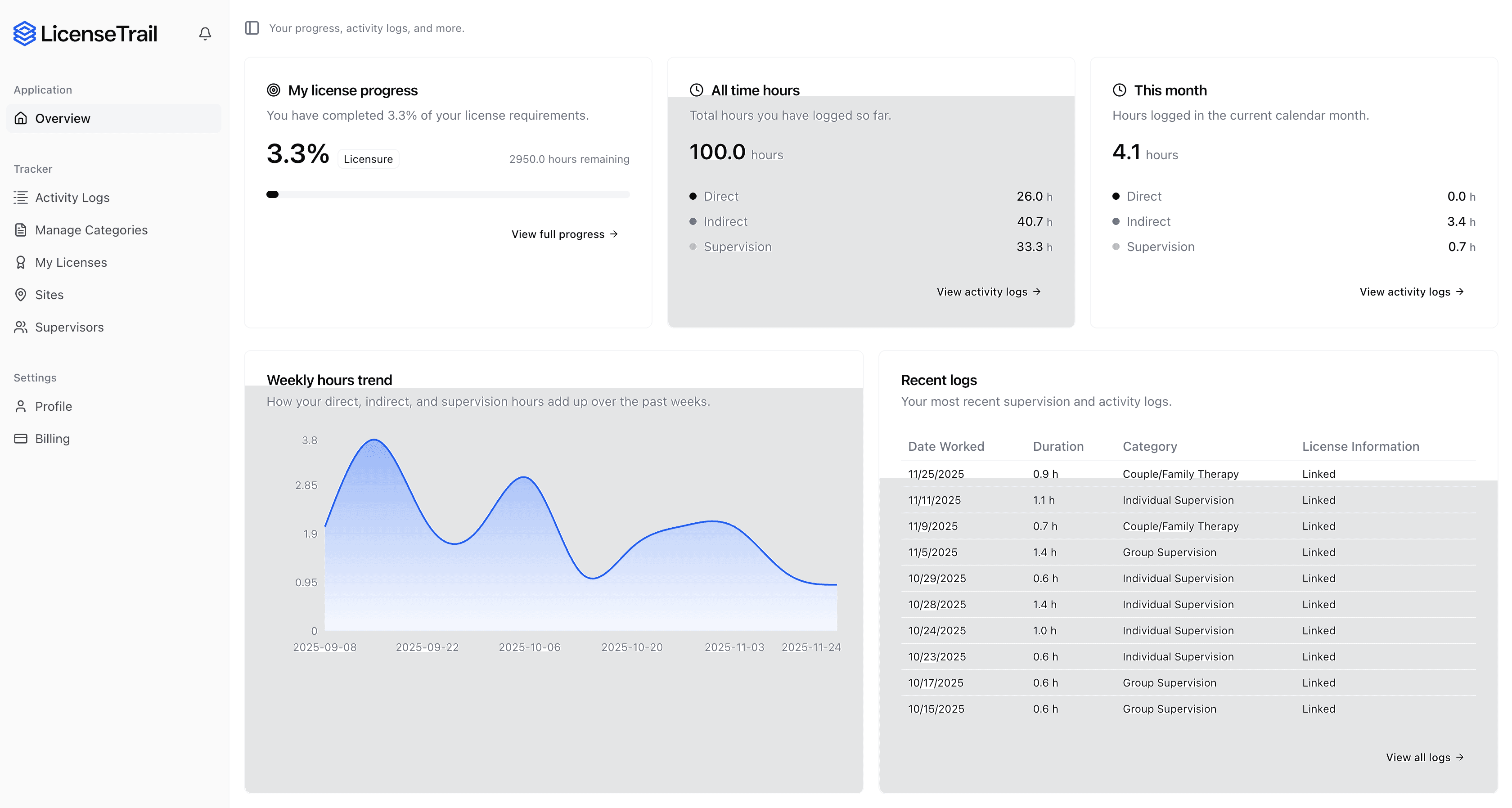 Start Tracking for Free
No credit card required · Free plan available
Is your spreadsheet hiding Oklahoma LBP Candidate risks?
Stop guessing if your categories match Oklahoma State Board of Behavioral Health Licensure requirements. License Trail checks your direct, indirect, and supervision hours continuously and flags mismatches before you submit.
Import or log
Bring your spreadsheet or start fresh
Upload your existing tracking spreadsheet and we'll map every hour into the right Oklahoma State Board of Behavioral Health Licensure categories automatically.
Verify against Oklahoma
Catch mismatches before the board does
License Trail checks your direct, indirect, and supervision hours against Oklahoma LBP Candidate requirements continuously.
Export board-ready
One-click clean reports
Generate professional, board-ready reports for supervision meetings and Oklahoma State Board of Behavioral Health Licensure submissions in seconds.
No credit card required · Free plan available