
Oklahoma LMFT Candidate Requirements: Hours, Exams & Step-by-Step Guide
Stop guessing if your categories match Oklahoma requirements. License Trail checks your direct, indirect, and supervision hours against LMFT Candidate requirements continuously and flags mismatches before you submit.
No credit card required · Free plan available
Quick Requirements Overview
- Eligibility: Age 21+; meet BBHL conduct/discipline standards; Candidate = application accepted and practicing only under supervision
- Education: Master’s+ in MFT or board-approved equivalent from regionally accredited school (COAMFTE programs accepted)
- Coursework: Required knowledge areas (theory, assessment/treatment, human development incl. psychopathology, ethics, research); each course counts only if ≥45 class hours
- Practicum/Internship (pre-licensure): ≥300 clock hours MFT practicum/internship in graduate program, with university-approved supervision
- Background checks: OSBI + FBI fingerprint-based checks; must be completed within 30 days of application; OSBI-CHIRP not accepted
- Exams: Pass AMFTRB National MFT Exam + OK law/rules exam (scores from before current application not counted)
- Supervision setup & reporting: Board-approved supervision agreement before hours count; semi-annual evaluations required (late >60 days = not credited); supervisors keep records 7 years
- Post-degree supervised experience: 3,000 on-the-job hours over ≥24 months, incl. 1,000 direct client contact and 250 relational hours (2+ in system); supervision minimums include ≥150 face-to-face (≤75 group) and required weekly/ratio limits per rule
License Details
Procedures
In Oklahoma, “Licensed Marital and Family Therapist Candidate” (LMFT Candidate) is the provisional license you hold while completing your post‑graduate supervised experience on the way to full LMFT licensure. The State Board of Behavioral Health Licensure (BBHL) treats Candidates as licensees who must follow almost all of the same rules as LMFTs, but always under supervision. (regulations.justia.com)
Below is a step‑by‑step guide, with an emphasis on the hours and the exact categories the Board uses.
1. Basic statutory qualifications
Under Oklahoma statute, anyone applying for an LMFT license (which includes those who will be licensed as Candidates) must: (law.justia.com)
- Be at least 21 years of age.
- Not have engaged in conduct that would be grounds for revoking or suspending a license.
- Comply with all BBHL rules and regulations under the Marital and Family Therapist Licensure Act.
Once your application is accepted and you are under supervision for licensure, you are legally a “licensed marital and family therapist candidate”. The Administrative Code defines this as someone “whose application for licensure has been accepted and who is under supervision for licensure” under the LMFT Act. (law.cornell.edu)
2. Academic and practicum requirements
2.1 Graduate degree
You must have at least a master’s degree in: (oklahoma.gov)
- Marital and family therapy, or
- A mental health, behavioral science, or counseling‑related field that the Board deems content‑equivalent to a graduate degree in marital and family therapy.
The degree must be from a college or university accredited by one of the six U.S. regional accrediting bodies recognized by the U.S. Department of Education. (oklahoma.gov)
The Board automatically accepts COAMFTE‑accredited MFT programs; those do not require additional academic review. (oklahoma.gov)
2.2 Required “knowledge areas”
The Board’s LMFT academic requirements specify coursework in defined knowledge areas, including: (oklahoma.gov)
- Theoretical Foundations of Marital and Family Systems – at least 3 graduate courses
- Assessment and Treatment in Marital and Family Therapy – at least 3 courses
- Human Development – at least 3 courses (with at least one in psychopathology/abnormal behavior)
- Ethics and Professional Studies – at least one course
- Research – at least one course
Each academic course must include at least 45 class hours to count. (oklahoma.gov)
2.3 Practicum / internship hours (pre‑licensure clinical training)
Before you can be licensed (even as a Candidate), you must show that your graduate program included a practicum/internship course with at least 300 clock hours in marital and family therapy. (oklahoma.gov)
The Board describes this as an organized practicum or internship that:
- Provides at least 300 clock hours in MFT, and
- Includes planned classroom and field experience with clients,
- Under supervision of college/university‑approved marital and family therapy professionals. (oklahoma.gov)
On the BBHL “Making Application” page, this is reinforced: new applicants must verify completion of a minimum of 300 hours of internship and/or practicum as part of the qualifying graduate program. (oklahoma.gov)
3. Criminal background checks
Effective January 1, 2024, all new applicants (including future LMFT Candidates) must obtain two fingerprint‑based criminal background checks: (oklahoma.gov)
- An OSBI fingerprint‑based background check, and
- An FBI fingerprint‑based background check.
Key details:
- Background checks processed more than 30 days before the date of application will not be accepted.
- OSBI‑CHIRP checks are specifically not accepted. (oklahoma.gov)
4. Initial application for licensure (the step that leads to Candidate status)
To start the process, you submit a new application for licensure via the BBHL applicant portal. For a new Oklahoma applicant (not already licensed elsewhere), a complete application must include: (oklahoma.gov)
- Application form (identifying information; graduate education and coursework; other credentials; ethics/conduct questions).
- Official university transcript (or temporarily an unofficial transcript plus “Verification of Academic Standing,” later replaced by an official transcript). (oklahoma.gov)
- Internship/Practicum Documentation Form, verifying the 300 practicum/internship hours. (oklahoma.gov)
- Fingerprint‑based OSBI and FBI background checks, completed within 30 days of the application date. (oklahoma.gov)
- Application fee, paid in the portal; it is non‑refundable. (oklahoma.gov)
The Administrative Code also lists these as core application elements: application form, Internship/Practicum Documentation, Supervision Agreement, Evaluation of Supervised Experience, and completed criminal background check. (law.cornell.edu) In practice, for a brand‑new graduate you typically file the supervision agreement when you are ready to start accruing post‑degree hours (see Section 7 below).
Once your application is accepted and you are under an approved supervision plan for licensure, you are recognized as an LMFT Candidate under Oklahoma’s definition. (law.cornell.edu)
5. Examinations required before full licensure (often taken as a Candidate)
Oklahoma requires you to pass two examinations: (regulations.justia.com)
- The National Examination in Marital and Family Therapy
- Administered through the Association of Marital & Family Therapy Regulatory Boards (AMFTRB) / Professional Testing Corporation.
- An Oklahoma LMFT law and regulations exam
- Described in rule as “an oral and/or written examination covering the LMFT law and regulations as approved by the Board.”
The Administrative Code states that the applicant must provide passing scores on both the national examination and the Oklahoma law/regulations exam. It also notes that exam results obtained before the date of the current application are not considered for that application. (regulations.justia.com)
The Board’s typical pattern is:
- You apply and are found academically eligible.
- You receive exam eligibility and pass the national and Oklahoma exams.
- You then proceed under the Candidate license while accruing supervised experience.
6. What “direct client contact” and “on‑the‑job experience” mean
Because the supervised experience for LMFT Candidates is defined in terms of specific categories of hours, it’s important to know the Board’s official terms.
6.1 Direct Client Contact Hours
“Direct Client Contact Hours” are defined in rule as performing therapeutic or clinical functions involving diagnosis, assessment and treatment of mental, emotional, and behavioral disorders, based primarily on verbal communication and intervention with, and in the presence of, one or more clients. (law.cornell.edu)
In simpler terms, these are your face‑to‑face (or synchronous) clinical sessions where you are actively assessing or treating clients.
6.2 On‑the‑job experience
“On‑the‑job experience” is defined as performing marital and family therapy as described in the LMFT Act, including assessment, diagnosis, and treatment of disorders (cognitive, affective, or behavioral) within the context of marital and family systems. (law.cornell.edu)
So your total supervised experience is broader than just direct sessions; it includes clinically related work in an LMFT role.
7. Supervision agreement and documentation (required before hours can count)
Before any supervised experience hours can be counted, the Board must approve a formal supervision plan:
- LMFT Supervision Agreement
- An “LMFT Supervision Agreement between supervisor and supervisee must be received and approved by the Board prior to the accrual of supervision hours.” (law.cornell.edu)
- On‑site supervisor (if applicable)
- If you’re in a setting where your Approved LMFT Supervisor is not physically on‑site, the rules allow use of an on‑site supervisor (who can be a variety of licensed mental health professionals) employed by the same agency, available any time you are providing services. (law.cornell.edu)
- Semi‑annual Evaluation of Supervised Experience
- The supervisor and supervisee must submit “Evaluation of Supervised Experience” forms every six months, documenting hours, observations, and consultations. Late evaluations (more than 60 days past the semi‑annual due date) are not credited toward the supervision duration. (law.cornell.edu)
Supervised experience must be reported in quarter credit hours, and supervisors must keep records for at least seven years beyond the end of supervision. (law.cornell.edu)
8. Post‑degree supervised experience requirements for LMFT Candidates
While you hold the LMFT Candidate license, you complete the supervised experience required for full LMFT licensure. This is where the key hour breakdowns come in.
8.1 Total hours and time frame
The Oklahoma Administrative Code requires: (regulations.justia.com)
- 3,000 clock hours of on‑the‑job experience in marital and family therapy
- Supervised by an Approved LMFT Supervisor
- Spanning a minimum of 24 months (two calendar years)
These hours make up your post‑degree supervised experience. They are usually completed entirely while you are licensed as an LMFT Candidate.
8.2 Breakdown of the 3,000 hours
Within those 3,000 clock hours of on‑the‑job experience, the Board specifies minimum amounts in particular categories: (regulations.justia.com)
-
Direct Client Contact
- At least 1,000 hours must be Direct Client Contact Hours (as defined above).
-
Relational Contact (“relational hours”)
- Within the direct hours, at least 250 hours must be “relational” hours, described in the current rule as sessions where two or more members of the relational system are present (for example, couples, families, or other multi‑person relational systems). (s3.amazonaws.com)
-
Supervision Hours
- At least 100 hours must be face‑to‑face or technology‑assisted supervision (this figure is explicitly listed within the 3,000‑hour total). (regulations.justia.com)
- Additional supervision structure:
- Weekly supervision must be at least 45 minutes. (s3.amazonaws.com)
- Supervision should be scheduled so that you receive no less than 6.25 hours of supervision for each 42 hours of direct client contact, and you may not count more than 42 direct client contact hours in any four‑week period. (s3.amazonaws.com)
- The amended rule further states: the total number of face‑to‑face supervision hours must be at least 150, and no more than 75 hours of that may be group supervision. (s3.amazonaws.com)
In practice, that means:
- You must have at least 150 hours of face‑to‑face supervision,
- Of which up to 75 can be in group supervision (3–6 candidates with one supervisor), and
- The rest must be individual or dyadic supervision.
In Oklahoma’s wording, group supervision is defined as an assemblage of three (3) to six (6) Candidates, and individual supervision is face‑to‑face with one supervisor and one or two supervisees. (law.cornell.edu)
8.3 Summary table of post‑degree hours as an LMFT Candidate
| Category | Minimum Required (Post‑degree) | Key Board Term(s) |
|---|---|---|
| Total supervised experience | 3,000 clock hours | “on‑the‑job experience” |
| Direct clinical work | 1,000 hours | “Direct Client Contact Hours” |
| Relational work (couples/families/groups) | 250 hours (within the 1,000) | “relational hours” / “relational system” |
| Supervision (total, face‑to‑face/tech) | At least 100 hours (within 3,000) | “face‑to‑face or technology‑assisted supervision” |
| Face‑to‑face supervision specifically | At least 150 hours | “Total number of face‑to‑face supervision hours” |
| Supervision allowed in group format | No more than 75 hours | “group supervision” |
| Time frame | Minimum 24 months | “must extend over a minimum of 24 months” |
All of these hours must be completed under an Approved LMFT Supervisor meeting the qualifications in OAC 86:15‑9‑3 (e.g., AAMFT Approved Supervisor or experienced LMFT with supervision training). (regulations.justia.com)
9. Practice status and duties while you are an LMFT Candidate
Two key points about your legal status once you’re a Candidate:
- You are licensed, but only to practice under supervision.
- By rule, “Every duty, obligation or requirement described in this Chapter and imposed upon a LMFT shall be applicable to every Candidate, unless specifically provided otherwise.” (regulations.justia.com)
That means, among other things:
- You must follow the same ethical, legal, and professional standards as fully licensed LMFTs.
- You are subject to Board discipline just like an LMFT.
- Your scope of practice is the same in terms of services provided, but you cannot practice independently; you must always be under an approved supervision arrangement.
10. When you move from LMFT Candidate to full LMFT
Once you have:
- Met the statutory and academic requirements, (law.justia.com)
- Completed at least 300 practicum/internship hours during your graduate program, (oklahoma.gov)
- Passed the National Examination in Marital and Family Therapy and the Oklahoma LMFT law and regulations exam, (regulations.justia.com)
- Accrued and properly documented 3,000 clock hours of on‑the‑job supervised experience, including:
- 1,000 direct client contact hours,
- 250 relational hours,
- Required supervision hours and ratios, (regulations.justia.com)
you may then be approved for full Licensed Marital and Family Therapist (LMFT) licensure. At that point, the “Candidate” designation is removed, and you may practice independently (subject to all LMFT laws and rules).
In short
For Oklahoma’s LMFT Candidate license:
-
Before licensure (Candidate status):
- Master’s or higher in MFT or closely related, from regionally accredited institution, with required coursework.
- 300‑hour practicum/internship in marital and family therapy.
- OSBI and FBI fingerprint‑based background checks.
- Complete application, transcripts, practicum verification, fees, and then pass national and Oklahoma LMFT exams.
-
While you are an LMFT Candidate:
- Complete 3,000 clock hours of supervised on‑the‑job experience, including:
- 1,000 hours of direct client contact,
- 250 “relational” hours (families, couples, multi‑person systems),
- At least 150 hours of face‑to‑face supervision (no more than 75 in group),
- Weekly supervision and required supervision‑to‑contact ratio.
- Complete 3,000 clock hours of supervised on‑the‑job experience, including:
All of these requirements and terms (“Direct Client Contact Hours,” “on‑the‑job experience,” “Licensed marital and family therapist candidate,” etc.) are taken directly from the Oklahoma statutes, Administrative Code, and BBHL guidance, which together govern LMFT Candidate licensure in the state. (law.cornell.edu)
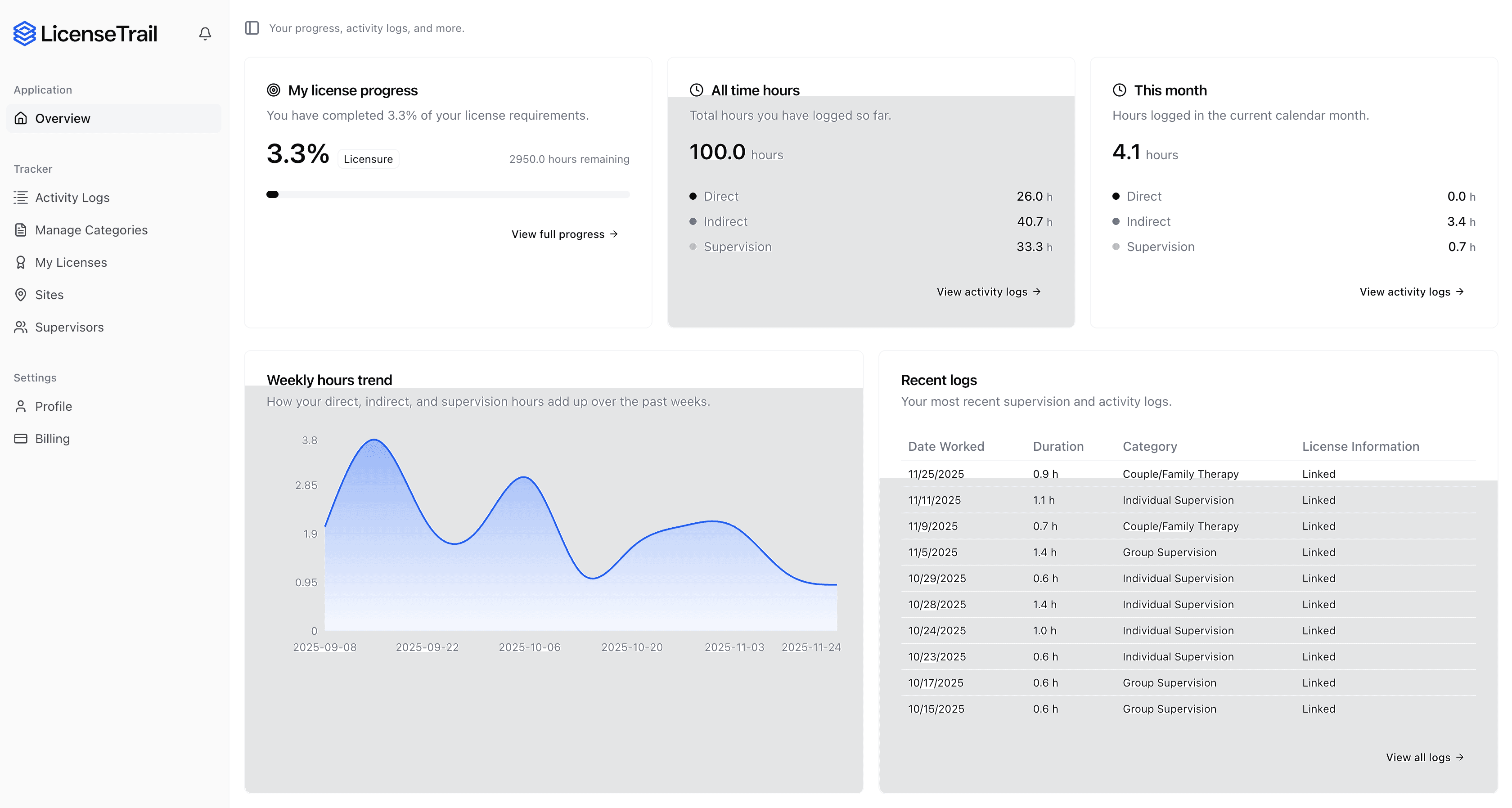
Track your LMFT Candidate hours with confidence
License Trail checks your direct, indirect, and supervision hours against Oklahoma LMFT Candidate requirements continuously and flags mismatches before you submit.
 Start Tracking for Free
No credit card required · Free plan available
Is your spreadsheet hiding Oklahoma LMFT Candidate risks?
Stop guessing if your categories match Oklahoma State Board of Behavioral Health Licensure requirements. License Trail checks your direct, indirect, and supervision hours continuously and flags mismatches before you submit.
Import or log
Bring your spreadsheet or start fresh
Upload your existing tracking spreadsheet and we'll map every hour into the right Oklahoma State Board of Behavioral Health Licensure categories automatically.
Verify against Oklahoma
Catch mismatches before the board does
License Trail checks your direct, indirect, and supervision hours against Oklahoma LMFT Candidate requirements continuously.
Export board-ready
One-click clean reports
Generate professional, board-ready reports for supervision meetings and Oklahoma State Board of Behavioral Health Licensure submissions in seconds.
No credit card required · Free plan available