
Oklahoma LPC Candidate Requirements: Hours, Exams & Step-by-Step Guide
Stop guessing if your categories match Oklahoma requirements. License Trail checks your direct, indirect, and supervision hours against LPC Candidate requirements continuously and flags mismatches before you submit.
No credit card required · Free plan available
Quick Requirements Overview
- Education prerequisite: Board‑approved counseling grad degree 60 semester hrs (90 quarter hrs) + 300‑hr practicum/internship (does not count toward post‑master’s hours)
- Candidate status begins / hours count only after: BBHL accepts application + pass OLERE + pass NCE (or approved exam) + W‑4 employment on file + Supervision Agreement approved (no retroactive hours)
- Post‑master’s experience: 3,000 clock hrs supervised “on‑the‑job” experience over ≥ 3 years; “full‑time” = 20+ hrs/week
- Direct client contact: 350 direct face‑to‑face hrs per 1,000 (minimum 1,050 direct within 3,000)
- Supervision dose: 45 min face‑to‑face supervision per 20 work hrs (≈ 112.5 supervision hrs if 3,000 work hrs)
- Group supervision limit: ≤ 50% of required supervision may be group (2–6 supervisees); remainder individual
- Completion window / minimum floor: Finish within 60 months of first Supervision Agreement approval; even with extra graduate coursework, must complete ≥ 1,000 supervised hrs (1 year)
- Ongoing documentation/oversight: EoSE every 6 months (late >60 days not credited); supervisor 2 observations per 6‑month period + consults with on‑site supervisor at least once per 6 months
License Details
Procedures
In Oklahoma, the title “Licensed Professional Counselor Candidate” (LPC Candidate) is the status you hold after your application for LPC licensure is accepted and you begin supervised post‑graduate practice toward full LPC licensure. The Oklahoma Administrative Code defines an LPC Candidate as a person whose application has been accepted and who is under supervision for licensure under 59 O.S. § 1906. (okrules.elaws.us)
Below is a step‑by‑step guide focused on what you must do to become an LPC Candidate through the Oklahoma State Board of Behavioral Health Licensure (BBHL) and exactly what kinds of hours you must complete.
1. Educational and practicum prerequisites
Before you can become an LPC Candidate, you must first meet Oklahoma’s academic requirements for LPC licensure:
- Hold a board‑approved graduate degree of at least 60 semester hours (or 90 quarter hours) in counseling (or a qualifying counseling program), from a regionally accredited institution.
- The degree must follow a planned counseling curriculum and be clearly intended to prepare you for a counseling career. (oklahoma.gov)
- You must complete at least one practicum/internship course with a minimum of 300 clock hours in counseling, under university-approved counseling supervisors. (oklahoma.gov)
These practicum/internship hours are academic hours and do not count toward the post‑master’s supervised experience described below; they are a prerequisite to starting candidacy.
2. When you are considered an “LPC Candidate”
Under the LPC rules, a “Licensed Professional Counselor Candidate” is:
A person whose application for licensure has been accepted and who is under supervision for licensure as provided in 59 O.S. § 1906. (okrules.elaws.us)
In practice, you become an LPC Candidate once:
- Your licensure application is accepted by BBHL.
- You have passed both required exams (see next section).
- BBHL has approved a Supervision Agreement for you (with a W‑4 from your employing agency on file).
Only after all of that is in place do your post‑graduate supervised hours begin to count.
3. Exams and paperwork required before ANY supervised hours count
Required exams
Before you can start accruing supervised experience hours, BBHL must confirm that you have:
- A completed LPC application on file.
- A passing score on the Oklahoma Legal and Ethical Responsibilities Examination (OLERE) – the state’s jurisprudence exam.
- A passing score on the National Counselor Examination (NCE) (or the board‑approved national exam). (oklahoma.gov)
Supervision Agreement and employment (W‑4)
You must also:
- Be formally employed by the agency where you will earn your supervised hours, documented by a W‑4 for that location.
- Submit a completed Supervision Agreement naming your BBHL‑approved LPC supervisor. (oklahoma.gov)
According to the board’s Supervision Agreement guidance:
- Supervised experience may only begin as of the approved date on the Supervision Agreement.
- Any hours accrued before that approval date will not be credited and may trigger complaints or affect supervisor approval status. (oklahoma.gov)
So, practically:
You are not an “LPC Candidate” for hour‑counting purposes until your application, exams, W‑4, and Supervision Agreement are all approved.
4. Where and how LPC Candidate hours may be earned
The supervised experience rules specify that:
- Supervised experience begins only after all academic requirements are complete (i.e., after your qualifying degree and required coursework are done). (regulations.justia.com)
- An LPC Candidate may accrue hours in academic, governmental, private not‑for‑profit, and private for‑profit settings. (regulations.justia.com)
- In private for‑profit or not‑for‑profit practice settings:
- You must be employed at the same facility as an on‑site supervisor (who is licensed in OK as one of several behavioral health professions) and who is immediately available whenever you are providing counseling.
- You must also be under a BBHL‑approved LPC supervisor, who can be offsite. (regulations.justia.com)
The rules use the term “on-the-job experience” to describe your counseling work. This consists of performing counseling activities such as applying mental health and developmental principles to prevent, diagnose, or treat mental, emotional, or behavioral disorders; conducting assessments; developing and implementing treatment plans; using counseling interventions; interpreting research; and other activities that fall under the LPC scope of practice in Section 1902 of the Act. (s3.amazonaws.com)
5. Total supervised experience required as an LPC Candidate
5.1 Overall requirement: 3,000 supervised “on‑the‑job” hours
The core supervision rule for LPC Candidates is:
- You must complete three (3) years or three‑thousand (3000) clock hours of full‑time, on‑the‑job experience, supervised by an approved LPC supervisor. (regulations.justia.com)
“Full‑time” is defined in the rules as:
- Full time means at least twenty (20) hours per week. (regulations.justia.com)
So the headline requirement is:
3,000 total post‑master’s supervised “on‑the‑job” hours, obtained over at least three years of “full‑time” (20+ hours/week) counseling employment under an approved LPC supervisor.
5.2 Required direct client contact within the 3,000 hours
Oklahoma further divides those 3,000 hours into:
- For each 1,000 clock hours of full‑time, on‑the‑job experience, 350 hours must be “direct face‑to‑face client contact.” (regulations.justia.com)
Across the full 3,000 hours, that works out to:
- Minimum direct client contact:
350 hours × 3 = 1,050 hours of direct, face‑to‑face client contact. - Remaining hours:
3,000 – 1,050 = 1,950 hours of other acceptable counseling work (indirect services and related duties) that fall within the “on‑the‑job experience” definition.
In other words, Oklahoma does not split the requirement into a fixed “X hours direct” plus “Y hours supervision only”; instead, it requires:
- 3,000 total supervised counseling hours, and
- Within that total, at least 1,050 hours must be direct client contact, and the rest can be other counseling‑related, on‑the‑job activities (documentation, case consultation, treatment planning, etc.), all under supervision.
6. Supervision hour requirements during candidacy
Supervision time is in addition to the 3,000 hours of on‑the‑job experience. The rules describe several supervision components.
6.1 Frequency and amount of supervision
The supervision rule states:
- Weekly, face‑to‑face supervision must be provided by an LPC at the rate of 45 minutes of supervision for every 20 hours of on‑the‑job experience. (regulations.justia.com)
Interpreting this ratio:
- For each 20 hours of counseling work you log, you owe 0.75 hours (45 minutes) of supervision.
- If you complete the full 3,000 hours, you will have approximately:
3,000 ÷ 20 = 150 supervision units × 0.75 hours = 112.5 hours of total supervision.
6.2 Individual vs. group supervision
Oklahoma distinguishes individual and group supervision:
- Individual supervision = face‑to‑face contact with one supervisor and one supervisee. (regulations.justia.com)
- Group supervision = a group of 2–6 supervisees with a supervisor, but
- No more than one‑half (½) of the required supervision hours may be in group supervision. (regulations.justia.com)
So, if your total supervision time for 3,000 hours is about 112.5 hours, no more than roughly 56.25 hours can be group supervision; at least half must be individual.
6.3 Minimum “year” of supervised experience that cannot be waived
The rules allow some substitution of graduate coursework for supervised hours, but they set a floor:
- You may gain one or two years of supervised experience credit at the rate of one year for each 30 graduate semester hours (or 45 quarter hours) in counseling‑related coursework beyond the master’s degree. (regulations.justia.com)
- However, regardless of how many additional graduate hours you have,
- You must still complete at least one (1) year or one‑thousand (1000) clock hours of supervised experience under the LPC supervision ratio described above. (regulations.justia.com)
So even with advanced coursework, you cannot avoid doing at least 1,000 supervised on‑the‑job hours as a Candidate.
6.4 Time limit to complete supervised hours
- The supervised experience requirements must be completed within 60 months (5 years) from the date of approval of your first supervision agreement, or the application is voided. (regulations.justia.com)
7. Documentation and evaluation of supervised experience
Oklahoma uses the Evaluation of Supervised Experience (EoSE) process to track Candidate hours.
Key points:
- LPC Candidates must submit an EoSE every six (6) months, starting from the approval date of the initial supervision agreement. (oklahoma.gov)
- Any EoSE submitted more than 60 days after its semi‑annual due date will not be credited toward the duration of supervision as described in the rules. (oklahoma.gov)
- When reporting hours:
- Hours are entered in quarter‑hour increments (0.25, 0.50, 0.75, etc.).
- All weeks in the six‑month period must be accounted for; if no counseling services were provided in a week, you report “0” hours for that week. (oklahoma.gov)
The rules also require your supervisor to:
- Perform at least two observations (live or recorded) of your work per six‑month evaluation period, and
- Consult with your on‑site supervisor at least once per six‑month period. (regulations.justia.com)
These observation and consultation requirements are part of what makes your hours count as acceptable supervised experience.
8. Continuing supervision if hours are done but license not yet issued
The duration rule also addresses what happens if you complete the hour requirement before final licensure:
- If you finish the required supervised experience before passing the licensure examination, you must continue to practice under LPC supervision (unless you fall under an exemption in the statute) until you are fully licensed. (regulations.justia.com)
So, candidate status and required supervision continue until BBHL actually issues your LPC license, not merely until you hit 3,000 hours.
9. Summary of the key hour requirements for an Oklahoma LPC Candidate
Putting everything together:
-
Total supervised experience
- 3,000 clock hours of full‑time, on‑the‑job experience (20+ hours/week) under an approved LPC supervisor. (regulations.justia.com)
-
Direct client contact requirement
- For each 1,000 hours, at least 350 hours must be direct face‑to‑face client contact.
- Over 3,000 hours, this means at least 1,050 hours of direct client contact, with up to 1,950 hours of other counseling‑related work. (regulations.justia.com)
-
Supervision hours
- 45 minutes of LPC supervision for every 20 hours of on‑the‑job experience (about 112.5 hours total supervision for a full 3,000 hours).
- No more than half of these supervision hours may be in group supervision; at least half must be individual. (regulations.justia.com)
-
Minimum non‑waivable supervised work
- Even with extra graduate coursework, you must complete at least 1,000 supervised clock hours (one year) under LPC supervision. (regulations.justia.com)
-
Timeframe
- All supervised experience must be completed within 60 months of the date your first supervision agreement is approved. (regulations.justia.com)
-
Prerequisites before hours can start
- Completed LPC application accepted by BBHL.
- Passing OLERE and NCE (or equivalent).
- Approved Supervision Agreement and W‑4 verifying you are an employee of the site where you will accrue hours. (oklahoma.gov)
Altogether, these requirements define exactly what it means, in Oklahoma’s own regulatory language, to be an LPC Candidate and what kinds of supervised hours you must complete to move from candidacy to full LPC licensure.
Track your LPC Candidate hours with confidence
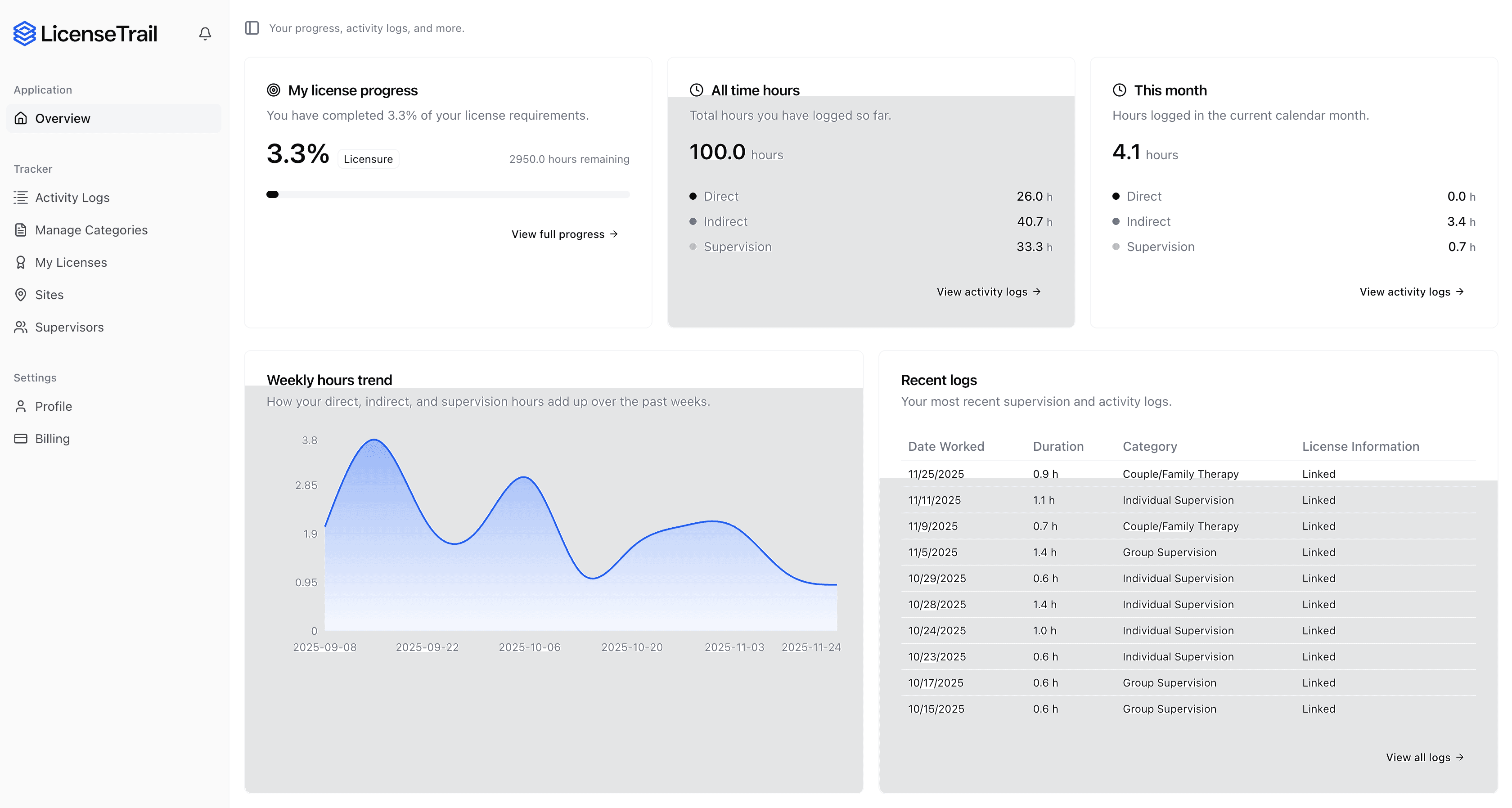
License Trail checks your direct, indirect, and supervision hours against Oklahoma LPC Candidate requirements continuously and flags mismatches before you submit.
 Start Tracking for Free
No credit card required · Free plan available
Is your spreadsheet hiding Oklahoma LPC Candidate risks?
Stop guessing if your categories match Oklahoma State Board of Behavioral Health Licensure requirements. License Trail checks your direct, indirect, and supervision hours continuously and flags mismatches before you submit.
Import or log
Bring your spreadsheet or start fresh
Upload your existing tracking spreadsheet and we'll map every hour into the right Oklahoma State Board of Behavioral Health Licensure categories automatically.
Verify against Oklahoma
Catch mismatches before the board does
License Trail checks your direct, indirect, and supervision hours against Oklahoma LPC Candidate requirements continuously.
Export board-ready
One-click clean reports
Generate professional, board-ready reports for supervision meetings and Oklahoma State Board of Behavioral Health Licensure submissions in seconds.
No credit card required · Free plan available