
Pennsylvania LCSW Requirements: Hours, Exams & Step-by-Step Guide
Stop guessing if your categories match Pennsylvania requirements. License Trail checks your direct, indirect, and supervision hours against LCSW requirements continuously and flags mismatches before you submit.
No credit card required · Free plan available
Quick Requirements Overview
- CSWE-accredited MSW (or DSW/PhD in social work); foreign grads need CSWE equivalency
- Must first hold PA Social Worker license (LSW); LSW requires ASWB Master’s exam (no experience required)
- LCSW exam: ASWB Clinical (scores sent to PA Board)
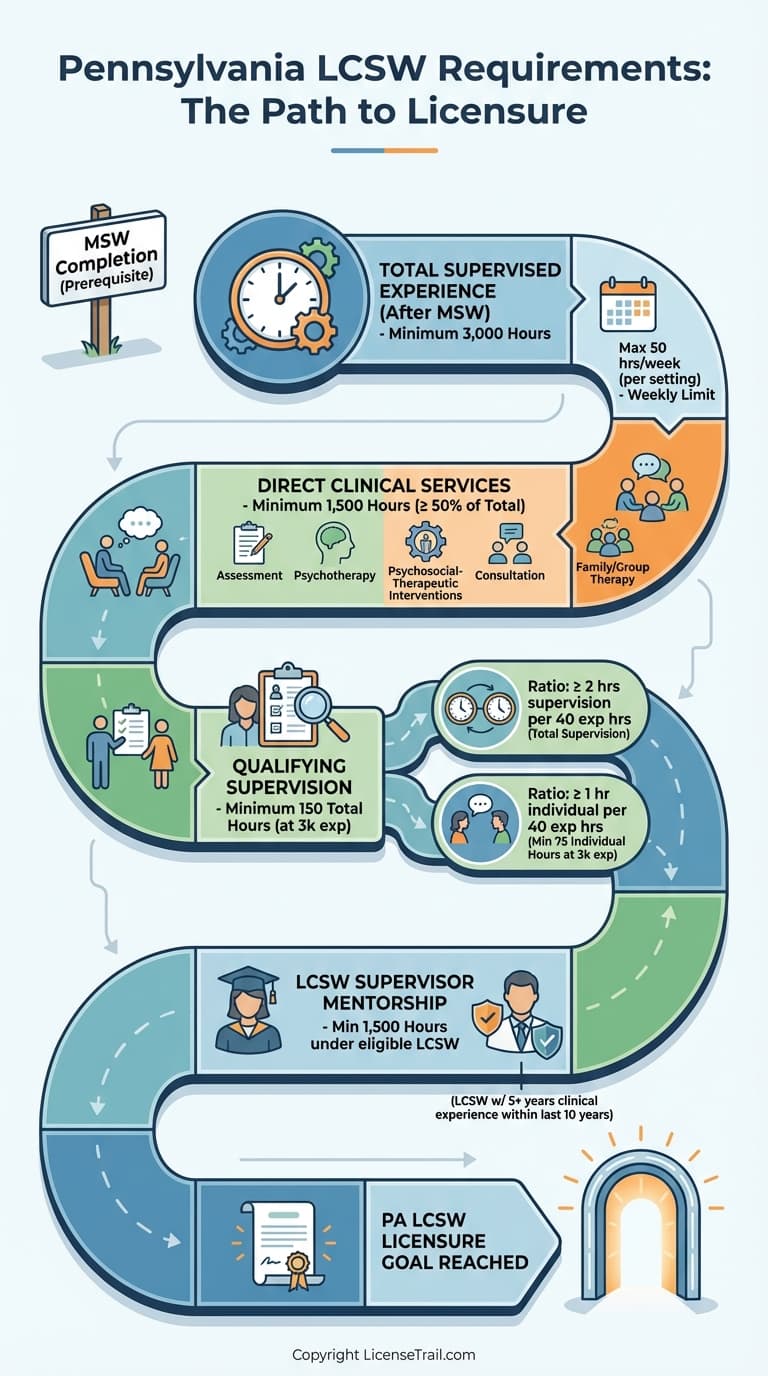
- Post-MSW supervised clinical experience: 3,000 hours, completed in 2–6 years; 500–1,800 hours per 12 months
- At least 50% (≥1,500 hours) must be direct clinical work (assessment, psychotherapy, psychosocial interventions, consultation, family/group therapy)
- Supervision: 2 hours per 40 hours worked; at least 1 hour individual in-person (up to 1 hour group in-person); supervisor max 6 supervisees (unless exception)
- Supervisor must meet PA “qualified supervisor” criteria; at least half of hours supervised by appropriately qualified LCSW-level supervisor (per regs)
- General/app/admin: good moral character, application + fees, 2 Board Certificates of Recommendation, 3-hour child abuse training; disclose supervisee status to clients + obtain written consent to discuss cases with supervisor
License Details
Procedures
In Pennsylvania, the Licensed Clinical Social Worker (LCSW) credential is issued by the State Board of Social Workers, Marriage and Family Therapists and Professional Counselors under Chapter 47 of Title 49 of the Pennsylvania Code. The pathway is essentially:
- Earn an accredited MSW (or higher in social work).
- Become licensed as a Social Worker (often called LSW) in Pennsylvania.
- Complete 3,000 hours of supervised clinical experience that meets very specific criteria.
- Pass the ASWB Clinical examination.
- Meet general licensure conditions (moral character, child abuse training, fees, etc.) and apply.
Below is a step‑by‑step guide laid out in the same structure the Board uses.
1. General licensure conditions that apply to LCSWs
All applicants for any social work license, including the LCSW, must first meet the “Qualifications for licensure” in 49 Pa. Code §47.12. In summary, the Board requires that:(law.cornell.edu)
- You are of good moral character.
- You have not been convicted of certain drug‑related felonies unless strict rehabilitation and time‑since‑conviction conditions are met.
- You submit the official application and required licensure fee.
- You provide two Certificates of Recommendation on Board forms.
- You complete at least 3 hours of Board‑approved training in child abuse recognition and reporting for initial licensure.
- You sign an affirmation verifying the information on your application.
These general conditions apply to both the Social Worker license and the Clinical Social Worker license.
2. Educational requirement for LCSW
The clinical license requires a graduate degree in social work:
- The Board states that an LCSW applicant must hold “a master’s degree in social work or social welfare or a doctoral degree in social work from a school accredited by the Council on Social Work Education.” (law.cornell.edu)
- Graduates of foreign programs must have their credentials evaluated by CSWE to show equivalency to an accredited U.S. social work program. (law.cornell.edu)
Practically, this means you need an MSW (or DSW/PhD in social work) from a CSWE‑accredited program or a CSWE‑approved foreign equivalent.
3. Social Worker license (LSW) as a prerequisite
Before you can be licensed as an LCSW in Pennsylvania, you must already be licensed under the Act as a Social Worker. 49 Pa. Code §47.12c(a)(3) explicitly requires that an LCSW applicant “is licensed under the act as a social worker.” (regulations.justia.com)
To obtain the Social Worker license (LSW), Pennsylvania requires:(regulations.justia.com)
- Degree:
- A master’s degree in social work or social welfare from a CSWE‑accredited program, or a doctoral degree in social work.
- Exam:
- Passing the Association of Social Work Boards (ASWB) Master’s level examination is required as the licensure examination for the Social Worker license.
- Experience:
- There is no post‑degree experience requirement for the Social Worker license in Pennsylvania.
- Child abuse training and general conditions:
- The same 3‑hour child abuse training and general qualifications described in Section 1.
Once you hold this Social Worker license, you can accrue the supervised clinical experience required for the LCSW (subject to the timing rules below).
4. Clinical examination requirement (LCSW)
For the LCSW itself, the required exam is the ASWB Clinical examination. Pennsylvania’s regulation on licensure examinations states: “The examination required as a prerequisite to being granted a license to hold oneself out as a licensed clinical social worker is the ASWB clinical level examination.” (law.cornell.edu)
You must have the exam scores sent directly from ASWB to the Pennsylvania Board.
5. Core clinical experience requirement: 3,000 hours
5.1 Total hours and timing
The Board’s clinical social work regulation (49 Pa. Code §47.12c) requires that an LCSW applicant:(law.cornell.edu)
- Has completed at least 3,000 hours of supervised clinical experience.
- Those hours must be obtained after completion of the master’s degree in social work.
- The supervised clinical experience must be completed in no less than 2 years and no more than 6 years.
- Only 500 to 1,800 hours may be credited in any 12‑month period.
- To count, supervised work must occur:
- In a single setting, either:
- At least 30–50 hours per week over a period of at least 3 months, or
- At least 15 hours per week over a period of at least 6 months.
- In a single setting, either:
These rules mean you cannot compress the 3,000 hours into less than two years, and you must maintain at least the minimum weekly engagement for a block of time for those hours to count.
5.2 Direct clinical service hours vs. other hours
Within the 3,000 supervised hours, Pennsylvania defines the nature of the work in subsection (b) of §47.12c. The regulation states that:
- At least one‑half of the experience must consist of providing services in specific clinical areas. These areas are:
- Assessment
- Psychotherapy
- Other psychosocial‑therapeutic interventions
- Consultation
- Family therapy
- Group therapy (law.cornell.edu)
In practical terms, at least 1,500 of the 3,000 hours must be direct clinical service to clients, because half the experience must be in those listed clinical activities. The remaining hours (up to about 1,500) can involve other clinically relevant tasks in an organized clinical setting (e.g., documentation, team meetings, case conferences, treatment planning), as long as they occur in a setting designed to prepare you for the practice of clinical social work and you remain under appropriate supervision.
The Board describes acceptable experience as work “in a setting that is organized to prepare the applicant for the practice of clinical social work consistent with the applicant’s education and training.” (law.cornell.edu)
6. Supervision requirements and supervisor qualifications
6.1 Who can supervise
Pennsylvania requires that supervision for the 3,000 hours be provided by a “supervisor” as defined in §§47.1 and 47.1a. The supervisor must meet one of the following criteria:(law.cornell.edu)
- Hold a license as a clinical social worker and have 5 years of experience within the last 10 years as a clinical social worker; or
- Hold a license and a master’s or doctoral degree in a related field, and have 5 years of experience within the last 10 years in that field.
Additionally, the LCSW regulation requires that:(law.cornell.edu)
- Supervision for all clinical hours must be provided by a supervisor as defined in §§47.1 and 47.1a.
- At least one‑half of the required 3,000 hours (i.e., at least 1,500 hours of supervised clinical experience) must be supervised by someone who meets the stricter qualifications in §47.1a(1) and (3). In practice, this means a substantial portion of your hours must be directly supervised by an experienced LCSW‑level supervisor (or a similarly qualified person as defined in the regulation).
6.2 Required intensity and structure of supervision
The Board specifies the minimum amount and format of supervision:(law.cornell.edu)
- The supervisor (or a delegate) must meet with the supervisee for a minimum of 2 hours of supervision for every 40 hours of supervised clinical experience.
- At least 1 of those 2 hours must be individual, in‑person supervision.
- Up to 1 of the 2 hours may be group, in‑person supervision.
- The supervisor must “oversee, direct, recommend and instruct” the clinical activities of the supervisee.
- The supervisor must ensure that if they are temporarily unable to supervise, a qualified substitute supervisor is designated, although the original supervisor retains ultimate responsibility.
- A supervisor may supervise no more than 6 supervisees at the same time, unless the Board grants a written exception based on undue hardship to the supervisee.
Because the regulation requires 2 hours of supervision per 40 clinical hours, completing the full 3,000 hours will normally entail at least about 150 hours of documented supervision (3,000 ÷ 40 × 2). This 150‑hour figure is not separately stated in the regulation, but follows directly from the required ratio.
6.3 Supervisee disclosure to clients
Pennsylvania also includes explicit client‑protection rules:(law.cornell.edu)
- The supervisee must disclose their status as a supervisee to each patient/client.
- The supervisee must obtain written permission from the client to discuss that client’s case with the supervisor.
These requirements should be reflected in your informed consent forms and documentation.
7. Putting the hours together (summary of what the Board expects)
Using the Board’s own structure, a compliant supervised experience for LCSW licensure in Pennsylvania typically looks like this:
-
Total clinical experience
- 3,000 hours of supervised clinical experience, all after the date your MSW is granted.
-
Direct clinical service vs. other hours
- At least 1,500 hours (half of the total) in direct clinical services to clients, in the following Board‑listed activities: assessment, psychotherapy, other psychosocial‑therapeutic interventions, consultation, family therapy, and group therapy.(law.cornell.edu)
- Up to approximately 1,500 hours in other clinical work in an organized clinical setting (documentation, case conferences, treatment planning, etc.), still under appropriate supervision.
-
Supervision
- Supervision must be by a Board‑qualified supervisor under §47.1a, with at least half of the 3,000 hours supervised by an LCSW‑level supervisor (or equivalent as defined).(law.cornell.edu)
- Ratio: A minimum of 2 hours of supervision for every 40 hours of clinical experience; at least 1 hour must be individual, in‑person, and up to 1 may be group, in‑person.
- This works out to roughly 150 hours of total supervision across the 3,000 hours.
-
Time frame and setting
- Experience must be completed in no less than 2 years and no more than 6 years.
- Only 500–1,800 hours may count in any 12‑month period.
- Hours must be in a single setting at either 30–50 hours/week for at least 3 months or 15+ hours/week for at least 6 months.(law.cornell.edu)
8. Additional items: fees and continuing education
From the Board’s “Clinical Social Worker Licensure Requirements Snapshot,” the key practical details are:(pa.gov)
- Initial LCSW application fee: $90.00.
- Biennial renewal fee: $95.00.
- Initial licensure child‑abuse CE: 3 hours (as also mandated in §47.12).
- Ongoing CE for each 2‑year renewal:
- 30 hours total, including:
- 2 hours Act 31 Child Abuse Reporter Training,
- 3 hours in ethics,
- 1 hour in suicide prevention.
- 30 hours total, including:
9. Licensure by endorsement (if already an LCSW elsewhere)
For applicants already licensed as clinical social workers in another state, Pennsylvania provides a licensure‑by‑endorsement path in §47.16. In summary, to be granted an LCSW license without retaking the exam, you must:(regulations.justia.com)
- Meet the general qualifications of §47.12 (moral character, child abuse training, etc.).
- Hold a master’s or doctoral degree in social work or social welfare from a CSWE‑accredited school (or CSWE‑evaluated foreign equivalent).
- Have passed a clinical social work examination acceptable to the Board (typically the ASWB Clinical exam) with a passing grade at least equal to Pennsylvania’s standard.
- Hold a clinical social work license in good standing in another state, with verification and disclosure of any disciplinary history.
- Demonstrate that you have completed at least 3,000 hours of supervised clinical experience meeting the requirements of the state where you are currently licensed.
This pathway is for established out‑of‑state clinicians; applicants starting their careers in Pennsylvania generally follow the in‑state process described in Sections 2–8.
In summary, Pennsylvania’s LCSW pathway is highly structured: graduate social work education, Social Worker licensure, a 3,000‑hour supervised clinical experience (of which at least 1,500 hours are direct clinical services under qualified supervision at a 1:20 supervision ratio), passage of the ASWB Clinical examination, and compliance with general licensure, child abuse training, and continuing‑education requirements. All of these elements must align with the specific definitions and ratios laid out in 49 Pa. Code Chapter 47 and the Board’s official snapshots.
Track your LCSW hours with confidence
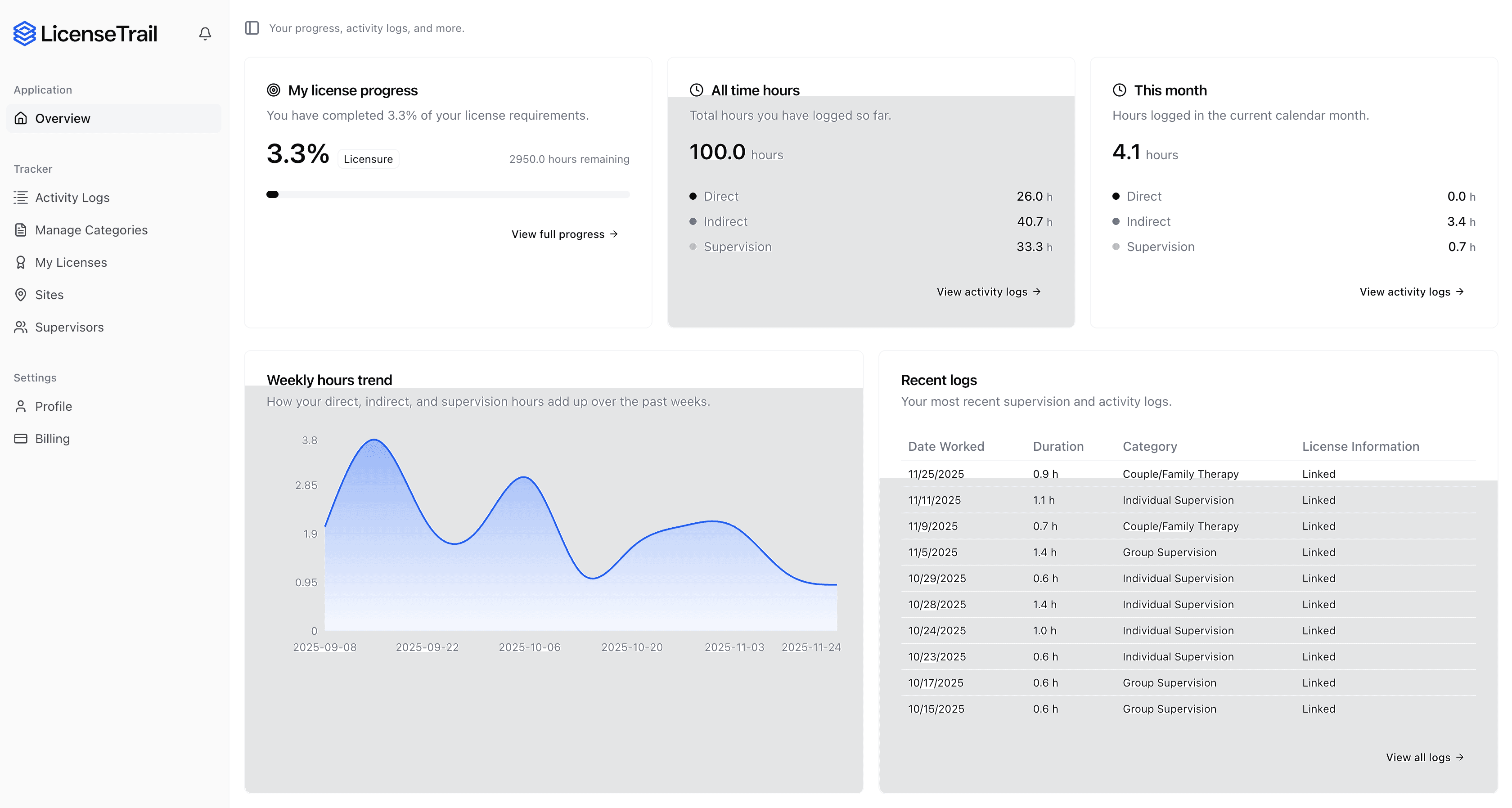
License Trail checks your direct, indirect, and supervision hours against Pennsylvania LCSW requirements continuously and flags mismatches before you submit.
 Start Tracking for Free
No credit card required · Free plan available
Is your spreadsheet hiding Pennsylvania LCSW risks?
Stop guessing if your categories match Pennsylvania State Board of Social Workers, Marriage and Family Therapists and Professional Counselors requirements. License Trail checks your direct, indirect, and supervision hours continuously and flags mismatches before you submit.
Import or log
Bring your spreadsheet or start fresh
Upload your existing tracking spreadsheet and we'll map every hour into the right Pennsylvania State Board of Social Workers, Marriage and Family Therapists and Professional Counselors categories automatically.
Verify against Pennsylvania
Catch mismatches before the board does
License Trail checks your direct, indirect, and supervision hours against Pennsylvania LCSW requirements continuously.
Export board-ready
One-click clean reports
Generate professional, board-ready reports for supervision meetings and Pennsylvania State Board of Social Workers, Marriage and Family Therapists and Professional Counselors submissions in seconds.
No credit card required · Free plan available