
Pennsylvania LPC Requirements: Hours, Exams & Step-by-Step Guide
Stop guessing if your categories match Pennsylvania requirements. License Trail checks your direct, indirect, and supervision hours against LPC requirements continuously and flags mismatches before you submit.
No credit card required · Free plan available
Quick Requirements Overview
- Regulator: PA State Board of Social Workers, Marriage & Family Therapists and Professional Counselors (49 Pa. Code Ch. 49; 63 P.S. §§ 1901–1922)
- Education: planned program 60 semester credits / 90 quarter hours in counseling or closely related field; includes at least a 48-credit master’s (or qualifying doctoral degree) from an accredited institution
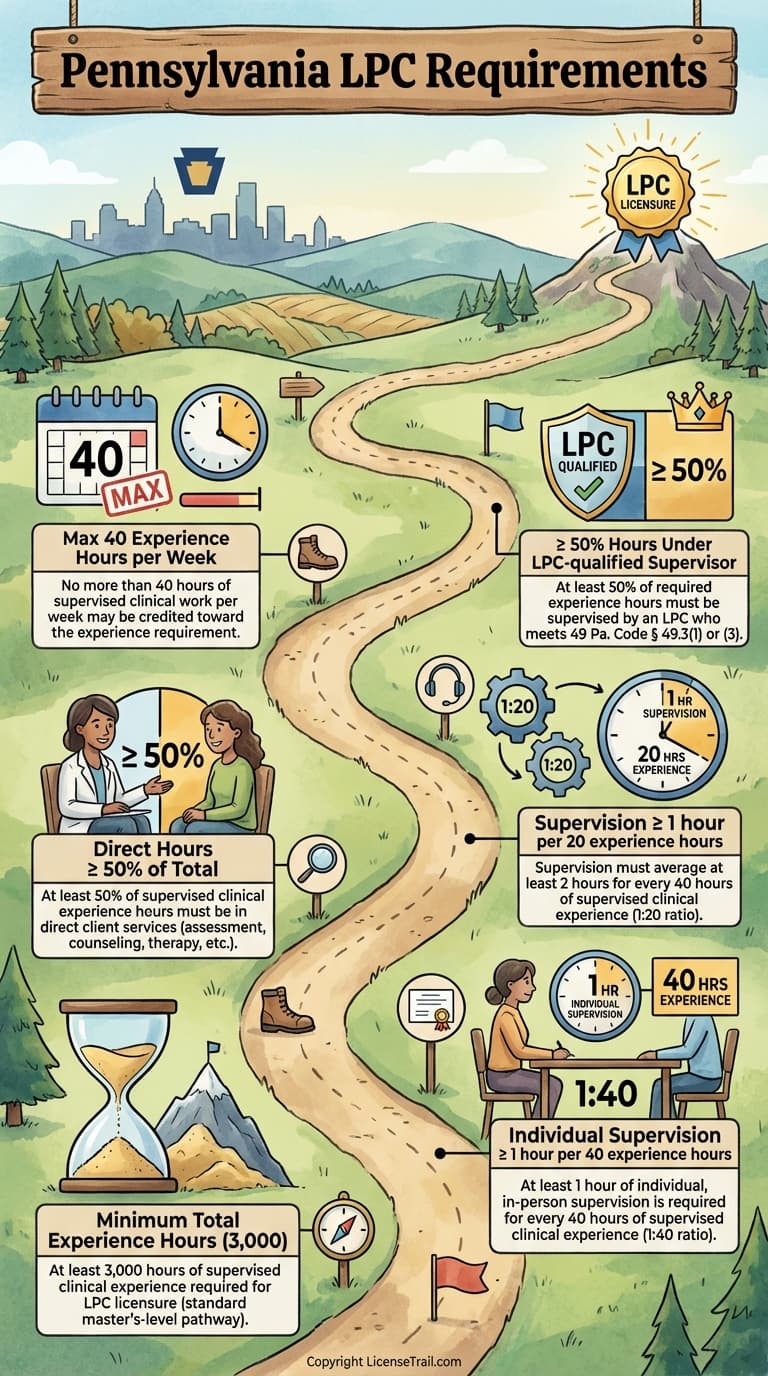
- Experience (Master’s route): 3,000 supervised clinical hours earned after 48 semester credits / 72 quarter hours completed; ≥50% (≥1,500 hrs) must be direct client services (assessment/counseling/therapy, etc.)
- Experience (Doctoral route): 2,400 supervised clinical hours; 1,200 hrs must be post-doctorate; ≥50% (≥1,200 hrs) direct client services
- Timeframe rules for experience: complete in 2–6 years; credit per 12 months 500–1,800 hrs; must be in one setting with minimum work patterns (30–40 hrs/wk for ≥3 months or ≥15 hrs/wk for ≥6 months)
- Supervision: 2 hrs supervision per 40 hrs experience; ≥1 hr must be individual, in-person (other hour may be in-person group); supervisor may oversee ≤6 supervisees at once (unless exception)
- Supervisor qualifications: ≥50% of hours supervised by an LPC with 5 years’ experience within last 10; remaining hours may be supervised by other qualified licensed professionals meeting Board criteria
- Other requirements: good moral character/criminal history review; 3 hrs child abuse training; 2 recommendations; apply/pay fee via PALS; pass a Board-approved exam (e.g., NCE, CRC, ATCB, CBMT, NAMP, AAODA, EMAC) with official scores sent to Board
License Details
Procedures
In Pennsylvania, the Licensed Professional Counselor (LPC) credential is regulated by the State Board of Social Workers, Marriage and Family Therapists and Professional Counselors under the Social Workers, Marriage and Family Therapists and Professional Counselors Act (63 P.S. §§ 1901–1922). The detailed LPC requirements appear in Title 49, Chapter 49 of the Pennsylvania Code, particularly §§ 49.11–49.14. (regulations.justia.com)
What follows is a step‑by‑step guide organized around that Board language, with special attention to the types and numbers of required hours.
1. General eligibility and character requirements
Under § 49.12 (“General qualifications for licensure”), every LPC applicant must: (law.cornell.edu)
- Be “of good moral character.”
- Not have disqualifying felony drug convictions, unless at least 10 years have passed and the applicant demonstrates rehabilitation to the Board’s satisfaction.
- Submit the Board’s application for licensure, pay the required fee, and provide:
- Two certificates of recommendation (on Board forms).
- An affirmation that the information in the application is true.
- Complete at least 3 hours of Board‑approved training in child abuse recognition and reporting (this is a mandatory training requirement for initial licensure).
The Board currently handles applications through the Pennsylvania Licensing System (PALS). (pa.gov)
2. Educational requirements for LPC
The LPC education standard is set out in § 49.13(a)(3). In Board language, you must complete a “planned program of 60 semester hours or 90 quarter hours of graduate coursework” in counseling or a field “closely related to the practice of professional counseling,” leading to at least a 48‑semester‑hour master’s degree, or complete a qualifying doctoral degree. (regulations.justia.com)
In simplified form:
A. Master’s‑level route
You must have:
- A master’s degree in counseling or a Board‑defined closely related field (for example, counseling, psychology, social work, art therapy, human services, etc.), from an accredited institution; and
- A planned 60‑credit graduate program (or 90 quarter hours) in counseling or a closely related field, as defined in § 49.1. (regulations.justia.com)
The regulation explicitly recognizes master’s degrees of at least 48 semester hours / 72 quarter hours within that 60‑credit program.
B. Doctoral‑level route
Instead of the master’s route, you may qualify with: (regulations.justia.com)
- A doctoral degree in counseling, or
- A doctoral degree in a closely related field to professional counseling (as defined by the Board), from an accredited institution.
Doctoral‑level applicants have a different total hour requirement for supervised experience (see Section 3).
3. Core experience requirement: supervised clinical experience
A. Total hours required
Section 49.13(a)(4) uses the term “supervised clinical experience” and sets the minimum totals based on your degree: (regulations.justia.com)
- Master’s‑route applicants (meeting § 49.13(a)(3)(i) or (ii)) must complete
- At least 3,000 hours of supervised clinical experience
- These hours must be obtained after completion of 48 semester hours or 72 quarter hours of graduate coursework.
- Doctoral‑route applicants (meeting § 49.13(a)(3)(iii) or (iv)) must complete
- At least 2,400 hours of supervised clinical experience, and
- 1,200 of those hours must be completed after the doctoral degree is granted.
In all cases, the experience must meet the Board’s criteria in § 49.13(b).
B. Direct client service vs. other activities
The Board does not break the requirement into a “direct” vs. “supervised” hour total the way some states do. Instead, § 49.13(b) defines “experience acceptable to the Board” and requires that: (regulations.justia.com)
“At least one-half of the experience shall consist of providing services” in specified areas.
Those areas are listed as:
- Assessment
- Counseling
- Therapy
- Psychotherapy
- Other therapeutic interventions
- Consultation
- Family therapy
- Group therapy
This effectively creates the following minimum direct service expectations:
-
Master’s‑route LPC
- Total required supervised clinical experience: 3,000 hours
- At least one‑half must be direct services in the areas above
- That means at least 1,500 hours of face‑to‑face clinical services (assessment, counseling/therapy, etc.).
- Up to 1,500 hours can be other counseling‑related duties in a qualifying setting (documentation, case conferences, trainings, indirect services), as long as they are within the Board’s definition of “experience acceptable to the Board” and under proper supervision.
-
Doctoral‑route LPC
- Total required supervised clinical experience: 2,400 hours
- At least one‑half must be direct services in the same Board‑listed areas
- That means at least 1,200 direct service hours, with the remaining 1,200 allowable as other supervised clinical activities.
In Board terms, “experience acceptable to the Board means experience as a supervisee in a setting that is organized to prepare the applicant for the practice of counseling consistent with the applicant’s education and training.” (regulations.justia.com)
C. Timeframe and pacing of hours
Section 49.13(b) also places important timing restrictions on how you accumulate these hours: (regulations.justia.com)
- Your supervised clinical experience must be completed in no less than 2 years and no more than 6 years.
- In any given 12‑month period, you may not be credited with:
- Fewer than 500 hours, or
- More than 1,800 hours of supervised clinical experience.
- Supervised work counts only if it is in one setting for either:
- 30–40 hours per week for at least a 3‑month period, or
- At least 15 hours per week for at least 6 months.
These timing rules apply regardless of whether you are on the master’s or doctoral track.
4. Supervision requirements and supervisor qualifications
A. What “supervision” means
In the Board’s definitions (§ 49.1): (regulations.justia.com)
- Supervisee – “An individual who is fulfilling the supervised experience requirement for licensure.”
- Supervision – “The act of overseeing, directing or instructing the activity or course of action of another.”
- Supervisor – An individual providing supervision to a supervisee who meets the criteria in § 49.3 (Qualifications for supervisors).
B. Supervisor qualifications – § 49.3
To qualify as a supervisor for LPC hours, an individual must meet one of the following criteria: (regulations.justia.com)
- Hold a license as a professional counselor and have 5 years of experience within the last 10 years as a professional counselor; or
- Hold a license (for example, another mental health license), have at least a master’s degree in a related field, and have 5 years of experience within the last 10 years in that field; or
- (Historical provision that expired January 1, 2006.)
For LPC applicants now, the practical reading is:
- At least 50% of your supervised clinical hours must be under a supervisor who is a licensed professional counselor with 5 years of experience in the last 10 years, because § 49.13(b)(2) requires that at least half the hours be supervised by someone meeting § 49.3(1) (and the now‑expired § 49.3(3)). (regulations.justia.com)
The remaining hours can be supervised by other qualified licensed professionals who meet § 49.3(2).
C. Structure and amount of supervision
Section 49.13(b) sets the supervision structure: (regulations.justia.com)
- Supervision ratio:
- You must receive a minimum of 2 hours of supervision for every 40 hours of supervised clinical experience.
- At least 1 of those 2 hours must be individual, in person with the supervisor.
- The other hour may be group supervision, in person.
- Maximum number of supervisees per supervisor:
- A supervisor may supervise no more than 6 supervisees at the same time, unless the Board grants an exception for undue hardship.
- Disclosure to clients:
- You must disclose your status as a supervisee to each patient and obtain written permission to discuss the case with your supervisor.
- Supervisor responsibilities:
- The supervisor must oversee, direct, recommend and instruct your professional counseling activities and is ultimately responsible for supervision, even if some responsibilities are delegated.
All of these are enforced through § 49.14 (“Standards for supervisors”), which adds that supervisors must be qualified, avoid dual relationships or conflicts (for example, cannot be your relative), maintain supervision notes, review ethics and practice issues, and periodically evaluate your progress. (regulations.justia.com)
5. Required licensure examination
Section 49.11 governs the LPC licensure examination. Instead of requiring one single test, Pennsylvania allows several Board‑approved national exams. The regulation lists the following as acceptable exams: (law.cornell.edu)
- National Counselor Examination for Licensure and Certification (NCE) – NBCC
- Certified Rehabilitation Counselor (CRC) Examination – CRCC
- Art Therapy Credentials Board (ATCB) Certification Examination – ATCB
- Board Certification Examination – CBMT (for music therapists)
- Practice Examination of Psychological Knowledge – North American Association of Master’s in Psychology (NAMP)
- Advanced Alcohol & Other Drug Abuse Counselor (AAODA) Examination – IC&RC/AODA
- Examination for Master Addictions Counselors (EMAC) – NBCC
You must:
- Apply directly to the testing organization,
- Pay that organization’s exam fee, and
- Arrange for the testing body to send official exam results to the Board.
The Board sets the passing score.
6. Putting the hours and steps together
For a typical master’s‑level LPC applicant in Pennsylvania, the Board‑defined path looks like this:
-
Earn the qualifying graduate education
- Complete a planned 60‑credit graduate program in counseling or a Board‑defined closely related field, including at least a 48‑credit master’s degree, from an accredited institution. (regulations.justia.com)
-
Accumulate supervised clinical experience under Board rules
- Total hours:
- 3,000 hours of supervised clinical experience obtained after at least 48 graduate credits.
- Direct service requirement:
- At least one‑half (≥1,500 hours) must be direct client services in assessment, counseling/therapy, psychotherapy, other therapeutic interventions, consultation, family therapy, or group therapy.
- Indirect/other hours:
- Up to 1,500 hours may be other counseling‑related duties in an approved setting (documentation, meetings, trainings, coordination), as long as they are part of supervised clinical experience.
- Timeframe & pace:
- Complete the 3,000 hours in no less than 2 and no more than 6 years.
- You may be credited with 500–1,800 hours per 12‑month period.
- Hours only count if worked in one setting at either 30–40 hours/week for at least 3 months or ≥15 hours/week for at least 6 months. (regulations.justia.com)
- Total hours:
-
Meet supervision requirements
- Supervision must be ongoing and formal:
- 2 hours of supervision per 40 hours of experience, with at least 1 hour being individual, in‑person; up to 1 hour may be in‑person group supervision.
- Supervisor qualifications:
- At least half of all supervised hours must be under a licensed professional counselor with at least 5 years’ experience in the last 10 years.
- Remaining hours may be supervised by other licensed mental health professionals with a master’s degree in a related field and 5 years’ recent experience. (regulations.justia.com)
- Supervision must be ongoing and formal:
-
Complete general licensure requirements
- Be of good moral character and satisfy the criminal history provisions.
- Complete 3 hours of Board‑approved child abuse recognition and reporting training.
- Obtain two professional recommendations on Board forms.
- Submit the application and fee via PALS. (law.cornell.edu)
-
Pass a Board‑approved national examination
- Most counseling applicants use the NCE, but other Board‑listed exams (CRC, ATCB, CBMT, NAMP practice exam, AAODA, EMAC) are also acceptable, depending on your specialty area. (law.cornell.edu)
-
Receive the LPC license and maintain it
- Once the Board determines that you have satisfied § 49.12 (general qualifications), § 49.13 (education and experience), and § 49.11 (exam), it may issue an LPC license allowing you to “hold oneself out as a licensed professional counselor” and to use the letters L.P.C. with your name. (regulations.justia.com)
Doctoral‑level summary
A doctoral‑level applicant follows essentially the same steps, with these modifications:
- Use the doctoral education pathway in § 49.13(a)(3)(iii) or (iv). (regulations.justia.com)
- Complete 2,400 hours of supervised clinical experience, of which 1,200 hours must be obtained after the doctoral degree is granted.
- At least 1,200 of the 2,400 hours must be direct client service (because the “one‑half direct services” rule still applies). (regulations.justia.com)
All other supervision ratios, timing limits, and general licensure qualifications remain the same.
This reflects the current text of the Pennsylvania regulations through the June 28, 2025 register, as published for the State Board of Social Workers, Marriage and Family Therapists and Professional Counselors. (regulations.justia.com)
Track your LPC hours with confidence
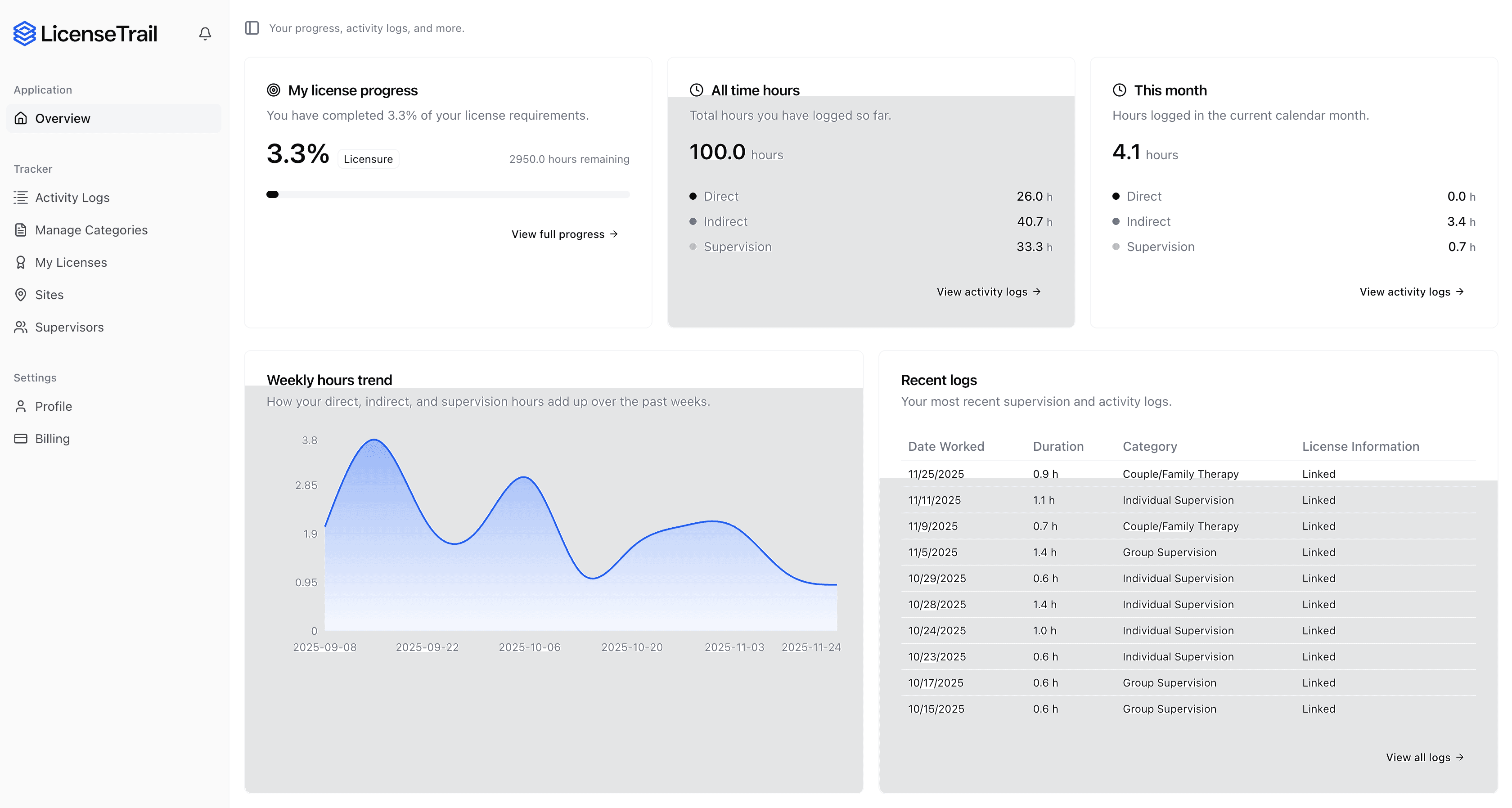
License Trail checks your direct, indirect, and supervision hours against Pennsylvania LPC requirements continuously and flags mismatches before you submit.
 Start Tracking for Free
No credit card required · Free plan available
Is your spreadsheet hiding Pennsylvania LPC risks?
Stop guessing if your categories match Pennsylvania State Board of Social Workers, Marriage and Family Therapists and Professional Counselors requirements. License Trail checks your direct, indirect, and supervision hours continuously and flags mismatches before you submit.
Import or log
Bring your spreadsheet or start fresh
Upload your existing tracking spreadsheet and we'll map every hour into the right Pennsylvania State Board of Social Workers, Marriage and Family Therapists and Professional Counselors categories automatically.
Verify against Pennsylvania
Catch mismatches before the board does
License Trail checks your direct, indirect, and supervision hours against Pennsylvania LPC requirements continuously.
Export board-ready
One-click clean reports
Generate professional, board-ready reports for supervision meetings and Pennsylvania State Board of Social Workers, Marriage and Family Therapists and Professional Counselors submissions in seconds.
No credit card required · Free plan available