
Pennsylvania LMFT Requirements: Hours, Exams & Step-by-Step Guide
Stop guessing if your categories match Pennsylvania requirements. License Trail checks your direct, indirect, and supervision hours against LMFT requirements continuously and flags mismatches before you submit.
No credit card required · Free plan available
Quick Requirements Overview
- Education: 60-semester-hour (90-quarter-hour) master’s in MFT or closely related field with Board-required MFT coursework (or doctoral degree with required MFT coursework)
- Graduate practicum: Minimum 1 year with 300 hours supervised direct client contact (individuals/couples/families)
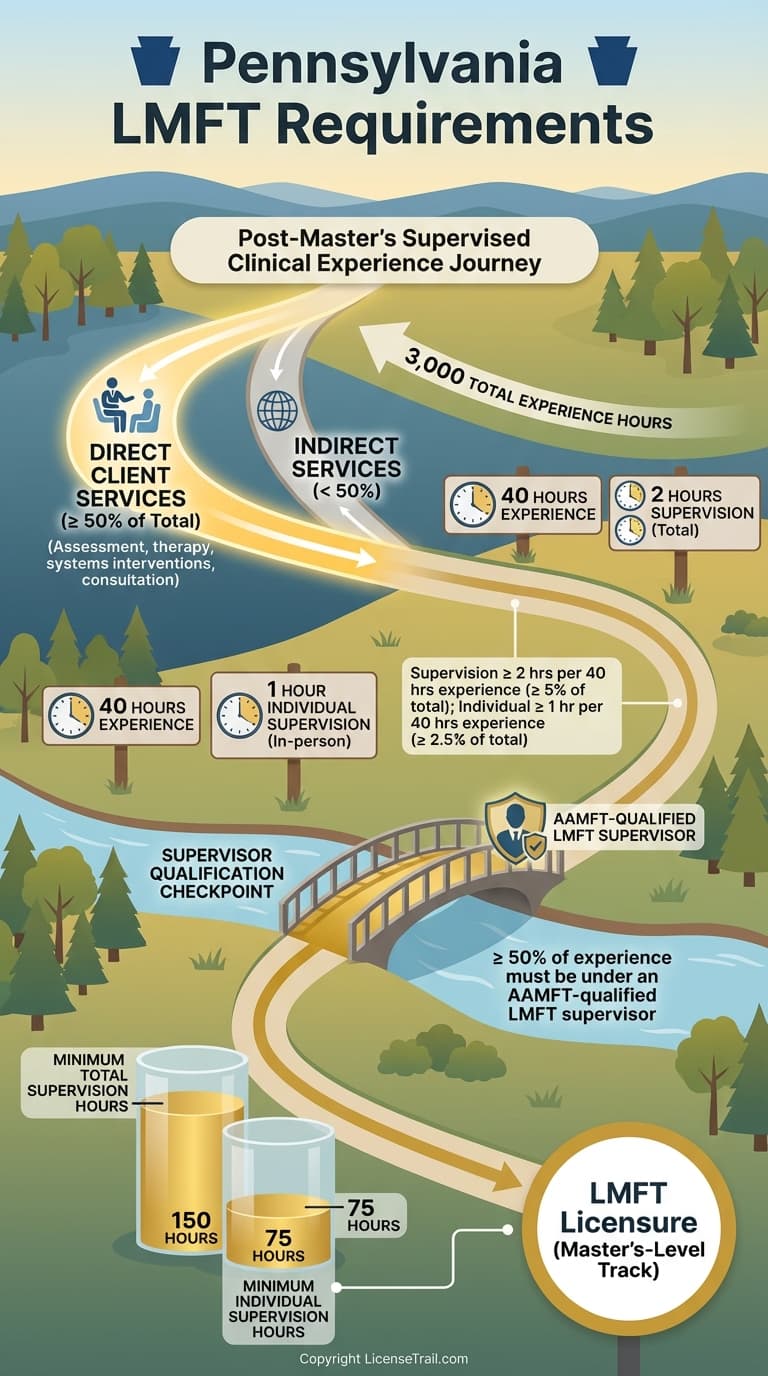
- Post-degree supervised clinical experience: 3,000 hours (master’s) OR 2,400 hours (doctorate); for doctorate, 1,200 hours must be post-doctoral degree award
- Direct service minimum within experience: At least 50% of experience hours in clinical services (assessment; couples/family/individual/group therapy; systems interventions; consultation)
- Timeframe/pace: Complete in 2–6 years; credit 500–1,800 hours per 12-month period; must meet weekly/setting minimums (30–50 hrs/wk for 3 months OR 15+ hrs/wk for 6 months per setting)
- Supervision requirement: 2 hours supervision per 40 hours experience; at least 1 hour individual in-person (up to 1 hour group in-person)
- Supervisor rules: Supervisor must meet §48.3; ≥50% of supervision hours must be by an AAMFT-qualified (or §48.3-qualified) MFT supervisor
- Other licensing steps: Pass AMFTRB National MFT Exam; complete 3 hours Act 31 child abuse training; submit application ($100), recommendations, and required background/character checks
License Details
Procedures
Licensure as a Licensed Marriage and Family Therapist (LMFT) in Pennsylvania is governed by the State Board of Social Workers, Marriage and Family Therapists and Professional Counselors, primarily through the Social Workers, Marriage and Family Therapists and Professional Counselors Act (63 P.S. §§1901–1922) and its regulations at 49 Pa. Code Chapter 48. The Board’s own “Licensure Snapshot” pages supplement these statutes and regulations. (pacodeandbulletin.gov)
Below is a step‑by‑step guide focused on the exact hour requirements and how the Board defines them.
1. Degree and Practicum Requirements
Acceptable degrees
To qualify for LMFT licensure, you must meet one of the educational paths in 49 Pa. Code §48.13(a)(3): (pacodeandbulletin.gov)
- A planned 60‑semester‑hour (or 90‑quarter‑hour) graduate program closely related to marriage and family therapy, which includes:
- A master’s degree in marriage and family therapy, or
- A master’s degree in a “field closely related to the practice of marriage and family therapy” (for example, social work, counseling, psychology) with graduate‑level MFT coursework that satisfies §48.2. (pacodeandbulletin.gov)
- OR a doctoral degree in marriage and family therapy or a closely related field, again with graduate‑level MFT coursework as defined in the regulations. (pacodeandbulletin.gov)
The Board defines “field closely related to the practice of marriage and family therapy” and “graduate level coursework in marriage and family therapy acceptable to the Board” in §48.1 and fleshes out specific required content areas (human development, marriage and family studies, MFT theory and techniques, professional studies, research) in §48.2. (pacodeandbulletin.gov)
Required graduate practicum
Within the degree, you must complete a practicum that is explicitly required in the regulations:
- Minimum of 1 year
- 300 hours of supervised direct client contact with individuals, couples, and families (pacodeandbulletin.gov)
This 300‑hour practicum is part of your graduate education and is separate from the post‑graduate supervised clinical experience described below.
2. General Qualifications for Licensure
Before focusing on hours, the Board requires that you: (pacodeandbulletin.gov)
- Be of good moral character.
- Not have certain disqualifying felony drug convictions (or must meet strict rehabilitation criteria if you do).
- Submit the Board’s application form and required fee.
- Provide two professional recommendation forms.
- Complete at least 3 hours of Board‑approved training in child abuse recognition and reporting (Act 31). (pacodeandbulletin.gov)
You will also be subject to a criminal background check process as part of Board licensing procedures. (pa.gov)
3. Post‑Graduate Supervised Clinical Experience
This is where the main hour requirements appear. Pennsylvania does not split the requirement into “direct hours” and “supervised hours” as two separate numerical totals (e.g., “1,500 direct + 1,500 supervised”). Instead, the Board requires a total number of “supervised clinical experience” hours, with internal conditions about how those hours are spent and how they are supervised. (pacodeandbulletin.gov)
3.1 Total hours required
The total supervised clinical experience required depends on your highest qualifying degree:
-
If your qualifying degree is a master’s (or equivalent 60‑credit graduate program):
- 3,000 hours of supervised clinical experience
- Hours must be acceptable to the Board and obtained after the relevant graduate coursework/degree (statute now specifies after the master’s degree). (pacodeandbulletin.gov)
-
If your qualifying degree is a doctoral degree in MFT or a closely related field:
- 2,400 hours of supervised clinical experience
- 1,200 of those hours must be obtained after the doctoral degree is granted. (pacodeandbulletin.gov)
These numbers (3,000 and 2,400) come directly from both the Act (63 P.S. §1907(e)) and 49 Pa. Code §48.13(a)(4). (pacodeandbulletin.gov)
3.2 What counts as “supervised clinical experience”
The Board defines “experience acceptable to the Board” as experience as a supervisee in a setting organized to prepare you for the practice of marriage and family therapy consistent with your education and training. (pacodeandbulletin.gov)
Within those 3,000 (or 2,400) hours:
- At least one‑half of the experience must consist of providing services in one or more of the following areas: (pacodeandbulletin.gov)
- Assessment
- Couples therapy
- Family therapy
- Other systems interventions
- Consultation
- Individual therapy
- Group therapy
In practice, this means:
- For a master’s‑level LMFT applicant, at least 1,500 of the 3,000 hours must be direct clinical service in these defined areas.
- For a doctoral‑level LMFT applicant, at least 1,200 of the 2,400 hours must be direct clinical service in these areas.
The remaining hours can be other clinically relevant activities in an organized MFT practice setting (e.g., case documentation, case conferences, treatment planning), so long as they occur under qualifying supervision.
3.3 Timeframe and pacing of hours
The regulations impose clear timing and pacing rules on these hours:
- The supervised clinical experience must be completed in no less than 2 years and no more than 6 years. (pacodeandbulletin.gov)
- In any 12‑month period, no fewer than 500 hours and no more than 1,800 hours may be credited toward the total. (pacodeandbulletin.gov)
- Work must be organized into qualifying “supervised work activity” blocks:
- Either 30–50 hours per week for at least 3 months in a single setting, or
- At least 15 hours per week for at least 6 months in a single setting. (pacodeandbulletin.gov)
If your work pattern does not meet these minimum weekly/setting requirements, those hours may not all be credited.
3.4 Supervision: how much, by whom, and how counted
The 3,000 / 2,400 hours are clinical experience hours, not supervision hours. Supervision is required in addition to those hours and is governed by §48.13(b) and §48.3. (pacodeandbulletin.gov)
Key supervision rules:
-
Supervision ratio
- You must receive a minimum of 2 hours of supervision for every 40 hours of supervised clinical experience. (pacodeandbulletin.gov)
- Of these 2 hours:
- At least 1 hour must be individual, in‑person supervision.
- Up to 1 hour may be in a group supervision, in‑person format.
-
Who can supervise
- A supervisor must meet the qualifications in §48.3. In summary, this means the supervisor must: (pacodeandbulletin.gov)
- Hold a license as an MFT and be an AAMFT‑approved supervisor or supervisor‑in‑training, or
- Hold a professional license with at least a master’s degree in a related field and 5 years of experience within the last 10 years in that field.
- For your supervised clinical experience, at least half of the required supervision hours must be provided by an MFT who meets the AAMFT supervisor/supervisor‑in‑training criteria (or the parallel MFT supervisor criteria in §48.3(1) or (3)). (pacodeandbulletin.gov)
- A supervisor must meet the qualifications in §48.3. In summary, this means the supervisor must: (pacodeandbulletin.gov)
-
Supervisor caseload and continuity
- A single supervisor may supervise no more than 6 supervisees at the same time, unless the Board grants a hardship exception. (pacodeandbulletin.gov)
- If a supervisor must stop supervising, they must generally give you two weeks’ written notice, to allow you to find a new supervisor, and may not abandon active client care. (pacodeandbulletin.gov)
-
Disclosure to clients
- You must disclose your status as a supervisee to each client and obtain written permission to discuss the case with your supervisor. (pacodeandbulletin.gov)
3.5 Settings and structure
The Board does not limit supervised clinical experience to a single type of employer, but it must be: (pacodeandbulletin.gov)
- A setting “organized to prepare the applicant for the practice of marriage and family therapy.”
- Consistent with your education and training in MFT.
- Under the direction of a qualified supervisor who oversees, directs, recommends, and instructs your MFT activities, and who is responsible for ensuring that the requirements in §48.13(b) are met.
4. Examination Requirement
Pennsylvania requires passage of the AMFTRB National Marriage and Family Therapy Examination as the licensure exam for LMFT. (pacodeandbulletin.gov)
- 49 Pa. Code §48.11 designates the AMFTRB National MFT Examination as the required exam and details the responsibilities of the applicant (applying to the testing organization, having scores sent to the Board, etc.). (pacodeandbulletin.gov)
You must pass this exam in addition to meeting education and supervised experience requirements.
5. Application and Fees
When you have:
- Completed the qualifying degree and practicum,
- Met the 3,000 (master’s) or 2,400 (doctoral) supervised clinical experience requirements under proper supervision, and
- Passed the National MFT Examination,
you apply to the Board for LMFT licensure.
According to the Department of State’s “Marriage & Family Therapist Licensure Requirements Snapshot”: (pa.gov)
- Initial LMFT application fee: $100
- You must show:
- Master’s or doctoral degree in MFT or related field,
- Passing exam score,
- Completion of the required supervised clinical experience, and
- Completion of at least 3 hours of child abuse recognition and reporting training.
6. Summary of Hour‑Related Requirements (Pennsylvania LMFT)
For clarity, here is how the Pennsylvania Board’s hour requirements break down, using its own terminology:
During the degree
- Practicum:
- Minimum 1 year
- 300 hours of supervised direct client contact with individuals, couples, and families (pacodeandbulletin.gov)
Post‑graduate supervised clinical experience
-
If highest qualifying degree is a master’s (or equivalent 60‑credit MFT‑related program): (pacodeandbulletin.gov)
- 3,000 hours of supervised clinical experience
- At least 1,500 hours (½) must be in direct clinical services (assessment, couples therapy, family therapy, other systems interventions, consultation, individual therapy, group therapy).
- Completed in no less than 2 years and no more than 6 years.
- 500–1,800 hours may be credited in any 12‑month period.
- Supervision: minimum 2 hours per 40 hours of experience, at least 1 hour individual in‑person; up to 1 hour may be in group, in‑person.
- At least half of supervision hours provided by an AAMFT‑qualified or §48.3‑qualified MFT supervisor.
-
If highest qualifying degree is a doctoral degree in MFT or a closely related field: (pacodeandbulletin.gov)
- 2,400 hours of supervised clinical experience
- At least 1,200 hours (½) must be direct clinical services in the same defined areas.
- At least 1,200 of the 2,400 hours must be obtained after the doctoral degree is granted.
- Same timeframe (2–6 years), annual hour caps (500–1,800), supervision ratio, and supervisor qualifications as above.
Pennsylvania’s Board thus uses a single total of supervised clinical experience hours (3,000 or 2,400), with explicit rules that at least half of those hours must be “providing services” in specified clinical activity categories, and with a fixed 2‑hours‑per‑40‑hours supervision ratio. It does not require, for example, “1,500 hours of direct experience plus 1,500 hours of separate supervised experience”; instead, it requires 3,000 supervised clinical hours, at least 1,500 of which are direct clinical services under Board‑qualified supervision. (pacodeandbulletin.gov)
Track your LMFT hours with confidence
License Trail checks your direct, indirect, and supervision hours against Pennsylvania LMFT requirements continuously and flags mismatches before you submit.
 Start Tracking for Free
No credit card required · Free plan available
Is your spreadsheet hiding Pennsylvania LMFT risks?
Stop guessing if your categories match Pennsylvania State Board of Social Workers, Marriage and Family Therapists and Professional Counselors requirements. License Trail checks your direct, indirect, and supervision hours continuously and flags mismatches before you submit.
Import or log
Bring your spreadsheet or start fresh
Upload your existing tracking spreadsheet and we'll map every hour into the right Pennsylvania State Board of Social Workers, Marriage and Family Therapists and Professional Counselors categories automatically.
Verify against Pennsylvania
Catch mismatches before the board does
License Trail checks your direct, indirect, and supervision hours against Pennsylvania LMFT requirements continuously.
Export board-ready
One-click clean reports
Generate professional, board-ready reports for supervision meetings and Pennsylvania State Board of Social Workers, Marriage and Family Therapists and Professional Counselors submissions in seconds.
No credit card required · Free plan available