
Pennsylvania LSW Requirements: Hours, Exams & Step-by-Step Guide
Stop guessing if your categories match Pennsylvania requirements. License Trail checks your direct, indirect, and supervision hours against LSW requirements continuously and flags mismatches before you submit.
No credit card required · Free plan available
Quick Requirements Overview
- No post‑degree supervised hours required for PA LSW (hours apply to LCSW, not LSW)
- Education: MSW (social work/social welfare) from CSWE‑accredited program, or doctoral in social work; foreign degrees need CSWE evaluation
- Exam: ASWB Master’s exam (Board approval/eligibility required before scheduling)
- Training: 3 hours Board‑approved child abuse recognition/reporting training
- Background check: Fingerprint‑based FBI check (IdentoGO; routed to Board)
- Application: Submit via PALS, pay $75 application/original license fee
- References: Two Board Certificates of Recommendation + signed application affirmation
- Character/eligibility: Good moral character; no disqualifying Controlled Substance Act felony (exceptions possible after 10 years + rehab)
License Details
Procedures
Licensure as a Licensed Social Worker (LSW) in Pennsylvania is governed by the State Board of Social Workers, Marriage and Family Therapists and Professional Counselors. The Board’s regulations are in Title 49, Chapter 47 of the Pennsylvania Code and the underlying statute is the Social Workers, Marriage and Family Therapists and Professional Counselors Act (63 P.S. §§1901–1922). (pacodeandbulletin.gov)
A key point up front: Pennsylvania’s LSW (licensed social worker) credential does not require any post‑degree supervised practice hours. All of the numeric hour requirements you may have heard about (3,000 hours with a specific breakdown, supervision ratios, timeframes, etc.) belong to the Licensed Clinical Social Worker (LCSW) license, not the LSW. (pacodeandbulletin.gov)
Below is a step‑by‑step guide based strictly on the Board’s own language and current official materials (updated through August 30, 2025).
1. License type and terminology
Pennsylvania law and regulations use the term “licensed social worker”; in practice this is often abbreviated LSW. The Board defines a licensed social worker as “a person who is currently licensed as a licensed social worker under section 7 of the act.” (pacodeandbulletin.gov)
This license allows you to hold yourself out as a licensed social worker, but it is not the independent clinical license. Independent clinical practice requires the separate LCSW license, which is built on top of the LSW.
2. Core statutory qualifications for an LSW
Under the Act and the Board’s regulations, an applicant for a social work license (LSW) must meet the following baseline criteria: (codes.findlaw.com)
-
Good moral character
- The statute requires that an applicant “is of good moral character,” and that any criminal convictions are evaluated under 63 Pa.C.S. §3113 using an individualized assessment. (codes.findlaw.com)
-
No disqualifying felony under the Controlled Substance Act
- The Board’s general qualifications section states that the applicant “has not been convicted of a felony” under Pennsylvania’s Controlled Substance, Drug, Device and Cosmetic Act (or an equivalent offense in another jurisdiction), unless at least 10 years have passed and rehabilitation is demonstrated. (pacodeandbulletin.gov)
-
Completion of mandatory child abuse training
- All applicants must complete “at least 3 hours of training in child abuse recognition and reporting” approved by the Board. (pacodeandbulletin.gov)
-
Application, fee, and recommendations
- You must:
- Submit an application on Board forms via the PA Licensing System (PALS). (pacodeandbulletin.gov)
- Pay the application/licensure fee set in §47.4 (currently $75 for application and original license issuance as an LSW). (pacodeandbulletin.gov)
- Provide two Certificates of Recommendation on Board forms. (pacodeandbulletin.gov)
- Sign an affirmation verifying the information in your application. (pacodeandbulletin.gov)
- You must:
-
Background check (procedural requirement)
- The Department of State’s current Social Workers Licensure Guide specifies that “all new applicants must obtain a fingerprint-based FBI background check” through IdentoGO using the service code provided in the application process. (pa.gov)
3. Education requirements
To qualify specifically as a Licensed Social Worker, the Board’s regulation §47.12a requires: (pacodeandbulletin.gov)
-
Master’s or doctoral degree in social work or social welfare:
The applicant must have “received a master’s degree in social work or social welfare from a school which was an accredited school on the date the degree was awarded or a doctoral degree in social work.” (pacodeandbulletin.gov)
-
“Accredited school” means a graduate program in social work or social welfare accredited by the Council on Social Work Education (CSWE), as defined in §47.1. (pacodeandbulletin.gov)
-
Graduates of CSWE “candidate” programs can apply once the program actually attains accreditation (the Board allows this explicitly in §47.12a(b)). (pacodeandbulletin.gov)
-
Foreign-educated applicants must have their credentials evaluated by CSWE to establish equivalence with an accredited U.S. graduate program (§47.12a(c)). (pacodeandbulletin.gov)
No specific number of practicum or fieldwork hours is set by the Board for the LSW. Field hours are dictated by your CSWE‑accredited program; the Board simply requires the accredited degree.
4. Examination requirement
The LSW is an exam‑based license. The Board’s licensure‑examination regulation, §47.11, states: (pacodeandbulletin.gov)
- “The examination required as a prerequisite to original licensure as a licensed social worker is the Association of Social Work Boards’ (ASWB) master’s level examination.”
In practice:
- You apply to the Pennsylvania Board through PALS and are approved/“made eligible” for the exam.
- After Board approval, you register separately with ASWB and schedule the ASWB Master’s Exam.
- ASWB sends your official score report to the Board. (pacodeandbulletin.gov)
The Board sets the passing score and relies on ASWB’s administration of the test. (pacodeandbulletin.gov)
5. Experience and hours: what is (and isn’t) required for an LSW
5.1. Hours required for LSW licensure
For the Licensed Social Worker (LSW) credential itself, the Board does not require any post‑degree supervised experience hours.
The controlling regulation, §47.12a, lists three conditions for an LSW: (1) meet the general qualifications of §47.12, (2) have the qualifying degree, and (3) pass the required exam—no hours are mentioned in this section. (pacodeandbulletin.gov)
Likewise, the statute’s “Qualifications for license” section for a social work license (63 P.S. §1907(a)) lists good moral character, a master’s or doctoral degree, passing the exam, application fee, and no disqualifying felony, but no practical-hours requirement. (codes.findlaw.com)
So, in direct response to your example:
- The Pennsylvania State Board does not say that LSW licensure requires “1,500 hours of direct experience and 1,500 hours of supervised experience,” or any other numeric breakdown.
- All such hour counts are attached to the Licensed Clinical Social Worker (LCSW) license, not the LSW.
5.2. Where the “1,500 hours of direct experience” figure comes from (LCSW, not LSW)
To avoid confusion, it’s helpful to see the language the Board actually uses for LCSW supervised experience, since this is where the well‑known hour requirements live:
- An LCSW applicant must have “completed at least 3,000 hours of supervised clinical experience” after the MSW. (pacodeandbulletin.gov)
- The regulation then defines what those hours must include. It states that “at least 1/2 of the experience” must be in direct clinical services such as:
- assessment
- psychotherapy
- other psychosocial‑therapeutic interventions
- consultation
- family therapy
- group therapy (pacodeandbulletin.gov)
Because “at least 1/2 of the experience” must be direct clinical services and the total required experience is 3,000 hours, the Board is effectively requiring at least 1,500 hours of direct client services (from that list) and up to 1,500 hours in other acceptable clinical activities (documentation, court testimony, case‑related work, etc.). (pacodeandbulletin.gov)
The same LCSW regulation also specifies: (pacodeandbulletin.gov)
- Supervision must total 2 hours of supervision for every 40 hours of supervised clinical experience (at least 1 hour individual, in person; up to 1 hour group, in person).
- The 3,000 hours must be completed in no less than 2 years and no more than 6 years, with at least 500 and no more than 1,800 hours credited in any 12‑month period.
All of this, again, is only for the LCSW license. The Board makes LCSW licensure contingent on already being “licensed under the act as a social worker” (i.e., already having your LSW). (pacodeandbulletin.gov)
6. Step‑by‑step application path to LSW in Pennsylvania
Putting the Board’s requirements into chronological order:
-
Complete your degree
- Earn an MSW or doctoral degree in social work/social welfare from a CSWE‑accredited program (or foreign equivalent documented through CSWE). (pacodeandbulletin.gov)
-
Complete mandatory 3‑hour child abuse course
- Take a Board‑approved course in child abuse recognition and reporting. Ensure the provider sends electronic confirmation of completion directly to the Board under your correct identity. (pacodeandbulletin.gov)
-
Obtain your FBI fingerprint‑based background check
- Pre‑register with IdentoGO using the service code given during your PALS application so the results go to the Board. (pa.gov)
-
Create a PALS account and submit the LSW application
- Go to the PA Licensing System (PALS) and:
- Select the State Board of Social Workers, Marriage and Family Therapists and Professional Counselors and the Social Worker license. (pa.gov)
- Upload any instructions/forms required (e.g., Certificates of Recommendation, verification of other licenses if applicable). (pacodeandbulletin.gov)
- Pay the application/original license fee listed in §47.4. (pacodeandbulletin.gov)
- Go to the PA Licensing System (PALS) and:
-
Have your school send transcripts or complete the Board’s education verification
- If you’re in your final semester, your program may complete an Education Verification form to make you temporarily exam‑eligible; after graduation, an official transcript conferring the degree must be sent directly to the Board. (pa.gov)
-
Receive Board approval to take the ASWB Master’s Exam
- Once your file is complete and you meet the requirements, the Board issues eligibility and e‑mails instructions on registering with ASWB for the Master’s exam. (pacodeandbulletin.gov)
-
Pass the ASWB Master’s Exam
- Take and pass the exam; ASWB transmits your scores to the Board. (pacodeandbulletin.gov)
-
License issuance
- After your passing score, background check, child abuse training, fees, and documentation are all in order, the Board issues your LSW license, authorizing you to hold yourself out as a Licensed Social Worker in Pennsylvania. (codes.findlaw.com)
7. Quick summary of LSW requirements vs. hour‑based LCSW requirements
Licensed Social Worker (LSW) – Pennsylvania
- Board: State Board of Social Workers, Marriage and Family Therapists and Professional Counselors
- Education: MSW or doctoral degree in social work/social welfare from CSWE‑accredited (or equivalent foreign) program
- Exam: ASWB Master’s Exam
- Other: Good moral character, no disqualifying controlled‑substance felony, FBI background check, 3 hours child abuse training, application/fee, 2 recommendations
- Post‑degree supervised hours required for licensure: None specified by the Board; no numeric hour requirement appears in §47.12a or §1907(a). (pacodeandbulletin.gov)
Licensed Clinical Social Worker (LCSW) – for context only
- Prerequisite: Must already be licensed as a social worker (LSW)
- Supervised clinical experience: At least 3,000 hours after completion of the MSW, within 2–6 years
- Direct clinical services: At least 1/2 of those hours (≥1,500) must be in assessment, psychotherapy, other psychosocial‑therapeutic interventions, consultation, family therapy, or group therapy
- Supervision: Minimum 2 hours of supervision per 40 hours of clinical experience; at least half of all hours supervised by a clinical social worker supervisor as defined in §47.1a; 500–1,800 hours creditable per 12‑month period. (pacodeandbulletin.gov)
If you are planning for the full progression to independent clinical practice, it’s common to obtain the LSW as soon as you qualify (degree + exam), and then accrue the LCSW‑qualifying 3,000 hours under appropriate supervision while working as an LSW.
Track your LSW hours with confidence
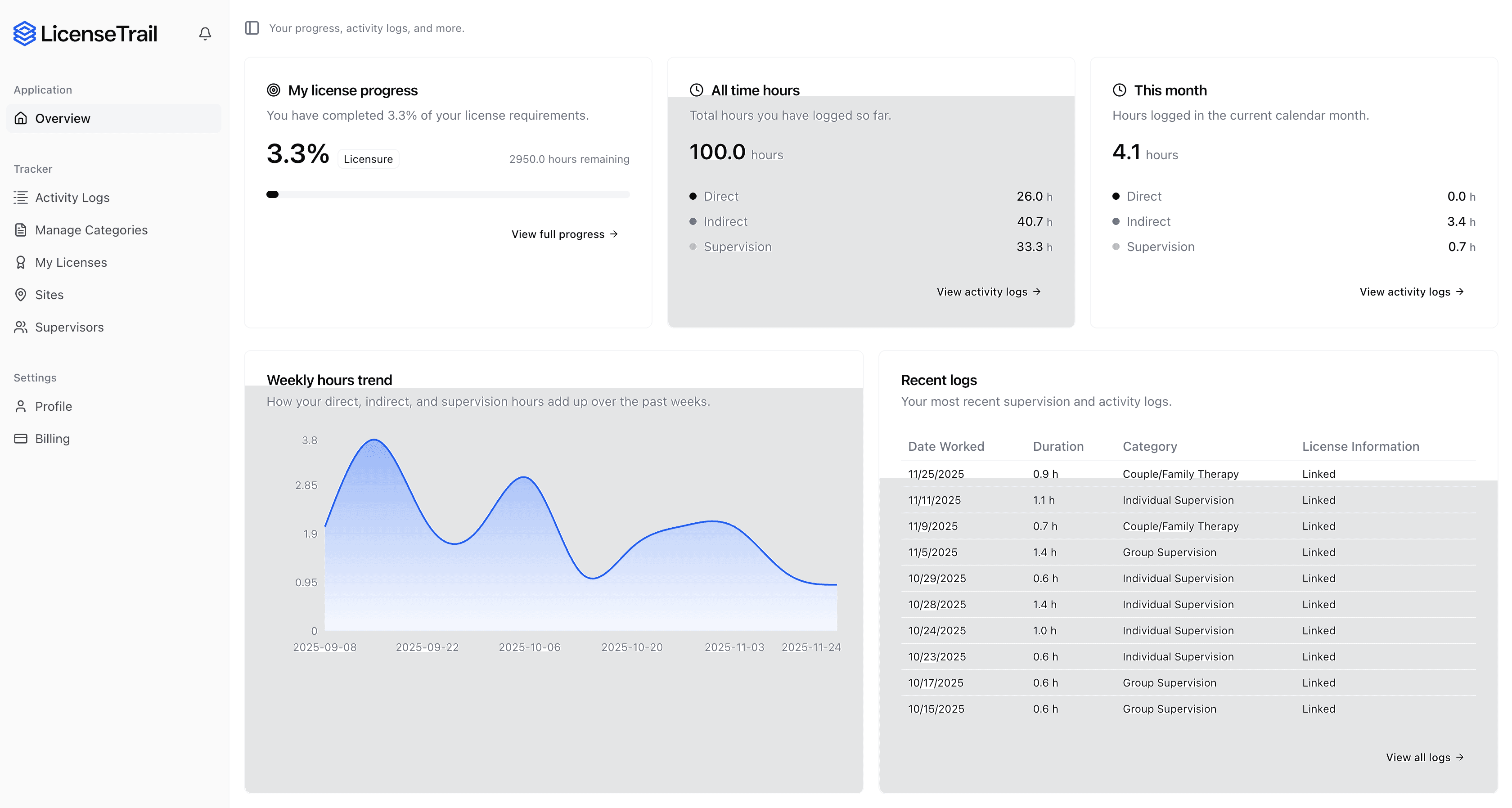
License Trail checks your direct, indirect, and supervision hours against Pennsylvania LSW requirements continuously and flags mismatches before you submit.
 Start Tracking for Free
No credit card required · Free plan available
Is your spreadsheet hiding Pennsylvania LSW risks?
Stop guessing if your categories match Pennsylvania State Board of Social Workers, Marriage and Family Therapists and Professional Counselors requirements. License Trail checks your direct, indirect, and supervision hours continuously and flags mismatches before you submit.
Import or log
Bring your spreadsheet or start fresh
Upload your existing tracking spreadsheet and we'll map every hour into the right Pennsylvania State Board of Social Workers, Marriage and Family Therapists and Professional Counselors categories automatically.
Verify against Pennsylvania
Catch mismatches before the board does
License Trail checks your direct, indirect, and supervision hours against Pennsylvania LSW requirements continuously.
Export board-ready
One-click clean reports
Generate professional, board-ready reports for supervision meetings and Pennsylvania State Board of Social Workers, Marriage and Family Therapists and Professional Counselors submissions in seconds.
No credit card required · Free plan available