
South-carolina LPC-A Requirements: Hours, Exams & Step-by-Step Guide
Stop guessing if your categories match South-carolina requirements. License Trail checks your direct, indirect, and supervision hours against LPC-A requirements continuously and flags mismatches before you submit.
No credit card required · Free plan available
Quick Requirements Overview
- Scope: LPC-A (“Professional Counselor Associate”) may practice only under direct supervision; no counseling services until Board approves supervision plan and issues license
- Education (CACREP): Graduate from CACREP Clinical Mental Health Counseling program (accredited at time of graduation)
- Education (Non-CACREP): 60 graduate semester hours primarily in counseling + official transcripts + Coursework Description/Verification + Practicum & Internship Review forms
- Exam: Pass NCE or NCMHCE (NBCC) (Board provides instructions after application/education approval if not already passed)
- Supervision plan: Submit Board Plan for Clinical Supervision of Post-Master’s Clinical Experience; must have a Board-approved supervisor
- License term: LPC-A is 2 years; if hours not completed, file Associate Extension before expiration (with updated plan + confirmation form + supervision log)
- Post-master’s hours for LPC upgrade (earned as LPC-A): 1,500 hrs over ≥2 years = 1,380 direct client contact + 120 supervision
- Supervision structure/qualifications: Of 120 supervision hrs, ≥60 individual/triadic; remaining 60 may be individual/triadic or group; supervisor must be LPCS or Board-approved QLMHP (e.g., MFT Supervisor, Addiction Counselor Supervisor, Psychologist, MD)
License Details
Procedures
South Carolina’s pathway to licensure as a Licensed Professional Counselor (LPC) begins with becoming a Licensed Professional Counselor Associate (LPC-A, called “Professional Counselor Associate” by the board). The associate license allows you to practice only under supervision while you accrue the post‑master’s hours required for full LPC licensure.
Below is a step‑by‑step guide built around the South Carolina Board’s own wording and categories of hours.
1. What the LPC-A License Is (and Is Not)
Under South Carolina law, a “professional counselor associate may practice only under the direct supervision of a licensed professional counselor supervisor.” (law.justia.com)
On the Board’s official page, the credential is described as:
“Professional Counselor Associate applicants must meet education and examination requirements. Associates can only practice under supervision, pursuant to an approved clinical supervision plan.” (llr.sc.gov)
So, to become an LPC-A you must:
- Meet the Board’s education requirements.
- Pass a Board‑approved national counseling exam.
- Obtain Board approval of your clinical supervision plan.
- Apply and be issued the Professional Counselor Associate license before providing counseling services.
The post‑master’s supervised hours (the 1,500‑hour requirement) are not required to obtain the LPC-A; they are completed while you hold the LPC-A and are needed to upgrade to full LPC.
2. Education Requirements
South Carolina recognizes two routes: CACREP‑accredited Clinical Mental Health Counseling programs and non‑CACREP programs.
2.1 CACREP‑Accredited Route
The Board states:
“To meet education requirements for licensure, an applicant can either show evidence of graduation from a Clinical Mental Health counseling program accredited by the CACREP at the time of graduation” (llr.sc.gov)
If your degree is from a CACREP‑accredited Clinical Mental Health Counseling program (at the time you graduated), you meet the education standard without further course‑by‑course review.
2.2 Non‑CACREP Route
If your program is not CACREP‑accredited, you must show:
“successful completion of a master’s degree, specialist’s degree or doctoral degree with a minimum of sixty (60) graduate semester hours primarily in counseling from a program accredited by a national educational accrediting body such as CACREP or one that requires and follows substantially similar educational standards…” (llr.sc.gov)
Key points for non‑CACREP graduates:
- At least 60 graduate semester hours “primarily in counseling.”
- The institution must be regionally or appropriately accredited (e.g., Southern Association of Colleges and Schools, Association of Theological Schools, or another regionally accredited institution). (llr.sc.gov)
- You must submit:
- Coursework Description and Verification Form
- Practicum and Internship Review Form
- Official transcripts
These are collectively referred to by the Board as the “NON-CACREP Required Graduate-Level Coursework Documentation.” (llr.sc.gov)
These forms allow the Board to verify that your coursework and field training are substantially equivalent to CACREP standards.
3. Examination Requirement
The Board requires that all licensure candidates pass one of two national exams:
“All licensure candidates must take and pass either the National Counselor Examination for Licensure and Certification (NCE) or National Clinical Mental Health Counseling Examination (NCMHCE). Both of these examinations are administered by NBCC.” (llr.sc.gov)
Process as described by the Board:
- You submit your LPC-A application and education documentation.
- After your education and application are approved, the Board sends you instructions on how to apply for the NCE or NCMHCE if you have not already taken and passed the exam. (llr.sc.gov)
Many applicants take and pass the exam near graduation so it is already satisfied when they apply for LPC-A.
4. Securing Supervision and Submitting a Supervision Plan
Because an LPC-A may only practice under supervision, you must:
- Identify a qualified supervisor (details in Section 7 below).
- Complete the Board’s “LPC Plan for Clinical Supervision of Post-Master's Clinical Experience in Counseling” form. (llr.sc.gov)
The Board emphasizes:
“A Professional Counselor Associate cannot provide professional counseling services until the supervision plan is submitted to the Board and approved and the Associate license is issued.” (llr.sc.gov)
The supervision plan:
- May be submitted with your Associate license application, or
- After you have obtained employment, but it must be in effect once you have passed your exam and your Associate license has been issued. (llr.sc.gov)
5. Applying for the LPC-A License
The application is submitted online through South Carolina LLR:
- Professional Counselor Associate Electronic Application (e‑service portal). (llr.sc.gov)
You will typically need to:
- Complete the online application.
- Pay the required fee.
- Upload:
- Official transcripts.
- Required education forms (if non‑CACREP).
- Proof of exam passage (if already passed).
- Your LPC Plan for Clinical Supervision of Post-Master's Clinical Experience in Counseling.
- Any identity/citizenship verification forms required by LLR.
Once approved, you are issued the Professional Counselor Associate license.
6. Length of the Associate License and Extensions
According to the Board:
“An LPC Associate license is a two-year license. If Post-Master's clinical experience has not been completed within that two-year period, you will need to apply for an Associate Extension.” (llr.sc.gov)
To extend:
- You submit an Associate Extension Request Application along with:
- A current or updated Plan for Clinical Supervision of Post-Master's Clinical Experience in Counseling.
- The LPC Confirmation of Clinical Supervision of Post-Master's Client Contact Form.
- An Associate Supervision Log Form documenting your hours to date. (llr.sc.gov)
The extension request must be submitted before your Associate license expires. (llr.sc.gov)
7. Required Hours While You Are an LPC-A (Toward Full LPC)
Although these hours are technically required to obtain the LPC, the Board explicitly states that:
“These supervised experience hours are obtained as an Associate.” (llr.sc.gov)
7.1 Total Post-Master’s Hours
To be licensed as a full Licensed Professional Counselor, the Board requires:
“a minimum of one thousand five hundred (1500) hours of post-master's clinical experience and post master's clinical supervision in the practice of professional counseling performed over a period of not fewer than two (2) years.” (llr.sc.gov)
This 1,500‑hour requirement is total post‑master’s professional counseling experience plus supervision, not 1,500 clinical and 1,500 supervision separately.
7.2 Breakdown: Direct Client Contact vs. Supervision
The Board further specifies:
“Of the one thousand five hundred (1500) hours, there must be a minimum of one thousand three hundred eighty (1,380) hours of documented direct client contact and a minimum of one hundred twenty (120) hours of documented supervision.” (llr.sc.gov)
So, in Board language:
- Total post‑master’s experience (minimum):
- 1,500 hours over at least 2 years.
- Direct client contact (minimum):
- 1,380 hours of “documented direct client contact” (face‑to‑face counseling with individuals, couples, families, or groups in the practice of professional counseling).
- Supervision (minimum):
- 120 hours of “documented supervision.”
In effect, 1,380 hours are “direct client contact” and 120 hours are “supervision,” adding up to 1,500 hours total.
7.3 Structure of Supervision Hours
The 120 hours of supervision must be structured as follows:
“A minimum of sixty (60) hours of the supervision hours must be individual/triadic, and the remaining sixty (60) hours may be individual/triadic or group.” (llr.sc.gov)
In practice:
- At least 60 hours: one‑on‑one or triadic supervision (you plus one other supervisee) with your supervisor.
- Up to 60 hours: can be group supervision, or more individual/triadic, as long as the total is at least 120.
7.4 Who Can Supervise
Supervision must be provided by:
“a licensed professional counselor supervisor (LPCS) or other qualified licensed mental health practitioner approved by the Board that included experience assessing and treating clients with the more serious problems as categorized in standard diagnostic nomenclature.” (llr.sc.gov)
The Board defines a qualified licensed mental health practitioner (QLMHP), in this context, as:
“a person licensed as a Marriage and Family Therapy Supervisor, and Addiction Counselor Supervisor, a Psychologist or a Medical Doctor.” (llr.sc.gov)
In all cases:
- The LPCS or QLMHP must be approved by the Board.
- They must have the “knowledge and expertise necessary to provide professional counseling supervision, including diagnosis and treatment of more serious problems categorized in standard diagnostic nomenclature.” (llr.sc.gov)
The Board posts a List of Supervisors to help you locate approved LPC supervisors. (llr.sc.gov)
8. Documenting Your Hours and Upgrading to LPC
While you are licensed as an LPC-A and accruing hours, you will:
- Maintain an Associate Supervision Log (tracking direct client contact and supervision hours).
- Have your supervisor complete:
- The LPC Confirmation of Clinical Supervision of Post-Master's Client Contact Form when you have met the hour requirements. (llr.sc.gov)
Once the Board confirms that you have:
- Completed at least 1,500 hours of post‑master’s clinical experience and supervision in no fewer than 2 years, including:
- 1,380 hours of documented direct client contact, and
- 120 hours of documented supervision (with the 60/60 individual/triadic vs. group breakdown),
- And you have already passed the NCE or NCMHCE,
you then submit the “LPC Associate to Licensed Professional Counselor Electronic Application” to upgrade to full LPC. (llr.sc.gov)
9. Summary of Key Hour Requirements (Board Verbiage)
For clarity, using the Board’s categories and wording:
- Post‑master’s requirement to move from LPC-A to LPC (completed as an Associate):
- “a minimum of one thousand five hundred (1500) hours of post-master's clinical experience and post master's clinical supervision in the practice of professional counseling performed over a period of not fewer than two (2) years”
- “a minimum of one thousand three hundred eighty (1,380) hours of documented direct client contact”
- “a minimum of one hundred twenty (120) hours of documented supervision”
- “A minimum of sixty (60) hours of the supervision hours must be individual/triadic, and the remaining sixty (60) hours may be individual/triadic or group.” (llr.sc.gov)
Those are the official hour categories and numerical requirements defined by the South Carolina Board for LPC-As working toward full LPC licensure.
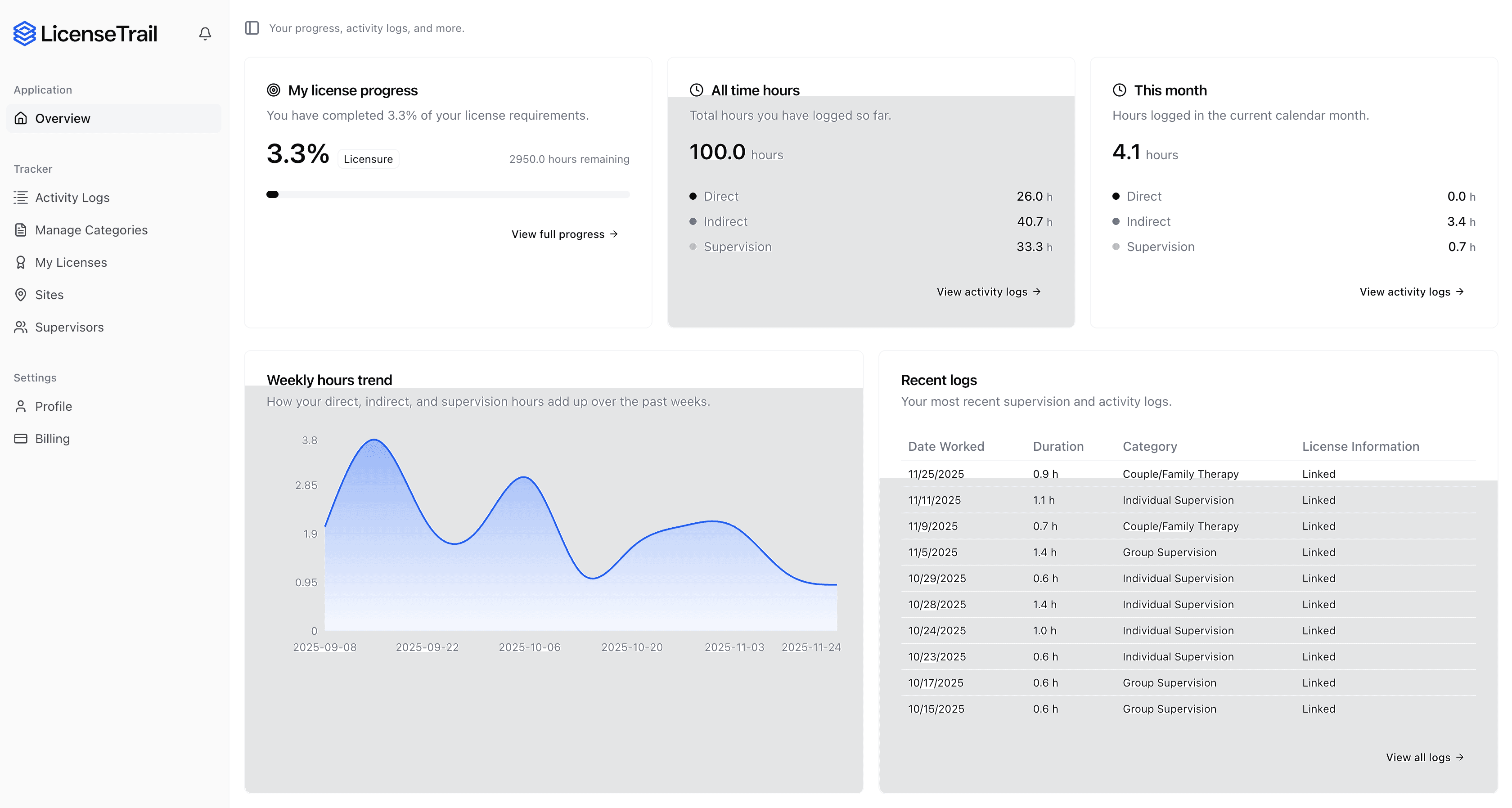
Track your LPC-A hours with confidence
License Trail checks your direct, indirect, and supervision hours against South-carolina LPC-A requirements continuously and flags mismatches before you submit.
 Start Tracking for Free
No credit card required · Free plan available
Is your spreadsheet hiding South-carolina LPC-A risks?
Stop guessing if your categories match South Carolina Board of Examiners for Licensure of Professional Counselors, Marriage and Family Therapists, Addiction Counselors and Psycho-Educational Specialists requirements. License Trail checks your direct, indirect, and supervision hours continuously and flags mismatches before you submit.
Import or log
Bring your spreadsheet or start fresh
Upload your existing tracking spreadsheet and we'll map every hour into the right South Carolina Board of Examiners for Licensure of Professional Counselors, Marriage and Family Therapists, Addiction Counselors and Psycho-Educational Specialists categories automatically.
Verify against South-carolina
Catch mismatches before the board does
License Trail checks your direct, indirect, and supervision hours against South-carolina LPC-A requirements continuously.
Export board-ready
One-click clean reports
Generate professional, board-ready reports for supervision meetings and South Carolina Board of Examiners for Licensure of Professional Counselors, Marriage and Family Therapists, Addiction Counselors and Psycho-Educational Specialists submissions in seconds.
No credit card required · Free plan available