
South-carolina LPES Requirements: Hours, Exams & Step-by-Step Guide
Stop guessing if your categories match South-carolina requirements. License Trail checks your direct, indirect, and supervision hours against LPES requirements continuously and flags mismatches before you submit.
No credit card required · Free plan available
Quick Requirements Overview
- Graduate degree in school psychology from a regionally accredited, NASP/APA‑approved (or Board‑equivalent) program; typically ≥60 graduate semester hours
- Program must include a 1,200‑hour, 1‑year internship; ≥50% in an approved school setting; supervised by LPES/school psychologist (or Board‑approved psychologist outside schools) and covering a full range of services
- Required graduate coursework in psychopathology and diagnostics
- Hold SC Dept. of Education School Psychologist Level II or III certification
- Post‑certification experience: 2 years successful service as a certified school psychologist; ≥1 year supervised by an LPES (incl. “more serious problems” experience for post‑1/1/2000 experience)
- Experience year definition: 1 contract year = ≥190 workdays (two consecutive half‑time years may count as one full year at Board discretion); provisional/temporary + pre‑degree hours don’t count
- Exam: Pass ETS School Psychology Examination at the Board‑set score
- Renewal CE: 40 hours/2 years (34 license‑related + 6 ethics); includes ≥1 hour suicide assessment/treatment/management for cycles ending after 2025
License Details
Procedures
South Carolina’s Licensed Psycho‑educational Specialist (LPES) credential is built around a specific graduate‑training model in school psychology plus defined internship hours and years of post‑certification practice, rather than the “X direct hours / Y supervision hours” format used for LPCs.
Below is a structured summary of what the Board of Examiners for Licensure of Professional Counselors, Marriage and Family Therapists, Addiction Counselors, and Psycho‑Educational Specialists requires for initial LPES licensure, with emphasis on the exact types of hours and experience they define.
1. Legal and regulatory framework
LPES requirements are set out in:
- South Carolina Code of Laws, Title 40, Chapter 75, Article 3 (Psycho‑educational Specialists), especially Section 40‑75‑530 (Application procedures; qualifications). (scstatehouse.gov)
- South Carolina Code of Regulations, Chapter 36, Article 3, Section 36‑13 (Licensing Provisions for Psycho‑educational Specialists). (regulations.justia.com)
The Board itself is the licensing authority for LPES under Section 40‑75‑510. (scstatehouse.gov)
2. Degree and coursework requirements (including internship hours)
2.1 Minimum degree level and total graduate semester hours
To qualify, you must document that you hold one of the following from a regionally accredited institution whose program is approved by NASP or APA, or is deemed substantially equivalent by the Board: (scstatehouse.gov)
- A master’s degree plus 30 graduate semester hours, or
- A 60‑semester‑hour master’s degree, or
- A specialist’s degree requiring 60 semester hours (or 90 quarter hours), or
- A doctorate in school psychology.
For programs the Board considers “substantially equivalent,” the regulations specify at least 60 graduate semester hours in an applied area of psychology, education, or behavioral sciences, plus substantial preparation in specified content areas (psychological foundations, educational foundations, assessment/intervention, statistics and research methods, and professional school psychology). (regulations.justia.com)
2.2 Required internship hours (pre‑degree)
Within that graduate program, the Board requires a one‑year 1,200‑hour internship in school psychology:
- The regulation states that the program must include “a one‑year twelve hundred (1200) hour internship, at least one‑half (1/2) of which must be in an approved school setting.” (regulations.justia.com)
- The internship must include a full range of psycho‑educational services.
- Supervision must be provided by:
- A licensed psycho‑educational specialist or a certified or licensed school psychologist for school‑based portions, or
- An appropriately credentialed psychologist for any non‑school setting, as approved by the Board. (regulations.justia.com)
The Board also recognizes the National Certified School Psychologist (NCSP) credential: possession of an NCSP issued after January 1, 1988 is treated as evidence that the degree program (including internship) meets these standards. (regulations.justia.com)
2.3 Specific graduate coursework in psychopathology and diagnostics
Regulation 36‑13 requires graduate‑level coursework (typically 3 semester hours each) in: (regulations.justia.com)
- Psychopathology – providing an understanding of abnormal behavior, etiology, and treatment.
- Diagnostics – providing an understanding of the diagnostics of psychopathology.
The Board’s language emphasizes that these courses must “provide the practitioner with an understanding” of psychopathology and the diagnostics of psychopathology.
3. Required certification with the South Carolina Department of Education
Before you can be licensed as an LPES, you must already be certified as a school psychologist by the South Carolina Department of Education:
- You must hold SCDE School Psychologist Level II or Level III certification. (scstatehouse.gov)
This certification requirement effectively ensures you have met state school psychology standards in addition to the licensing board’s requirements.
4. Post‑degree / post‑certification experience: years and work‑days, not “X direct / Y supervised” hours
4.1 Minimum years of service as a certified school psychologist
After earning the qualifying degree and SCDE certification, the law and regulations require:
- You must have “served successfully for at least two years as a certified school psychologist in a school psychology or comparable setting”. (scstatehouse.gov)
This is a service‑time requirement, not a simple accumulation of clinical hours.
4.2 Supervision requirement within those two years
Within those two years:
- At least one of the two years must have been under the supervision of a licensed psycho‑educational specialist. (scstatehouse.gov)
The regulation adds that for experience obtained after January 1, 2000, that supervised year must include experience “assessing and treating clients with the more serious problems as categorized in standard diagnostic nomenclature.” (regulations.justia.com)
4.3 How the Board defines a “year” of experience
The Board is very specific in how a qualifying “year” is calculated:
- One year of experience is defined as full‑time employment for one contract year of at least 190 work days. (regulations.justia.com)
- Two consecutive years of half‑time work may, at the Board’s discretion, be counted as equivalent to one full year of experience.
- The experience must include provision of a full range of services to children, youth, and families (e.g., assessment, intervention, consultation in typical school‑psychology roles). (regulations.justia.com)
4.4 Experience that does not count toward the two years
The Board expressly excludes certain kinds of experience:
- Time worked under a provisional or temporary school psychology certificate does not count.
- Pre‑degree experiences, such as practica or internships (including the 1,200‑hour internship described above), also do not count toward the two‑year post‑certification requirement. (regulations.justia.com)
4.5 Important distinction from LPC‑style hour requirements
For LPES, South Carolina does not specify something like “1,500 hours of direct counseling plus 150 hours of supervision.” That sort of numerical breakdown does exist in the regulations for Licensed Professional Counselors (LPC) — for example, LPC applicants must document 2,000 hours of supervised clinical experience including 1,500 hours of direct counseling and 150 hours of immediate supervision. (law.justia.com)
However, LPES licensure is structured differently:
- Quantitative requirement:
- Pre‑degree: a 1,200‑hour internship (at least half in schools). (regulations.justia.com)
- Post‑degree: two contract years (≥190 days each) of employment as a certified school psychologist, with one year under LPES supervision.
- No regulation breaks those years down into total clinical hours, direct hours, or specified supervision‑hour counts the way LPC and LMFT regulations do.
This distinction is important if you are used to thinking in terms of “direct client” vs. “supervision” hours; for LPES, the Board focuses on role, setting, and duration (years/days) instead.
5. Examination requirement
You must demonstrate a passing score on the examination recognized by the Board:
- Section 40‑75‑530(4) specifies “a satisfactory score, as prescribed by the board, on the Educational Testing Service’s School Psychology Examination.” (scstatehouse.gov)
- Regulation 36‑13 also requires “evidence of a passing score on examinations approved by the Board.” (regulations.justia.com)
In practice, this means you must take and pass the designated ETS school psychology exam at or above the minimum score the Board has adopted.
6. Formal application to the Board
Once the degree, internship, SCDE certification, experience, and examination requirements are met, you then complete the formal licensing process with the Board:
-
Application form and fee
- The regulations require that an applicant “submit an application on forms approved by the Board, along with the required fee.” (regulations.justia.com)
-
Documentation you should expect to provide
- Official graduate transcripts showing:
- Total graduate semester hours (≥60 if substantially equivalent).
- Required coursework, including psychopathology and diagnostics.
- Completion of the 1,200‑hour internship (often transcript‑ or program‑verified).
- Verification of SCDE School Psychologist Level II or III certification.
- Verification of two years of successful service as a certified school psychologist, including:
- Dates of employment and contract length (to show 190 work days per full‑time year, or equivalent half‑time combinations).
- Documentation that at least one year was under the supervision of a licensed psycho‑educational specialist.
- Official test scores for the ETS School Psychology Examination.
- Official graduate transcripts showing:
-
Other Board‑administered requirements
- The Board may also require standard items such as background checks or additional explanatory documentation, administered under its general authority in Chapter 40‑75 and associated regulations. (scstatehouse.gov)
Because procedural details (exact forms, fees, submission addresses, online portal instructions) can change, they are typically obtained directly from the South Carolina LLR / Board website.
7. After licensure: continuing education and renewal hours
Once licensed, LPES practitioners have ongoing continuing education (CE) requirements, which do specify numbers of hours:
- 40 total CE hours every two‑year licensure period, of which:
- 34 hours must relate directly to the LPES professional license, and
- 6 hours must be specific to ethical standards related to the license. (law.cornell.edu)
- If you hold LPES plus another license under this Board (e.g., LPC, LMFT, LAC), you must complete at least 50 hours of formal CE in the two‑year period; 6 of those must be ethics, and the remaining 44 hours should be divided “as equally as possible” among your disciplines. (law.cornell.edu)
- CE can be obtained in person or online and may include workshops, conferences, courses, supervision of associates, research/publication, self‑study, and leadership roles, within specific category limits (e.g., caps on hours from self‑study or leadership). (law.cornell.edu)
Section 40‑75‑540 also requires at least one hour of CE in suicide assessment, treatment, and management as part of the CE required for license renewal, for cycles ending after 2025. (scstatehouse.gov)
8. Summary of key “hour” and “time” requirements for LPES in South Carolina
Putting the Board’s language into a compact checklist:
-
Graduate program
- At least 60 graduate semester hours in an approved or substantially equivalent school psychology program. (regulations.justia.com)
- Must include:
- One‑year, 1,200‑hour internship, at least half in an approved school setting, supervised by LPES or a school psychologist (or an appropriately credentialed psychologist in non‑school settings), covering a full range of psycho‑educational services. (regulations.justia.com)
- Graduate coursework in psychopathology and diagnostics.
-
Certification
- SCDE School Psychologist Level II or III credential. (scstatehouse.gov)
-
Post‑degree / post‑certification service
- Two years of successful service as a certified school psychologist in a school or comparable setting.
- At least one of those years must be under the supervision of a licensed psycho‑educational specialist, including experience with “more serious” problems under standard diagnostic nomenclature. (regulations.justia.com)
- Each qualifying year is one contract year of at least 190 work days (or two consecutive half‑time years may be counted as one full year, at the Board’s discretion).
- Pre‑degree practicum or internship hours and experience under provisional/temporary certification do not count toward these two years.
-
Examination
- Passing score on the ETS School Psychology Examination, at or above the score level set by the Board. (scstatehouse.gov)
-
Application process
- Application on Board‑approved forms, with required fee and all supporting documentation. (regulations.justia.com)
-
Continuing education after licensure
- 40 CE hours every 2 years (34 content‑specific + 6 ethics for LPES alone; 50 total if dually licensed), including at least one hour in suicide assessment/treatment/management for renewal cycles ending after 2025. (law.cornell.edu)
These are the current regulatory requirements as of late 2025; when you are preparing an actual application, it is prudent to verify the latest forms and any procedural updates on the South Carolina LLR / Board website, and—if needed—confirm interpretations directly with Board staff.
Track your LPES hours with confidence
License Trail checks your direct, indirect, and supervision hours against South-carolina LPES requirements continuously and flags mismatches before you submit.
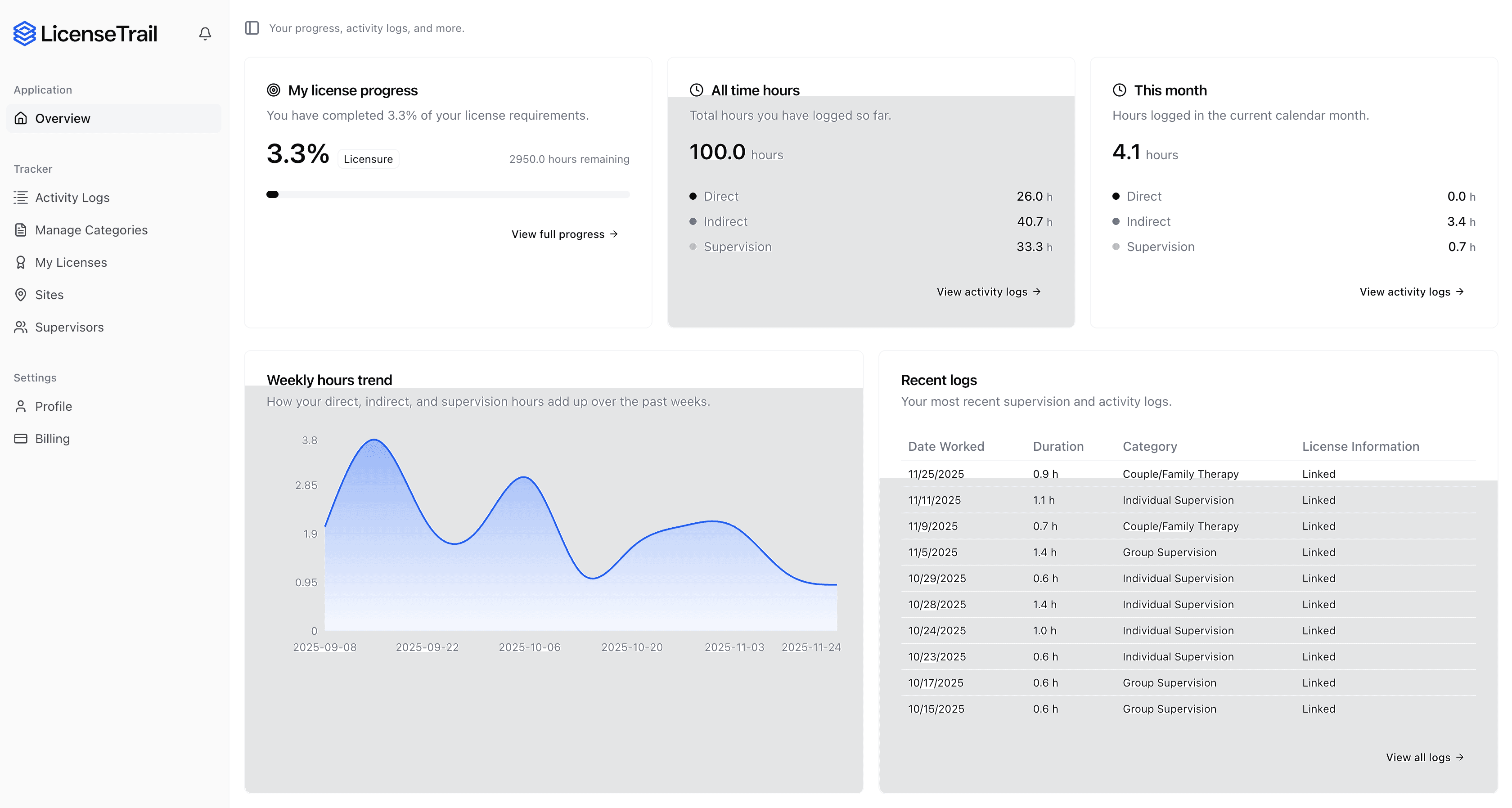 Start Tracking for Free
No credit card required · Free plan available
Is your spreadsheet hiding South-carolina LPES risks?
Stop guessing if your categories match South Carolina Board of Examiners for Licensure of Professional Counselors, Marriage and Family Therapists, Addiction Counselors and Psycho-Educational Specialists requirements. License Trail checks your direct, indirect, and supervision hours continuously and flags mismatches before you submit.
Import or log
Bring your spreadsheet or start fresh
Upload your existing tracking spreadsheet and we'll map every hour into the right South Carolina Board of Examiners for Licensure of Professional Counselors, Marriage and Family Therapists, Addiction Counselors and Psycho-Educational Specialists categories automatically.
Verify against South-carolina
Catch mismatches before the board does
License Trail checks your direct, indirect, and supervision hours against South-carolina LPES requirements continuously.
Export board-ready
One-click clean reports
Generate professional, board-ready reports for supervision meetings and South Carolina Board of Examiners for Licensure of Professional Counselors, Marriage and Family Therapists, Addiction Counselors and Psycho-Educational Specialists submissions in seconds.
No credit card required · Free plan available