
South-carolina LMFT-A Requirements: Hours, Exams & Step-by-Step Guide
Stop guessing if your categories match South-carolina requirements. License Trail checks your direct, indirect, and supervision hours against LMFT-A requirements continuously and flags mismatches before you submit.
No credit card required · Free plan available
Quick Requirements Overview
- Degree: COAMFTE-accredited MFT program or CACREP marriage/couple/family counseling specialty or non-accredited equivalency with 60+ graduate semester hours in MFT from a regionally (or otherwise Board-recognized) accredited institution
- Apply + fee: Submit Board application on approved forms with required documentation/transcripts (extra coursework docs if non-accredited)
- Exam: Pass the National Marital & Family Therapy Exam (AMFTRB) after Board reviews/approves application & education
- Supervision plan: Submit a Board-approved Plan for Clinical Supervision (LMFT-S or other Board-approved QLMHP)
- Practice limitation: May provide MFT services only after LMFT-A license is issued and supervision plan is approved; no independent practice/advertising as LMFT
- Post-master’s hours toward LMFT (earned as LMFT-A): 1,500 hours over ≥2 years = 1,380 direct client contact + 120 supervision (≥60 individual/triadic; remainder individual/triadic or group)
- Term/extension: LMFT-A is a 2-year license; request extension before expiration if hours not complete
- Upgrade to LMFT: After hours, submit “Associate to LMFT” application with Board forms/logs confirming hours and supervision
License Details
Procedures
Licensure as a Marriage and Family Therapy Associate (LMFT‑A) in South Carolina is the gateway credential you hold while completing the supervised post‑master’s hours required for full LMFT licensure. The South Carolina Board of Examiners for Licensure of Professional Counselors, Marriage and Family Therapists, Addiction Counselors and Psycho‑Educational Specialists sets out the requirements in its regulations and on its website.
Below is a step‑by‑step outline, followed by a detailed breakdown of the hour requirements and key Board language.
1. Understanding the LMFT‑A role in South Carolina
Under South Carolina law, a “marriage and family therapy associate may practice only under the direct supervision of a licensed marriage and family therapist supervisor, as approved by the board.” (law.justia.com)
Practically, that means:
- You cannot practice independently or advertise yourself as a marriage and family therapist.
- You practice only under an approved LMFT Supervisor or other Board‑approved “qualified licensed mental health practitioner” (QLMHP).
- The 1,500 post‑master’s hours needed for full LMFT licensure are accumulated while you hold the Associate license, under a Board‑approved clinical supervision plan. (llr.sc.gov)
2. Educational requirements for LMFT‑A
The education standard for an LMFT‑A is set in Regulation 36‑07 and mirrored on the Board’s LMFT‑A page. An applicant for initial licensure as a Marriage and Family Therapy Associate must: (law.cornell.edu)
2.1. Application & accredited degree
Regulation 36‑07 requires you to:
- Submit an application on Board‑approved forms and pay the required fee. (law.cornell.edu)
- Meet one of two education routes:
Route A – COAMFTE / CACREP program
- Submit proof you graduated from:
- A program accredited by COAMFTE, or
- A marriage, couple and family counseling specialty program accredited by CACREP. (law.cornell.edu)
Route B – Non‑COAMFTE / Non‑CACREP (equivalency)
If your program is not COAMFTE or CACREP‑accredited, you must submit evidence of: (law.cornell.edu)
- Successful completion of a master’s, specialist, or doctoral degree with a minimum of sixty (60) graduate semester hours in marriage and family therapy, and
- The program must:
- Be accredited by a national educational accrediting body such as COAMFTE or one that follows substantially similar educational standards, or
- Be a marriage, couple and family counseling specialty program accredited by CACREP, or
- Be a post‑degree MFT program meeting similar standards (e.g., COAMFTE‑type standards or CACREP).
- The degree must be from an institution accredited by:
- The Commission on Colleges of the Southern Association of Colleges and Schools or one of its regional equivalents,
- The Association of Theological Schools in the United States and Canada, or
- Another regionally accredited institution of higher learning. (law.cornell.edu)
The Board provides an “MFT Non‑Accredited Education Documents” package and requires official transcripts and detailed coursework documentation when you go this route. (llr.sc.gov)
3. Examination requirement
To be licensed as an LMFT‑A, you must pass the National Marital and Family Therapy Examination:
- The Board states that “All licensure candidates must take and pass the National Marital and Family Therapy examination.” (llr.sc.gov)
- The exam is the AMFTRB Examination in Marital and Family Therapy, administered for South Carolina by the Professional Testing Corporation (PTC). (llr.sc.gov)
- You cannot register directly until:
- Your application and education have been reviewed and approved by the Board.
- The Board then sends you instructions on how to apply for the exam through the testing service. (llr.sc.gov)
Regulation 36‑07 requires “evidence of a passing score on examinations approved by the Board.” (law.cornell.edu)
4. Supervision plan requirement for the Associate
In addition to education and examination, Regulation 36‑07 requires that an LMFT‑A applicant: (law.cornell.edu)
- Submit a supervision plan, satisfactory to the Board, designed to take effect after notice of licensure as a Licensed Marriage and Family Therapy Associate.
Key points from the Board:
- The supervision plan is submitted using the “MFT Plan for Clinical Supervision of Post‑Master’s Clinical Experience in Marriage and Family Therapy” form. (llr.sc.gov)
- You may submit the plan:
- With your Associate license application, or
- After you obtain employment, but:
- It must be in effect once you have passed the exam and the Associate license has been issued. (llr.sc.gov)
- You cannot provide marriage and family therapy services until:
- Your supervision plan has been submitted to and approved by the Board, and
- Your Associate license has been issued. (llr.sc.gov)
5. Required hours while licensed as an LMFT‑A
Although the Associate license itself does not require a set number of post‑master’s hours at the time of initial issuance, its sole purpose is to allow you to accrue the hours needed for full LMFT licensure.
The Board’s LMFT‑A page and Regulation 36‑08 spell out the required post‑master’s clinical experience and supervision hours that must be completed while you are an Associate: (llr.sc.gov)
“In order to obtain the Marriage and Family Therapy license, documentation of completion of a minimum of one thousand five hundred (1500) hours of post‑master's clinical experience and post master's clinical supervision in marriage and family therapy performed over a period of not fewer than two (2) years must be submitted to the Board.”
5.1. Exact hour breakdown (post‑master’s, obtained as an Associate)
The Board requires:
- 1,500 total post‑master’s hours in marriage and family therapy over at least two (2) years, consisting of:
- 1,380 hours minimum of documented direct client contact, and
- 120 hours minimum of documented supervision. (llr.sc.gov)
More specifically:
-
Total post‑master’s hours
- “A minimum of one thousand five hundred (1500) hours of post‑master's clinical experience and post master's clinical supervision in marriage and family therapy” over no fewer than two (2) years. (llr.sc.gov)
-
Direct client contact hours (clinical experience)
- Of the 1,500 total hours, at least 1,380 must be documented direct client contact hours. (llr.sc.gov)
- Direct client contact is understood (from the Board’s LMFT and LPC regulations) as face‑to‑face clinical work with individuals, couples, families, or groups in which you are providing therapeutic services, not just observation or administrative tasks. (law.justia.com)
-
Supervision hours
- You must document at least 120 hours of supervision by a Board‑approved supervisor. (llr.sc.gov)
- Of those 120 hours:
- Minimum 60 hours must be individual/triadic supervision, and
- The remaining 60 hours may be individual/triadic or group supervision. (llr.sc.gov)
-
Who may supervise you?
The supervision must be provided by: (llr.sc.gov)- A Licensed Marriage and Family Therapy Supervisor (LMFT‑S), or
- Another Qualified Licensed Mental Health Practitioner (QLMHP) approved by the Board before supervision begins.
- The Board explicitly defines a QLMHP in its materials as including:
- Professional Counselor Supervisor,
- Addiction Counselor Supervisor,
- Psychologist, or
- Medical Doctor,
who has the necessary knowledge and expertise to provide MFT supervision (including diagnosis and treatment of more serious problems as categorized in standard diagnostic nomenclature). (llr.sc.gov)
-
Nature of “supervision”
The Board’s definitions section states that supervision involves face‑to‑face contact between supervisor and supervisee in which the supervisee reports on diagnosis and treatment of clients, clinical cases are discussed, the supervisor provides oversight and guidance, and performance is evaluated, with a focus on raw clinical data (e.g., written notes, live observation, recordings). (law.justia.com) -
Where and when these hours are obtained
- The Board is explicit: “These supervised experience hours are obtained as an Associate, pursuant to a Plan for Clinical Supervision.” (llr.sc.gov)
- Your work setting must allow for the kind of clinical contact and supervision that meets the Board’s criteria (i.e., marriage and family therapy services under a qualified supervisor following your approved plan).
6. Duration of the LMFT‑A license and extensions
The Board describes the LMFT‑A as a two‑year license: (llr.sc.gov)
- Initial term:
- The Marriage and Family Therapy Associate license is valid for two years.
- If you have not completed the 1,500 hours within that period:
- You must apply for an Associate Extension before the Associate license expires.
- This is done through an “Associate Extension Request Application” and supporting documentation, submitted via your online e‑service account under “Document Submission.” (llr.sc.gov)
- You will also use:
- The MFT Plan for Clinical Supervision of Post‑Master's Clinical Experience form,
- The MFT Confirmation of Clinical Supervision of Post‑Master's Client Contact form, and
- The Associate Supervision Log to document your hours. (llr.sc.gov)
7. Moving from LMFT‑A to full LMFT
Once you have:
- Maintained a current, active, unrestricted LMFT‑A license, and
- Completed the Board‑required 1,500 post‑master’s hours (1,380 direct client contact + 120 supervision, over at least two years), (law.cornell.edu)
you may apply for full Licensed Marriage and Family Therapist (LMFT) status.
The Board requires you to:
- Submit documentation of completion of the hours and supervision on Board forms (e.g., Associate Supervision Log, Confirmation of Clinical Supervision). (llr.sc.gov)
- Apply through the “MFT Associate to Licensed Marriage and Family Therapist” electronic application, with the required fee and documentation. (llr.sc.gov)
At that point, assuming your clinical hours and supervision are accepted and all other requirements (including the exam) are satisfied, the Board may grant the LMFT license.
8. Quick checklist for becoming an LMFT‑A in South Carolina
To obtain the LMFT‑A license itself:
-
Earn an appropriate graduate degree
- Master’s, specialist, or doctoral degree with 60+ graduate semester hours in MFT from:
- A COAMFTE‑accredited program, or
- A CACREP‑accredited marriage, couple and family counseling specialty program, or
- A program meeting substantially similar educational standards from an appropriately accredited institution. (law.cornell.edu)
- Master’s, specialist, or doctoral degree with 60+ graduate semester hours in MFT from:
-
Complete and submit the LMFT‑A application
- Board application form + fee. (law.cornell.edu)
-
Have your education approved
- Direct acceptance if COAMFTE/CACREP.
- Full documentation package if non‑accredited (Non‑COAMFTE / Non‑CACREP Education Verification). (llr.sc.gov)
-
Pass the required exam
- National Marital and Family Therapy Examination (AMFTRB MFT exam), administered by PTC. (llr.sc.gov)
-
Submit a Board‑approved clinical supervision plan
- Plan must specify Board‑approved LMFT Supervisor or other QLMHP, site(s), expected activities, etc. (law.cornell.edu)
-
Wait for Board approval and issuance of your LMFT‑A license
- Do not provide MFT services until:
- The supervision plan is on file and approved, and
- The Associate license is issued. (llr.sc.gov)
- Do not provide MFT services until:
Then, while holding the LMFT‑A license:
-
Accrue the required post‑master’s hours under supervision
- 1,500 total hours over at least two years:
- 1,380 direct client contact hours, and
- 120 supervision hours (≥60 individual/triadic; ≤60 group or additional individual/triadic). (llr.sc.gov)
- All supervision must be under an approved LMFT‑S or other Board‑approved QLMHP and follow your Plan for Clinical Supervision. (llr.sc.gov)
- 1,500 total hours over at least two years:
-
If needed, request an Associate Extension before your 2‑year LMFT‑A license expires. (llr.sc.gov)
-
Once the hours are complete, submit the LMFT application (MFT Associate to LMFT), with:
- Documentation of hours,
- Confirmation of supervision, and
- Any other Board‑required forms and fees. (llr.sc.gov)
In summary, to become an LMFT‑A in South Carolina you must meet specific education and examination requirements, file a supervision plan, and practice only under Board‑approved supervision. While holding the Associate license, you complete 1,500 post‑master’s hours (1,380 direct client contact + 120 supervision, with at least 60 individual/triadic supervision hours) over a minimum of two years; these hours are what ultimately qualify you for full LMFT licensure. (llr.sc.gov)
Track your LMFT-A hours with confidence
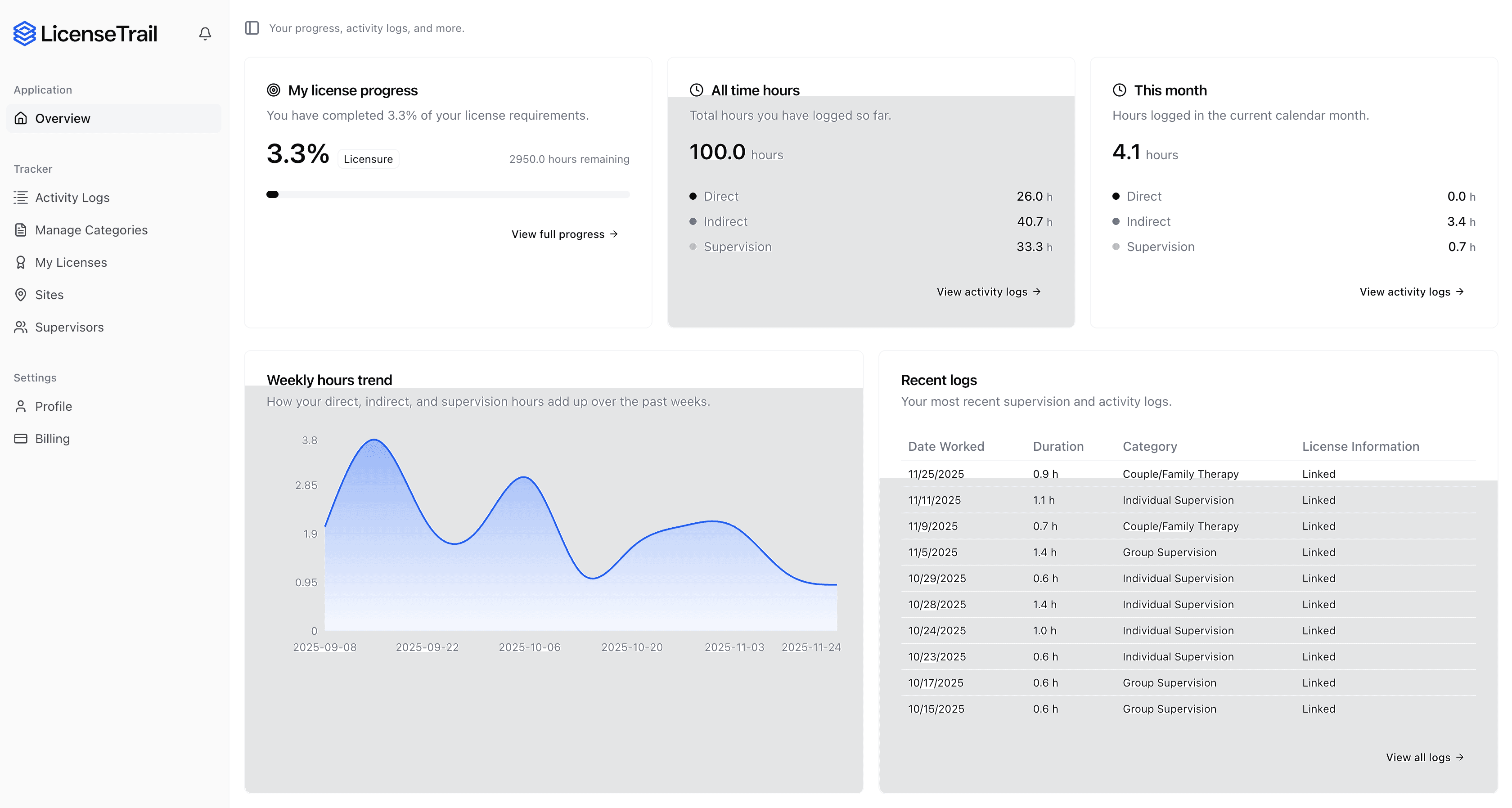
License Trail checks your direct, indirect, and supervision hours against South-carolina LMFT-A requirements continuously and flags mismatches before you submit.
 Start Tracking for Free
No credit card required · Free plan available
Is your spreadsheet hiding South-carolina LMFT-A risks?
Stop guessing if your categories match South Carolina Board of Examiners for Licensure of Professional Counselors, Marriage and Family Therapists, Addiction Counselors and Psycho-Educational Specialists requirements. License Trail checks your direct, indirect, and supervision hours continuously and flags mismatches before you submit.
Import or log
Bring your spreadsheet or start fresh
Upload your existing tracking spreadsheet and we'll map every hour into the right South Carolina Board of Examiners for Licensure of Professional Counselors, Marriage and Family Therapists, Addiction Counselors and Psycho-Educational Specialists categories automatically.
Verify against South-carolina
Catch mismatches before the board does
License Trail checks your direct, indirect, and supervision hours against South-carolina LMFT-A requirements continuously.
Export board-ready
One-click clean reports
Generate professional, board-ready reports for supervision meetings and South Carolina Board of Examiners for Licensure of Professional Counselors, Marriage and Family Therapists, Addiction Counselors and Psycho-Educational Specialists submissions in seconds.
No credit card required · Free plan available