
Tennessee CPT Requirements: Hours, Exams & Step-by-Step Guide
Stop guessing if your categories match Tennessee requirements. License Trail checks your direct, indirect, and supervision hours against CPT requirements continuously and flags mismatches before you submit.
No credit card required · Free plan available
Quick Requirements Overview
- Governed by TN Board for LPC/LMFT/LCPT under T.C.A. Title 63, Ch. 22, Part 2 (see §63-22-203); CPT rules currently being amended—statutes control
- Minimum age 18; “good moral character” (typically 2 reference letters); pay required application fee
- Education: Board-approved master’s/doctoral program with ≥60 graduate semester hours, including ≥9 hours in diagnosis & treatment of mental disorders
- Degree must include a supervised clinical practicum/internship (assessment/diagnosis/treatment incl. psychodynamic, interpersonal, spiritual dynamics) under a Board-approved supervisor
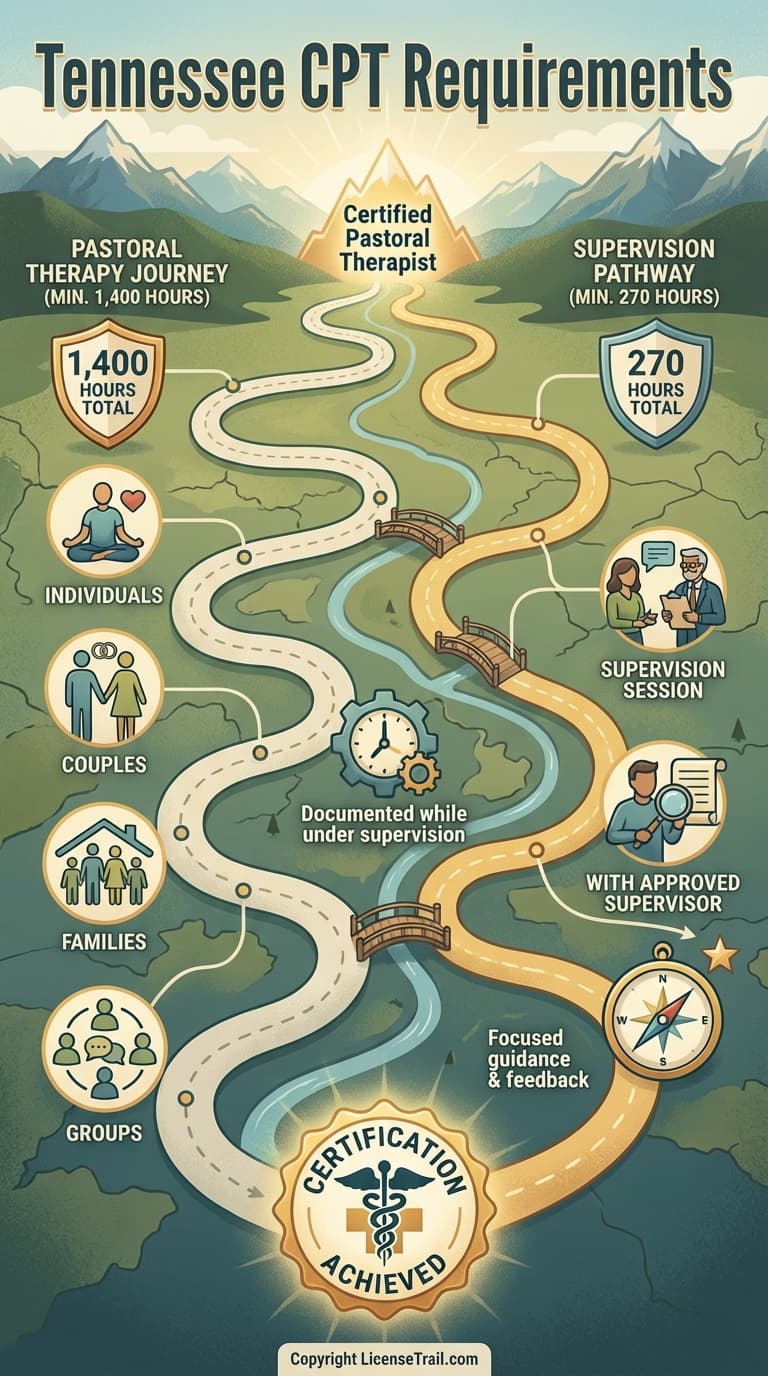
- Experience: 1,400 hours of pastoral therapy (individuals/couples/families/groups)
- Supervision: 270 hours supervising the 1,400 therapy hours under Board-approved supervision (current practice allows some group supervision; some may count from practicum/internship)
- Exams: Board-approved examination(s) (often a national clinical exam) plus TN jurisprudence exam before licensure issuance
- Application typically requires official transcripts, practicum verification, hour/supervision verifications, ID/citizenship & background check materials, completed forms, and fees
License Details
Procedures
Licensure as a Clinical Pastoral Therapist in Tennessee is governed by the Board for Licensed Professional Counselors, Licensed Marital and Family Therapists, and Licensed Clinical Pastoral Therapists, under Tennessee Code Annotated (T.C.A.) Title 63, Chapter 22, Part 2 (Clinical Pastoral Therapy).(tn.gov)
The Board itself notes that the rules for Clinical Pastoral Therapists are being amended and that applicants should look to the statutes—primarily T.C.A. § 63‑22‑203—for current qualifications.(tn.gov) What follows focuses on those statutory requirements, supplemented by current Board‑aligned guidance from the Tennessee Association of Pastoral Therapists (TnAPT).
1. Primary route: Licensure as a Clinical Pastoral Therapist by examination
1.1 Basic eligibility
Under T.C.A. § 63‑22‑203(a), an applicant for licensure as a licensed clinical pastoral therapist must:(law.justia.com)
- Be at least 18 years of age.
- Be of good moral character.
- The Board commonly requires letters attesting to moral character and professional ethics (for example, the current CPT rules require at least two letters written within the preceding 12 months on professional letterhead).(regulations.justia.com)
- Pay a non‑refundable application fee set by the Board.(law.justia.com)
1.2 Educational requirements (graduate coursework + supervised practicum)
By statute, the applicant must meet educational standards set by the Board, which must include all of the following:(law.justia.com)
-
Graduate coursework: minimum of 60 semester hours
- The law requires “a minimum of sixty (60) graduate semester hours in a curriculum approved by the board,” and at least nine (9) graduate hours must specifically relate to the diagnosis and treatment of mental disorders, culminating in a master’s or doctoral degree from a recognized educational institution.(law.justia.com)
- In practice, TnAPT describes this as at least 60 graduate credits that cover a defined CPT “Body of Knowledge” (e.g., core clinical theory, pastoral counseling theory, areas of specialization, and diagnosis/treatment of mental disorders), with remaining hours as electives.(tnapt.com)
-
Supervised clinical experience within the degree program
- The statute requires “a supervised clinical experience within the academic degree program as either a practicum or internship” that includes experience in assessment, diagnosis, and treatment of psychodynamics, interpersonal dynamics, and spiritual dynamics of persons in emotional, behavioral, relational, or spiritual distress.(law.justia.com)
- This experience must be conducted under a board‑approved supervisor.(law.justia.com)
- The law does not specify a fixed minimum number of practicum/internship hours, but the Board expects this to be a significant, structured clinical component embedded in the graduate program.
In other words: you must complete a qualifying master’s or doctoral program (at least 60 graduate hours, including 9 in diagnosis/treatment of mental disorders) and your program must include a supervised clinical practicum or internship that integrates psychological and spiritual dimensions of care under a Board‑approved supervisor.
1.3 Clinical and supervision hours (the key numbers)
In addition to the degree and practicum/internship, the statute imposes a separate, quantified clinical‑hours requirement:
- The applicant “has provided a minimum of one thousand four hundred (1,400) hours of pastoral therapy with individuals, couples, families, or groups while receiving a minimum of two hundred seventy (270) hours of supervision of such therapy under board‑approved supervision.”(law.justia.com)
That is the core Board‑defined hour requirement, and it breaks down as:
-
1,400 hours of pastoral therapy
- Direct clinical work (“pastoral therapy”) with:
- Individuals
- Couples
- Families
- Groups(law.justia.com)
- In practical terms, this is direct client contact in a clinical pastoral therapy role—what many call direct service or direct practice hours.
- Direct clinical work (“pastoral therapy”) with:
-
270 hours of supervision of that therapy
- Supervision must be:
- Of the 1,400 hours of pastoral therapy, and
- Provided under board‑approved supervision.(law.justia.com)
- Supervision must be:
TnAPT—summarizing current Board‑aligned expectations—frames this as:
- At least 1,400 “client clock hours” of clinical work,
- While being supervised for 270 hours by an Approved Supervisor.(tnapt.com)
They further note (reflecting Board practice):
- Up to 90 of the 270 supervision hours may come from your degree practicum/internship.
- Up to half (135) of the 270 supervision hours may be group supervision; the remaining hours must be individual or “dyadic individual” (no more than two supervisees per session).(tnapt.com)
These details explain how you can accumulate the statutory 270 supervision hours but the controlling numbers written into law are still 1,400 clinical (“pastoral therapy”) hours and 270 supervision hours under Board‑approved supervision.(law.justia.com)
1.4 Who can supervise (Board‑approved supervision)
While the CPT statute requires supervision to be under a “board‑approved supervisor,” it does not define the supervisor’s credentials in detail.(law.justia.com)
General Board supervision rules for counselors (not CPT‑specific, but often referenced) state that supervisors for post‑graduate counseling supervision must have held certain mental‑health licenses for at least five years (e.g., LPC, LMFT, LCPT, LCSW, psychologist‑HSP, psychiatrist).(regulations.justia.com)
TnAPT’s summary of current CPT supervision standards (adopted by the Board but still moving through rulemaking) adds that:(tnapt.com)
- Up to 180 of the 270 supervision hours may be with an approved supervisor from any licensed mental health profession (or a certified psychoanalyst), and
- At least 90 supervision hours must be under a Licensed Clinical Pastoral Therapist who either:
- Was an AAPC Fellow or Diplomate, or
- Has completed CPT supervisory training recognized by the Board.
Those specifics are best verified directly with the Board or in the final published rules, but they reflect how the Board is currently structuring “board‑approved” CPT supervision in practice.(tn.gov)
1.5 Examinations
The statute requires that the applicant “has passed examinations as approved by the board.”(law.justia.com)
In current practice, as reflected in TnAPT guidance and Board communications:
- You must pass one national clinical exam, such as:
- Marital and Family Therapy Examination
- NCMHCE (National Clinical Mental Health Counseling Examination)
- EPPP (Examination for Professional Practice in Psychology)
- National Social Work Exam at the highest clinical level(tnapt.com)
- After your file is complete, you must pass a Tennessee jurisprudence exam on CPT statutes and rules before licensure can be issued.(tnapt.com)
The statute itself leaves the choice of exams to the Board; the list above reflects current Board‑approved options, which could be updated over time.
1.6 Application documentation
From Board guidance and TnAPT’s checklist (which closely tracks current application practice), you should expect to submit:(tn.gov)
- Official graduate transcript(s) sent directly to the Board
- Academic coursework summary or curriculum forms the Board may require
- Proof of supervised practicum/internship from your graduate program
- Verification of 1,400 client hours and 270 supervision hours, with supervisor signatures
- Two letters attesting to your moral character and professional ethics
- Identification documents (e.g., birth certificate, passport‑style photo)
- Declaration of Citizenship form and criminal background check (fingerprinting)
- Completed application form and fees
The Board’s Applications page provides the current Clinical Pastoral Therapist Paper Application and electronic application links and explains where to send transcripts and other documentation.(tn.gov)
2. Understanding the “types” of hours required
To align with your example, here is how Tennessee breaks down the key types of hours, using the Board’s own language where possible and then interpreting:
2.1 Graduate practicum/internship hours (supervised clinical experience within the degree)
- Required by statute as a “supervised clinical experience within the academic degree program as either a practicum or internship,” with specific emphasis on assessment, diagnosis, and treatment of psychological and spiritual dynamics.(law.justia.com)
- These hours are:
- Part of your graduate training,
- Supervised by a board‑approved supervisor, and
- Often count both toward:
- Your degree requirements, and
- Your overall 1,400 clinical / 270 supervision hour totals (within limits the Board sets—TnAPT notes up to 90 supervision hours can come from practicum/internship).(tnapt.com)
2.2 Post‑degree (or combined) clinical practice hours
- The 1,400 hours are expressly “pastoral therapy with individuals, couples, families, or groups.”(law.justia.com)
- This is effectively your direct clinical experience requirement:
- One hour of face‑to‑face clinical work with a client system typically counts as one client clock hour.
- These hours may accumulate:
- During your graduate program (beyond basic classroom instruction) in practicum/internship and CPE settings, and
- After graduation, while working under supervision in approved clinical roles.
2.3 Supervision hours
- 270 hours of supervision are required, and they must be supervision specifically of your pastoral therapy work.(law.justia.com)
- Current Board‑aligned practice (per TnAPT) clarifies that:
- Up to 135 of these hours may be group supervision,
- The rest must be individual or dyadic supervision, and
- At least 90 must be with a suitably qualified Licensed Clinical Pastoral Therapist.(tnapt.com)
Functionally, you can think of Tennessee’s requirement as:
- 1,400 hours of direct, client‑facing clinical pastoral therapy, and
- 270 hours of structured professional supervision of that therapy under Board‑approved supervisors, some of which may be counted from your degree practicum/internship if properly documented.
The law does not impose a separate block of “indirect” or administrative hours; the hours that count toward licensure are specifically clinical (“pastoral therapy”) and supervision.
3. Licensure by endorsement (out‑of‑state or AAPC‑credentialed practitioners)
Tennessee law and rules also provide for licensure by endorsement for certain experienced pastoral therapists. Current CPT rules 0450‑03‑.04 describe endorsement routes for:(regulations.justia.com)
- Fellows or Diplomates of the American Association of Pastoral Counselors (AAPC), and
- Individuals certified as clinical members of AAPC who have been in full‑time practice for at least five years.
Endorsement applicants must still:(regulations.justia.com)
- Be at least 18,
- Demonstrate good moral character (with letters of reference), and
- Pass the Board’s written and oral/jurisprudence examinations.
Because the Board is actively amending CPT rules, anyone seeking endorsement should confirm current pathways directly with the Board office.
4. After licensure: continuing education (briefly)
Once licensed, Clinical Pastoral Therapists in Tennessee must meet the Board’s continuing education (CE) requirements:
- 10 clock hours of CE each calendar year for a single license, or
- 30 hours every two years if you hold two of the Board’s licenses (e.g., LPC and CPT), or
- 40 hours every two years if you hold all three (LPC, LMFT, CPT).
- In all multi‑license cases, at least 10 hours must directly relate to each profession in which you are licensed.(tn.gov)
These CE obligations apply after you are fully licensed; they do not count toward the 1,400/270 pre‑licensure requirements.
5. Practical summary of hour requirements
Based on Tennessee’s statutes and current Board‑aligned guidance, the quantified clinical requirements for licensure as a Clinical Pastoral Therapist are:
-
Graduate education
- At least 60 graduate semester hours, including:
- 9 hours in diagnosis and treatment of mental disorders,
- A master’s or doctoral degree in a Board‑approved curriculum.(law.justia.com)
- A supervised practicum or internship within that degree, under a board‑approved supervisor, integrated with clinical and spiritual assessment/treatment.(law.justia.com)
- At least 60 graduate semester hours, including:
-
Clinical and supervision hours
- 1,400 hours of direct pastoral therapy (client sessions with individuals, couples, families, or groups).(law.justia.com)
- 270 hours of supervision of that therapy, under Board‑approved supervision; current practice allows a mix of group and individual supervision and requires a portion with a Licensed Clinical Pastoral Therapist.(law.justia.com)
-
Examinations
- At least one national clinical exam approved by the Board, plus a Tennessee jurisprudence exam on CPT statutes and rules.(law.justia.com)
All of these sit on top of the baseline requirements of being at least 18, of good moral character, and submitting a complete application with fees and supporting documentation.(law.justia.com)
Track your CPT hours with confidence
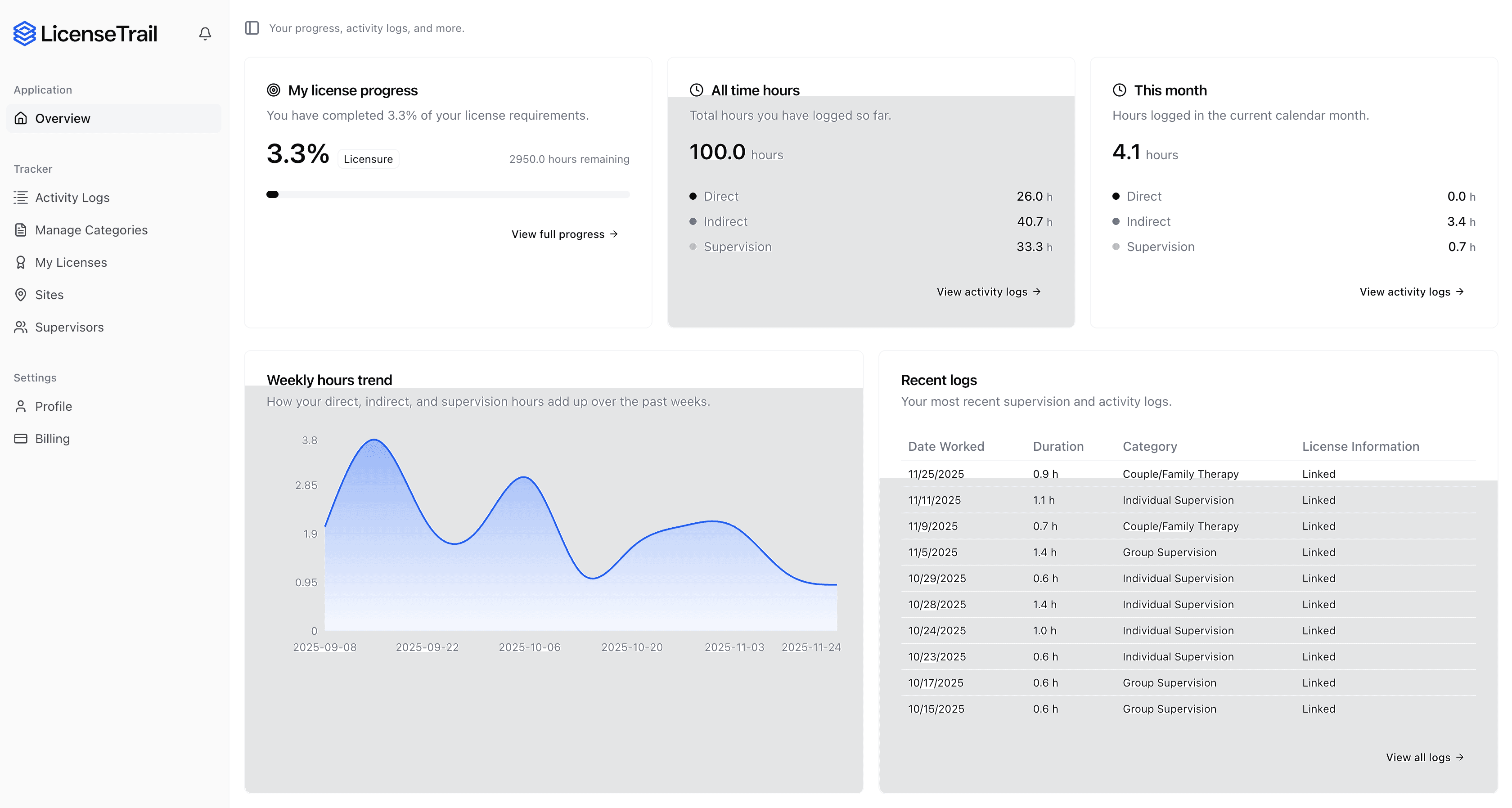
License Trail checks your direct, indirect, and supervision hours against Tennessee CPT requirements continuously and flags mismatches before you submit.
 Start Tracking for Free
No credit card required · Free plan available
Is your spreadsheet hiding Tennessee CPT risks?
Stop guessing if your categories match Tennessee Board for Professional Counselors, Marital and Family Therapists, and Clinical Pastoral Therapists requirements. License Trail checks your direct, indirect, and supervision hours continuously and flags mismatches before you submit.
Import or log
Bring your spreadsheet or start fresh
Upload your existing tracking spreadsheet and we'll map every hour into the right Tennessee Board for Professional Counselors, Marital and Family Therapists, and Clinical Pastoral Therapists categories automatically.
Verify against Tennessee
Catch mismatches before the board does
License Trail checks your direct, indirect, and supervision hours against Tennessee CPT requirements continuously.
Export board-ready
One-click clean reports
Generate professional, board-ready reports for supervision meetings and Tennessee Board for Professional Counselors, Marital and Family Therapists, and Clinical Pastoral Therapists submissions in seconds.
No credit card required · Free plan available