
Tennessee LPC/MHSP Requirements: Hours, Exams & Step-by-Step Guide
Stop guessing if your categories match Tennessee requirements. License Trail checks your direct, indirect, and supervision hours against LPC/MHSP requirements continuously and flags mismatches before you submit.
No credit card required · Free plan available
Quick Requirements Overview
- Eligibility: 18+; evidence of good moral character/professional ethics
- Education: 60 graduate semester hours, counseling major, from SACS/CACREP/comparable accredited institution
- Required MHSP coursework: 9 graduate semester hours focused on diagnosis/treatment/appraisal/assessment of mental disorders (incl. DSM)
- Practicum/Internship: required as part of graduate program (pre‑master’s; does not count toward post‑master’s hours)
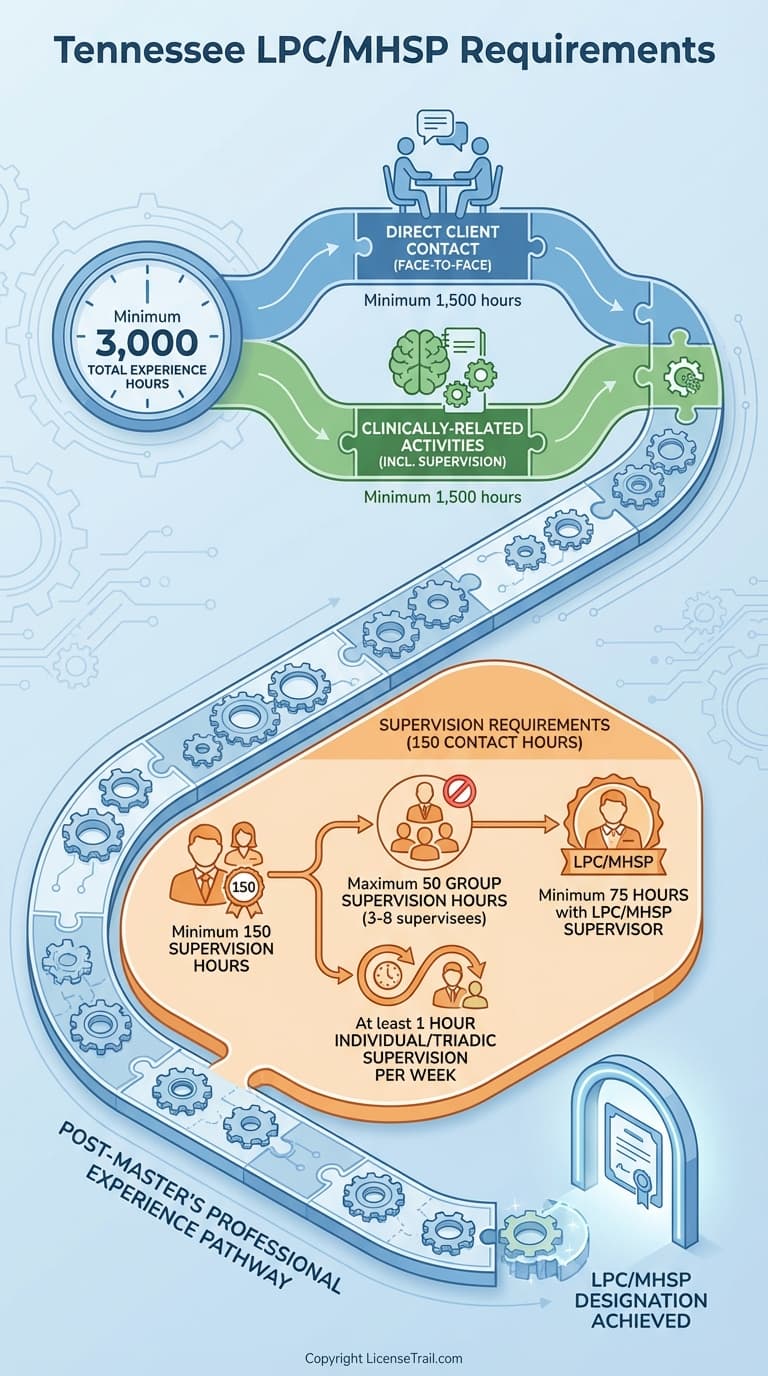
- Post‑master’s experience: 3,000 hours in a clinical setting over 2–4 years = 1,500 face‑to‑face client contact (50‑min hours) + 1,500 clinically‑related activities (not grad coursework; not admin supervision)
- Supervision: 150 hours total (max 50 group); ≥75 hours by an LPC/MHSP; minimum 1 hr/week individual formal supervision; supervisor must be approved/qualified (LPC without MHSP cannot supervise)
- Exams: NCE + NCMHCE + TN Jurisprudence Exam
- Temporary LPC/MHSP: available after completing academics; valid up to 3 years; only one temporary license issued
License Details
Procedures
In Tennessee, the Licensed Professional Counselor with Mental Health Service Provider designation (LPC/MHSP) is the license that authorizes independent clinical practice, including diagnosis and treatment of mental disorders. Requirements are set by the Board for Professional Counselors, Marital and Family Therapists, and Clinical Pastoral Therapists in Chapter 0450‑01 of the Tennessee rules.
Below is a step‑by‑step outline focused on how the Tennessee Board itself defines the required hours and supervision.
1. Basic eligibility
To apply for LPC/MHSP by examination, you must:
- Be at least 18 years of age. (law.cornell.edu)
- Provide evidence that you are “highly regarded in moral character and professional ethics.” (law.cornell.edu)
These are general prerequisites; the real substance is in education, supervised experience, and exams.
2. Required graduate education
The LPC/MHSP section of the rules (0450‑01‑.04(4)) requires the following: (law.cornell.edu)
-
Degree and credit hours
- At least 60 graduate semester hours with a major in counseling.
- Degree must be from an institution accredited by:
- Southern Association of Colleges and Schools,
- The Council for Accreditation of Counseling and Related Educational Programs (CACREP), or
- A comparable accrediting body.
-
Core content areas
Your 60 hours must include coursework in core counseling areas such as (summarizing the Board’s list): (law.cornell.edu)- Theories of human behavior, learning, and personality
- Abnormal behavior
- Theories of counseling and psychotherapy
- Evaluation and appraisal procedures
- Group dynamics, theories, and techniques
- Counseling techniques
- Multicultural counseling
- Ethics
- Research
- Clinical practicum or internship (as required in T.C.A. § 63‑22‑104)
- Use of the DSM
- Treatment and treatment planning
-
Extra coursework in diagnosis and treatment of mental disorders
The Board, citing T.C.A. § 63‑22‑120, requires a minimum of nine (9) graduate semester hours of coursework “specifically related to diagnosis, treatment, appraisal and assessment of mental disorders.” (law.cornell.edu)- These 9 hours can be part of your degree or taken post‑graduate.
- Courses must focus substantially on:
- Diagnosis
- Treatment and treatment planning
- Appraisal and assessment of mental disorders
- Psychopathology
- Use of the DSM
-
Practicum / internship
- The rules require a clinical practicum or internship as part of the graduate program. (law.cornell.edu)
- Practice‑oriented summaries of Tennessee’s rules describe this as at least 500 total hours, with at least 300 hours in a mental health or community agency setting, supervised by an appropriately qualified mental health professional. (onlinecounselingprograms.com)
These practicum/internship hours are pre‑master’s and do not count toward the post‑master supervised hours discussed next.
3. Key Board definitions that affect your hours
The Tennessee definitions section (0450‑01‑.01) contains several terms that directly shape how you count hours:
- Client Contact Hour – defined as a 50‑minute period during which a counselor works with an individual, family, or group. (law.cornell.edu)
- Clinically‑related activities – defined as activities such as clinically‑related workshops, trainings and seminars, treatment teams, clinical supervision, and research/leadership preparation for individual and group counseling. The Board explicitly states that graduate coursework in pursuit of licensure and administrative supervision are not clinically‑related activities. (law.cornell.edu)
- Supervision – “ongoing, direct clinical oversight for the purpose of training or teaching” that includes regular, documented face‑to‑face or approved live video consultation with an approved supervisor. (law.cornell.edu)
- Approved Supervisor – must be appropriately licensed (LPC, LPC/MHSP, LMFT, Clinical Pastoral Therapist, LCSW, Psychologist with HSP designation, Senior Psychological Examiner, or Psychiatrist), licensed at least five years, and must take responsibility for the supervisee’s practice. For LPC/MHSP candidates, an LPC supervisor must also hold the Mental Health Service Provider designation. (law.cornell.edu)
These definitions drive exactly how the 3,000 hours are broken down and what can and cannot be counted.
4. Clinical setting and supervision structure
Clinical setting
Your post‑master’s experience must be in a clinical setting, which the Board defines as a place where professional counseling occurs and which meets these criteria: (regulations.justia.com)
- A public, private, or community agency/mental health setting with integrated clinical mental health counseling programs.
- Adequate physical resources (e.g., private space that meets HIPAA requirements).
- At least one licensed mental health professional on site for a cumulative minimum of 20 hours per week, whose duties include being available to you for supervision/consultation. That person may serve as your supervisor if they meet the Board’s supervisor requirements.
The site may not be privately owned or independently operated by you during your post‑master’s professional experience. (law.cornell.edu)
Who may supervise an LPC/MHSP candidate?
For Mental Health Service Provider designation, supervisors must: (law.cornell.edu)
- Be licensed at least five years and in good standing.
- Hold one of the following licenses:
- LPC with Mental Health Service Provider designation
- Licensed Marital and Family Therapist
- Licensed Clinical Pastoral Therapist
- Licensed Clinical Social Worker
- Licensed Psychiatrist
- Licensed Senior Psychological Examiner
- Licensed Psychologist with Health Service Provider designation
- A Licensed Professional Counselor without MHSP designation may not supervise an LPC/MHSP candidate.
Additionally, of the 150 required supervision hours, at least 75 must be provided by an LPC who holds the MHSP designation. (law.cornell.edu)
5. The core requirement: 3,000 hours of supervised post‑master’s experience
For LPC/MHSP by examination, Tennessee requires a very specific post‑master’s experience as laid out in Rule 0450‑01‑.04(4)(d) and Rule 0450‑01‑.10(6). (law.cornell.edu)
Total hours and timeframe
- You must complete 3,000 hours of supervised post‑master’s professional experience. (law.cornell.edu)
- Rule 0450‑01‑.10 adds that this is a minimum of 3,000 hours of direct clinical experience completed:
- Under supervision, and
- In no less than two (2) years and no more than four (4) years from the beginning of supervised clinical practice. (law.cornell.edu)
In practice, this means:
- You cannot compress all 3,000 hours into a single year; the supervised period must span at least 24 months.
- You must complete the 3,000 hours within four years of starting your supervised clinical practice.
Breakdown of the 3,000 hours
The Tennessee rules are explicit:
- 1,500 of the 3,000 hours must be face‑to‑face client contact hours.
- 1,500 of the 3,000 hours must be clinically‑related activities. (law.cornell.edu)
So the Board’s structure is:
-
1,500 hours – “face‑to‑face client contact hours”
- Sessions (individual, couple, family, or group) where you are providing counseling directly to clients, typically in 50‑minute “client contact hours.” (law.cornell.edu)
-
1,500 hours – “clinically‑related activities”
These are not direct sessions, but must be clinically oriented. The Board’s definition (paraphrased) includes: (law.cornell.edu)- Clinically‑related workshops, trainings, and seminars
- Participation in treatment teams
- Clinical supervision
- Research and leadership preparation directly tied to individual or group counseling
The Board explicitly excludes:
- Graduate coursework taken toward licensure
- Administrative supervision in the work setting
Thus, you cannot count regular staff meetings or purely administrative duties as clinically‑related activities, and you cannot reuse your graduate coursework hours toward this 1,500‑hour total.
Required supervision within those 3,000 hours
The 3,000 hours must also include supervision as follows:
-
Total supervision required:
- 150 contact hours of supervision specifically for Mental Health Service Provider designation, with no more than 50 of those hours in a group setting. (law.cornell.edu)
-
Individual vs. group supervision:
- The Board defines individual supervision consistent with CACREP models (one supervisor to one or two supervisees).
- Group supervision is one supervisor with 3–8 supervisees, and the rules cap group supervision at 50 of the 150 supervision hours. (law.cornell.edu)
-
Who must provide those 150 hours?
- At least 75 of the 150 supervision hours must be conducted by an LPC with MHSP designation. (law.cornell.edu)
-
Minimum weekly supervision:
- The Board requires a minimum of one hour per week of direct, individual, formal supervision with a qualified supervisor.
- Classwork, practicum, or other course‑related experiences used to earn the required 60 graduate hours cannot be counted as part of this post‑master’s supervision. (law.cornell.edu)
-
What cannot count as supervision or experience:
- Your own personal therapy or encounter‑type groups (i.e., experiences for your personal growth rather than your clients’) cannot count toward supervision or experience requirements.
- You supervising others does not count as your own supervision experience. (law.cornell.edu)
6. Temporary LPC/MHSP license while you earn hours
Tennessee allows you to hold a Temporary Licensed Professional Counselor with Mental Health Service Provider designation while completing the supervised hours: (law.cornell.edu)
To qualify for a temporary LPC/MHSP license, you must:
- Have completed all academic coursework and training required for LPC/MHSP except the post‑master’s supervised experience.
- Submit an LPC/MHSP application (with fees and supporting documents), except you do not yet have to show proof of:
- The 3,000 supervised hours, or
- Passing the National Clinical Mental Health Counseling Examination (NCMHCE) or the Tennessee Jurisprudence Exam.
- Provide information about your proposed supervisor(s), including:
- Proof they meet the Board’s supervisor qualifications in Rule 0450‑01‑.10(1), and
- A proposed supervisory agreement or employment contract.
Key limitations:
- Only one temporary license may be issued to an individual.
- The temporary LPC/MHSP license is valid for no more than three (3) years. (regulations.justia.com)
Most candidates obtain the temporary license after graduation, then complete their 3,000 hours under that status.
7. Examinations required for LPC/MHSP
Once education and (for full licensure) supervision requirements are met, the rules require you to pass specific examinations: (law.cornell.edu)
For LPC/MHSP by examination, you must pass:
- National Counselor Examination (NCE)
- National Clinical Mental Health Counseling Examination (NCMHCE)
- Tennessee Jurisprudence Examination (covering Tennessee law and rules for professional counselors)
Common sequencing in practice (as reflected in licensure summaries): (counselingdegreesonline.org)
- NCE is often taken earlier and can support provisional or temporary licensure.
- NCMHCE and the Tennessee Jurisprudence Exam are typically required before issuance of the full LPC/MHSP license.
8. Application for full LPC/MHSP licensure
When you have:
- Completed 3,000 hours of supervised post‑master’s clinical experience (1,500 face‑to‑face client contact hours + 1,500 clinically‑related activities), including 150 supervision hours (with at least 75 by an LPC/MHSP), within a 2‑to‑4‑year period; (law.cornell.edu)
- Met all educational requirements (60 graduate hours with the specified core content and 9 hours specifically related to diagnosis, treatment, appraisal and assessment of mental disorders); (law.cornell.edu)
- Passed the NCE, NCMHCE, and Tennessee Jurisprudence Exam; (law.cornell.edu)
you may apply to the Board for full LPC/MHSP licensure.
The application process itself (forms, fees, timing) is governed by Procedure rules 0450‑01‑.05 and 0450‑01‑.06; they specify that the burden is on you to show that your coursework, supervision, and experience meet or are equivalent to the Board’s requirements. (law.cornell.edu)
9. Ongoing requirements (briefly)
After licensure, you must meet continuing education requirements:
- 20 clock hours every two years of continuing education for those regulated under Chapter 0450‑01, with at least 3 hours in ethics/jurisprudence during that period. (law.cornell.edu)
- Separate provisions require at least two hours of suicide‑prevention training every five years. (law.cornell.edu)
If you provide supervision to LPC/LPC‑MHSP candidates, an additional portion of your CE must specifically address supervision topics. (law.cornell.edu)
10. Core hour requirements in one place
For quick reference, under current Tennessee rules for LPC/MHSP by examination you must complete:
-
Total post‑master’s supervised experience:
- 3,000 hours of direct clinical experience under supervision, completed over at least 2 and no more than 4 years. (law.cornell.edu)
-
Breakdown of those 3,000 hours: (law.cornell.edu)
- 1,500 hours of face‑to‑face client contact (in 50‑minute client contact hours)
- 1,500 hours of clinically‑related activities (clinically‑oriented trainings, treatment teams, clinical supervision, and research/leadership preparation for counseling—but not graduate coursework and not administrative supervision)
-
Supervision embedded in those hours: (law.cornell.edu)
- 150 contact hours of supervision total
- No more than 50 of those hours may be group supervision
- At least 75 of those hours must be conducted by an LPC with MHSP designation
- At least one hour per week of individual, formal supervision
- Supervision must be for the direct provision of mental health services to clients (your own personal therapy or supervising others does not count)
Those are the specific hour types and quantities the Tennessee Board itself uses in its rules for licensure as an LPC with Mental Health Service Provider designation.
Track your LPC/MHSP hours with confidence
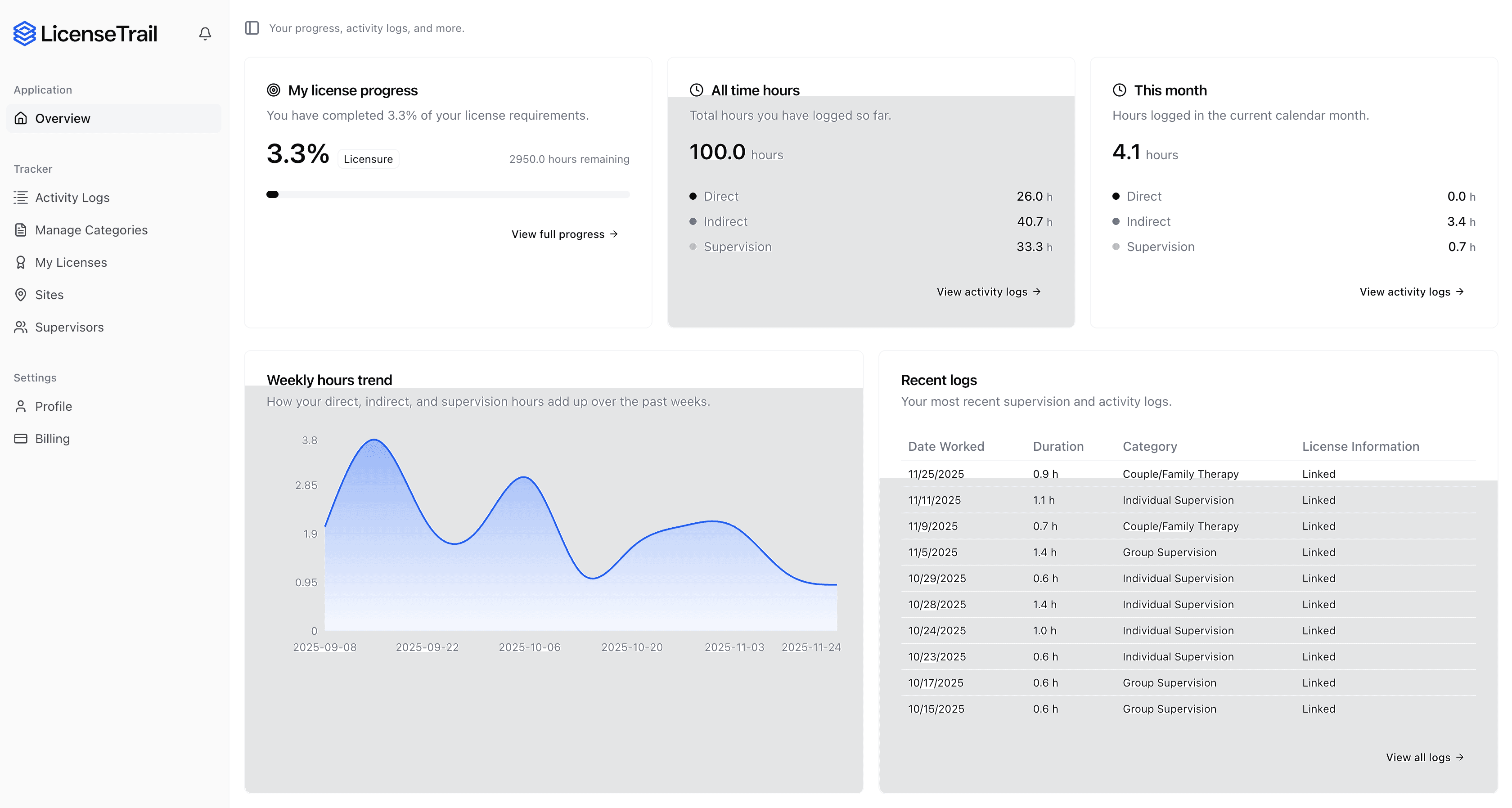
License Trail checks your direct, indirect, and supervision hours against Tennessee LPC/MHSP requirements continuously and flags mismatches before you submit.
 Start Tracking for Free
No credit card required · Free plan available
Is your spreadsheet hiding Tennessee LPC/MHSP risks?
Stop guessing if your categories match Tennessee Board for Professional Counselors, Marital and Family Therapists, and Clinical Pastoral Therapists requirements. License Trail checks your direct, indirect, and supervision hours continuously and flags mismatches before you submit.
Import or log
Bring your spreadsheet or start fresh
Upload your existing tracking spreadsheet and we'll map every hour into the right Tennessee Board for Professional Counselors, Marital and Family Therapists, and Clinical Pastoral Therapists categories automatically.
Verify against Tennessee
Catch mismatches before the board does
License Trail checks your direct, indirect, and supervision hours against Tennessee LPC/MHSP requirements continuously.
Export board-ready
One-click clean reports
Generate professional, board-ready reports for supervision meetings and Tennessee Board for Professional Counselors, Marital and Family Therapists, and Clinical Pastoral Therapists submissions in seconds.
No credit card required · Free plan available