
Tennessee LMFT Requirements: Hours, Exams & Step-by-Step Guide
Stop guessing if your categories match Tennessee requirements. License Trail checks your direct, indirect, and supervision hours against LMFT requirements continuously and flags mismatches before you submit.
No credit card required · Free plan available
Quick Requirements Overview
- Governing board: TN Board for Licensed Professional Counselors, Licensed Marital and Family Therapists, and Licensed Clinical Pastoral Therapists
- Eligibility: ≥18 years old; evidence of good moral character/professional ethics; education completed before applying
- Education: Master’s/Doctorate in MFT (or related field with required coursework) from accredited institution
- Required coursework (graduate): 3 Human Development/Personality; 3 MFT Studies; 3 MFT Therapy; 1 Research; 1 Ethics; 1 DSM-based Assessment/Diagnosis
- Practicum/Internship: ≥300 supervised hours (assessment/diagnosis/treatment) as part of the degree
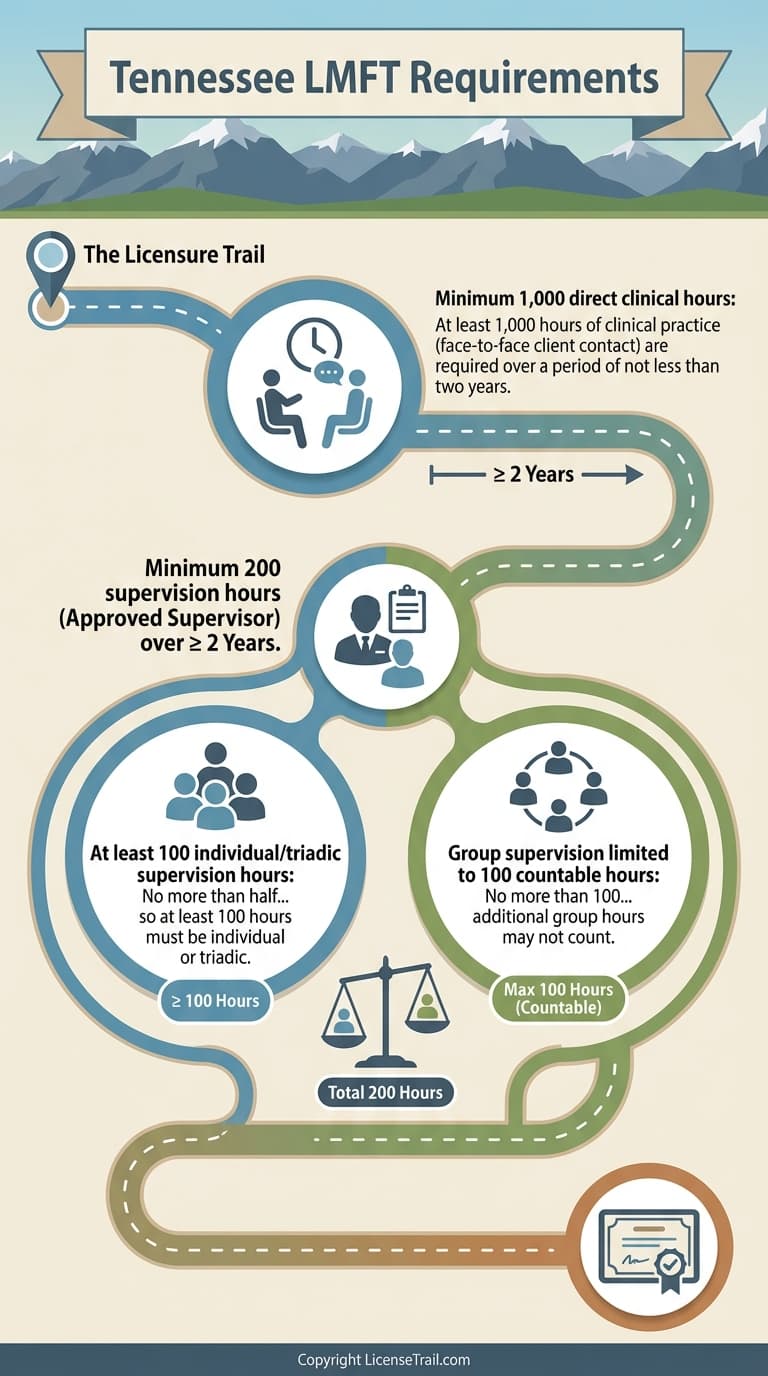
- Post-master’s experience: 2 years with ≥10 face-to-face client contact hours/week (≈1,000+ hours practical minimum)
- Supervision: AAMFT Approved Supervisor or Supervisor-in-Training; ≤50% group supervision; group max 6 supervisees (commonly planned as ~200 supervision hours)
- Exams/temporary practice: Pass AMFTRB written + TN oral + jurisprudence; temporary license available (nonrenewable, up to 3 years) for supervised practice and must pass written exam within 2 years of temp issuance
License Details
Procedures
Becoming a Licensed Marital and Family Therapist (LMFT) in Tennessee is governed by the Tennessee Board for Licensed Professional Counselors, Licensed Marital and Family Therapists, and Licensed Clinical Pastoral Therapists. The legal requirements are laid out in the Tennessee Compilation of Rules and Regulations, Chapter 0450‑02 (General Rules Governing Marital and Family Therapists) and in related statutes.
Below is a step‑by‑step guide that stays close to the wording of the Tennessee rules, with the hours translated into practical terms.
1. License type and pathways
Tennessee has one main MFT license:
- Licensed Marital and Family Therapist (LMFT)
You can reach it in three ways under Rule 0450‑02‑.04:
- By examination (standard path) – for new graduates. (law.cornell.edu)
- By reciprocity – for those already licensed in another state with substantially equivalent requirements. (law.cornell.edu)
- By endorsement – for applicants who are current AAMFT Clinical Members. (law.cornell.edu)
The detailed “hours” questions you asked apply to the standard path by examination.
2. Basic eligibility for LMFT by examination
Under Rule 0450‑02‑.04(1), before you even submit an application for LMFT by examination you must: (law.cornell.edu)
-
Age requirement
- Be at least 18 years of age.
-
Moral character and ethics
- Provide evidence that you are “highly regarded in moral character and professional ethics,” as further referenced in Rule 0450‑02‑.05 (Procedures for Licensure). (law.cornell.edu)
-
Education completed before application
- The full education requirement must be completed prior to the date of application.
3. Educational requirements (graduate degree + practicum)
The Board is unusually specific about coursework. Under Rule 0450‑02‑.04(1)(c), you must have: (law.cornell.edu)
3.1 Degree
- A master’s or doctoral degree in marriage and family therapy or equivalent from an institution accredited by the Southern Association of Colleges and Schools or comparable accrediting body.
The board will also accept a related subject field degree if (and only if) it contains the specified coursework below.
3.2 Required graduate coursework
Your degree must include, with each course at least one semester in length: (law.cornell.edu)
- Human Development and Personality – 3 courses
- Marriage and Family Studies – 3 courses
- Marriage and Family Therapy – 3 courses
- Research – 1 course
- Professional Ethics – 1 course
- Assessment and diagnosis (DSM) – 1 course in “assessment and diagnosis of cognitive, affective and behavioral problems and dysfunctions” using DSM‑IV‑TR or its successor.
3.3 Supervised practicum/internship
The rules explicitly require a minimum of 300 hours in a supervised practicum or internship: (law.cornell.edu)
- “Supervised practicum/internship of no less than three hundred (300) hours” that includes experience in the assessment, diagnosis, and treatment of DSM‑related cognitive, affective, and behavioral problems or dysfunctions.
This 300‑hour practicum is part of your degree, not part of the post‑master’s supervised experience for licensure.
4. Post‑master’s clinical and supervision requirements
After the qualifying degree is complete, Tennessee requires post‑master’s clinical experience and supervision before full LMFT licensure.
4.1 How the Board itself phrases the requirement
Rule 0450‑02‑.04(1)(d) states that a candidate must have: (law.cornell.edu)
Two years of post‑masters clinical experience consisting of not less than 10 hours per week pursuant to rule 0450‑02‑.14 and 0450‑02‑.05.
Rule 0450‑02‑.14 then defines what “actively engaged” in practice means: (law.cornell.edu)
- “Actively engaged” is defined as 10 or more face‑to‑face client contact hours per week of marital and family therapy.
In plain terms, directly from the Board’s rules:
- You must complete two (2) years of post‑master’s clinical work, and
- During those two years, you must be “actively engaged,” meaning at least 10 face‑to‑face client contact hours per week.
This is the Board’s own verbiage, not an hours‑total formula like “1,500 direct hours” used in some other states.
4.2 What that means in hours of direct client experience
Although the rules do not state a total number explicitly, you can derive a practical minimum:
- Minimum weekly client contact: 10 hours
- Over 52 weeks in a year: 10 × 52 ≈ 520 hours per year
- Over two years: about 1,040 hours of face‑to‑face client contact.
Professional summaries from AAMFT and licensure‑prep sites therefore describe Tennessee’s requirement as a minimum of 1,000 hours of clinical practice for LMFT licensure, which is just a rounded expression of that two‑year, 10‑hours‑per‑week standard. (aamft.org)
So in practical terms, plan on at least 1,000 hours of direct clinical experience as a marital and family therapist after your master’s degree.
4.3 Supervision: who supervises and how it’s structured
Tennessee regulates supervision in Rule 0450‑02‑.10 (SUPERVISION). The key points are: (law.cornell.edu)
-
Supervisor qualifications
- Supervision must be by an AAMFT Approved Supervisor or Supervisor‑in‑Training whose qualifications meet AAMFT standards.
-
Type and format of supervision
- Supervision may be:
- Direct supervision of one or two persons’ interaction with a client, or
- Supervision in a group setting.
- However, no more than one‑half of the required supervision hours may be in a group setting.
- Unless AAMFT defines otherwise, a group may not have more than six supervisees.
- Supervision may be:
-
Continuing supervision until licensure
- Even after you have completed the required post‑master’s supervised experience, you must continue in supervision until you actually receive your LMFT license. This “post‑supervision” may be “less intense and/or less frequent,” at the supervisor’s judgment. (law.cornell.edu)
The rule does not spell out a specific number of supervision hours in this section for new applicants by examination. However:
- For people upgrading from older “certified marital and family therapist” (CMFT) status, Rule 0450‑02‑.04(2)(b) explicitly says that one upgrade path is to document 200 hours of clinical supervision under Rule 0450‑02‑.10. (law.cornell.edu)
4.4 How many supervision hours in practice?
The Board rules phrase the requirement in terms of time period and weekly client contact, with supervision tied to AAMFT standards, rather than a clean “X hours supervised” line.
However, both:
- The American Association for Marriage and Family Therapy’s Tennessee licensure summary, and
- A commonly used Tennessee LMFT licensure guide
describe the requirement for full LMFT licensure as: (aamft.org)
- At least 1,000 hours of clinical practice, and
- At least 200 hours of direct supervision with a Board‑approved/AAMFT‑qualified supervisor.
This 200‑hour figure is consistent with the Board’s explicit 200‑hour standard for CMFTs upgrading to LMFT and with traditional AAMFT supervision standards.
So, in practical planning terms for Tennessee LMFT:
- Direct client experience:
- Minimum: ~1,000 hours of post‑master’s, face‑to‑face clinical practice over two years.
- Supervision:
- Minimum: ~200 hours of clinical supervision, with:
- An AAMFT‑approved or Supervisor‑in‑Training supervisor,
- No more than half of those supervision hours in group format,
- Group size capped at six supervisees.
- Minimum: ~200 hours of clinical supervision, with:
You accrue these clinical and supervision hours while practicing under temporary licensure (see next section).
5. Temporary LMFT license and supervised practice
Tennessee law and rules provide for a temporary license for LMFT applicants who have finished the degree and practicum but not yet completed the post‑master’s supervised experience.
5.1 When you can get a temporary license
Under Rule 0450‑02‑.05(5) and Tenn. Code Ann. § 63‑22‑121, a temporary license may be issued to an applicant who: (regulations.justia.com)
- Has completed the academic coursework and training required for the license (including the 300‑hour practicum), except for the required post‑master’s supervised clinical experience; and
- Has an agreement with an approved supervisor (as defined in statute/rule) under whose supervision the applicant will practice.
The temporary license:
- Is non‑renewable,
- Is valid for no more than three (3) years, and
- Authorizes you to practice marital and family therapy only under supervision.
5.2 Titles you may use while under temporary license
Holders of a temporary license may not represent themselves as licensed marital and family therapists. By rule and statute, they may only use titles like: (regulations.justia.com)
- “Marital therapy intern”
- “Family therapy trainee”
- Or another clearly trainee‑level title approved by the Board.
5.3 Completing requirements under the temporary license
Within the temporary license period you must: (regulations.justia.com)
- Accrue the required post‑master’s supervised clinical experience (two years at ≥10 client hours/week).
- Complete the required supervision under an approved supervisor.
- Take and pass the written exam within two years of the temporary license issuance.
- Submit documentation of your completed supervised experience and pass the oral exam for full LMFT licensure.
If the Board grants or denies the regular license, or if the temporary license is revoked, the temporary license immediately ceases to be valid.
6. Examinations (written, oral, jurisprudence)
Tennessee requires both a written and an oral exam for LMFT licensure by examination, except in some reciprocity/endorsement situations.
Under Rule 0450‑02‑.08: (regulations.justia.com)
-
Written examination
- Tennessee adopts as its written exam the AMFTRB national MFT exam (formerly PES).
- Passing the written exam is a prerequisite to taking the oral exam.
-
Oral examination
- All LMFT applicants by examination must pass a Board‑administered oral exam (unless specifically exempted by reciprocity rules). (law.cornell.edu)
-
Jurisprudence exam
- The Board also requires a jurisprudence examination (on Tennessee statutes and rules). The FAQ states that you may request this exam after an MFT application has been submitted. (tn.gov)
7. Application and documentation procedures
The practical application steps are set out in Rule 0450‑02‑.05 (Procedures for Licensure) and in Board FAQs. In summary: (regulations.justia.com)
-
Obtain the application
- You may download the LMFT application (or temporary license application) from the Tennessee Department of Health’s site or request it from the Board office.
-
Submit a complete packet
- The rule states that all documentation should be completed before filing the application, and that personal resumes are not accepted in lieu of formal documentation.
-
What you must document
- Age and identity.
- Evidence of moral character and professional ethics (as described in Rule 0450‑02‑.05).
- Official transcripts showing the qualifying degree and required coursework.
- Documentation of the 300‑hour supervised practicum/internship.
- For full licensure: written evidence (from supervisors/colleagues) that you have been “actively engaged” in practice (≥10 face‑to‑face client hours/week) for two years post‑master’s, per Rule 0450‑02‑.14. (law.cornell.edu)
- Verification of board‑approved supervision, including supervisor credentials and supervision format.
-
Fees and timelines
- Pay all required fees with the application.
- You must also keep your temporary license and later your LMFT license current with renewals and (after licensure) annual continuing education requirements (10 hours per calendar year for LMFTs, per Board CE guidance). (tn.gov)
8. Reciprocity and endorsement (for out‑of‑state LMFTs)
If you are already licensed elsewhere, Tennessee offers:
-
Licensure by reciprocity (Rule 0450‑02‑.04(3)) (law.cornell.edu)
- Hold a current MFT license from another state,
- Show that the out‑of‑state requirements meet or exceed Tennessee’s standards (age, education, post‑master’s experience), and
- Pass the oral exam (written exam may be waived).
-
Licensure by endorsement (Rule 0450‑02‑.04(4)) (law.cornell.edu)
- Be at least 18,
- Show evidence of good character and ethics,
- Hold current AAMFT Clinical Membership, and
- Pass the Tennessee oral examination.
9. Summary of Tennessee LMFT hour‑type requirements
Putting the Board’s language and the practical interpretations together:
-
Graduate practicum/internship (pre‑degree)
- At least 300 hours, supervised, including assessment, diagnosis, and treatment of DSM‑related problems. (law.cornell.edu)
-
Post‑master’s clinical experience (for LMFT by examination)
- Two (2) years of clinical work
- At not less than 10 face‑to‑face client contact hours per week, as defined in Rule 0450‑02‑.14.
- Functionally, this equals ≈1,000+ hours of direct clinical practice with clients. (law.cornell.edu)
-
Supervision of that clinical experience
- Must be under an AAMFT Approved Supervisor or Supervisor‑in‑Training meeting AAMFT standards.
- No more than half of supervision hours may be in a group setting; groups max six supervisees. (law.cornell.edu)
- In practice, Tennessee guidance (through AAMFT and licensure resources) reflects a minimum of 200 hours of direct supervision during the 1,000+ hours of post‑master’s clinical practice. (aamft.org)
Unlike some states that state, for example, “1,500 hours of direct service plus 1,500 hours of supervised experience” in the rules, Tennessee’s own regulations phrase the requirement primarily as “two years” at “10 or more face‑to‑face client contact hours per week” under AAMFT‑standard supervision. The 1,000+ clinical hours and 200 supervision hours are the practical, widely‑accepted interpretation of that regulatory language.
Track your LMFT hours with confidence
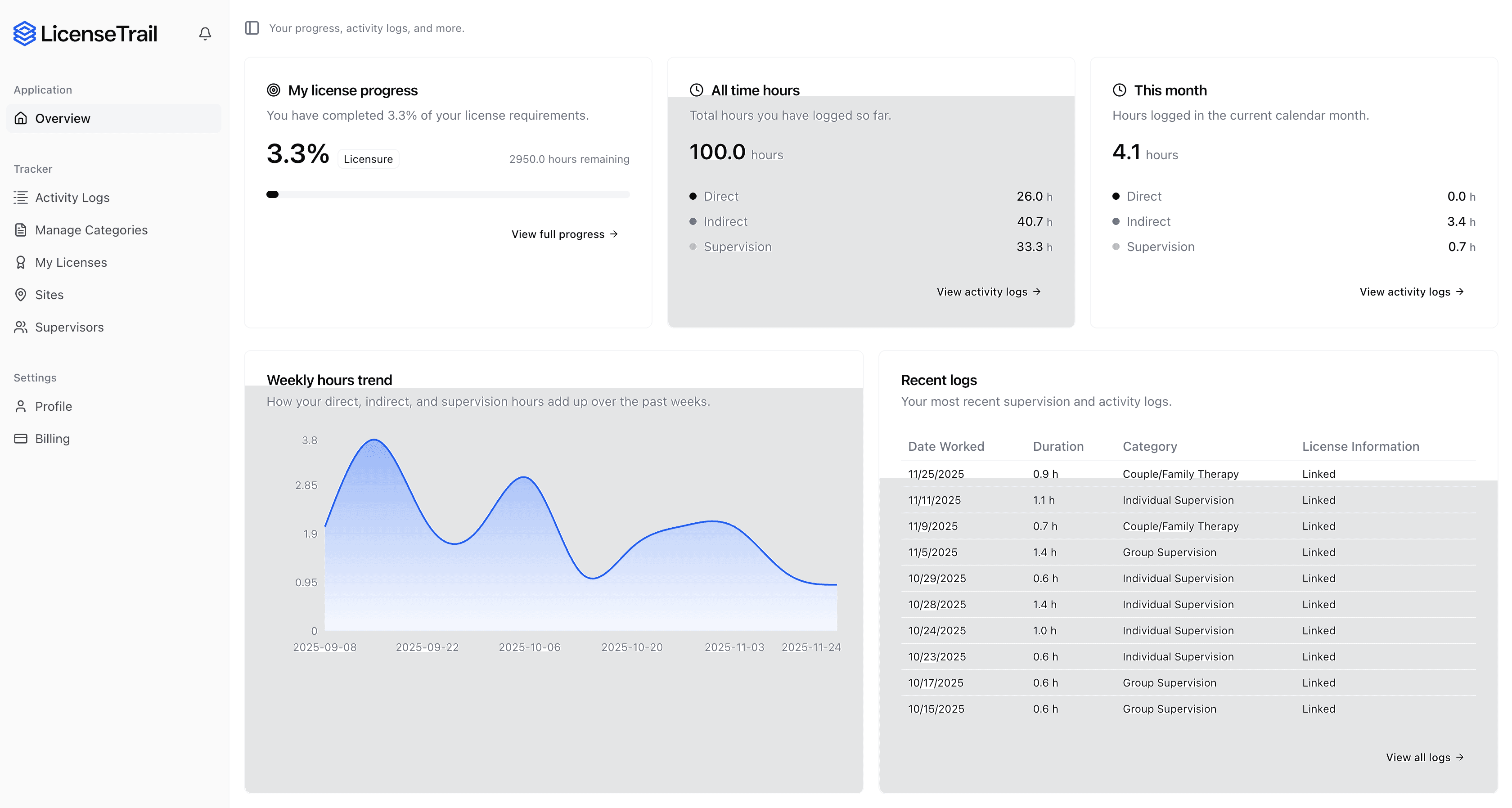
License Trail checks your direct, indirect, and supervision hours against Tennessee LMFT requirements continuously and flags mismatches before you submit.
 Start Tracking for Free
No credit card required · Free plan available
Is your spreadsheet hiding Tennessee LMFT risks?
Stop guessing if your categories match Tennessee Board for Professional Counselors, Marital and Family Therapists, and Clinical Pastoral Therapists requirements. License Trail checks your direct, indirect, and supervision hours continuously and flags mismatches before you submit.
Import or log
Bring your spreadsheet or start fresh
Upload your existing tracking spreadsheet and we'll map every hour into the right Tennessee Board for Professional Counselors, Marital and Family Therapists, and Clinical Pastoral Therapists categories automatically.
Verify against Tennessee
Catch mismatches before the board does
License Trail checks your direct, indirect, and supervision hours against Tennessee LMFT requirements continuously.
Export board-ready
One-click clean reports
Generate professional, board-ready reports for supervision meetings and Tennessee Board for Professional Counselors, Marital and Family Therapists, and Clinical Pastoral Therapists submissions in seconds.
No credit card required · Free plan available