
Tennessee LPC Requirements: Hours, Exams & Step-by-Step Guide
Stop guessing if your categories match Tennessee requirements. License Trail checks your direct, indirect, and supervision hours against LPC requirements continuously and flags mismatches before you submit.
No credit card required · Free plan available
Quick Requirements Overview
- Age/character: Must be 18+ and meet good moral character/professional ethics requirements
- Education: Graduate degree (major in counseling) from accredited school; minimum 60 graduate semester hours (degrees under 60 hours don’t qualify)
- Coursework/practicum: 60 hours must cover required core counseling content and include a supervised practicum/internship
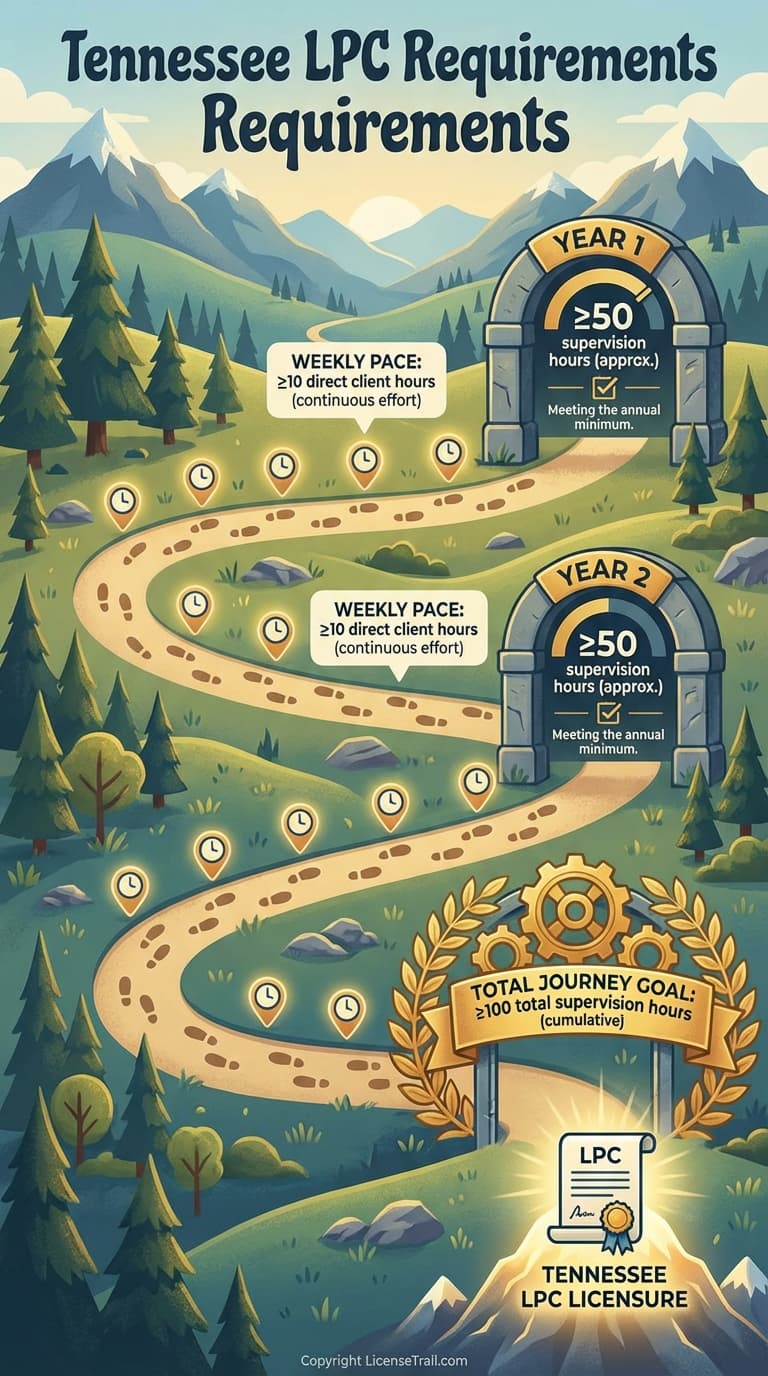
- Post‑master experience: 2 years of supervised post‑master professional experience with ≥10 client‑contact hours/week (non‑volunteer)
- Supervision minimum: 50 contact hours of supervision per year during the 2 post‑master years
- Supervisor rules: Supervisor must be an approved, appropriately licensed/experienced professional; no conflicts/relatives/household supervisors; stay supervised until license issued
- Exams: Pass NCE + TN jurisprudence exam (NCMHCE is for MHSP, not LPC-only)
- Application/docs: Submit application, official transcript, verification of supervision, NBCC scores, plus background check/forms/fees
License Details
Procedures
Licensure as a Licensed Professional Counselor (LPC) in Tennessee—without the Mental Health Service Provider (MHSP) designation—is governed by the Board for Licensed Professional Counselors, Licensed Marital and Family Therapists, and Licensed Clinical Pastoral Therapists under Tennessee’s rules, Chapter 0450‑01.
Below is a step‑by‑step guide based directly on those rules and the Board’s own materials, with a focus on the exact types of hours required.
1. License type: LPC vs. LPC/MHSP
Tennessee distinguishes between:
- Licensed Professional Counselor (LPC) – may practice professional counseling, but may not independently diagnose and treat mental disorders in all settings (that authority is tied to the MHSP designation; scope is also governed by other state laws and employer policies).
- Licensed Professional Counselor with Mental Health Service Provider designation (LPC/MHSP) – must meet additional mental health coursework and 3,000-hour clinical experience requirements, and can function as an independent mental health provider under Tennessee law. (law.cornell.edu)
Your question is specifically about the LPC without MHSP. The Board’s rules use different hour language for this license: they talk in terms of years of supervised experience and weekly minimums, not a fixed total like “3,000 hours.”
2. Baseline eligibility
To be licensed as an LPC by examination, you must: (law.cornell.edu)
- Be at least 18 years old.
- Be of good moral character and professional ethics, documented as required by Rule 0450‑01‑.05.
- Meet education, examination, and supervised experience requirements described below.
3. Education requirements
3.1 Graduate degree and total hours
The Board requires: (law.cornell.edu)
- A graduate degree with a major in counseling, from a nationally or regionally accredited institution.
- At least 60 graduate semester hours in counseling or a closely related field.
- The education must be complete before you apply.
The Board’s application page reinforces this: graduate counseling degrees under 60 hours “will not qualify you for any level of LPC licensure.” (tn.gov)
3.2 Required coursework content
Within those 60 hours, the rules specify that your coursework must include core areas such as: (law.cornell.edu)
- Theories of human behavior, learning, and personality
- Abnormal behavior
- Theories of counseling and psychotherapy
- Evaluation and appraisal procedures
- Group dynamics, theories, and techniques
- Counseling techniques
- Multicultural counseling
- Ethics
- Research
- Clinical practicum or internship (as required by Tenn. Code Ann. § 63‑22‑104)
The rules do not set a specific practicum/internship hour total in the LPC rule itself, but you must have a supervised clinical field experience as part of your degree. Recent legislation (Public Chapter 1035) also refers to completion of a supervised practicum or internship as part of qualifying for LPC licensure. (wapp.capitol.tn.gov)
4. Examination requirements
Before applying to the Board, you must pass the examinations specified in Rule 0450‑01‑.08: (law.cornell.edu)
- National Counselor Examination (NCE) – the primary national licensure exam for LPCs, administered by NBCC.
- Tennessee Jurisprudence Examination – a test on Tennessee’s counselor statutes, rules, and ethics (based on the ACA Code of Ethics), also administered through NBCC.
For LPC without MHSP, these two exams are sufficient.
The National Clinical Mental Health Counseling Examination (NCMHCE) is required only if you apply for LPC with MHSP designation. (law.cornell.edu)
5. Supervised post‑master experience (core of the “hours” question)
This is where the LPC‑without‑MHSP requirements differ most clearly from LPC/MHSP.
5.1 Years and weekly minimums
For an LPC (no MHSP), Rule 0450‑01‑.04(1)(d) requires: (law.cornell.edu)
- “A minimum of two (2) years of supervised post master professional experience”
- The experience must involve “not less than ten (10) hours per week” of professional experience.
- You must receive 50 contact hours of supervision per year during this post‑master experience.
The rule does not convert this into a single number like “2,000 hours” or “3,000 hours” for LPC without MHSP. Instead, it uses:
- A time frame: at least 2 years
- A weekly client‑contact minimum: at least 10 hours/week
- A supervision minimum: at least 50 hours of supervisor contact per year
5.2 What counts as “professional experience”?
Rule 0450‑01‑.01 defines “professional experience” as: (law.cornell.edu)
- A minimum of 10 client contact hours per week,
- In practice activities described in the definition of professional counseling,
- Excluding volunteer hours.
So, for your two post‑master years:
- You must be actually counseling clients (paid or non‑volunteer role).
- At least 10 face‑to‑face client contact hours per week must be documented as part of that experience.
(The definition of “professional counseling” itself is broad, including helping individuals achieve mental, emotional, social, educational, and career development through counseling methods. (law.cornell.edu))
5.3 Supervision requirements during those two years
Supervision requirements for LPCs are described in Rules 0450‑01‑.04 and 0450‑01‑.10. Key points: (law.cornell.edu)
-
Approved supervisor
- Must be licensed at least five years as one of the following:
- Licensed Professional Counselor (LPC)
- Licensed Professional Counselor with MHSP designation
- Licensed Marital and Family Therapist
- Licensed Clinical Pastoral Therapist
- Licensed Clinical Social Worker
- Licensed Psychologist with Health Service Provider designation
- Licensed Senior Psychological Examiner
- Licensed Psychiatrist
- Must take responsibility for your practice during the supervision period.
- Must be licensed at least five years as one of the following:
-
Supervision contact hours
- For LPC (no MHSP), Rule 0450‑01‑.04(1)(d) specifies 50 contact hours of supervision per year during the two‑year post‑master experience.
- For MHSP, there is a separate, higher requirement (see section 6 below).
-
Supervisor qualifications and training
- Supervisors must meet experience and training standards set in Rule 0450‑01‑.10, including either:
- A graduate course in supervision,
- A recognized supervision credential (e.g., NBCC Approved Clinical Supervisor), or
- 12 contact hours of supervision‑specific continuing education. (law.cornell.edu)
- Supervisors must meet experience and training standards set in Rule 0450‑01‑.10, including either:
-
Conflict‑of‑interest restrictions
- Supervision cannot be provided by certain relatives (parent, spouse, siblings, in‑laws, etc.), employees, or anyone sharing your household, and those hours will not count toward licensure requirements. (law.cornell.edu)
-
Continued supervision until licensure
- Even after you complete the official two‑year post‑master requirement, the rule states you must remain under supervision until you receive your LPC license. (law.cornell.edu)
In practice, this means:
- You work under supervision for at least two years after your master’s,
- You maintain at least 10 direct client hours each week,
- You meet with your supervisor often enough to log at least 50 hours of supervision each year, and
- You stay under some level of supervision until the license is actually granted.
Again, there is no explicit “total hours” requirement (such as 3,000) in the LPC‑only rule; the board frames it in terms of years, weekly client‑contact minimum, and yearly supervision hours.
6. How this differs from LPC/MHSP (the 1,500/1,500 example)
Your example of “1,500 hours of direct experience and 1,500 hours of supervised experience” closely matches the LPC/MHSP requirements, not the LPC‑only requirements.
For LPC/MHSP, Tennessee requires: (law.cornell.edu)
-
3,000 hours of supervised post‑master clinical experience, completed in 2–4 years, including:
- 1,500 hours of face‑to‑face client contact
- 1,500 hours of clinically‑related activities (as defined by the rules—things like clinical trainings, treatment teams, and clinical supervision; not administrative supervision or additional graduate coursework)
-
150 contact hours of supervision, with limits on how many of those may be in group format.
Those numbers do not apply to LPC without MHSP. For LPC, the Board instead requires:
- Two years of supervised post‑master experience
- At least 10 client‑contact hours per week during that time
- 50 supervision contact hours per year
7. Application and documentation
Once you have completed education, exams, and supervised experience, you apply to the Board. The Board’s applications page outlines the key items: (tn.gov)
-
Online or paper application for Professional Counselors
- You may apply online via the state’s licensing system or by paper application.
-
Official graduate transcript
- Must be sent directly from the institution to the Board (by mail or by official email to the Board’s address).
-
Verification of supervision form
- The Board provides a “LPC Verification of Supervision Form” for your supervisor(s) to document:
- Dates of supervision
- Weekly client‑contact hours
- Supervision hours and supervisor’s license/credentials
- The Board provides a “LPC Verification of Supervision Form” for your supervisor(s) to document:
-
Examination verification
- NBCC must submit your official NCE and Tennessee jurisprudence exam scores directly to the Board. (law.cornell.edu)
-
Background check and other standard forms
- Criminal background check instructions
- Declaration of citizenship
- Mandatory practitioner profile questionnaire (for licensed health care providers)
- Any required fees
-
Ongoing supervision
- You remain under supervision until you actually receive your LPC license, as required by Rule 0450‑01‑.10(5). (law.cornell.edu)
8. Condensed checklist: LPC (without MHSP) in Tennessee
Putting it all together, to become an LPC without MHSP designation you must:
-
Complete education
- Graduate counseling degree (major in counseling) from an accredited institution
- At least 60 graduate semester hours, including required core courses and a supervised practicum/internship (law.cornell.edu)
-
Obtain supervised post‑master experience
- Minimum two years of supervised post‑master professional experience
- At least 10 client‑contact hours per week (non‑volunteer)
- At least 50 hours of supervision each year with an approved supervisor (law.cornell.edu)
-
Pass required exams
- National Counselor Examination (NCE)
- Tennessee jurisprudence exam for professional counselors (law.cornell.edu)
-
Submit application and documentation
- LPC application (online or paper)
- Official transcripts
- Verification of supervision
- NBCC score reports
- Background check and other required forms/fees (tn.gov)
-
Remain under supervision until license is issued
- Even after completing the formal two‑year requirement, continue supervised practice until the LPC license is granted. (law.cornell.edu)
Because Tennessee regulations can be amended (for example, by Public Chapter 1035 in 2024), always confirm you are using the current versions of Rules 0450‑01‑.01, 0450‑01‑.04, 0450‑01‑.08, and 0450‑01‑.10 and the Board’s current application instructions before you finalize your plan.
Track your LPC hours with confidence
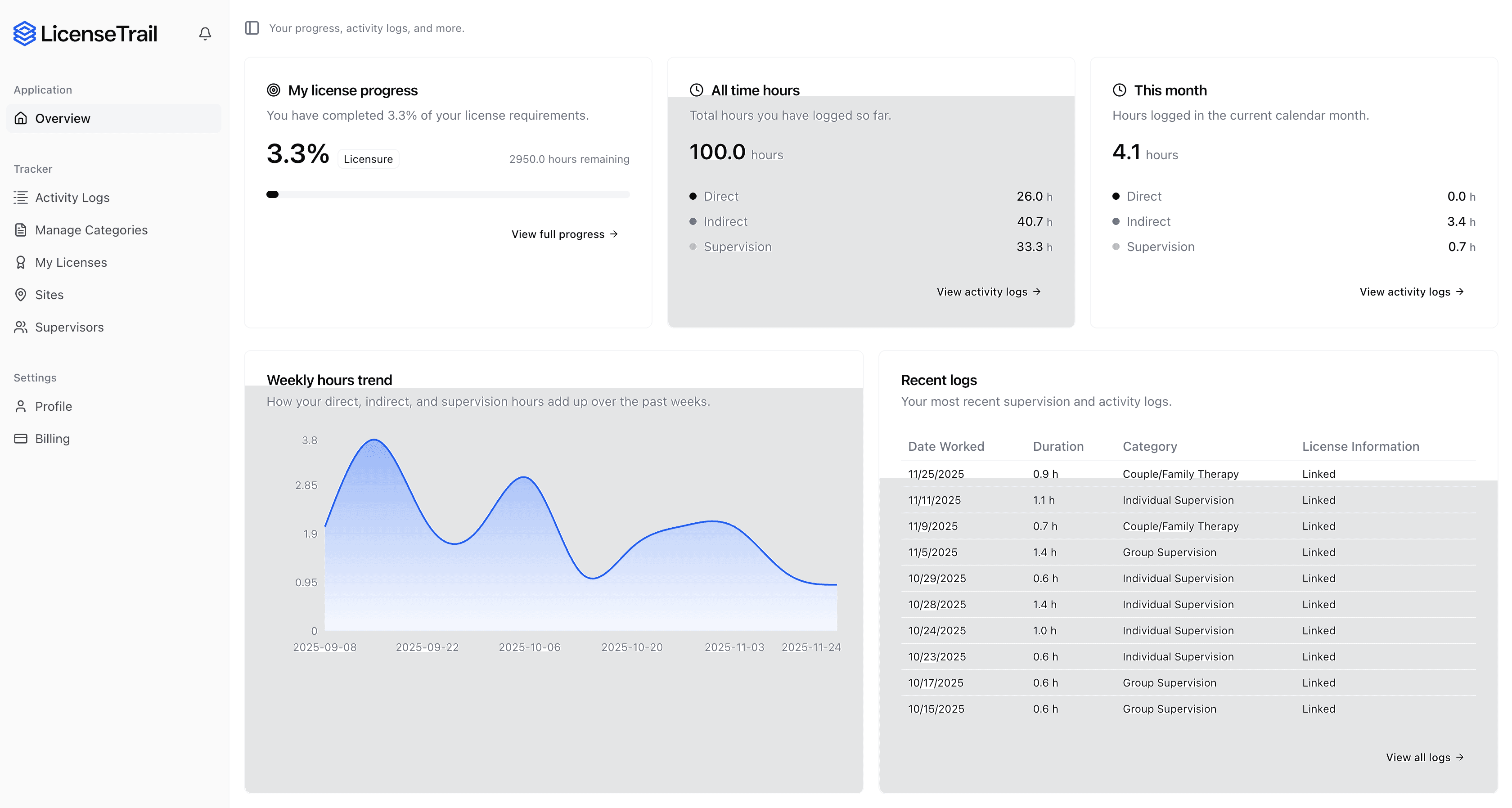
License Trail checks your direct, indirect, and supervision hours against Tennessee LPC requirements continuously and flags mismatches before you submit.
 Start Tracking for Free
No credit card required · Free plan available
Is your spreadsheet hiding Tennessee LPC risks?
Stop guessing if your categories match Tennessee Board for Professional Counselors, Marital and Family Therapists, and Clinical Pastoral Therapists requirements. License Trail checks your direct, indirect, and supervision hours continuously and flags mismatches before you submit.
Import or log
Bring your spreadsheet or start fresh
Upload your existing tracking spreadsheet and we'll map every hour into the right Tennessee Board for Professional Counselors, Marital and Family Therapists, and Clinical Pastoral Therapists categories automatically.
Verify against Tennessee
Catch mismatches before the board does
License Trail checks your direct, indirect, and supervision hours against Tennessee LPC requirements continuously.
Export board-ready
One-click clean reports
Generate professional, board-ready reports for supervision meetings and Tennessee Board for Professional Counselors, Marital and Family Therapists, and Clinical Pastoral Therapists submissions in seconds.
No credit card required · Free plan available