
Utah CPR Requirements: Hours, Exams & Step-by-Step Guide
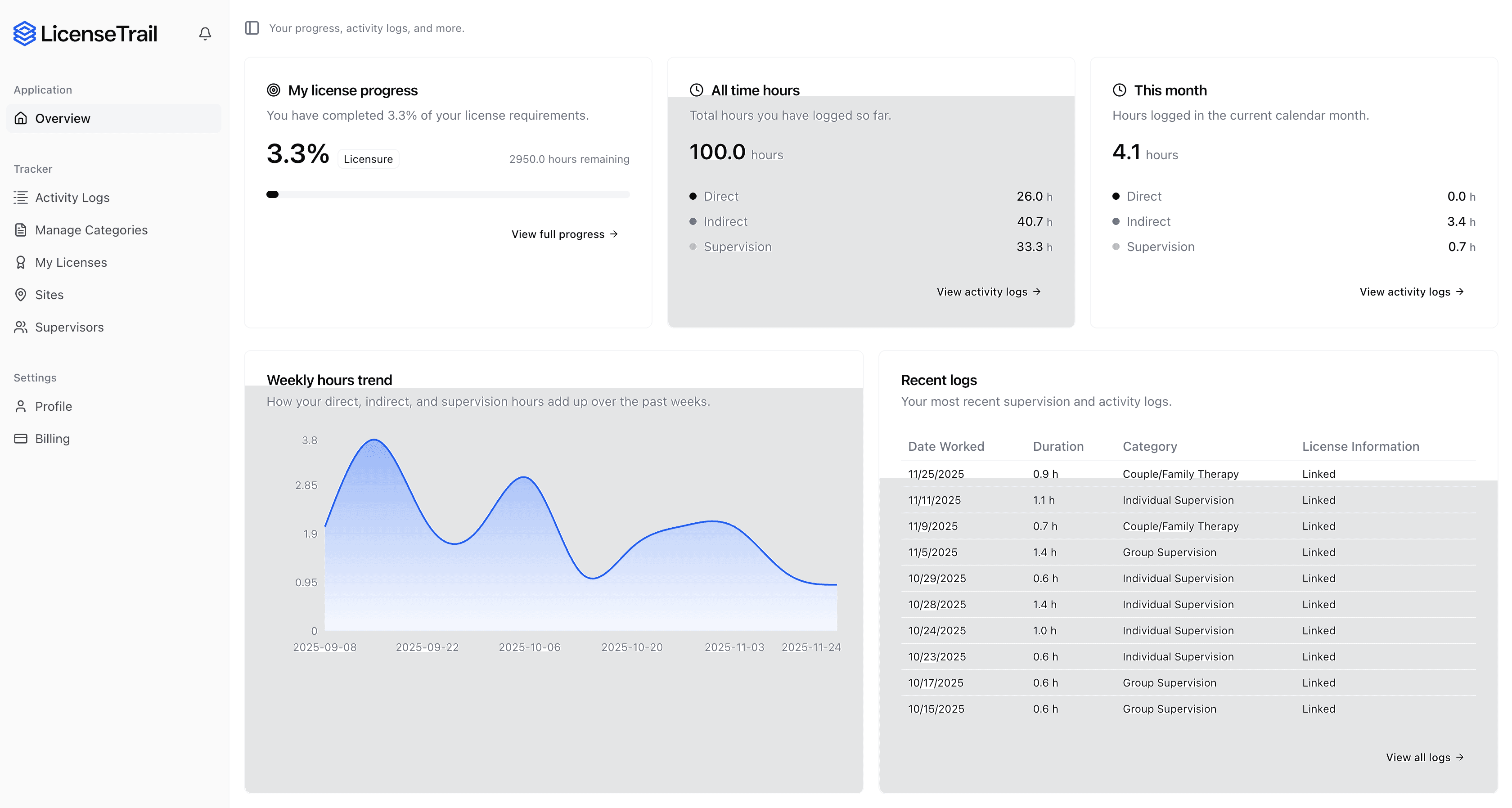
Stop guessing if your categories match Utah requirements. License Trail checks your direct, indirect, and supervision hours against CPR requirements continuously and flags mismatches before you submit.
No credit card required · Free plan available
Quick Requirements Overview
- CPR required to engage in Utah postdoctoral supervised residency hours that count toward psychologist licensure (predoctoral practicum/internship typically not).
- Prereq education: qualifying doctoral degree in psychology (per Utah rule/standards); submit official transcripts.
- Application items: DOPL application + fees + criminal background check/fingerprints; Board interview possible if requested.
- Experience tied to CPR: licensure requires 4,000 hours of approved supervised “psychology training,” completed within 4 years post‑doctorate (extensions possible).
- Mental health therapy authority: within the 4,000, need 1,000 hours supervised mental health therapy (post‑master’s), with ≥1 hour direct supervision per 40 hours.
- Supervision minimums: predoctoral 1:20; postdoctoral (CPR) 1:40; supervision must be by an approved psychologist supervisor.
- Weekly caps: training program max 40 hrs/week full‑time or 20 hrs/week part‑time.
- CPR duration/maintenance: temporary—after minimum training, may extend up to 1 year (never > 2 years past training completion) while progressing to licensure; 24 CE hours per 2‑year cycle for renewal.
License Details
Procedures
Utah’s Certified Psychology Resident (often abbreviated “CPR”) credential is the temporary license status the Utah Division of Occupational and Professional Licensing (DOPL) uses for psychologists who are in a postdoctoral residency and still completing the supervised training required for full psychologist licensure.
Under Utah law, you must hold this certification in order to engage in a residency program of supervised clinical training that counts toward psychologist licensure. (law.justia.com)
Below is a step‑by‑step guide, with emphasis on the hours, how they are defined, and the exact structure the Utah Psychologist Licensing Board uses.
1. Legal framework and role of the Certified Psychology Resident
Two key sets of rules govern this status:
- Utah Code Title 58, Chapter 61 – Psychologist Licensing Act, particularly:
- §58‑61‑301 (Licensure required; certifications) (law.justia.com)
- §58‑61‑304 (Qualifications for licensure by examination or endorsement) (law.justia.com)
- Utah Administrative Code R156‑61 – Psychologist Licensing Act Rule, especially:
- R156‑61‑102 (Definitions) (law.cornell.edu)
- R156‑61‑302a (Education requirements) (law.cornell.edu)
- R156‑61‑302b (Experience requirements) (regulations.justia.com)
- R156‑61‑302d & 302e (Supervisor qualifications and duties) (regulations.justia.com)
- R156‑61‑403 (Continuing education) (regulations.justia.com)
By statute, anyone engaged in a residency program of supervised clinical training necessary to meet psychologist licensing requirements “shall be certified…as a psychology resident.” (law.justia.com)
DOPL’s own licensing page labels this credential “Certified Psychology Resident License.” (dopl.utah.gov)
2. Prerequisite: qualifying doctoral education
Before you can be certified as a psychology resident, you must meet the same core education standard required for full psychologist licensure:
- Doctoral degree in psychology from a program that:
- Meets criteria set by rule (e.g., accredited or in the accreditation process with the APA Committee on Accreditation (APA‑CoA) or the Canadian Psychological Association Accreditation Panel (CPAAP), or meets specified alternative standards). (law.cornell.edu)
In statute, an applicant for licensure as a psychologist must “produce certified transcripts…verifying satisfactory completion of a doctoral degree in psychology” that meets these rule‑based criteria. This same education provision is incorporated by reference for psychology residents. (law.justia.com)
3. Core statutory requirements to be certified as a psychology resident
3.1 Which pieces of the psychologist requirements apply?
Utah Code §58‑61‑304(3)(a) states:
An applicant for certification as a psychology resident shall comply with the provisions of Subsections (1)(a), (b), (c), (g), and (h). (law.justia.com)
Those subsections require you to:
- Submit an application on a form provided by the division. (law.justia.com)
- Pay the required fee. (law.justia.com)
- Provide transcripts documenting the qualifying doctoral degree in psychology. (law.justia.com)
- Consent to a criminal background check under §58‑61‑304.1. (law.justia.com)
- Meet with the Board if requested for good cause to evaluate your qualifications. (law.justia.com)
DOPL’s online instructions for the Certified Psychology Resident license add a fingerprint submission requirement as part of the background check. (dopl.utah.gov)
3.2 When you must hold the CPR license
By law, a person must be certified as a psychology resident to engage in the residency program of supervised clinical training that counts toward psychologist licensing. (law.justia.com)
In other words:
- Predoctoral practica and internship happen while you are enrolled in the doctoral program and do not require the CPR license.
- Postdoctoral residency hours that are part of the licensing requirement must be done while you hold certified psychology resident status (unless you are still within a short “on‑the‑job training” window described later).
4. Hour requirements that relate to the CPR role
The Certified Psychology Resident credential exists to allow you to complete the experience required for full psychologist licensure. The central numeric requirements live in §58‑61‑304(1) and R156‑61‑302b.
4.1 The overall 4,000‑hour psychology training requirement
To become a licensed psychologist, an applicant must:
- “have completed a minimum of 4,000 hours of psychology training” as defined by division rule, under supervision of an approved psychologist supervisor. (law.justia.com)
The rule defines how that 4,000 hours must be structured:
-
Quantity and approval
- At least 4,000 hours of psychology training must be approved by the Division in collaboration with the Board. (regulations.justia.com)
-
Timeframe
- Those 4,000 hours must be completed “in not more than four years following the awarding of the doctoral degree,” unless the Division and Board grant an extension for extenuating circumstances. (regulations.justia.com)
-
Status while accruing hours
- The hours must be completed while you are either:
- enrolled in an approved doctoral program, or
- licensed as a certified psychology resident. (regulations.justia.com)
- The hours must be completed while you are either:
-
Supervision requirement for the 4,000 hours
- All hours must be done under an “approved psychologist supervisor” (see Section 4.4). Hours supervised by someone who does not meet that standard cannot be counted toward the 4,000. (regulations.justia.com)
-
What counts as “psychology training”
- The rule defines “psychology training” as practical training experience providing direct services in the practice of mental health therapy and psychology under supervision and clarifies that non‑clinical tasks (coursework, billing, generic teaching, etc.) do not count. (law.cornell.edu)
Implication for you as a CPR:
Every hour you want to count toward the licensing requirement must be:
- Directly related to the practice of psychology/mental health therapy, and
- Performed while in a qualifying role (doctoral student or certified psychology resident), and
- Under an approved psychologist supervisor.
There is no Utah rule that splits these 4,000 hours into, for example, “1,500 direct client hours + 1,500 supervised hours” the way some states do. Instead:
- The 4,000 is all clinical “psychology training” time, and
- Supervision has separate minimum ratios and does not itself count toward the 4,000 hours.
4.2 Additional 1,000 hours of supervised mental health therapy (within the 4,000)
If you want to be licensed as a psychologist qualified to engage in mental health therapy (i.e., to practice psychotherapy independently), Utah Code §58‑61‑304(1)(e) adds a specific subset of hours:
- You must document “not less than 1,000 hours of supervised training in mental health therapy” obtained after completion of a master’s‑level education in psychology. (law.justia.com)
- Those 1,000 hours:
- May be included as part of the 4,000 hours of psychology training in §58‑61‑304(1)(d), and
- Must be supervised so that there is at least one hour of supervision for each 40 hours of that mental health therapy training, under the direct supervision of a psychologist. (law.justia.com)
In practice, for most Certified Psychology Residents aiming at independent clinical practice:
- Total psychology training: at least 4,000 hours (predoctoral + postdoctoral combined).
- Within those 4,000 hours: at least 1,000 hours are specifically mental health therapy under the stricter supervision ratio (1:40, with “direct supervision” defined as in‑person or real‑time audio‑visual contact). (law.cornell.edu)
4.3 Supervision ratios for predoctoral and postdoctoral training
R156‑61‑302b sets minimum amounts of supervision per unit of training time:
-
During predoctoral training:
- At least 1 hour of supervision for every 20 hours of training and experience. (regulations.justia.com)
-
During postdoctoral training (this is where CPR status typically applies):
- At least 1 hour of supervision for every 40 hours of training and experience. (regulations.justia.com)
These minimums are separate from the 1:40 supervision requirement that applies specifically to the 1,000 mental health therapy hours described above. The net effect is:
- General psychology training (postdoc): minimum 1:40 supervision.
- Mental health therapy subset (1,000 hours): also 1:40, and supervision must qualify as “direct supervision” under the definition (same‑room or approved live audio‑visual). (law.cornell.edu)
4.4 Weekly hour limits and acceptable settings
The Board also limits how intense your training can be:
- Your supervised psychology training program cannot exceed:
- 40 hours per week if full‑time (internship or postdoctoral residency), or
- 20 hours per week if part‑time. (regulations.justia.com)
Training must occur as part of a “supervised psychology training program” as defined in rule, which means a structured clinical setting offering direct services under supervision (e.g., internship, postdoc residency, on‑the‑job program that meets the rule’s standards). (law.cornell.edu)
4.5 Qualifications of your supervisor
To count hours toward the 4,000, your supervisor must be an approved psychologist supervisor:
- Must be currently licensed in good standing as a psychologist in the jurisdiction where the training occurs.
- Must have practiced at least 4,000 hours as a licensed psychologist over at least two years. (regulations.justia.com)
Supervisors also have specific duties, including being professionally responsible for the supervisee’s acts, monitoring records, ensuring compliance with law and ethics, and documenting your performance and competence for DOPL. (law.cornell.edu)
Hours supervised by someone who does not meet these standards cannot be counted toward the required 4,000 hours of psychology training. (regulations.justia.com)
5. On‑the‑job training window around graduation
Utah’s rules recognize a narrow “on‑the‑job training program” option around the time you finish coursework:
- It applies to individuals who:
- Have completed all courses required for graduation in a qualifying doctoral program, and
- Are hired as employees in a public or private agency practicing psychology. (law.cornell.edu)
Key features:
- Must start immediately after completing coursework.
- Must end no later than 60 days after it begins or upon licensure, whichever comes first.
- Cannot be extended or repeated.
- Must include weekly, physically present supervision by a licensed psychologist. (law.cornell.edu)
This mechanism lets you begin accruing certain hours while your application and certification as a psychology resident are being processed, but it is time‑limited and narrowly defined.
6. Time limits on Certified Psychology Resident status
Utah tightly limits how long you can remain a psychology resident once your clinical training requirement is completed:
- Your psychology resident certification lasts only for the time needed to complete the clinical training described in §58‑61‑304(1)(d) and (e). (law.justia.com)
- After you have finished the minimum training:
- The certification may extend up to one additional year while you are preparing for and taking licensing examinations, provided you show “reasonable progress” toward licensure.
- In any case, it cannot extend more than two years past the date the minimum supervised clinical training requirement was completed. (law.justia.com)
So, once you have your 4,000 hours (including the required 1,000 mental health therapy hours if you seek that authority), the clock starts ticking; the CPR status is temporary and is meant to bridge you to full licensure, not to be a long‑term practice status.
7. Continuing education while you are a Certified Psychology Resident
To maintain (renew or reinstate) a Certified Psychology Resident license, you must meet continuing education (CE) requirements:
- During each two‑year renewal cycle (October 1 of an even‑numbered year through September 30 two years later), a certified psychology resident must complete at least 24 hours of continuing education related to professional practice. (regulations.justia.com)
This is exactly half of the 48‑hour requirement applied to fully licensed psychologists.
8. Hour requirements at a glance (Utah CPR context)
Putting the key numbers together, for someone following the standard path (doctoral program → CPR → psychologist license) as of November 23, 2025:
-
Total psychology training required for psychologist licensure
- 4,000 hours of “psychology training” (direct clinical services in psychology/mental health therapy under supervision) approved by the Division and Board. (law.justia.com)
-
Mental health therapy subset
- At least 1,000 of those 4,000 hours must be supervised mental health therapy if you want to be licensed to engage in mental health therapy.
- These 1,000 hours must be:
- Completed after a master’s‑level education in psychology, and
- Supervised at a minimum ratio of 1 hour of direct supervision per 40 hours of therapy training, under a psychologist. (law.justia.com)
-
Supervision ratios for all training hours
- Predoctoral training: at least 1 supervision hour per 20 training hours.
- Postdoctoral training (typically under CPR license): at least 1 supervision hour per 40 training hours.
- Mental health therapy subset: also 1:40, and supervision must meet the “direct supervision” standard (same room or live audio‑visual under an approved agreement). (regulations.justia.com)
-
Weekly limits and timing
- Full‑time training: up to 40 hours/week; part‑time: up to 20 hours/week.
- The 4,000 hours must be completed within 4 years after the doctoral degree (absent an approved extension). (regulations.justia.com)
-
Duration of CPR status
- Valid only while completing required clinical training plus
- Up to 1 extra year afterward (extendable up to, but not beyond, 2 years after training completion with evidence of reasonable progress toward licensure). (law.justia.com)
-
Continuing education while CPR
- 24 hours of CE every 2 years to renew. (regulations.justia.com)
9. Important nuance about “types” of hours
Utah’s Psychologist Licensing Act and rules do not divide hours into simple categories like “X direct client hours + Y supervision hours” for Certified Psychology Residents.
Instead, they:
- Define what counts as “psychology training” (direct, supervised clinical services),
- Exclude specific non‑clinical activities from counting,
- Set overall totals (4,000 hours; 1,000 therapy hours), and
- Impose supervision ratios and weekly caps rather than fixed sub‑totals by activity type. (law.cornell.edu)
If you see a breakdown such as “1,500 direct hours and 1,500 supervised hours” in other contexts, that is not Utah’s scheme. Utah cares that:
- All counted hours are clinical psychology/mental health therapy work under supervision,
- The total and the mental‑health‑therapy subset meet the numeric requirements, and
- Supervision and timing rules are satisfied.
10. Practical takeaway for becoming a Certified Psychology Resident in Utah
To become licensed as a Certified Psychology Resident (CPR) in Utah through the Psychologist Licensing Board:
- Complete a qualifying doctoral degree in psychology (meeting R156‑61‑302a education standards).
- Apply to DOPL for the Certified Psychology Resident license, including:
- Application form and fees,
- Official transcripts,
- Background check and fingerprints,
- Any additional documentation DOPL requests (e.g., supervisor/placement information). (law.justia.com)
- Enter an approved postdoctoral residency in which:
- Your work qualifies as “psychology training” (direct clinical services),
- You are supervised by an approved psychologist supervisor,
- You accumulate the hours in compliance with the ratios and weekly caps,
- You complete (within or alongside those 4,000 hours) at least 1,000 hours of supervised mental health therapy if you wish to qualify for mental health therapy authority.
- Track hours and supervision carefully so your supervisor can certify them to DOPL.
- Maintain your CPR license by meeting CE and renewal requirements while you finish hours and take the EPPP and Utah law/ethics exam.
All of these details are grounded in the current (effective 2024–2025) Utah Code and Utah Administrative Code provisions cited above.
Track your CPR hours with confidence
License Trail checks your direct, indirect, and supervision hours against Utah CPR requirements continuously and flags mismatches before you submit.
 Start Tracking for Free
No credit card required · Free plan available
Is your spreadsheet hiding Utah CPR risks?
Stop guessing if your categories match Utah Psychologist Licensing Board requirements. License Trail checks your direct, indirect, and supervision hours continuously and flags mismatches before you submit.
Import or log
Bring your spreadsheet or start fresh
Upload your existing tracking spreadsheet and we'll map every hour into the right Utah Psychologist Licensing Board categories automatically.
Verify against Utah
Catch mismatches before the board does
License Trail checks your direct, indirect, and supervision hours against Utah CPR requirements continuously.
Export board-ready
One-click clean reports
Generate professional, board-ready reports for supervision meetings and Utah Psychologist Licensing Board submissions in seconds.
No credit card required · Free plan available