
Utah PPP Requirements: Hours, Exams & Step-by-Step Guide
Stop guessing if your categories match Utah requirements. License Trail checks your direct, indirect, and supervision hours against PPP requirements continuously and flags mismatches before you submit.
No credit card required · Free plan available
Quick Requirements Overview
- Hold an active UT psychologist license in good standing (PPP is a certification attached to the psychologist license, not a separate license class)
- Psychologist licensure training: 4,000 hours supervised psychology training under an approved psychologist supervisor (with defined supervision ratios/weekly limits)
- If seeking mental health therapy authority: 1,000 hours supervised mental health therapy training (may be within the 4,000; supervision ≥ 1 hr/40 hrs)
- Doctoral program experiential minimums: 400-hour practicum (≥150 direct service; ≥20 formal supervision) and 2,000-hour internship
- Education for PPP: doctoral degree in psychology + master’s in clinical psychopharmacology meeting UT Board-approved content (CPP pathway cites ≥30 didactic credits over ≥4 semesters)
- PPP application/admin: fees, official transcripts/evidence, no pending/active discipline, criminal background check, liability insurance; Board interview if requested
- Prescribing training toward CPP (typically while holding PPP): 4,000 hours supervised prescribing-psychology clinical training over ≥2 years under a licensed physician (extra 1-year population focus if specializing)
- Renewal/CE: 48 CE hours per 2-year cycle, including ≥6 hours ethics/law (applies to PPP)
License Details
Procedures
Utah is one of the few states that authorizes specially trained psychologists to prescribe certain psychotropic medications. In Utah, this occurs in two stages:
- Provisional Prescribing Psychologist (PPP) – a provisional prescribing certification held while you complete supervised prescribing training.
- Certified Prescribing Psychologist (CPP) – the fully certified prescriber after completing all required postdoctoral prescribing hours and examinations.
A PPP is a certification attached to your psychologist license, not a separate psychologist license class. The Utah Division of Professional Licensing (DOPL) and the Utah Psychologist Licensing Board implement these requirements through Utah Code Title 58, Chapter 61, and Rule R156‑61.
Below is a structured guide to the requirements, with a focus on hour requirements and how the Board defines them.
1. Big picture: Where the “hours” live
Utah law does not set a special, stand‑alone “1,500 direct / 1,500 supervised” requirement for the PPP itself. Instead, the hour requirements you must meet on the PPP pathway are in three buckets:
-
Hours to become a licensed psychologist in Utah
- At least 4,000 hours of psychology training under supervision. (law.justia.com)
- Within this, at least 1,000 hours of supervised training in mental health therapy if you want mental‑health‑therapy authority. (law.justia.com)
- These hours include structured practicum and internship embedded in an approved doctoral program.
-
Program‑embedded practicum and internship hours (as part of the doctoral degree)
- At least 400 hours of supervised practicum, including 150 hours in direct service and 20 hours in formally scheduled supervision. (law.cornell.edu)
- At least 2,000 experience hours in an APA‑style internship (clinical, counseling, or school psychology). (law.cornell.edu)
-
Postdoctoral supervised prescribing hours (toward full prescribing certification)
- At least 4,000 hours of supervised clinical training in prescribing psychology over a minimum of two years, under the direction of a licensed physician. (law.justia.com)
- These hours are what ultimately qualify you for Certified Prescribing Psychologist; you typically accrue them while holding the PPP.
So the PPP certificate itself is largely about meeting education and licensing prerequisites so you may start (or continue) your supervised prescribing psychology training.
2. Step One: Become a licensed psychologist in Utah
You must already have “authority to engage in the practice of psychology” under Utah Code § 58‑61‑301 to qualify for PPP. (law.justia.com) In practice, that means being licensed as a psychologist.
2.1 Required supervised hours for Utah psychologist licensure
Utah Code § 58‑61‑304(1)(d) requires an applicant for psychologist licensure to:
have completed a minimum of 4,000 hours of psychology training as defined by division rule … under the supervision of a psychologist supervisor approved by the division in collaboration with the board. (law.justia.com)
Rule R156‑61‑302b explains how those 4,000 hours of psychology training must be structured. Key points: (law.cornell.edu)
-
The 4,000 hours must:
- Be completed in not more than four years after your doctoral degree (unless extended for extenuating circumstances).
- Be completed while enrolled in an approved doctoral program or licensed as a certified psychology resident.
- Occur under supervision of an approved psychologist supervisor (meeting R156‑61‑302d criteria).
- Be part of a “supervised psychology training program” that:
- Does not exceed 40 hours/week for full‑time internship or postdoc.
- Does not exceed 20 hours/week for part‑time internship or postdoc.
-
Supervision ratios for the 4,000 hours:
- At least 1 hour of supervision for every 20 hours of predoctoral training.
- At least 1 hour of supervision for every 40 hours of postdoctoral training. (regulations.justia.com)
Hours supervised by someone who is not an approved psychologist supervisor may not be counted toward the 4,000‑hour requirement. (regulations.justia.com)
2.2 Mental health therapy hours (if you want MHT authority)
If you intend to engage in mental health therapy as a psychologist (which most prescribing‑psychology pathways assume), Utah law separately requires: (law.justia.com)
- At least 1,000 hours of supervised training in mental health therapy, obtained after completion of a master’s‑level education in psychology.
- These 1,000 hours may be included within the 4,000 total psychology hours, but must be specifically documented as mental health therapy.
- Supervision ratio for these 1,000 hours: not less than one hour of supervision for each 40 hours of supervised mental health therapy training.
2.3 Practicum and internship hours embedded in the doctoral program
Rule R156‑61‑302a defines minimum experiential components for a doctoral program that will qualify you for psychologist licensure and future PPP/CPP certification. Key experiential requirements include: (law.cornell.edu)
-
Supervised practicum
- At least 400 hours total practicum experience.
- At least 150 hours of direct service experience.
- At least 20 hours of formally scheduled supervision.
-
Supervised internship
- Clinical or counseling psychology internships must include at least one full‑time calendar year or two half‑time calendar years, and at least 2,000 experience hours.
- School or counseling psychology internships have parallel minimums (1 year full‑time or two years half‑time) and 2,000 experience hours.
These practicum and internship hours generally count toward the 4,000‐hour psychology‑training requirement rather than being in addition to it.
3. Step Two: Earn a qualifying master’s in clinical psychopharmacology
To be eligible for PPP, Utah Code § 58‑61‑304(6)(c)(ii) requires you to have: (law.justia.com)
- A master’s degree in clinical psychopharmacology from an institution whose program:
- Meets “approval criteria” established by division rule, and
- Includes instruction in four core areas:
- Neuroscience, pharmacology, psychopharmacology, physiology, and pathophysiology.
- Appropriate and relevant physical and laboratory assessment.
- Basic sciences (general biology, microbiology, cell and molecular biology, human anatomy, human physiology, biochemistry, genetics).
- Any other areas of instruction the division, in collaboration with the Board, determines necessary.
For Certified Prescribing Psychologist, the statute expressly requires that this master’s include “at least 30 credit hours of didactics coursework over no less than four semesters” in clinical psychopharmacology. (law.justia.com)
Utah’s PPP subsection does not repeat the “30 credits / four semesters” language, but because both PPP and CPP draw on the same type of clinical psychopharmacology master’s and Board‑approved criteria, in practice your program will almost certainly meet this standard if it is designed for Utah prescribing psychology.
4. Step Three: Meet the Provisional Prescribing Psychologist (PPP) statutory criteria
Once you are a licensed psychologist and have completed the qualifying psychopharmacology master’s, you may apply to DOPL for the PPP certification.
4.1 Board/DOPL checklist
The DOPL PPP application page currently lists the following requirements, in plain language: (dopl.utah.gov)
- Hold a current and active psychology license in good standing.
- Hold a doctoral degree in psychology.
- Hold a master’s degree in clinical psychopharmacology.
4.2 Statutory PPP requirements
Utah Code § 58‑61‑304(6) lays out the legal requirements. An applicant for certification as a provisional prescribing psychologist must: (law.justia.com)
- Have authority to engage in the practice of psychology (i.e., be a licensed psychologist) under § 58‑61‑301.
- Pay the required fee (determined by the department).
- Demonstrate by official transcript or other official evidence that:
- You completed a doctoral degree in psychology that:
- Includes core coursework specified by division rule.
- Comes from a program that met Board approval criteria at the time you earned the degree.
- You completed a master’s degree in clinical psychopharmacology meeting Board approval criteria and including the core content areas listed above.
- You completed a doctoral degree in psychology that:
- Have no disciplinary action pending or in effect against any psychologist license or other prescribing‑related professional license.
- Consent to a criminal background check under § 58‑61‑304.1 and applicable rules.
- Commit to maintaining professional liability insurance while acting as a provisional prescribing psychologist.
- Meet with the Board, if requested, for evaluation of your qualifications.
- Satisfy any further requirements established by the division in rule.
4.3 Important point about “hours” at the PPP stage
Notice that § 58‑61‑304(6) does not assign a specific number of new clinical hours solely for obtaining the PPP certificate. By the time you qualify for PPP, you have already:
- Completed the 4,000 hours of supervised psychology training (plus 1,000 mental health‑therapy hours if applicable) that were required for your psychologist license. (law.justia.com)
- Completed the experiential components embedded in your doctoral program (e.g., 400‑hour practicum, 2,000‑hour internship). (law.cornell.edu)
The additional “prescribing‑specific” hours are tied to postdoctoral supervised clinical training in prescribing psychology, which leads to Certified Prescribing Psychologist status and are typically earned while you hold the PPP.
5. Step Four: Complete supervised prescribing psychology hours (toward full prescribing certification)
To progress from PPP to Certified Prescribing Psychologist, Utah Code § 58‑61‑304(4)(c)(iii) requires postdoctoral supervised training in prescribing psychology under a licensed physician, including: (law.justia.com)
- “not less than 4,000 hours of supervised clinical training throughout a period of at least two years”, and
- For applicants specializing in children (≤17), older adults (≥65), or individuals with comorbid medical conditions, at least one year prescribing psychotropic medications to those populations, as certified by the supervising physician.
The statute does not further subdivide these 4,000 hours into “X direct prescribing hours” versus “Y supervision hours” in the way it does for general psychology/mental‑health‑therapy training. Instead, it uses the general phrase “supervised clinical training in prescribing psychology under the direction of a licensed physician”, leaving detailed implementation to division rule and supervision agreements. (law.justia.com)
Practically, you hold the PPP certification during this 4,000‑hour postdoctoral prescribing‑psychology training period.
6. Ongoing requirement: Continuing education hours as a PPP
Once certified as a Provisional Prescribing Psychologist, you are subject to the same continuing‑education (CE) rule as other psychologists.
Rule R156‑61‑403 provides that during each two‑year renewal cycle (starting October 1 of each even‑numbered year): (law.cornell.edu)
- A psychologist, including a certified prescribing psychologist or a certified provisional prescribing psychologist, must complete at least 48 hours of continuing education.
The rule also specifies:
- At least six hours must be in ethics and law.
- There are caps on how many hours may come from self‑study, readings, or distance‑learning formats.
These CE hours are in addition to the training hours described earlier—they are about maintaining competence while you practice as a psychologist and PPP.
7. Summary of key hour requirements on the PPP pathway
Below is a consolidated view of the hour‑based requirements relevant to becoming and functioning as a Provisional Prescribing Psychologist in Utah:
| Stage / Requirement | Hours | How Utah law/Board defines them |
|---|---|---|
| Doctoral practicum (embedded in degree) | ≥ 400 hours, incl. 150 direct service and 20 hours supervision | Supervised practicum “appropriate to the practice of psychology” with specified minimum direct service and supervision. (law.cornell.edu) |
| Doctoral internship (embedded in degree) | ≥ 2,000 experience hours | Full‑time year (or two half‑time years) in an APA‑type internship in clinical, counseling, or school psychology. (law.cornell.edu) |
| Psychology training for Utah psychologist license | ≥ 4,000 hours | “A minimum of 4,000 hours of psychology training” under an approved psychologist supervisor; completed in ≤4 years post‑doctorate, within a supervised training program, with set weekly maximums and supervision ratios (1:20 pre‑doc; 1:40 post‑doc). (law.justia.com) |
| Mental health therapy training (if seeking MHT authority) | ≥ 1,000 hours supervised | “Not less than 1,000 hours of supervised training in mental health therapy” after master’s‑level education; may be part of the 4,000 hours, with at least 1 hour of supervision per 40 hours. (law.justia.com) |
| Clinical psychopharmacology master’s | Typically ≥ 30 didactic semester credits over ≥ 4 semesters | For prescribing psychologists, master’s “includes at least 30 credit hours of didactics coursework over no less than four semesters” and must cover specified core scientific and assessment domains. (law.justia.com) |
| Postdoctoral supervised prescribing psychology | ≥ 4,000 hours supervised clinical training, over ≥ 2 years | “Not less than 4,000 hours of supervised clinical training throughout a period of at least two years” in prescribing psychology under a licensed physician; additional one‑year specialty requirement for certain populations. (law.justia.com) |
| Continuing education as PPP | ≥ 48 CE hours every 2 years | A psychologist, including a certified provisional prescribing psychologist, must complete at least 48 CE hours per biennium, with specific content/distribution rules. (law.cornell.edu) |
Bottom line
To become a Provisional Prescribing Psychologist (PPP) in Utah, you do not meet a new, stand‑alone “PPP hour count.” Instead, you:
- Complete the hour‑intensive pathway to Utah psychologist licensure (including at least 4,000 hours of psychology training and, if applicable, 1,000 hours of mental‑health‑therapy training under defined supervision ratios).
- Graduate from a doctoral program and clinical psychopharmacology master’s that satisfy detailed Board approval standards, including embedded practicum and internship hours.
- Obtain your PPP certification, then
- Accrue 4,000 hours of supervised clinical training in prescribing psychology over at least two years under a physician to become a Certified Prescribing Psychologist, all while meeting ongoing CE requirements.
Those are the hour‑based requirements and core statutory/Board‑rule language that define the Utah PPP pathway as of late 2025.
Track your PPP hours with confidence
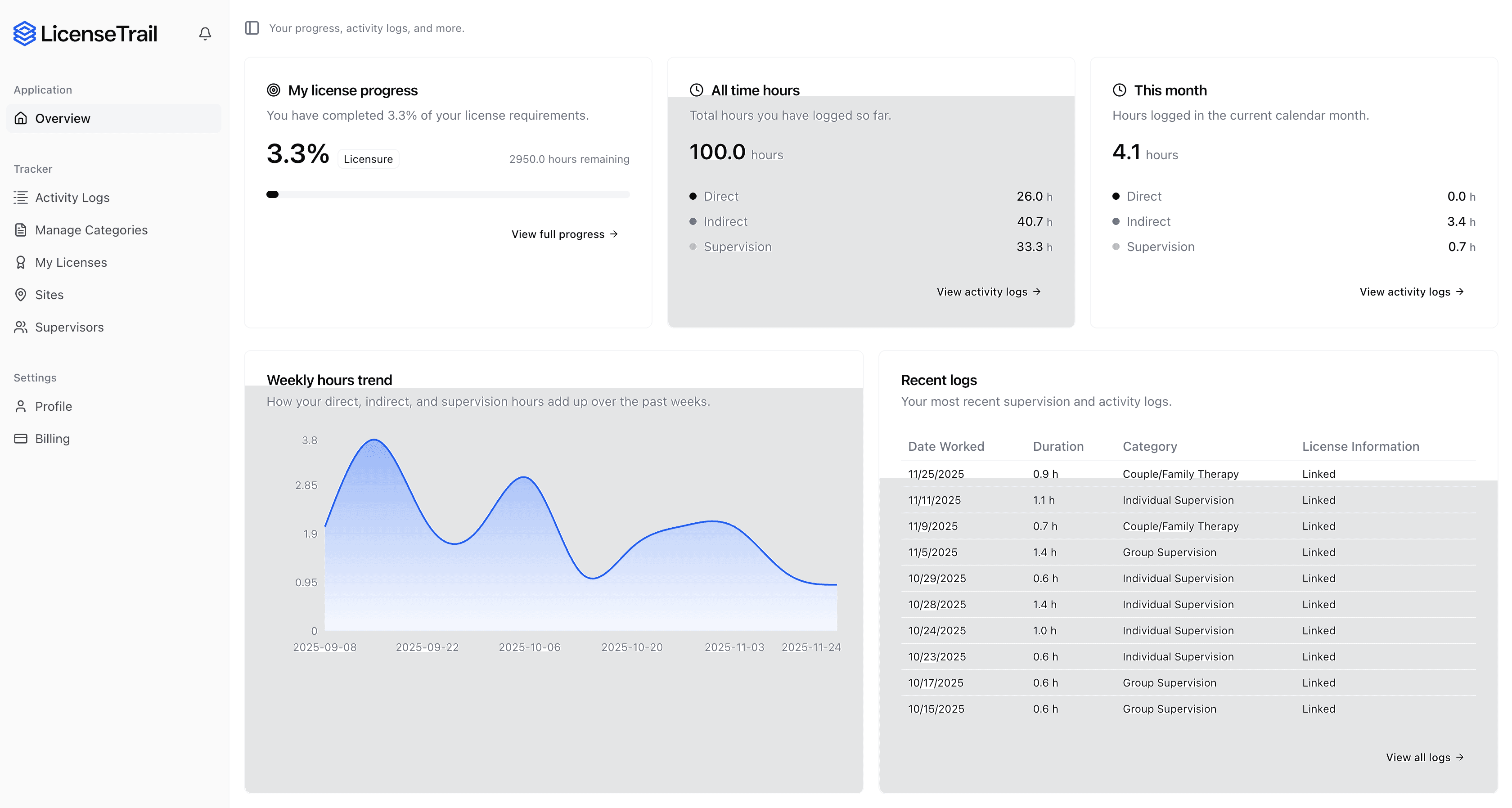
License Trail checks your direct, indirect, and supervision hours against Utah PPP requirements continuously and flags mismatches before you submit.
 Start Tracking for Free
No credit card required · Free plan available
Is your spreadsheet hiding Utah PPP risks?
Stop guessing if your categories match Utah Psychologist Licensing Board requirements. License Trail checks your direct, indirect, and supervision hours continuously and flags mismatches before you submit.
Import or log
Bring your spreadsheet or start fresh
Upload your existing tracking spreadsheet and we'll map every hour into the right Utah Psychologist Licensing Board categories automatically.
Verify against Utah
Catch mismatches before the board does
License Trail checks your direct, indirect, and supervision hours against Utah PPP requirements continuously.
Export board-ready
One-click clean reports
Generate professional, board-ready reports for supervision meetings and Utah Psychologist Licensing Board submissions in seconds.
No credit card required · Free plan available