
Virginia LCSW Requirements: Hours, Exams & Step-by-Step Guide
Stop guessing if your categories match Virginia requirements. License Trail checks your direct, indirect, and supervision hours against LCSW requirements continuously and flags mismatches before you submit.
No credit card required · Free plan available
Quick Requirements Overview
- Provided text describes West Virginia (WV) LCSW (Level C), not Virginia (VA)—can’t verify VA requirements from this source
- Education: MSW from a CSWE-accredited program
- Experience: 2 years full-time post‑MSW social work or 3,000 hours post‑MSW experience
- While earning experience: practice must be as a licensed social worker (e.g., LSW/LGSW)
- Exam: pass ASWB Advanced Generalist (Board authorization required before registering)
- Application/character: at least 18, good moral character, plus 3 non-relative references
- Restrictions: no disqualifying substance abuse; no recent/related felony/misdemeanor convictions as specified in statute
- Renewal (after licensure): 30 CE hours per 2-year cycle (per Board update)
License Details
Procedures
Licensure as a Licensed Certified Social Worker (LCSW) in West Virginia is governed by both the West Virginia Code (Chapter 30, Article 30) and the West Virginia Board of Social Work’s rules and manual. Together, they define not only the degree and exam you need, but also the exact amount and nature of post‑master’s experience required.
Below is a structured guide based strictly on that language and current board materials as of late 2025.
1. What the West Virginia LCSW License Is
West Virginia calls this credential the Level C – LCSW (Licensed Certified Social Worker), a “Certified Social Work License” issued to MSW‑prepared social workers who have completed specific post‑master’s experience and passed the ASWB Advanced Generalist examination. (wvsocialworkboard.org)
In statute, this is the “license to practice as a certified social worker” under WV Code §30‑30‑10. (code.wvlegislature.gov)
2. Core Statutory Eligibility Requirements (Summary)
Under West Virginia Code §30‑30‑10(a), to be eligible for a license to practice as a certified social worker (LCSW), an applicant must: (code.wvlegislature.gov)
- Submit an application to the Board of Social Work.
- Be at least 18 years of age.
- Be of good moral character.
- Have obtained a master’s degree in social work (MSW) from a program accredited by the Council on Social Work Education (CSWE).
- Have practiced social work for at least two years post‑master’s in full‑time employment OR earned 3,000 hours of post‑master’s social work experience (more detail below).
- Have passed an examination approved by the board – for LCSW this is the ASWB Advanced Generalist exam. (wvsocialworkboard.org)
- Provide three letters of recommendation from persons not related to the applicant, to show the applicant “merits the public trust.” (code.wvlegislature.gov)
- Not be an alcohol or drug abuser, with limited allowance for applicants in verified active recovery.
- Not have a felony conviction within five years preceding application that remains unreversed.
- Not have any misdemeanor or felony conviction related to the practice of social work that remains unreversed.
- Meet any additional requirements established by the board.
The Board’s Professional Manual restates this for the LCSW level and adds practical details around experience and applications. (wvsocialworkboard.org)
3. Post‑Master’s Experience and Hours: Exact Requirements
3.1 Board and Statutory Language
The controlling language on experience for LCSW appears in both the statute and the professional manual:
-
Statute (WV Code §30‑30‑10(a)(5)) requires that an applicant:
“Have practiced social work for at least two‑years post‑master's experience in full‑time employment or earned three thousand hours of post‑masters social work experience.” (code.wvlegislature.gov) -
The Board’s Professional Manual describes LCSW eligibility this way:
Candidates must have “practiced social work as a licensed social worker for at least two‑years post‑master's experience in full‑time employment or earned three thousand hours of post‑master’s social work experience.” (wvsocialworkboard.org)
These two sources are consistent: you must show either two full years of qualifying post‑MSW work or 3,000 hours of post‑MSW social work experience.
3.2 How the Experience Requirement Works
From the Board’s documents and statute, you can break the requirement down as follows:
-
Time / hours threshold (you must meet one of these):
- Option A – Time‑based:
At least two years of post‑master’s social work experience in full‑time employment; or - Option B – Hour‑based:
At least 3,000 hours of post‑master’s social work experience (which allows for part‑time or mixed schedules). (code.wvlegislature.gov)
- Option A – Time‑based:
-
Type of work:
The statute and manual describe this as “social work” or “post‑master’s social work experience”, without subdividing it into “direct client hours” vs “supervision hours” or specifying that it must be clinical. (code.wvlegislature.gov)- By contrast, the clinical license (LICSW) explicitly requires clinical social work and supervised direct clinical practice totaling 3,000 hours and at least 100 hours of face‑to‑face clinical supervision. (wvsocialworkboard.org)
- For the LCSW, there is no separate supervision requirement attached to the 3,000 hours. The Board’s own comparison chart lists supervision for Level C – LCSW as “N/A”. (wvsocialworkboard.org)
-
Licensure status while earning hours:
The Professional Manual specifies that candidates must have “practiced social work as a licensed social worker” while accumulating these two years or 3,000 hours, which in practice means holding a regular license (typically LSW or LGSW) during that period. (wvsocialworkboard.org)
In short: for LCSW in West Virginia, the legislatively defined experience is general post‑MSW social work practice, not clinical practice, and the Board does not split it into separate categories of “direct client contact hours” versus “supervision hours.” The key numeric standard is:
Two years of full‑time post‑MSW social work OR 3,000 hours of post‑MSW social work experience.
4. Examination Requirement
The Board’s LCSW page states that the Certified Social Work License is issued to an applicant who has an MSW, has completed two years of post‑master’s social work practice, and has passed the ASWB Advanced Generalist level state social work exam. (wvsocialworkboard.org)
The Professional Manual’s “Exam & License Levels” section reiterates this:
- Level C – LCSW requires:
- MSW from a CSWE‑accredited program
- Evidence of two years post‑MSW social work practice experience
- Passage of the ASWB Advanced Generalist examination. (wvsocialworkboard.org)
For in‑state upgrades, you request exam authorization through the Board; they must pre‑approve you before you register with ASWB. (wvsocialworkboard.org)
5. Step‑by‑Step Path to LCSW in West Virginia
Step 1 – Earn a CSWE‑Accredited MSW
You must complete a master’s degree in social work from a CSWE‑accredited program. This is explicitly required both by statute and by the Board’s LCSW description. (wvsocialworkboard.org)
Step 2 – Obtain an Initial Regular License and Begin Practice
Before you can count post‑MSW experience toward LCSW, you are expected to “practice social work as a licensed social worker” for at least two years or 3,000 hours. (wvsocialworkboard.org)
In practice, this usually means:
- After your MSW, apply for a Level B – LGSW (Licensed Graduate Social Worker) or possibly LSW, depending on your path, and pass the appropriate ASWB exam (Masters level for LGSW). (wvsocialworkboard.org)
- Work in a position that legally requires or appropriately uses social work licensure, performing duties within the scope of practice for your level of license.
During this phase you are accumulating:
- Either two years of full‑time post‑MSW employment; or
- 3,000 hours of post‑MSW social work experience (which can be full‑time or part‑time). (wvsocialworkboard.org)
Step 3 – Meet the Character, Legal, and Reference Requirements
When you are ready to apply for the LCSW level, you must be able to attest to and document the statutory character requirements:
- At least 18 years old and of good moral character.
- No disqualifying substance abuse, felony, or practice‑related convictions as specified in §30‑30‑10(a)(8)–(10). (code.wvlegislature.gov)
- Provide three professional letters of recommendation from non‑relatives, on the Board’s forms, attesting to your fitness for practice and that you “merit the public trust.” (code.wvlegislature.gov)
Step 4 – Obtain Board Authorization and Pass the ASWB Advanced Generalist Exam
Before you take the exam:
- Request exam approval from the Board (per the Professional Manual’s ASWB section). (wvsocialworkboard.org)
- After receiving authorization, register with ASWB for the Advanced Generalist level and pass the exam.
Passing scores are sent officially to the Board by ASWB; your record is updated once the Board receives them. (wvsocialworkboard.org)
Step 5 – Apply for the LCSW License (or License Level Upgrade)
Depending on your situation, you will:
-
In‑state Level Upgrade:
If you already hold a West Virginia regular license (e.g., LGSW), you use the License Level Upgrade Application. The Board notes that to upgrade, “all provisions of the higher level of license must be met – verification of degree, passage of examination, and upgrade fee are required,” and that the specific criteria are found in the Professional Manual. (wvsocialworkboard.org) -
Out‑of‑state or new regular license:
If you are coming from another state or do not yet hold a WV regular license, you use the Application for Social Work License (LSW/LGSW/LCSW), submit official transcripts, identification, references, and have any prior licenses verified as in good standing. (wvsocialworkboard.org)
In either case, you must demonstrate:
- MSW from CSWE‑accredited program
- 2 years full‑time or 3,000 hours post‑MSW social work experience
- Passing ASWB Advanced Generalist exam
- Statutory character and reference requirements
Once the Board reviews and approves your application and fee, they issue the Level C – LCSW license.
6. Supervision and Hours: LCSW vs. LICSW
The Board’s materials sometimes cause confusion because the clinical license (LICSW, Level D) has explicit hour and supervision rules that look more like “1,500 / 1,500” type breakdowns, while LCSW does not.
For clarity:
-
LCSW (Level C – Certified Social Worker)
- Experience requirement:
- Two years full‑time post‑MSW OR
- 3,000 hours post‑MSW social work experience. (wvsocialworkboard.org)
- No specific requirement that those hours be clinical, direct client, or under formal clinical supervision.
- Board’s license type chart lists “Supervision required: N/A” for this level. (wvsocialworkboard.org)
- Experience requirement:
-
LICSW (Level D – Independent Clinical Social Worker)
- Requires clinical social work practice and a total of 3,000 hours of supervised clinical practice, plus a minimum of 100 hours of face‑to‑face clinical supervision, structured by a formal supervision contract and proportional supervision ratio (about 1 hour of supervision for every 30 hours of practice). (wvsocialworkboard.org)
When you are only pursuing LCSW, you are working toward the general social work practice requirement (2 years or 3,000 hours), not the more stringent supervised clinical hour requirements reserved for the LICSW.
7. After Licensure: Renewal and Continuing Education (Briefly)
Once you hold the LCSW license, it is issued for a two‑year period. The Professional Manual historically referenced 40 CE hours, but the Board updated this requirement:
- Effective July 1, 2022, all regular licensees (LSW, LGSW, LCSW, LICSW) must earn 30 hours of Board‑approved continuing social work education every two‑year licensing period. (wvsocialworkboard.org)
This CE requirement applies to maintaining your LCSW, but it is not part of the initial qualification beyond the first licensing cycle.
8. Key Takeaways for Planning Your LCSW Path in West Virginia
- The degree requirement is clear: MSW from a CSWE‑accredited program.
- The experience requirement is quantified as:
- 2 years full‑time post‑MSW social work practice OR 3,000 hours of post‑MSW social work experience, typically while holding a regular social work license (LSW or LGSW).
- For LCSW, West Virginia does not split these hours into “direct” vs. “supervised” categories, and does not mandate a specific count of supervision hours; supervision requirements appear only at the independent clinical (LICSW) level. (wvsocialworkboard.org)
- You must pass the ASWB Advanced Generalist exam and meet the statutory age, character, criminal‑history, and reference requirements.
- In‑state LSW/LGSW licensees use a License Level Upgrade once they have met all LCSW criteria; out‑of‑state or new applicants use the regular license application form.
Track your LCSW hours with confidence
License Trail checks your direct, indirect, and supervision hours against Virginia LCSW requirements continuously and flags mismatches before you submit.
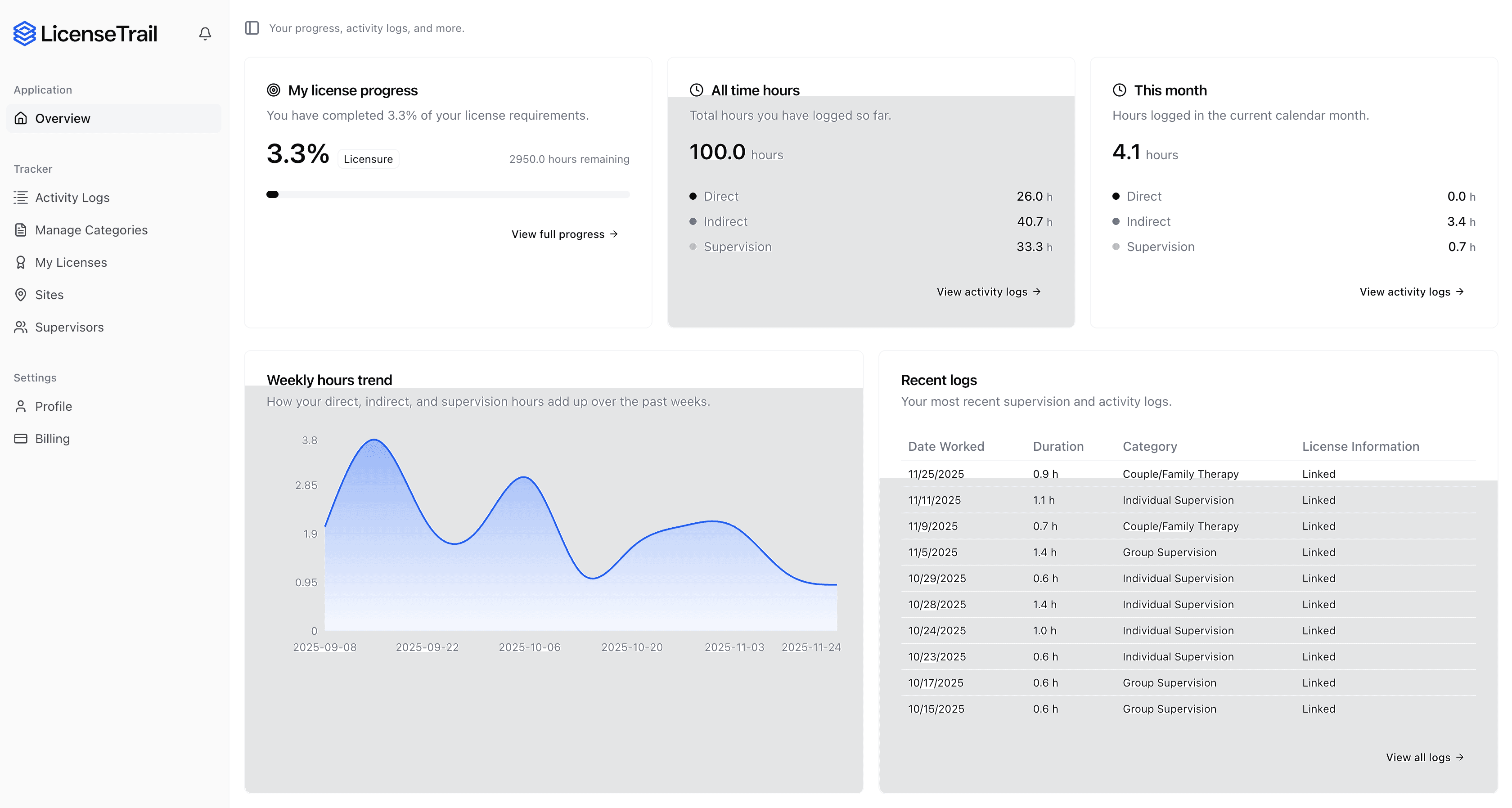 Start Tracking for Free
No credit card required · Free plan available
Is your spreadsheet hiding Virginia LCSW risks?
Stop guessing if your categories match West Virginia Board of Social Work requirements. License Trail checks your direct, indirect, and supervision hours continuously and flags mismatches before you submit.
Import or log
Bring your spreadsheet or start fresh
Upload your existing tracking spreadsheet and we'll map every hour into the right West Virginia Board of Social Work categories automatically.
Verify against Virginia
Catch mismatches before the board does
License Trail checks your direct, indirect, and supervision hours against Virginia LCSW requirements continuously.
Export board-ready
One-click clean reports
Generate professional, board-ready reports for supervision meetings and West Virginia Board of Social Work submissions in seconds.
No credit card required · Free plan available