
Virginia LGSW Requirements: Hours, Exams & Step-by-Step Guide
Stop guessing if your categories match Virginia requirements. License Trail checks your direct, indirect, and supervision hours against LGSW requirements continuously and flags mismatches before you submit.
No credit card required · Free plan available
Quick Requirements Overview
- Note: provided text describes West Virginia (WV) LGSW (Level B), not Virginia (VA)
- CSWE-accredited MSW required
- Submit Board application + fee (mail-in per Board guidance)
- Must be 18+ and meet good moral character/public trust standards
- Provide 3 non-relative letters of recommendation
- Pass ASWB “Intermediate” exam (Board-approved exam for LGSW)
- No post-grad experience or supervision hours required to obtain LGSW; clinical services only under an approved supervision contract and as an employee (plus graduate supervised clinical field placement/equivalent for clinical practice)
License Details
Procedures
In West Virginia, the Licensed Graduate Social Worker (LGSW) is the master’s‑level, post‑degree license classified by the West Virginia Board of Social Work as a “Level B – LGSW (Licensed Graduate Social Worker) License.” (wvsocialworkboard.org)
Unlike many other states and license types, West Virginia does not require a specific number of post‑graduate practice hours or supervised hours to obtain the LGSW itself. The Board states explicitly that for this level “there are no experience or supervision requirements for this level of license.” (wvsocialworkboard.org)
What follows is a structured guide to what is required and how to obtain the LGSW, with special attention to any hour‑related requirements that do exist in law or Board policy.
1. Core eligibility requirements for LGSW in West Virginia
Under West Virginia law (Chapter 30, Article 30, §30‑30‑12) and the Board’s own license description, an applicant for the LGSW must meet all of the following: (code.wvlegislature.gov)
-
Application to the Board
- You must submit a formal application for social work license (the combined LSW/LGSW/LCSW application) to the West Virginia Board of Social Work and pay the applicable fee. (wvsocialworkboard.org)
-
Age requirement
- You must be at least 18 years of age. (code.wvlegislature.gov)
-
Good moral character
- The statute requires that the applicant “be of good moral character.” (code.wvlegislature.gov)
-
Accredited MSW degree
- You must have a master’s degree in social work (MSW) from a program accredited by the Council on Social Work Education (CSWE). (wvsocialworkboard.org)
-
Pass the Board‑approved examination
- You must have passed an examination approved by the Board.
- The Board’s LGSW page specifies that this is the Association of Social Work Boards (ASWB) “Intermediate” level state social work exam. (wvsocialworkboard.org)
-
Letters of recommendation / public trust
- You must satisfy the Board that you merit public trust by providing three letters of recommendation from persons not related to you. (code.wvlegislature.gov)
-
Substance use requirement
- You may not be an alcohol or drug abuser as defined in West Virginia law; an applicant in documented active recovery may be considered at the Board’s discretion. (code.wvlegislature.gov)
-
Criminal history limits
- You must:
- Not have been convicted of a felony in any jurisdiction within five years before applying, if the conviction remains unreversed; and
- Not have been convicted of any misdemeanor or felony related to the practice of social work, if that conviction remains unreversed. (code.wvlegislature.gov)
- You must:
-
Other Board‑set requirements
- The statute also allows the Board to impose “any other requirements established by the board.” This is a catch‑all for any additional conditions added by rule (for example, fees, form requirements, or updated procedures). (code.wvlegislature.gov)
-
If licensed in another state
- If you are or have ever been licensed as a social worker in another state, the Board requires verification of licensure in good standing from the other State Social Work Board(s). (wvsocialworkboard.org)
2. Experience and supervision requirements: what is (and isn’t) required for LGSW
2.1. Post‑degree practice hours for LGSW
For the LGSW itself, the West Virginia Board of Social Work is very clear:
- The LGSW page states that “There are no experience or supervision requirements for this level of license.” (wvsocialworkboard.org)
That means:
- No minimum number of post‑MSW practice hours is required.
- No minimum number of supervised hours is required.
- The Board does not set a split such as “1,500 hours of direct experience and 1,500 hours of supervised experience” to obtain the LGSW.
In other words, once you have a CSWE‑accredited MSW and meet the statutory and examination requirements, you can qualify for the LGSW without accumulating specified post‑graduate practice hours.
2.2. Graduate field placement / clinical training
While there are no post‑license hour requirements for obtaining the LGSW, West Virginia law does reference graduate‑level clinical training when an LGSW wants to practice clinical social work under supervision.
Section 30‑30‑12(b) provides that a licensed graduate social worker may engage in clinical social work only if they have, among other things: (code.wvlegislature.gov)
- Completed a supervised clinical field placement at the graduate level, or
- Completed post‑master’s clinical training that the Board finds equivalent.
The law does not specify a particular number of hours for this field placement or clinical training; those hours are typically determined by your MSW program and CSWE standards, not by the Board as a licensing condition. The key point is that some formal, supervised clinical training at the graduate level is required if you want to do clinical work as an LGSW under supervision, but it is not quantified in state statute as “X hours.”
2.3. Clinical supervision after you are licensed (for actual clinical practice)
Once licensed as an LGSW, you may perform clinical or psychotherapeutic services, but only: (wvsocialworkboard.org)
- Under the clinical supervision of another experienced and credentialed behavioral health professional (typically a Licensed Independent Clinical Social Worker (LICSW) or other Board‑approved professional), and
- Only after entering into a written contract in which that supervisor assumes responsibility for and supervises your practice, and
- While employed by an institution or organization in which you have no direct or indirect interest other than employment (i.e., not in private practice).
These provisions govern permission to practice clinical social work as an LGSW, not the issuance of the LGSW license itself. The detailed numerical hours (for example the 3,000 hours of practice and 100 hours of face‑to‑face supervision required for the independent clinical license, LICSW) appear elsewhere in Board materials and apply at the LICSW stage, not at the initial LGSW stage. (code.wvlegislature.gov)
3. Step‑by‑step path to LGSW licensure in West Virginia
Step 1 – Complete a CSWE‑accredited MSW
- Enroll in and graduate from an MSW program accredited by CSWE.
- If you plan to do clinical work later, choose a concentration and field placements that meet clinical training expectations, as West Virginia law references a supervised clinical field placement for clinical practice eligibility as an LGSW. (wvsocialworkboard.org)
Step 2 – Prepare for and take the ASWB “Intermediate” exam
- Register for the ASWB Intermediate level exam designated by the West Virginia Board for the LGSW. (wvsocialworkboard.org)
- Students in West Virginia are allowed by policy (e.g., at WVU) to sit for this exam in their final semester of the MSW program, but the LGSW license will not be issued until after the degree is officially awarded and an official transcript is sent to the Board. (socialwork.wvu.edu)
Step 3 – Consider a temporary permit if you have not yet passed the exam
- If you have not yet taken and passed the ASWB exam, the Board directs you to apply for a Temporary Permit instead of the regular license while you complete the exam requirement. (wvsocialworkboard.org)
- The temporary permit is separate from the LGSW and has its own eligibility and supervision framework.
Step 4 – Gather required documentation
For the LGSW application, you will typically need:
- Completed application form for the LSW/LGSW/LCSW license. (wvsocialworkboard.org)
- Official MSW transcript sent directly from your school, showing the degree awarded. (socialwork.wvu.edu)
- Three letters of recommendation from non‑relatives, as required by §30‑30‑12(a)(6). (code.wvlegislature.gov)
- Verification of licensure in good standing from any other state(s) where you are or have been licensed, if applicable. (wvsocialworkboard.org)
- Any other documentation the Board may require under its rules (e.g., information related to criminal background, substance use or other character‑related issues). (code.wvlegislature.gov)
Step 5 – Submit application and fee
- The Board emphasizes that completed applications must be mailed (not faxed or emailed) to its office, because the forms contain personally identifiable information. (wvsocialworkboard.org)
- Include the required fee as listed in the Board’s current fee schedule.
Step 6 – Board review and license issuance
- The Board reviews your application for compliance with statutory requirements (§30‑30‑12) and its own rules. (code.wvlegislature.gov)
- If approved, you are issued the Level B – LGSW license. At this point:
- You are a licensed graduate social worker.
- You can perform all duties within the scope of practice of a licensed social worker and provisional social worker.
- You may also engage in clinical or psychotherapeutic services only under approved clinical supervision and within the contractual and employment conditions described earlier. (wvsocialworkboard.org)
4. Summary of hour‑related rules specific to LGSW
Putting all of this together, in the exact terms that matter for hours:
-
Hours required to obtain the LGSW license itself
- None. The Board explicitly states that for Level B – LGSW, “There are no experience or supervision requirements for this level of license.” (wvsocialworkboard.org)
-
Graduate clinical training prerequisite (for clinical practice as an LGSW)
- The law requires that a licensed graduate social worker who wishes to practice clinical social work must have completed a supervised clinical field placement at the graduate level, or equivalent post‑master’s clinical training.
- The statute does not state a specific number of hours for that placement or training; it is tied to your MSW curriculum rather than a Board‑set numeric benchmark. (code.wvlegislature.gov)
-
Supervised practice hours for later independent clinical licensure (LICSW)
- These do not apply to the initial LGSW license, but are often completed while holding an LGSW or LCSW.
- For the LICSW, West Virginia requires:
- 3,000 hours of practice in at least two years of employment, with
- At least 100 hours of face‑to‑face supervision. (wvsocialworkboard.org)
They are relevant to your long‑term career plan but are not prerequisites for becoming an LGSW.
5. Practical implications for someone planning to become an LGSW
- If your question is whether West Virginia expects something like “1,500 hours direct experience + 1,500 hours supervised experience” before issuing an LGSW, the answer is no. The state does not impose any numeric experience or supervision hour requirement at that stage; the key gatekeepers are your CSWE‑accredited MSW, ASWB Intermediate exam, and the statutory character and recommendation requirements. (wvsocialworkboard.org)
- Your MSW field practicum will involve supervised hours, but those are governed by your university and CSWE, not quantified in Board rules for the LGSW license.
- Once licensed as an LGSW, any clinical work you perform must occur under an approved clinical supervision contract and as an employee of an agency or institution, not as an independent practitioner. (code.wvlegislature.gov)
This structure—no post‑graduate hours to obtain LGSW, with hours coming later for advanced clinical licensure—is specific to West Virginia’s current Board rules and statutes as of late 2025.
Track your LGSW hours with confidence
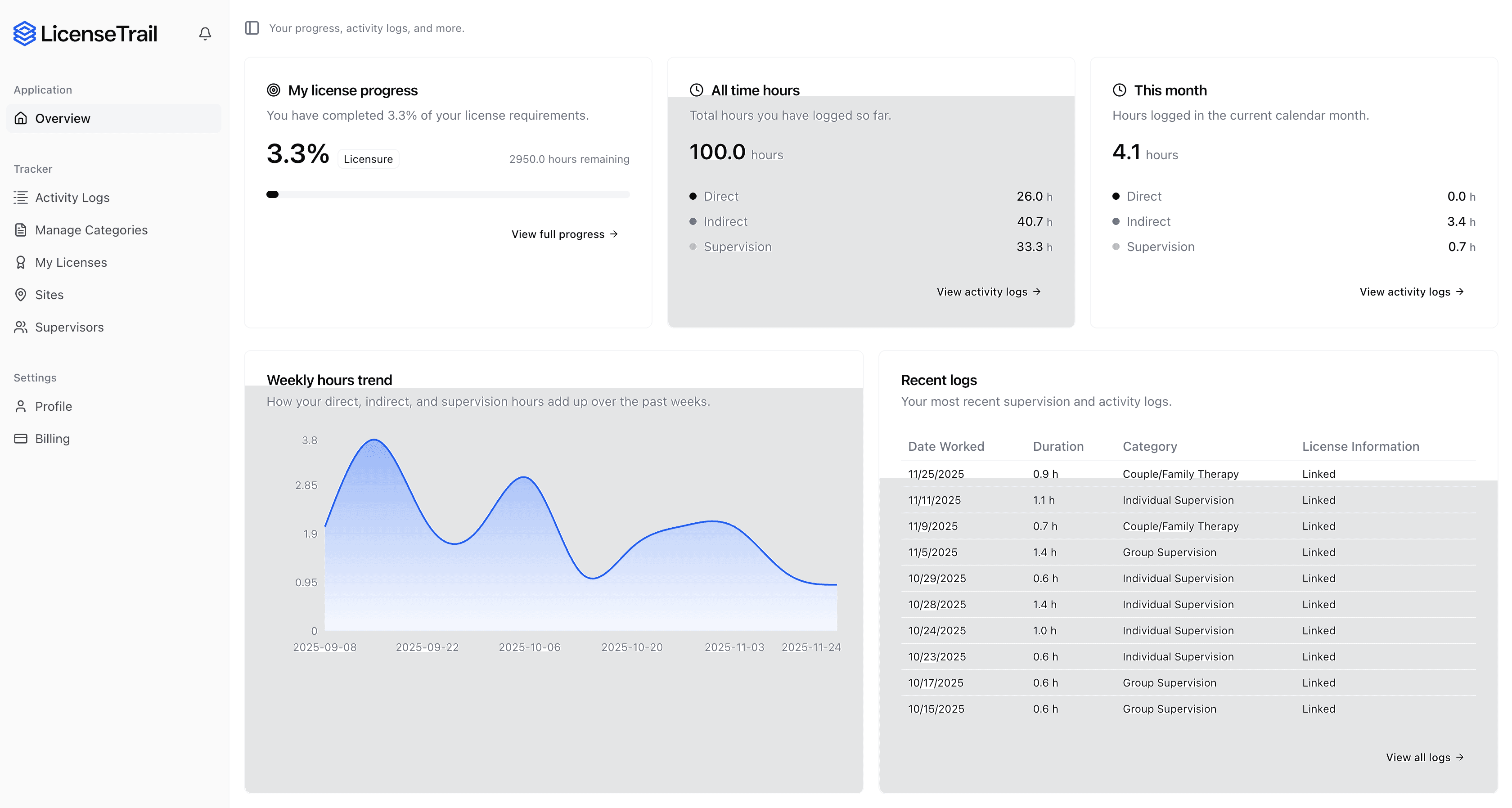
License Trail checks your direct, indirect, and supervision hours against Virginia LGSW requirements continuously and flags mismatches before you submit.
 Start Tracking for Free
No credit card required · Free plan available
Is your spreadsheet hiding Virginia LGSW risks?
Stop guessing if your categories match West Virginia Board of Social Work requirements. License Trail checks your direct, indirect, and supervision hours continuously and flags mismatches before you submit.
Import or log
Bring your spreadsheet or start fresh
Upload your existing tracking spreadsheet and we'll map every hour into the right West Virginia Board of Social Work categories automatically.
Verify against Virginia
Catch mismatches before the board does
License Trail checks your direct, indirect, and supervision hours against Virginia LGSW requirements continuously.
Export board-ready
One-click clean reports
Generate professional, board-ready reports for supervision meetings and West Virginia Board of Social Work submissions in seconds.
No credit card required · Free plan available