
Virginia Provisional Requirements: Hours, Exams & Step-by-Step Guide
Stop guessing if your categories match Virginia requirements. License Trail checks your direct, indirect, and supervision hours against Provisional requirements continuously and flags mismatches before you submit.
No credit card required · Free plan available
Quick Requirements Overview
- Text provided describes West Virginia (WV) provisional/conditional-restricted license (not Virginia, VA); VA requirements not stated here
- Restricted certificate: no independent practice/fee-for-service/contracting; cannot use LSW/LGSW/LCSW/LICSW initials
- Eligibility: age 18+; related bachelor’s (or MSW enrollment exception); 3 non-relative references; character/background limits (recent felony, practice-related convictions, substance abuse)
- Must have regular, full-time supervised employment in a critical workforce shortage setting; employer must show attempt to recruit fully licensed SW and need to hire provisional
- Supervision: Board-approved SW supervisor; face-to-face at least quarterly; annual sworn reports; supervisor caseload limits (generally max 15)
- No hour-count requirement; conversion based on 4 years continuous supervised employment (with possible Board-approved interruptions)
- During provisional period: 12 credits (4 core SW courses) from CSWE-accredited program + 20 CE hours/2 years (max 10 online)
- To convert to regular LSW: ASWB Bachelor’s exam + employer letters verifying 4 years + transcript/CE documentation; license issued 2 years, renewable once (max 4 years)
License Details
Procedures
West Virginia’s Provisional License, Conditional/Restricted, is a special pathway that lets people with a related bachelor’s degree (but not a BSW/MSW) work as social workers in tightly supervised, high‑need settings. It is explicitly defined in rule as a “restricted license certificate” and is treated by the Board as its own “type” of license separate from regular, temporary, and telehealth licenses. (wvsocialworkboard.org)
Unlike many states, West Virginia does not base this license on a fixed number of direct-practice or supervision hours (for example, 1,500 clinical hours). Instead, the Board and statute use time‑based employment plus education and continuing education requirements, with quarterly supervision and a four‑year supervised employment period.
Below is a step‑by‑step guide grounded in the exact statute and Board rules.
1. What this license allows (and why it’s “conditional/restricted”)
By law, a “provisional license” is a restricted social work license issued under alternative education/training provisions in §30‑30‑16. The rules make clear that:
- A provisional social worker is not a licensed social worker and may not use initials such as LSW, LGSW, LCSW, or LICSW. (law.cornell.edu)
- The Board further explains that a provisional social worker may not contract, operate a business, join a practice, perform fee‑for‑service work, or otherwise act as an independent practitioner. (wvsocialworkboard.org)
The scope of practice is limited to eight categories of supervised services such as assessment (without formal mental health diagnosis), service planning, implementing service plans, supportive (non‑psychotherapy) counseling, prevention/psychoeducation, case management, information and referral, and assessing one’s own practice. (code.wvlegislature.gov)
2. Baseline eligibility to pursue a Provisional License
2.1 Statutory eligibility (WV Code §30‑30‑16(a))
To be eligible under state law, you must: (code.wvlegislature.gov)
- Submit an application to the Board.
- Be at least 18 years of age.
- Have a baccalaureate degree in a related field, as defined by Board rule (see below).
- Have regular supervised employment (or a written promise of such employment contingent on licensure) in a “critical social work workforce shortage” position, area, or setting that requires a social work license, and not be working as:
- An independent practitioner,
- A contracted employee,
- A sole proprietor,
- A consultant, or
- Any other form of “nonregular” employment.
- Provide three letters of recommendation from people who are not related to you, to show that you merit the public trust.
- Not be an alcohol or drug abuser, as defined in §27‑1A‑11 (with some allowance, at the Board’s discretion, for applicants in active recovery).
- Not have an unreversed felony conviction within five years before application.
- Not have an unreversed misdemeanor or felony conviction related to the practice of social work.
- Meet any additional Board requirements.
2.2 “Related degree” requirement
The Board’s rules and website give more detail about what counts as a “related” bachelor’s degree: (regulations.justia.com)
- Your degree must be a four‑year academic degree from an accredited college in a related field.
- Examples the Board specifically recognizes include: Psychology, Sociology, Counseling, Criminal Justice, and certain Human Services/Behavioral Science/RBA degrees, as well as other degrees the Board deems related.
- Individuals with non‑related degrees may still qualify if they are currently enrolled in an MSW program accredited by CSWE and provide appropriate enrollment documentation.
3. Employment and supervision structure
3.1 Type of job you must have
Before the Board will issue a provisional license, you must secure qualifying employment: (regulations.justia.com)
- The job must be “regular supervised employment” in a critical social work workforce shortage setting that requires a social work license.
- Under Board rule, you must provide evidence of full‑time social work employment under a provisional license supervisor as part of the Provisional License Agreement before issuance of the license.
- The employer must apply to the Board to be approved to hire provisional licensees and must document:
- That it first tried to recruit a fully licensed social worker (LSW, LGSW, LCSW, LICSW), and
- That there is a critical need to hire a provisional licensee. (regulations.justia.com)
Note: The rules use the term “full‑time social work employment” but do not define it numerically (for example, they do not say “40 hours per week”). If your position is less than a traditional full‑time FTE, you should confirm directly with the Board how it will be treated.
3.2 Who can supervise you
The provisional licensing supervisor must: (law.cornell.edu)
- Be a licensed social worker, licensed graduate social worker, licensed certified social worker, or licensed independent clinical social worker in good standing in West Virginia.
- Have a BSW or MSW from a CSWE‑accredited program and two years of post‑graduate social work experience.
- Apply to and be approved by the Board as a provisional supervisor, providing:
- A résumé showing at least two years of continuous employment in social work,
- Three professional recommendation letters,
- Confirmation of good moral character and no disciplinary history, plus any other documentation the Board requires.
- Provide at least one face‑to‑face supervision session every three months with you and report annually to the Board on your performance.
Supervisors are limited in how many provisional licensees they can oversee at once (generally no more than 15, and newly approved LSW‑level supervisors are initially limited to 5), unless the Board grants a written waiver. (regulations.justia.com)
4. Application sequence
The Board’s published process breaks into two main stages. (wvsocialworkboard.org)
Step 1 – Eligibility Application
- You first request and submit a Provisional License Eligibility Application to the Board.
- With that application you must provide:
- An official transcript showing your four‑year degree in a related field, and
- Documentation that you meet the requirements in WV Code §30‑30‑16 (age, character, etc.).
The Board reviews this and decides if you are eligible to pursue a provisional license. An eligibility letter is not a license, but it confirms for employers that you may be licensed provisionally if hired.
Step 2 – Provisional License Agreement and issuance
Once you have an eligible job offer:
- You and your employer identify a Board‑approved provisional licensing supervisor.
- You submit a Provisional License Agreement (on the Board’s form), documenting:
- The supervisor,
- The employer,
- That the position is full‑time social work employment in an approved shortage setting.
- The Board receives written evidence of qualified supervision and employment, approves the agreement, and then sends an invoice for the provisional license certificate.
- After fee payment and approval, the Board issues your Provisional License.
The license is initially issued for two years and, if all conditions are met, can be renewed once for a final two‑year period, for a maximum of four years in provisional status. (regulations.justia.com)
5. Time‑and‑education requirements during the provisional period
5.1 Four years of continuous supervised employment (not a set hour count)
To convert your provisional license into a full Licensed Social Worker (LSW) license, state law requires that you: (code.wvlegislature.gov)
- Be continuously employed for four years as a social worker and supervised.
- If you lose your job because of a reduction in force or have medical issues, you may ask the Board for a reasonable interruption and extra time to finish the requirements.
Crucially, neither the statute nor the Board’s provisional‑license rules assign a specific number of practice hours (e.g., “1,500 client contact hours” or “100 supervision hours”) for provisional licensees. The legally controlling requirement is continuous, supervised employment for four years, not a particular cumulative hour total.
The only explicit practice/supervision hour figures in these rules appear in a different context—clinical supervision for independent clinical social workers (LICSW) seeking approval as clinical supervisors (3,000 hours of employment and 100 hours of clinical supervision)—and do not apply to the provisional (conditional/restricted) license. (regulations.justia.com)
5.2 Core social work coursework (12 credit hours / four classes)
Within the four‑year provisional period, you must complete: (code.wvlegislature.gov)
- Twelve (12) credit hours of “core” social work study from a CSWE‑accredited social work program.
- The Board’s website describes this as four core classes in social work.
- These must be post‑bachelor’s courses taken “in conjunction with the school.”
- Successful completion means you must receive a passing grade.
- Exceptions: If you are enrolled in an accredited BSW or MSW program, that enrollment can satisfy or alter the core‑course requirement under the Board’s exception rule.
The Board expects you to enroll in the required coursework within six months of licensure and to have evidence of coursework at the two‑year renewal mark. (wvsocialworkboard.org)
5.3 Continuing education “hours”
The provisional license carries its own continuing education (CE) requirement: (regulations.justia.com)
- You must earn twenty (20) hours of Board‑approved social work continuing education every two years.
- Up to ten (10) of the twenty CE hours may be online (Board‑approved); provisional license CE may not be entirely independent study according to the Board’s website.
- You must provide a sworn annual statement to the Board confirming you are:
- Meeting all requirements for maintaining the provisional license,
- Completing the required continuing education,
- Attending quarterly face‑to‑face supervision sessions, and
- Taking the required core social work courses (with transcript documentation).
5.4 Supervision meetings
Board rule specifies that your supervisor must: (regulations.justia.com)
- Hold at least one face‑to‑face supervision session every three months after your provisional license is issued.
- Provide an annual sworn statement to the Board:
- Confirming that these quarterly sessions occurred, and
- Stating whether you have satisfactorily performed social work duties under supervision.
Again, the rules do not convert this into a specific number of supervision hours (for example, “one hour every 30 hours of practice”) for provisional licenses. The “one hour per 30 hours” ratio in the rules applies to clinical supervision for advanced clinical licensure, not to provisional social workers. (regulations.justia.com)
6. Documentation needed to convert to a regular LSW
When you have completed the provisional period and are ready to become a Licensed Social Worker (Level A – LSW), you must provide final documentation that you have met all requirements in §30‑30‑16 and Rule 25‑1‑3. Specifically, before conversion, you must show: (regulations.justia.com)
-
Passing an examination approved by the Board
- This is the ASWB Bachelor’s (BSW‑level) exam, as reflected in the Board’s LSW information.
-
Four years of continuous, supervised employment
- Documented via official letters from all employers during your provisional license tenure, confirming four years of continuous supervised social work employment.
-
Completion of 12 credit hours of core social work courses
- Verified with an official college transcript showing attendance and passing grades in at least twelve hours of core social work classes at a CSWE‑accredited program (or satisfaction of the requirement via an approved BSW/MSW program path, where applicable).
-
Continuing education
- Documentation that you have completed at least twenty (20) hours of social work continuing education every two years while provisionally licensed.
-
Ongoing compliance
- The Board may also rely on your annual sworn statements and your supervisor’s annual statements confirming satisfactory performance and required supervision throughout the four‑year period.
Once these are verified, the Board may convert your Provisional License, Conditional/Restricted into a Regular Level A – LSW license, lifting the provisional restrictions and allowing you to practice as a fully licensed social worker (subject to the usual LSW scope of practice and supervision standards).
7. Summary of “hours” and time requirements
Putting the numeric pieces together for the Provisional (Conditional/Restricted) license in West Virginia:
-
Practice hours:
- The Board and statute do not specify any minimum number of direct client or supervised practice hours (e.g., “1,500 hours of direct experience”).
- Instead, they require four years of continuous supervised employment in full‑time social work with an approved employer and supervisor.
-
Supervision meetings:
- At least one face‑to‑face supervision session every three months (quarterly), documented annually by your supervisor.
- No total supervision‑hour minimum is specified for provisional licensees.
-
Coursework:
- 12 credit hours (typically four courses) of core social work study in a CSWE‑accredited program during the four‑year period.
-
Continuing education:
- 20 CE hours every two years in Board‑approved social work education; up to 10 of those hours may be online.
Those are the controlling “hours” and time‑based requirements imposed by the West Virginia Board of Social Work for its Provisional License, Conditional/Restricted—and they intentionally differ from the hour‑based schemes used in many other states.
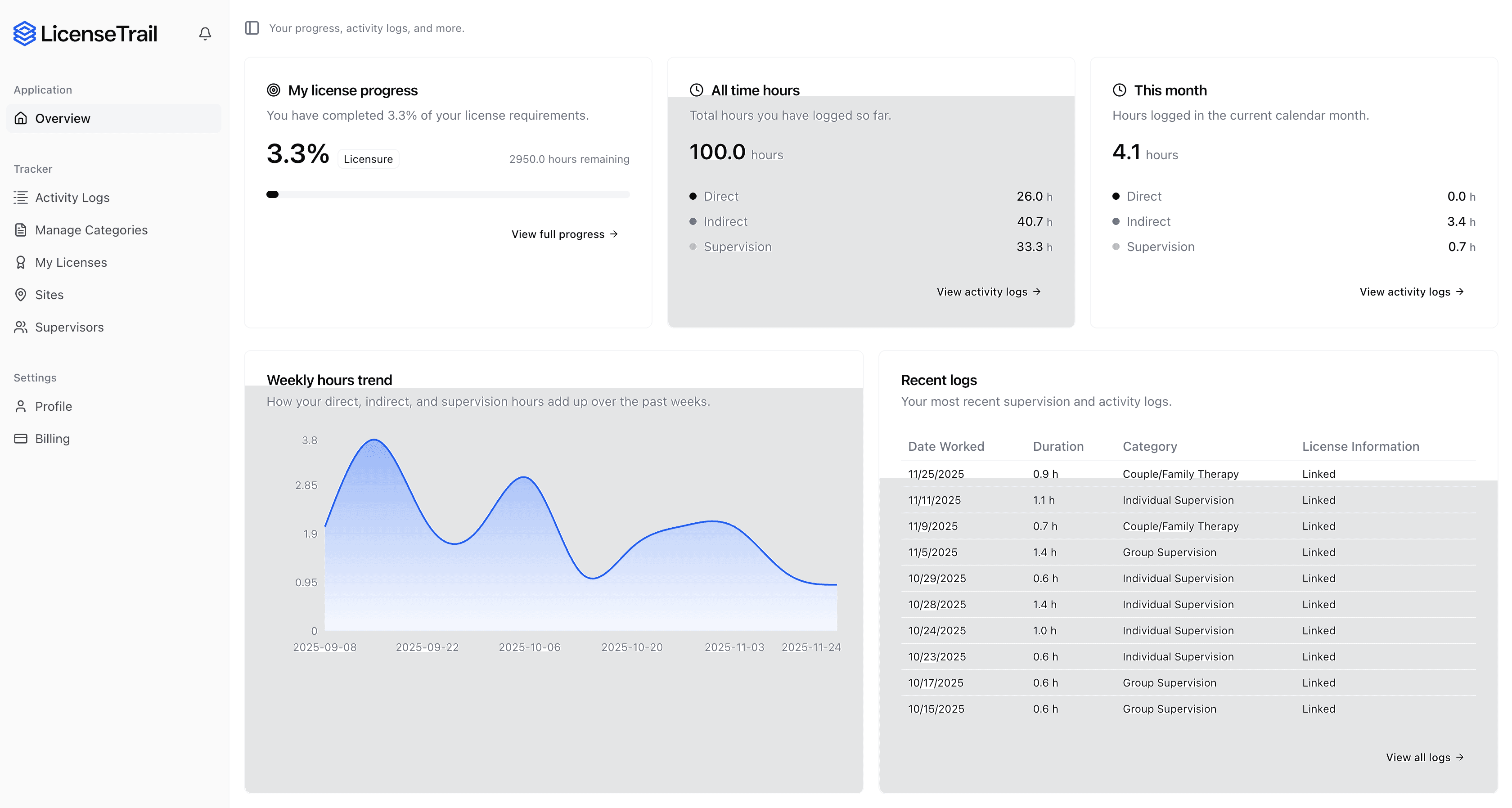
Track your Provisional hours with confidence
License Trail checks your direct, indirect, and supervision hours against Virginia Provisional requirements continuously and flags mismatches before you submit.
 Start Tracking for Free
No credit card required · Free plan available
Is your spreadsheet hiding Virginia Provisional risks?
Stop guessing if your categories match West Virginia Board of Social Work requirements. License Trail checks your direct, indirect, and supervision hours continuously and flags mismatches before you submit.
Import or log
Bring your spreadsheet or start fresh
Upload your existing tracking spreadsheet and we'll map every hour into the right West Virginia Board of Social Work categories automatically.
Verify against Virginia
Catch mismatches before the board does
License Trail checks your direct, indirect, and supervision hours against Virginia Provisional requirements continuously.
Export board-ready
One-click clean reports
Generate professional, board-ready reports for supervision meetings and West Virginia Board of Social Work submissions in seconds.
No credit card required · Free plan available