
Washington LMFTA Requirements: Hours, Exams & Step-by-Step Guide
Stop guessing if your categories match Washington requirements. License Trail checks your direct, indirect, and supervision hours against LMFTA requirements continuously and flags mismatches before you submit.
No credit card required · Free plan available
Quick Requirements Overview
- Credential/Regulator: WA DOH issues LMFTA (pre-licensure) under RCW 18.225 / WAC 246-809
- Education: Master’s/Doctorate in MFT or equivalent behavioral science; 45 semester/60 quarter credits with required content areas + supervised clinical practice; equivalency per WAC 246-809-121 (AAMFT clinical membership can satisfy education if verified to DOH)
- Pre-Associate Hours: No supervised postgraduate hours required to obtain the LMFTA credential (per updated WAC 246-809-130)
- Practice Limits: Must practice under approved supervision; no independent practice for a fee; provide client disclosure at first contact (RCW 18.225.100)
- Path to LMFT (postgraduate experience): 3,000 total hours (or 2,700 with qualifying SUDP credit) including 1,000 direct client contact with 500 diagnosing/treating couples & families
- Supervision for LMFT: 200 hours qualified supervision; ≥100 one-on-one; 100 hours with an LMFT supervisor (LMFT with ≥2 years clinical experience)
- Exam: AMFTRB national exam (request form typically ≥60 days before desired exam window)
- Renewal/CE (LMFTA): 18 CE hours annually; from 2nd renewal 6 ethics/law hours per preceding 2 years; 2 hours health equity every 4 years
License Details
Procedures
In Washington State, the “Licensed Marriage and Family Therapist Associate” (LMFTA) credential is the pre-licensure status for people who have finished a qualifying graduate degree and are working toward full Licensed Marriage and Family Therapist (LMFT) status under supervision. The credential is issued by the Washington State Department of Health (DOH), with rules developed under Chapter 18.225 RCW and Chapter 246‑809 WAC and overseen with input from the Mental Health Counselors, Marriage and Family Therapists, and Social Workers Advisory Committee. (doh.wa.gov)
Below is a step‑by‑step guide focused on the exact state language around hours, supervision, and other requirements.
1. Understand what the LMFTA credential is
Washington DOH defines an “associate” as a prelicensure candidate who has a qualifying graduate degree and “is gaining the supervision and supervised experience necessary” to become a licensed social worker, mental health counselor, or marriage and family therapist. (doh.wa.gov)
Key points about LMFTAs:
- You are not yet independently licensed.
- You hold a temporary/associate credential while you accrue supervised postgraduate experience toward LMFT.
- You must work under an approved supervisor and cannot practice independently.
Practice and fee restrictions
Under Washington law and DOH policy:
- Associates may not provide independent social work, mental health counseling, or marriage and family therapy “for a fee, monetary or otherwise.” (doh.wa.gov)
- Associates must work under the supervision of an approved supervisor (defined in WAC 246‑809‑134). (doh.wa.gov)
- At the first professional contact, an associate must give clients a disclosure form stating that they are an associate working under supervision, as required by RCW 18.225.100. (wa-law.org)
2. Educational requirements for LMFTA
To be licensed as a Marriage and Family Therapist Associate, Washington DOH requires: (doh.wa.gov)
-
Degree level and type
- A master’s or doctoral degree in:
- Marriage and family therapy, or
- A behavioral science/master’s or doctoral program in an allied field that is equivalent in coursework, from a school approved by the secretary of health.
- A master’s or doctoral degree in:
-
Coursework distribution
Your graduate program must include at least:
- 45 semester hours or 60 quarter credits total in specified areas.
- At least 27 semester credits or 36 quarter credits must be in the first five areas of study: (doh.wa.gov)
- Marital and family systems
- Marital and family therapy
- Individual development
- Psychopathology
- Human sexuality
- Additional required areas:
- Research
- Professional ethics and law
- An elective (one course)
- Programs must also include supervised clinical practice at the graduate level; DOH uses a coursework form and official transcripts to verify this. (doh.wa.gov)
-
Program equivalency
- If the degree is not explicitly an MFT degree, it must meet program equivalency criteria in WAC 246‑809‑121; DOH may ask for syllabi if course titles are unclear. (doh.wa.gov)
-
AAMFT clinical membership as equivalency (education only)
- Applicants who have achieved American Association for Marriage and Family Therapy (AAMFT) clinical membership are deemed by DOH to have met the educational requirements for licensure, if AAMFT sends verification directly to the department. (doh.wa.gov)
3. Supervised experience and hours: how they relate to LMFTA
No supervised hours required before becoming an LMFTA
Under the current WAC 246‑809‑130 (as amended in 2025), the rule explicitly states:
- “Licensed marriage and family therapist associate applicants are not required to have supervised postgraduate experience prior to becoming an associate.” (lawfilesext.leg.wa.gov)
In other words:
- To get the associate license itself, you do not need a minimum number of postgraduate supervised hours first.
- You qualify based on your degree and coursework, plus general application requirements (background, fees, etc.).
- Once you hold the LMFTA credential, you then accrue the supervised hours needed for full LMFT.
The hours you must eventually complete for full LMFT (while an LMFTA)
Even though LMFTA applicants don’t need hours beforehand, the core reason to hold the associate credential is to work toward the supervised experience required for full LMFT licensure.
Washington’s law and rules (RCW 18.225.090 and WAC 246‑809‑130) define the supervised experience requirement as follows: (wa-law.org)
Total supervised experience requirement
- Minimum of 3,000 hours of experience in marriage and family therapy.
These 3,000 hours must include:
-
Direct client contact hours
- At least 1,000 hours of direct client contact.
- Of those, at least 500 hours must be “gained in diagnosing and treating couples and families.” (regulations.justia.com)
“Direct client contact” is defined in WAC 246‑809‑110 as face‑to‑face therapy (in person or via eligible telehealth) where you are delivering psychotherapy services directly to individuals, couples, families, or groups (not admin time, training, or observation-only time).
-
Qualified supervision hours
- At least 200 hours of qualified supervision with an approved supervisor. (regulations.justia.com)
- The 200 hours must meet all of the following:
- At least 100 hours must be one‑on‑one supervision.
- The remaining hours can be a mix of one‑on‑one or group supervision.
- Of the 200 hours, 100 hours must be with a licensed marriage and family therapist, and under the latest WAC text that LMFT must have at least two years of clinical experience (earlier versions and some DOH webpages still state five years; the updated WAC controls). (regulations.justia.com)
- The other 100 hours may be with an equally qualified licensed mental health practitioner (such as an LMHC, LICSW, psychologist, psychiatrist, or psychiatric ARNP) as defined in chapter 246‑809 WAC. (regulations.justia.com)
-
Nature of supervision
- “Qualified supervision” means supervision that meets WAC 246‑809‑134 requirements (for MFT supervisors), including specific training/experience, appropriate license type, and a structured supervisory relationship with documentation. (doh.wa.gov)
-
Credit for COAMFTE‑accredited master’s programs
- If you completed a master’s program accredited by COAMFTE (the Commission on Accreditation for Marriage and Family Therapy Education), you are credited with:
- 500 hours of direct client contact, and
- 100 hours of qualified supervision (formal meetings with an approved supervisor). (regulations.justia.com)
- If you completed a master’s program accredited by COAMFTE (the Commission on Accreditation for Marriage and Family Therapy Education), you are credited with:
-
Credit for prior Substance Use Disorder Professional practice
- If you have practiced as a Substance Use Disorder Professional (SUDP) for three years within the past 10 years, the department reduces the total required supervised hours from 3,000 to 2,700 hours.
- The internal structure of the hours (1,000 direct contact, 500 with couples/families, 200 supervision, etc.) does not change; only the total is reduced. (regulations.justia.com)
These 3,000 hours (or 2,700 with SUDP credit) are typically accumulated after you receive your LMFTA credential, while you are working in approved settings under supervision.
4. Examination requirements
Both LMFTA and LMFT applicants are subject to an exam requirement established in statute and DOH rule. (doh.wa.gov)
- Washington uses the Association of Marital and Family Therapy Regulatory Boards (AMFTRB) national exam.
- DOH’s LMFT/LMFTA licensing page notes:
- You may apply to sit for the exam once you have applied for the LMFT or LMFTA credential.
- You must submit a DOH “request for examination” form at least 60 days before the exam window you want. (doh.wa.gov)
- Passing an approved exam is required for eventual full LMFT licensure under RCW 18.225.090. (wa-law.org)
5. Continuing education requirements for LMFTAs
Washington requires continuing education (CE) even at the associate level.
According to DOH’s continuing education guidance and RCW 18.225.090: (doh.wa.gov)
- LMFTAs must complete 18 hours of CE every year.
- Beginning with the second renewal, at least 6 of the CE hours in the preceding two years must be in professional ethics and law (those ethics hours can be counted toward the 18 total for that year).
- All behavioral health associates (including LMFTAs) must also complete at least 2 hours of health equity training every four years, in line with RCW 43.70.613 and WAC 246‑12‑830. (doh.wa.gov)
For full LMFT licensure, you will also need:
- 36 hours of CE, six of which must be in professional ethics, completed after completing academic requirements and before DOH issues the LMFT license. (doh.wa.gov)
6. Step‑by‑step path to becoming an LMFTA in Washington
Step 1 – Complete a qualifying graduate degree
- Earn a master’s or doctoral degree meeting:
- Degree type (MFT or equivalent behavioral science),
- Credit totals (45 semester / 60 quarter, with required content areas),
- Supervised clinical practice requirements. (doh.wa.gov)
Step 2 – Confirm coursework equivalency
- Compare your transcript against WAC 246‑809‑121.
- If titles are unclear, be prepared to provide syllabi.
- If you have AAMFT clinical membership, ask AAMFT to send verification directly to DOH to prove educational equivalency. (doh.wa.gov)
Step 3 – Secure an approved supervisor and practice setting
- Identify an approved supervisor (LMFT, LMHC, LICSW, licensed psychologist, psychiatrist, or psychiatric ARNP who meets WAC supervisor criteria). (doh.wa.gov)
- Ensure your employment or practice site is an approved setting under chapter 246‑809 WAC (e.g., agency, clinic, group practice with appropriate oversight).
Step 4 – Apply for LMFTA through Washington DOH
Typical application components include: (doh.wa.gov)
- Completed LMFTA application form and fees.
- Official graduate transcripts sent directly to DOH.
- Answers to personal data questions and any requested explanations.
- Disclosure of any other states where you have held or applied for credentials, with verification sent directly from those jurisdictions.
At this point, no supervised postgraduate hours are required yet; you only must declare that you are working toward full licensure as required by WAC 246‑809‑130(3)(e). (lawfilesext.leg.wa.gov)
Step 5 – Begin practice as an LMFTA under supervision
Once the LMFTA license is issued:
- Practice only under supervision and do not provide independent services for a fee. (doh.wa.gov)
- Provide clients a disclosure statement stating you are an associate under the supervision of an approved supervisor. (wa-law.org)
Step 6 – Accrue supervised experience toward full LMFT
Over time, while working as an LMFTA, you must accrue the following postgraduate supervised experience to qualify later for LMFT:
-
Total experience:
- 3,000 hours of marriage and family therapy (or 2,700 if you qualify for the SUDP reduction). (regulations.justia.com)
-
Direct client contact (within the 3,000):
- 1,000 hours minimum of direct client contact,
- including at least 500 hours spent diagnosing and treating couples and families. (regulations.justia.com)
-
Supervision (also within the 3,000):
- 200 hours of qualified supervision, of which:
- At least 100 hours one‑on‑one supervision,
- Up to 100 hours may be group or additional one‑on‑one,
- 100 hours must be with an LMFT supervisor (now defined in WAC as an LMFT with at least two years of clinical experience). (regulations.justia.com)
- 200 hours of qualified supervision, of which:
-
Possible credits:
- If COAMFTE‑accredited: 500 direct hours + 100 supervision hours credited automatically.
- If SUDP: total hours reduced from 3,000 to 2,700, but direct‑contact and supervision minimums stay the same. (regulations.justia.com)
You must have supervisors verify your hours on DOH forms when you later apply for full LMFT licensure. (doh.wa.gov)
Step 7 – Maintain CE and renew your LMFTA annually
- Complete 18 CE hours each year, with:
- At least 6 hours in ethics and law every two years, and
- At least 2 hours in health equity training every four years. (doh.wa.gov)
Keep documentation of CE in case of audit.
Step 8 – Pass the AMFTRB exam
- Apply to sit for the AMFTRB exam once DOH has your LMFTA or LMFT application and you submit a request for examination form (at least 60 days before the exam window you want). (doh.wa.gov)
- You must achieve a passing score established by the AMFTRB and PTC.
Step 9 – Apply for full LMFT licensure
When you have:
- Completed the 3,000 hours of supervised experience (with all required sub‑components),
- Passed the AMFTRB exam,
- Completed 36 hours of CE (6 in ethics) post‑degree and pre‑license, (doh.wa.gov)
- Met all personal data and background requirements,
you may apply to DOH to upgrade from LMFTA to Licensed Marriage and Family Therapist (LMFT). At that point, you are eligible to practice independently within the LMFT scope of practice defined in RCW 18.225. (wa-law.org)
Summary of key hour requirements (as defined by Washington rules)
While the associate license itself does not require hours in advance, to progress from LMFTA to LMFT you must, at minimum, complete:
- 3,000 hours of supervised postgraduate marriage and family therapy experience
- including:
- 1,000 hours of direct client contact, with
- 500 hours diagnosing and treating couples and families, and
- 200 hours of qualified supervision
- 100 hours one‑on‑one,
- 100 hours with an LMFT supervisor (≥2 years’ clinical experience under the current WAC),
- up to 100 hours may be in group or additional individual supervision. (regulations.justia.com)
- including:
Those hours—and the way Washington defines “direct client contact” and “qualified supervision”—are what structure your LMFTA experience as you work toward full licensure.
Track your LMFTA hours with confidence
License Trail checks your direct, indirect, and supervision hours against Washington LMFTA requirements continuously and flags mismatches before you submit.
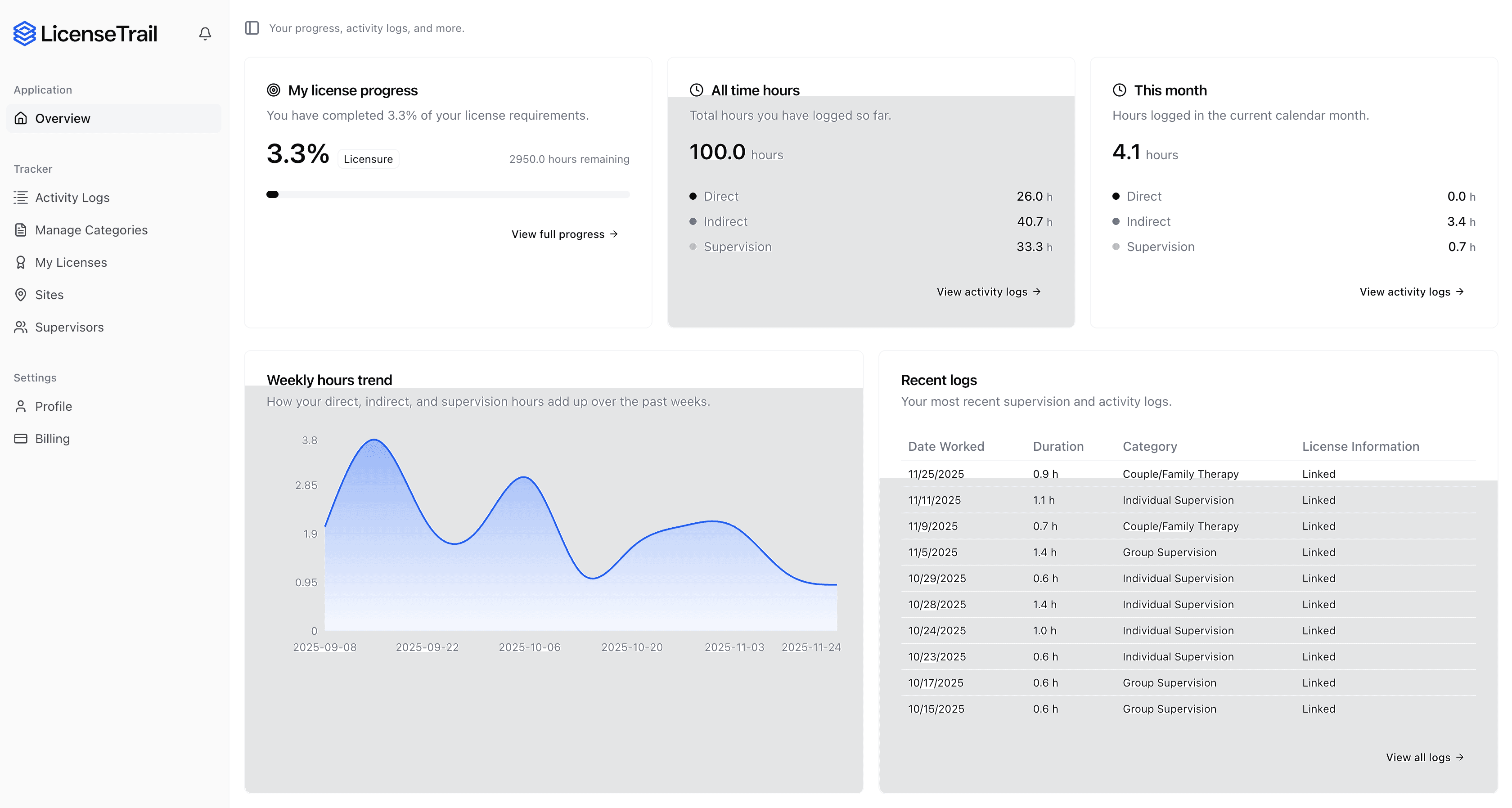 Start Tracking for Free
No credit card required · Free plan available
Is your spreadsheet hiding Washington LMFTA risks?
Stop guessing if your categories match Washington State Department of Health (Mental Health Counselors, Marriage and Family Therapists, and Social Workers Advisory Committee) requirements. License Trail checks your direct, indirect, and supervision hours continuously and flags mismatches before you submit.
Import or log
Bring your spreadsheet or start fresh
Upload your existing tracking spreadsheet and we'll map every hour into the right Washington State Department of Health (Mental Health Counselors, Marriage and Family Therapists, and Social Workers Advisory Committee) categories automatically.
Verify against Washington
Catch mismatches before the board does
License Trail checks your direct, indirect, and supervision hours against Washington LMFTA requirements continuously.
Export board-ready
One-click clean reports
Generate professional, board-ready reports for supervision meetings and Washington State Department of Health (Mental Health Counselors, Marriage and Family Therapists, and Social Workers Advisory Committee) submissions in seconds.
No credit card required · Free plan available