
Wyoming CAP Requirements: Hours, Exams & Step-by-Step Guide
Stop guessing if your categories match Wyoming requirements. License Trail checks your direct, indirect, and supervision hours against CAP requirements continuously and flags mismatches before you submit.
No credit card required · Free plan available
Quick Requirements Overview
- Regulator: Wyoming Mental Health Professions Licensing Board; CAP is a certification (not independent practice)
- Scope: provide addictions services only under employer (administrative) supervision + DQCS clinical supervision
- Baseline eligibility: age of majority; legal U.S. inhabitant; no disqualifying convictions; application + fees
- Education (meet one): NCAC II or bachelor’s in addiction therapy or bachelor’s in human behavioral discipline + NASAC-accredited addictions degree or specified addictions coursework (incl. 3-cr practicum, 10+ semester hrs in addictions topics, 2-cr ethics, 6 contact hrs communicable-disease training)
- Exam: pass NAADAC NCAC II or IC&RC AODA (or Board-approved); 3 attempts (4th w/ remediation); must be within 5 years of application/approval
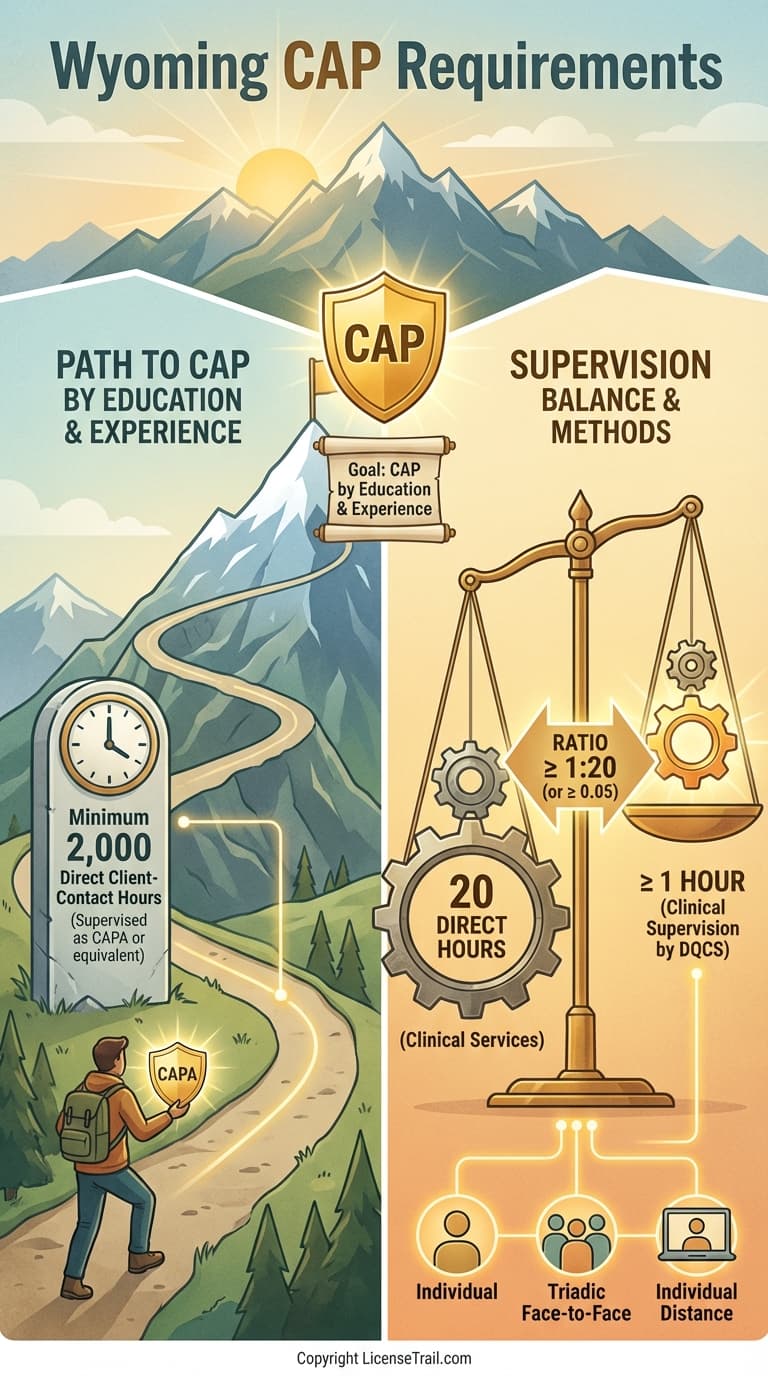
- Experience route (CAP by Experience): 2,000 hours supervised work as CAPA/equivalent, all direct client contact, completed in 24–60 months
- Supervision ratio (CAP/CAPA): minimum 1 hour DQCS clinical supervision per 20 hours direct service (≈ 100 supervision hours across 2,000 direct hours)
- If employed before fully credentialed: must complete CAP requirements within 6 months of hire (extension possible); otherwise stop working as CAP
License Details
Procedures
Wyoming regulates addictions counselors through the Wyoming Mental Health Professions Licensing Board. One of the Board’s entry‑level addictions credentials is the Certified Addictions Practitioner (CAP), a certification that allows you to provide addictions treatment under supervision. Below is a step‑by‑step outline of what the Board itself requires, with emphasis on hours and how the rules describe them.
1. What a Certified Addictions Practitioner (CAP) is in Wyoming
The Board’s rules define a Certified Addictions Practitioner (CAP) as someone certified under the Mental Health Professions Practice Act to practice addictions therapy for which they are qualified by training and experience, under both employer (administrative) supervision and a designated qualified clinical supervisor (DQCS) licensed in Wyoming. (law.cornell.edu)
The practice of a CAP includes addictions treatment, prevention, intervention, diagnosis, referral, and follow‑up, delivered either face‑to‑face or via approved electronic methods, again under the supervision of a DQCS. (law.cornell.edu)
Importantly, CAP is a certification, not an independent license; you must remain under clinical supervision.
2. Overall pathways to Wyoming CAP
The Board recognizes several application routes for CAP: (mentalhealth.wyo.gov)
- CAP by Examination – for applicants whose education already meets CAP standards and who pass an approved addictions counseling exam.
- CAP by Experience (Education and Experience) – for those who have a bachelor’s degree in a human behavioral discipline other than addiction therapy and who complete a required block of supervised clinical hours.
- CAP by Reciprocity – for those already certified/licensed in another jurisdiction (not detailed here, since you asked about Wyoming’s own requirements and hours).
The two main Wyoming‑based routes (Examination and Experience) share some baseline eligibility but differ in their hour requirements.
3. Baseline eligibility (applies to all CAP routes)
Under Chapter 3, Section 3‑2 of the Board’s rules and Wyoming Statute §33‑38‑106(c), a CAP applicant must: (law.cornell.edu)
- Be of the age of majority.
- Have no felony convictions and no misdemeanor convictions that adversely relate to the practice of addictions therapy or the ability to practice addictions therapy (the Board can grant exceptions if consistent with public interest).
- Be a legal inhabitant of the United States.
- File the Board’s application form, pay the required fee, and provide documentation showing you meet all education and examination requirements.
Six‑month employment window
If you are already working in a CAP role (under supervision) while you complete requirements:
- You have six (6) months from the date of employment to finish all CAP requirements.
- If you don’t, you must immediately stop working as a CAP.
- The Board may grant an extension “for good cause shown.” (law.cornell.edu)
This six‑month window is critical for those hired contingent on obtaining CAP certification.
4. Education requirements for CAP
The Board’s CAP education rule (Chapter 3, Section 3‑3) lays out several ways to meet the “educational requirement for certification as an addictions practitioner”. (law.cornell.edu)
You must satisfy one of the following:
-
Hold NCAC II
- Hold a current National Certified Addictions Counselor Level II (NCAC II) credential in good standing; or
-
Bachelor’s degree in addiction therapy
- Earn a baccalaureate degree in addiction therapy from a CHEA‑recognized accredited institution; or
-
Bachelor’s in human behavioral discipline + addictions degree
- Earn a baccalaureate degree in a human behavioral discipline (e.g., psychology, social work, counseling, related fields), from a CHEA‑recognized accredited institution, and
- Complete an addictions‑specific associate degree or higher from a program accredited by NASAC; or
-
Bachelor’s in human behavioral discipline + specific addictions coursework
- Earn a bachelor’s in a human behavioral discipline from a CHEA‑recognized institution, and
- Complete defined addictions coursework as follows: (law.cornell.edu)
Core courses (semester credits)
- Counseling Theories – 3 credits
- Counseling Skills – 3 credits
- Practicum in Addictions/Chemical Dependency Counseling – 3 credits
- Counseling Ethics – 2 credits
Subject area coursework (minimum of 10 semester hours total across these areas)
- Alcoholism (biochemical, sociocultural, psychological factors)
- Drugs and Behavior (non‑alcohol drugs with abuse potential, including psychopharmacology)
- Addictions and Special Populations (e.g., adolescents, women, ethnic groups, older adults, impaired professionals, etc.)
- Addictive Behaviors (gambling, eating disorders, sexual addictions, compulsive non‑ingestive behaviors, etc.)
- Addictions Assessment (appraisal, assessment, testing, diagnosis/dual diagnosis; can also be met by specialty training)
Additional contact‑hour requirement
- Six (6) contact hours of specialty training in communicable diseases, via coursework or workshops.
If you follow option (4), the rules also specify that your transcript, course prefixes, and descriptions must clearly show the coursework prepares you to be a practitioner and that the coursework must be at college level (associate, baccalaureate, or later). (law.cornell.edu)
5. Examination requirement for CAP
The CAP exam requirement is in Chapter 3, Section 3‑4 and on the Board’s “Examination Information” page. (law.cornell.edu)
You must pass one of these:
- NAADAC NCAC Level II exam; or
- IC&RC Alcohol and Other Drug Abuse Counselor (AODA) exam; or
- Another examination the Board specifically approves.
Additional exam rules:
- You normally get three (3) attempts to pass; a 4th attempt may be allowed if the Board approves a remediation plan you submit.
- The exam must have been passed within the five (5) years immediately before you apply or after the Board approves you to sit for the exam.
6. Experience and hour requirements for CAP
6.1. Does every CAP applicant need a set number of clinical hours?
For CAP by Examination (the standard route where your degree/NCAC II already satisfies the education rule), the Board’s rules do not specify a fixed number of pre‑certification clinical hours beyond:
- Any practicum required by your academic program (e.g., the 3‑credit practicum listed in the CAP education rule); and (law.cornell.edu)
- The supervision requirements that apply to all CAPs once they begin providing services (see Section 7 below).
The only explicit, numeric clinical‑hour requirement appears in the CAP by Experience route.
6.2. CAP by Experience (Education and Experience route) – 2,000 direct client contact hours
Chapter 3, Section 3‑5 of the Board’s rules creates a “Certification by Education and Experience” pathway for applicants who: (law.cornell.edu)
- Have a bachelor’s degree in a human behavioral discipline other than addiction therapy, and
- Do not otherwise meet the addiction‑specific degree or NCAC II options.
To qualify as CAP by Experience, you must document:
- 2,000 hours of supervised work experience
- This experience must be as a Certified Addictions Practitioner Assistant (CAPA) or equivalent in the field of addiction therapy.
- All 2,000 hours must be “direct client contact” hours – i.e., clinical work with clients, not administrative or purely support tasks.
- These 2,000 hours must be completed over a period of at least 24 months but no more than 60 months before you apply for CAP.
In other words, the Board expects 2,000 hours of supervised, direct client contact experience over 2–5 years as a CAPA (or equivalent) for this route.
The Board’s application page mirrors this, describing “Certified Addictions Practitioner by Experience” as intended for applicants with a human behavioral bachelor’s degree (not in addiction therapy) plus 2,000 hours of supervised work experience as a CAPA or equivalent. (mentalhealth.wyo.gov)
7. Ongoing supervision and how “supervised” hours work
Whether you are accumulating hours as a CAPA or practicing as a CAP, Wyoming’s Chapter 18 – Supervision rules govern clinical supervision. (regulations.justia.com)
Key points:
-
Who must be supervised?
The rule states that Certified Addictions Practitioners, Certified Addictions Practitioner Assistants, Certified Mental Health Workers, Certified Social Workers, and all provisional licensees may only provide services under the clinical supervision of a DQCS and under the administrative supervision of their employer. -
Supervision ratio for clinical services
The Board requires that individual or triadic face‑to‑face clinical supervision (or approved distance supervision) by a DQCS be provided “at a ratio of at least one (1) hour for every twenty (20) hours of direct clinical provision of services”. (regulations.justia.com)
What this means for your CAP by Experience hours:
- For the 2,000 direct client contact hours required under CAP by Experience, the rule effectively requires a minimum of about 100 hours of documented supervision by a DQCS during that period (2,000 ÷ 20 = 100).
- Those supervision hours are in addition to your 2,000 clinical hours; they are not counted as client‑contact time.
This supervision standard also applies while you are working as a CAP after certification, not just during the experience‑gathering phase.
8. Timeframe and sequencing – putting it together as a practical path
A. CAP by Examination (no fixed 2,000‑hour requirement)
- Confirm baseline eligibility
- Age of majority, no disqualifying convictions, legal inhabitant of the U.S. (law.cornell.edu)
- Complete qualifying education
- Meet one of the education options in Chapter 3, Section 3‑3 (e.g., bachelor’s in addiction therapy; or bachelor’s in a human behavioral discipline plus specified addictions coursework; or NCAC II). (law.cornell.edu)
- Arrange supervision if employed while finishing requirements
- If you start working under the CAP title before certification, you must have a DQCS and complete all requirements within six months of your employment start date. (law.cornell.edu)
- Pass an approved exam
- NCAC II or IC&RC AODA exam (or Board‑approved equivalent), within five years of your application, within the Board’s attempt limits. (law.cornell.edu)
- Submit application to the Board
- Use the “Certified Addictions Practitioner by Examination” application, arrange for official transcripts and exam scores to be sent, and pay fees. (mentalhealth.wyo.gov)
In this route, your hours come primarily from the required practicum and any job experience you gain under supervision; the Board does not specify a fixed total like “1,500 direct hours plus 1,500 supervised hours” for CAP by Examination.
B. CAP by Experience (explicit 2,000‑hour requirement)
- Earn a bachelor’s in a human behavioral discipline (non‑addiction‑therapy major).
- Obtain CAPA certification (or equivalent) and work under a DQCS.
- CAPA education requires 270 contact hours of education/training in alcoholism and drug abuse or related counseling subjects, as detailed in statute and Chapter 4. (law.cornell.edu)
- Accumulate clinical hours as a CAPA
- Complete 2,000 hours of supervised work experience as a CAPA (or equivalent), and
- Ensure all 2,000 hours are direct client contact, and
- Spread those hours over at least 24 months but no more than 60 months before you apply for CAP. (law.cornell.edu)
- Throughout, receive at least 1 hour of clinical supervision for every 20 hours of direct service, i.e., about 100 supervision hours over 2,000 clinical hours. (regulations.justia.com)
- Pass an approved CAP exam (NCAC II, IC&RC AODA, or Board‑approved exam). (law.cornell.edu)
- Apply as CAP by Experience
- Use the “Certified Addictions Practitioner by Experience” application and have your supervisor complete the Board’s CAP by Experience VESE form documenting your hours and supervision. (mentalhealth.wyo.gov)
9. Summary of “hours” as defined in Wyoming’s CAP rules
- Educational contact hours
- For CAP education via coursework, you must include:
- A 3‑credit Practicum in Addictions/Chemical Dependency Counseling;
- At least 10 semester hours across required addiction topics;
- 6 contact hours of communicable‑disease training. (law.cornell.edu)
- For CAP education via coursework, you must include:
- CAP by Experience clinical hours
- 2,000 hours of supervised work experience as a CAPA or equivalent,
- All 2,000 hours must be direct client contact,
- Completed over 24–60 months before application. (law.cornell.edu)
- Supervision hours while practicing (CAP and CAPA)
- At least 1 hour of clinical supervision by a DQCS for every 20 hours of direct clinical services, implying roughly 100 supervision hours during a 2,000‑hour experience block. (regulations.justia.com)
Wyoming’s rules therefore do not set a universal “X hours direct + Y hours supervised” total for every CAP candidate. Instead, they:
- Define detailed education/credit‑hour standards for addiction‑specific training, and
- For the CAP by Experience route, require 2,000 supervised, direct client contact hours over 2–5 years as a CAPA (or equivalent), with a mandated supervision ratio that effectively builds in the supervision‑hour minimum.
Track your CAP hours with confidence
License Trail checks your direct, indirect, and supervision hours against Wyoming CAP requirements continuously and flags mismatches before you submit.
 Start Tracking for Free
No credit card required · Free plan available
Is your spreadsheet hiding Wyoming CAP risks?
Stop guessing if your categories match Wyoming Mental Health Professions Licensing Board requirements. License Trail checks your direct, indirect, and supervision hours continuously and flags mismatches before you submit.
Import or log
Bring your spreadsheet or start fresh
Upload your existing tracking spreadsheet and we'll map every hour into the right Wyoming Mental Health Professions Licensing Board categories automatically.
Verify against Wyoming
Catch mismatches before the board does
License Trail checks your direct, indirect, and supervision hours against Wyoming CAP requirements continuously.
Export board-ready
One-click clean reports
Generate professional, board-ready reports for supervision meetings and Wyoming Mental Health Professions Licensing Board submissions in seconds.
No credit card required · Free plan available