
Wyoming LCSW Requirements: Hours, Exams & Step-by-Step Guide
Stop guessing if your categories match Wyoming requirements. License Trail checks your direct, indirect, and supervision hours against LCSW requirements continuously and flags mismatches before you submit.
No credit card required · Free plan available
Quick Requirements Overview
- Education: CSWE-accredited MSW (or higher) required (may be ≤ 6 semester hours short only for PCSW eligibility)
- Provisional (PCSW): Board-approved DQCS + supervision agreement required before provisional license/practice
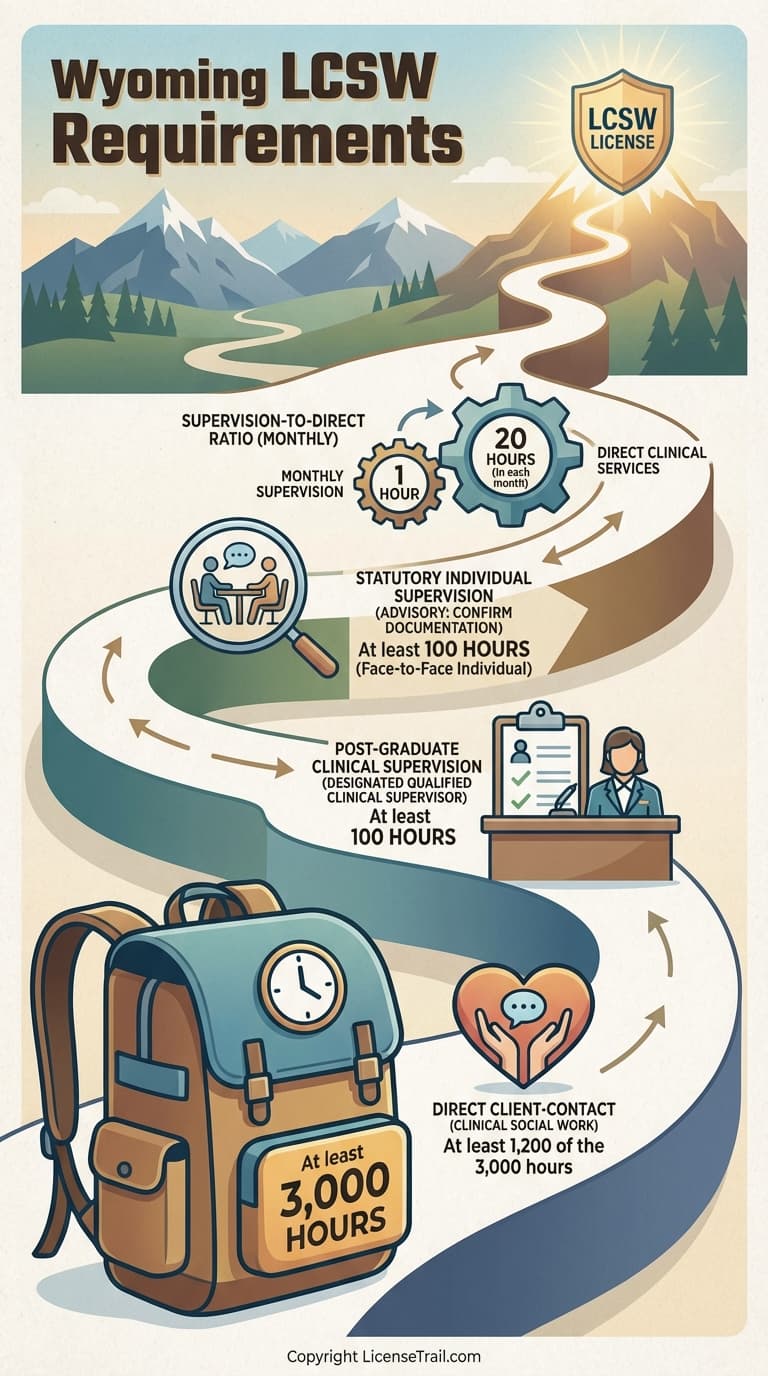
- Experience: 3,000 post‑graduate supervised clinical social work hours (no pre‑MSW hours)
- Timeframe: Complete hours in 18–36 months (extension possible)
- Direct hours: Minimum 1,200 direct client contact hours; remaining hours may be clinically related indirect work (charting, meetings, trainings, etc.)
- Supervision minimum: 100 post‑graduate hours of qualifying clinical supervision with a Board-approved DQCS (includes face-to-face individual requirement per statute)
- Supervision cadence/format: At least 1 hour supervision per 20 hours direct service; counts as individual/triadic (max 2 supervisees) face‑to‑face or individual distance
- Exam: Pass ASWB Clinical (or Board-approved equivalent); must be within 5 years of application (limited exceptions)
License Details
Procedures
Becoming a Licensed Clinical Social Worker (LCSW) in Wyoming is governed by the Wyoming Mental Health Professions Licensing Board under the Mental Health Professions Practice Act and the Board’s administrative rules. The credential allows independent practice of “clinical social work” as defined in Wyoming law. (law.justia.com)
Below is a step‑by‑step guide, with emphasis on the exact hour and supervision requirements and the Board’s own terminology.
1. Role and definition of an LCSW in Wyoming
Wyoming defines the “practice of clinical social work” as applying social work theory and methods to the diagnosis, treatment, and prevention of psychosocial dysfunction, disability, or impairment, including emotional and mental disorders. It explicitly includes assessment, diagnosis, treatment (including psychotherapy and counseling), client‑centered advocacy, consultation, and evaluation with individuals, families, groups, communities, and organizations. (law.justia.com)
Chapter 9 of the Board’s rules then describes “the practice of a Licensed Clinical Social Worker” as using social work theory, knowledge, methods, ethics, and the professional use of self to restore or enhance functioning of individuals, couples, families, groups, organizations, and communities, including assessment, diagnosis, and treatment of mental, emotional, and behavioral disorders. (regulations.justia.com)
Only LCSWs (and other independently licensed mental health professionals) may provide this scope of clinical services independently in Wyoming. (law.justia.com)
2. Educational requirement
The education requirement for Wyoming LCSW licensure is straightforward and fully defined in rule:
“All educational requirements for licensure shall be met through the completion of a Council on Social Work Education (CSWE) accredited master's degree program in social work.” (regulations.justia.com)
So you must hold a CSWE‑accredited MSW (or higher social work degree) to qualify.
3. Provisional licensure (PCSW) while you earn hours
Wyoming expects applicants to complete their post‑graduate experience under a Provisional Clinical Social Worker (PCSW) license.
Purpose of provisional license. Provisional licensure is explicitly described as:
“a means by which an individual may continue progress, under the supervision of a DQCS and under the administrative supervision of an employer, towards satisfactory completion of the education, experience and examination requirements established in these rules.” (law.cornell.edu)
To receive a provisional license (PCSW), you must, among other things:
- Be of majority age.
- Have no felony and no relevant misdemeanor convictions, unless the Board grants an exception in the public interest. (law.cornell.edu)
- Satisfy the educational requirements (or be no more than six (6) semester hours short, with specific coursework already completed). (law.cornell.edu)
- Have a Designated Qualified Clinical Supervisor (DQCS) identified and a supervision agreement approved by the Board before the provisional license is issued. The rule states that applicants must “submit and receive approval of a supervision agreement prior to the issuance of their license.” (law.cornell.edu)
Provisional licensees must use titles such as “Provisional Clinical Social Worker” only after the license is granted, and only for activities that are part of their supervised clinical experience. (regulations.justia.com)
4. Core clinical experience requirement: 3,000 supervised hours
The central quantitative requirement for an LCSW in Wyoming is found in Chapter 9, Section 9‑4 of the Board’s rules and in Wyo. Stat. § 33‑38‑106.
The Board’s rule states:
“A minimum of three thousand (3,000) hours of supervised clinical training/work experience in clinical social work under the direct supervision of a DQCS is required for all applicants.” (regulations.justia.com)
Key details:
-
Total hours and time frame
- 3,000 hours of supervised clinical training/work experience in clinical social work.
- Must be completed over not less than eighteen (18) months or more than thirty‑six (36) months, unless the Board grants an extension. (regulations.justia.com)
-
Post‑graduate only
- “All three thousand (3,000) hours of supervised clinical training/work experience required shall be completed after the award of the graduate degree.” (regulations.justia.com)
No pre‑MSW hours may be counted.
-
Direct client contact vs. indirect hours
The Board breaks the 3,000 hours into direct client contact and indirect supporting activities:
-
At least 1,200 hours must be “direct client contact”:
“Of the three thousand (3,000) hours required, at least one thousand two hundred (1,200) hours shall be direct client contact hours providing clinical social work as defined in Wyoming Statute 33‑38‑102(a)(v).” (regulations.justia.com)
This means at least 1,200 hours of assessment, diagnosis, treatment, psychotherapy, counseling, and related direct interventions with clients, in line with the statutory definition of clinical social work.
-
The remaining approximately 1,800 hours are “indirect” but must still be clinically relevant:
“The balance of the remaining indirect hours shall consist of work experience that supports the direct client contact hours, e.g. charting, preparation, meetings, trainings, or the other duties of clinical social work.” (regulations.justia.com)
So in practical terms the Board’s hour structure is:
- 1,200 hours – direct client contact (required minimum), and
- Up to 1,800 hours – indirect but clinically related work under supervision.
-
-
Statutory confirmation
The underlying statute mirrors this requirement, stating that an applicant must demonstrate completion of:
“three thousand (3,000) hours of supervised clinical experience including a minimum of one hundred (100) hours of face‑to‑face individual clinical supervision from a qualified clinical supervisor.” (codes.findlaw.com)
5. Supervision requirements and DQCS qualifications
5.1. Who can supervise: Designated Qualified Clinical Supervisor (DQCS)
The Board defines a “Designated Qualified Clinical Supervisor (DQCS)” in its general provisions:
A DQCS “shall be licensed in Wyoming as a licensed professional counselor, licensed clinical social worker, licensed marriage and family therapist, licensed addictions therapist, licensed psychologist, licensed psychiatrist, or licensed advanced practitioner of nursing with psychiatric specialty. In addition, a licensed physician with specialty in addictionology shall qualify as a designated qualified clinical supervisor for a candidate seeking licensure as an Addictions Therapist.” (regulations.justia.com)
Chapter 18 adds further DQCS requirements:
- Must have been licensed for independent practice for at least two (2) years before supervising.
- Must have four (4) years of post‑graduate professional experience in their discipline.
- Must be free from disciplinary action, unless the Board grants an exception.
- Must have completed a graduate‑level course in clinical supervision or at least 3 contact hours of continuing education in clinical supervision. (regulations.justia.com)
5.2. Minimum supervision hours
In addition to the 3,000 total practice hours, the Board specifically requires:
“An applicant shall have a minimum of one hundred (100) post graduate hours of clinical supervision with a DQCS as described in Chapter 18.” (regulations.justia.com)
This dovetails with the statute’s requirement for “a minimum of one hundred (100) hours of face‑to‑face individual clinical supervision” as part of the 3,000 supervised clinical hours. (codes.findlaw.com)
5.3. Supervision ratio and format
Chapter 18 adds operational detail about how supervision must be delivered:
-
Clinical practice is not permitted until documentation of a DQCS has been provided to, and approved by, the Board, and practice must be “only under the clinical supervision of an approved DQCS.” (regulations.justia.com)
-
For certified and provisional professionals (which includes PCSWs), supervision must occur at this minimum ratio:
“Individual, triadic face‑to‑face clinical supervision or individual distance clinical supervision by a DQCS shall be provided monthly at a ratio of at least one (1) hour for every twenty (20) hours of direct clinical provision of services defined in this act.” (regulations.justia.com)
- “Triadic” means supervision with the supervisor and up to two supervisees present.
- This 1:20 ratio is a floor; you still must meet the separate 100‑hour minimum of post‑graduate supervision.
-
The Board recognizes specific types of supervision:
- Individual face‑to‑face clinical supervision.
- Triadic face‑to‑face clinical supervision.
- Individual distance clinical supervision (e.g., via secure telecommunication) as long as it ensures quality and competence. (regulations.justia.com)
The rules specify:
“Supervision of more than 2 supervisees simultaneously is not permitted to count towards the face‑to‑face supervision requirement.” (regulations.justia.com)
So supervision sessions that include more than you and one other supervisee cannot be counted toward the required face‑to‑face supervision hours.
5.4. Supervisor’s role and limits
The Board’s supervision chapter emphasizes several additional points:
-
The DQCS must:
- Allow the supervisee to perform independently only those functions for which the supervisee has training and experience.
- Keep records verifying supervision, including types and number of hours.
- Be readily available to give aid, direction, and instruction. (regulations.justia.com)
-
A DQCS may not supervise more than five (5) supervisees at one time without a written exception from the Board. (regulations.justia.com)
-
If supervision changes:
- The supervisee must notify the Board within ten (10) days.
- No services may be provided until new DQCS documentation is approved.
- The outgoing DQCS must submit a Verification and Evaluation of Supervised Experience (VESE) form to the Board within thirty (30) days of supervision ending. (regulations.justia.com)
6. Examination requirement
To become an LCSW, you must pass an approved clinical‑level examination.
The Board’s LCSW examination rule provides:
“The Board shall accept a passing score as established by the examination provider of the following examination:
(i) The Association of Social Work Boards (ASWB) examination at the Clinical Level; or
(ii) Other examination as may be approved by the Board.” (regulations.justia.com)
Additional details:
- The examination must have been passed within five (5) years immediately prior to submitting the LCSW application, with limited exceptions (e.g., certain reciprocity or completion‑of‑provisional situations). (regulations.justia.com)
You typically sit for the ASWB Clinical exam after your provisional license is approved, per the Board’s examination information. (mentalhealth.wyo.gov)
7. General licensure requirements beyond hours and supervision
In addition to education, experience, supervision, and the exam, Wyoming requires that you meet several general criteria.
The LCSW‑specific rule states that you must provide satisfactory evidence to the Board that you:
- Are of majority age.
- Have no felony convictions and no misdemeanor convictions that relate adversely to the practice of clinical social work or to your ability to practice, unless the Board finds an exception consistent with the public interest.
- Are a legal inhabitant of the United States.
- Satisfy the requirements established in the rules. (regulations.justia.com)
The statute that governs licensure (covering professional counselors, LMFTs, LCSWs, and addictions therapists) adds that you must:
- Hold the appropriate master’s or doctoral degree.
- Have passed the standard examination for your discipline.
- Have completed the 3,000 hours of supervised clinical experience including the 100 hours of face‑to‑face individual clinical supervision from a qualified clinical supervisor, as already described. (codes.findlaw.com)
8. Hour and supervision requirements at a glance
Putting the Board’s language and numbers together, Wyoming’s LCSW clinical experience requirements can be summarized as:
-
Total clinical experience
- 3,000 hours of “supervised clinical training/work experience in clinical social work under the direct supervision of a DQCS”.
- Completed in 18–36 months.
- All hours must be post‑MSW. (regulations.justia.com)
-
Direct vs. indirect hours
- At least 1,200 hours must be “direct client contact hours providing clinical social work” as defined in statute. (regulations.justia.com)
- The remaining up to 1,800 hours consist of “work experience that supports the direct client contact hours, e.g. charting, preparation, meetings, trainings, or the other duties of clinical social work.” (regulations.justia.com)
-
Supervision
- Minimum 100 post‑graduate hours of clinical supervision with a DQCS, counted separately within the supervised period. (regulations.justia.com)
- Supervision must be:
- Individual or triadic face‑to‑face, or individual distance supervision.
- Delivered at at least one hour of supervision for every 20 hours of direct clinical services.
- Provided only by a Board‑approved DQCS meeting the Chapter 18 requirements.
- Limited to no more than two supervisees in a session for face‑to‑face supervision credit, and no more than five supervisees per DQCS overall (absent an exception). (regulations.justia.com)
-
Licensure level while accruing hours
- You practice as a Provisional Clinical Social Worker (PCSW) under a DQCS, with a Board‑approved supervision agreement and clear disclosure of your supervised status to clients. (law.cornell.edu)
Once you have:
- Completed a CSWE‑accredited MSW,
- Accrued the 3,000 hours with the required 1,200 direct client contact hours and appropriate indirect hours,
- Obtained at least 100 hours of qualifying clinical supervision at the required ratio and under a qualified DQCS, and
- Passed the ASWB Clinical exam within the allowed timeframe,
you may apply to the Wyoming Mental Health Professions Licensing Board for full Licensed Clinical Social Worker (LCSW) licensure under Chapter 9 and Wyo. Stat. § 33‑38‑106. (regulations.justia.com)
Track your LCSW hours with confidence
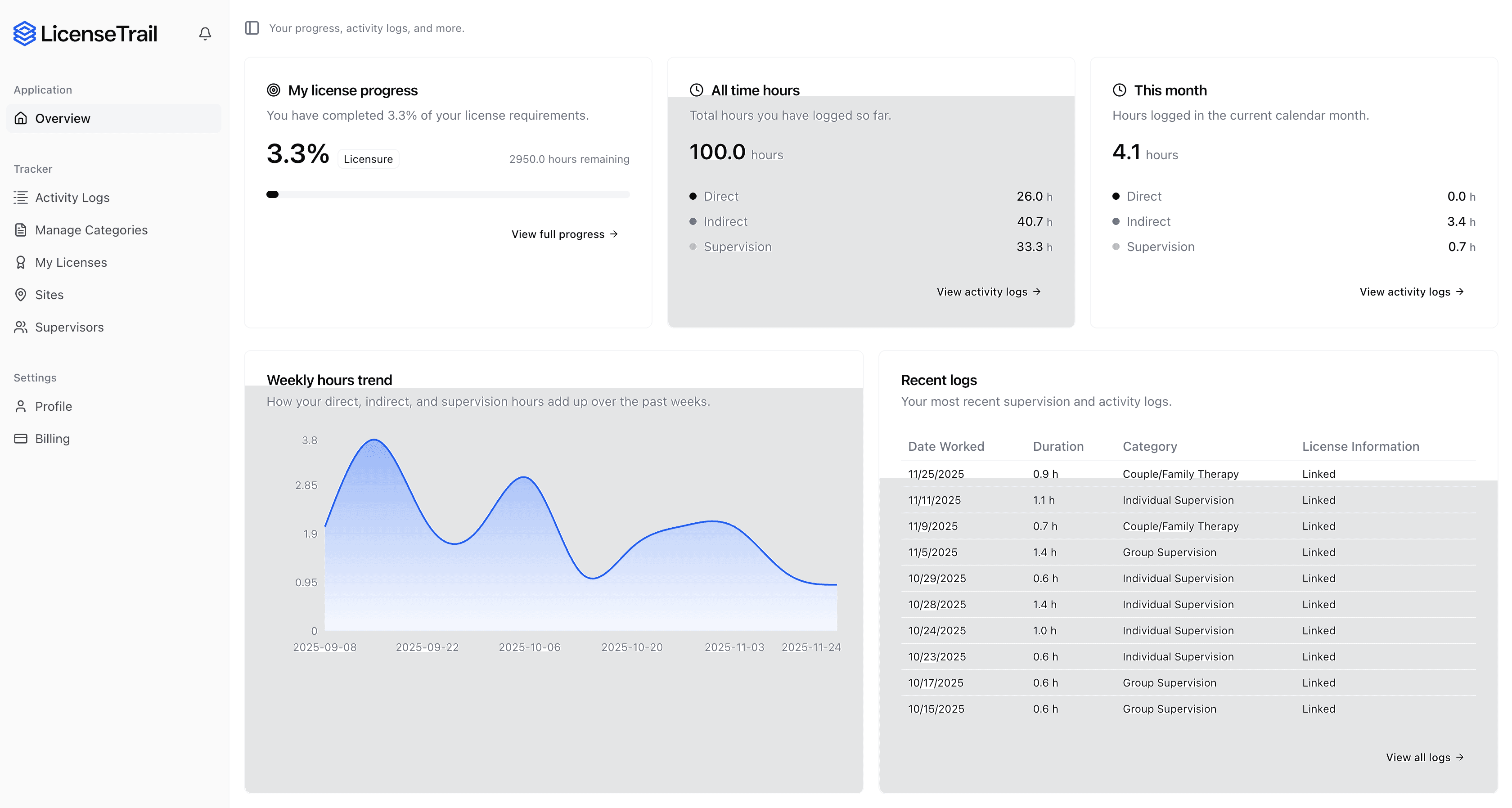
License Trail checks your direct, indirect, and supervision hours against Wyoming LCSW requirements continuously and flags mismatches before you submit.
 Start Tracking for Free
No credit card required · Free plan available
Is your spreadsheet hiding Wyoming LCSW risks?
Stop guessing if your categories match Wyoming Mental Health Professions Licensing Board requirements. License Trail checks your direct, indirect, and supervision hours continuously and flags mismatches before you submit.
Import or log
Bring your spreadsheet or start fresh
Upload your existing tracking spreadsheet and we'll map every hour into the right Wyoming Mental Health Professions Licensing Board categories automatically.
Verify against Wyoming
Catch mismatches before the board does
License Trail checks your direct, indirect, and supervision hours against Wyoming LCSW requirements continuously.
Export board-ready
One-click clean reports
Generate professional, board-ready reports for supervision meetings and Wyoming Mental Health Professions Licensing Board submissions in seconds.
No credit card required · Free plan available