
Wyoming LMFT Requirements: Hours, Exams & Step-by-Step Guide
Stop guessing if your categories match Wyoming requirements. License Trail checks your direct, indirect, and supervision hours against LMFT requirements continuously and flags mismatches before you submit.
No credit card required · Free plan available
Quick Requirements Overview
- Two-step path: PMFT (supervised practice) → LMFT (independent) under WY Mental Health Professions Licensing Board (Title 33 Ch. 38; Board Rules Ch. 10).
- Degree: Master’s/doctorate in MFT; COAMFTE accepted; CACREP-MCFC only if enrolled pre‑1/1/2020; or “substantially similar” program with ≥48 semester (72 quarter) hours from CHEA-accredited institution.
- Practicum/internship required in grad program, but does not count toward post-degree hours.
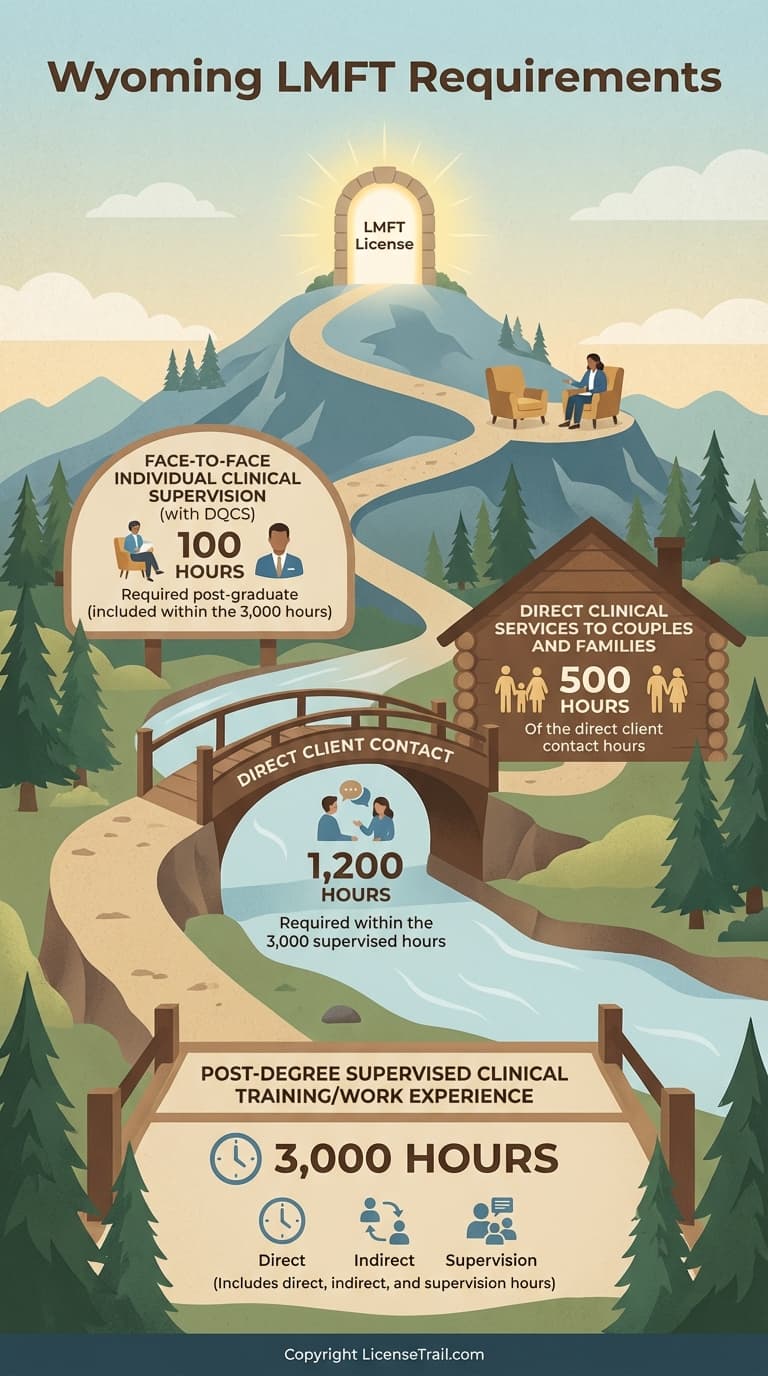
- Post-degree experience: 3,000 hours supervised clinical training/work experience under a DQCS.
- Direct client contact: ≥1,200 hours (face-to-face therapy); ≥500 hours must be with couples/families (subset of the 1,200).
- Supervision: ≥100 hours face-to-face individual post-grad clinical supervision with a DQCS (included within the 3,000).
- Timeframe: complete the 3,000 hours in 18–36 months (extension possible).
- Exam: pass the AMFTRB national MFT exam (Board approval required to sit).
License Details
Procedures
Licensure as a Licensed Marriage and Family Therapist (LMFT) in Wyoming is governed by the Wyoming Mental Health Professions Licensing Board under Title 33, Chapter 38 of the Wyoming Statutes and Chapter 10 of the Board’s rules (Wyoming Administrative Code, Agency 078). The process has two main stages: Provisional Marriage and Family Therapist (PMFT) and then full LMFT.
Below is a structured summary of the current requirements, with emphasis on the exact types and amounts of hours the Board requires.
1. License structure in Wyoming
Wyoming uses a two-step model for marriage and family therapists:
- Provisional Marriage and Family Therapist (PMFT) – allows you to practice under supervision while you accumulate post‑degree hours toward independent practice.
- Licensed Marriage and Family Therapist (LMFT) – independent clinical license once education, supervised experience, and examination are complete. (aamft.org)
The supervised clinical experience that counts toward LMFT must be accrued after the graduate degree is awarded and under an approved supervisor (a Designated Qualified Clinical Supervisor, or DQCS). (regulations.justia.com)
2. Statutory baseline requirements for an LMFT
Under Wyoming Statute § 33‑38‑106, the Board issues an LMFT license when an applicant: (codes.findlaw.com)
- Has reached the age of majority.
- Has no felony convictions and no misdemeanor convictions that adversely relate to practice (the Board can grant exceptions if consistent with public interest).
- Has a master’s or doctorate degree in one of the regulated disciplines (for LMFT, a marriage and family therapy–focused degree) that meets Board‑established academic and training standards.
- Demonstrates knowledge in marriage and family therapy by passing a Board‑approved examination (for MFTs, the AMFTRB exam).
- Demonstrates completion of 3,000 hours of supervised clinical experience, including a minimum of 100 hours of face‑to‑face individual clinical supervision from a qualified clinical supervisor.
The statute sets the global framework (3,000 supervised hours + at least 100 hours of individual face‑to‑face supervision). The detailed breakdown of how those hours must be structured comes from the Board’s Chapter 10 rules.
3. Education requirements (Chapter 10, § 10‑3)
For LMFT, the Board’s Chapter 10 rules specify that education must be in marriage and family therapy (or a substantially equivalent couple/marriage/family therapy program). (regulations.justia.com)
3.1. Acceptable degree programs
-
Primary route:
A master’s degree in marriage and family therapy from a COAMFTE‑accredited program, or from a CACREP–Marriage and Family Counseling (CACREP‑MCFC) program (only accepted if the applicant enrolled in CACREP‑MCFC before January 1, 2020). (regulations.justia.com) -
Non‑COAMFTE/CACREP programs (“substantially similar”) may be accepted if:
- The graduate program and any additional coursework were completed at an institution accredited by a CHEA‑recognized body.
- The program is clearly identified as preparing couple, marriage and family therapists.
- The applicant has at least 48 semester hours (or 72 quarter hours) of graduate‑level coursework. (regulations.justia.com)
For older (pre‑2020) graduates from non‑accredited programs, coursework must cover specific core areas (e.g., Individual and Family Development, Theoretical and Clinical Knowledge of Couples/Family Therapy, Research, Professional Identity & Ethics, etc.). (regulations.justia.com)
3.2. Practicum / Internship
The graduate program must include a practicum or internship in marriage and family therapy with appropriate clinical supervision and instructor qualifications. (regulations.justia.com)
Important for hour counting: Practicum/internship hours obtained as part of the graduate program do not fulfill the 3,000‑hour post‑degree supervised clinical experience requirement. All 3,000 hours must be accumulated after the degree is awarded. (regulations.justia.com)
4. Supervised clinical experience required for LMFT (Chapter 10, § 10‑4)
This is where Wyoming spells out exactly what kind of hours are required and how they are categorized. All of these hours are post‑degree and supervised.
4.1. Total supervised clinical training/work experience
Chapter 10, § 10‑4 requires: (regulations.justia.com)
-
Total:
A minimum of 3,000 hours of supervised clinical training/work experience in individual, couple, marriage and family therapy under the direct supervision of a Designated Qualified Clinical Supervisor (DQCS). -
Timing:
- All 3,000 hours must be completed after the award of the graduate degree.
- The hours must be completed in not less than 18 months and not more than 36 months, unless the Board grants an extension.
So in Wyoming’s own terms, you are accumulating 3,000 hours of “supervised clinical training/work experience” rather than two separate buckets such as “direct experience” and “supervised experience.” Direct client contact and supervision are specific components within that supervised clinical experience.
4.2. Direct client contact hours (subset of the 3,000)
Within the 3,000 supervised hours, the Board requires: (regulations.justia.com)
-
At least 1,200 hours of direct client contact.
These are face‑to‑face therapeutic services you provide directly to clients (individuals, couples, or families). -
Of those 1,200 direct hours, at least 500 must be direct clinical services to couples and families.
In other words:- 1,200 hours = minimum direct client contact total
- ≥ 500 of those 1,200 hours must specifically be therapy with couples and families (not just individuals)
This distinguishes Wyoming from some states that only specify a global direct‑service number without a required couples/family subset.
4.3. Indirect (supporting) hours (the remaining hours of the 3,000)
The remainder of the 3,000‑hour requirement—i.e., the hours beyond the 1,200 direct client contact hours—can be indirect but still supervised work that supports your clinical practice. The rules explicitly list examples such as: (regulations.justia.com)
- Charting and clinical documentation
- Preparation for clinical work
- Meetings
- Trainings
- Other duties of marriage and family counseling
So, conceptually:
- Total supervised clinical hours: 3,000
- Direct client contact: at least 1,200
- Within these 1,200, couple/family direct services: at least 500
- Indirect/supporting activities: up to approximately 1,800 hours, as long as they meet the rule’s description and are under proper supervision.
- Direct client contact: at least 1,200
5. Supervision hour requirements (part of supervised experience)
Both statute and rules speak to supervision:
- The statute states that the 3,000 hours of supervised clinical experience must include a minimum of 100 hours of face‑to‑face individual clinical supervision by a qualified clinical supervisor. (codes.findlaw.com)
- Chapter 10 adds that an LMFT applicant “shall have a minimum of one hundred (100) post‑graduate hours of clinical supervision with a DQCS,” referring you to Chapter 18 for supervision standards. (regulations.justia.com)
In practice, this means:
- Supervision requirement:
- 100 hours minimum of post‑graduate clinical supervision
- Supervision must be face‑to‑face individual supervision (not large‑group only), delivered by a Designated Qualified Clinical Supervisor (DQCS) as defined in Chapter 18.
- Relationship to 3,000 hours:
- State law is clear that the 3,000 supervised clinical hours include these 100 supervision hours, rather than being 3,000 + 100. (codes.findlaw.com)
Some secondary websites list different numbers (for example, 1,500 direct hours or 200 supervision hours), but those figures do not match the current Wyoming Administrative Code and statute, which remain the authoritative sources.
6. Examination requirement
For both PMFT and LMFT, Wyoming requires a passing score on the Association of Marital and Family Therapy Regulatory Boards (AMFTRB) national exam (or another exam the Board may approve). (mentalhealth.wyo.gov)
The Board’s own examination information page states that, per Chapter 10, Section 5, PMFT and LMFT applicants must complete the AMFTRB exam. Application approval by the Board is required before you can register for the exam.
7. Typical sequence to become a Wyoming LMFT
Putting the legal and regulatory pieces together, the pathway usually looks like this:
-
Complete an approved graduate degree in MFT (education stage).
- COAMFTE or eligible CACREP‑MCFC program, or a substantially equivalent couple/marriage/family therapy program meeting Chapter 10 criteria. (regulations.justia.com)
-
Apply for a Provisional Marriage and Family Therapist (PMFT) license.
- You submit an application to the Wyoming Mental Health Professions Licensing Board, including transcripts and any required documentation.
- You must develop a supervision plan with a DQCS; supervised experience must meet Chapter 10 and Chapter 18 requirements. (aamft.org)
-
Accrue post‑degree supervised clinical training/work experience.
- Accumulate 3,000 hours of supervised clinical training/work experience:
- ≥ 1,200 hours direct client contact.
- ≥ 500 of those 1,200 in direct clinical services to couples and families.
- The remainder in indirect but related duties (documentation, meetings, training, etc.).
- Complete at least 100 hours of post‑graduate, face‑to‑face individual clinical supervision with a DQCS.
- Finish all hours in no less than 18 months and no more than 36 months, unless the Board grants an extension. (regulations.justia.com)
- Accumulate 3,000 hours of supervised clinical training/work experience:
-
Pass the AMFTRB MFT examination.
- After your application or provisional license is approved, the Board authorizes you to sit for the exam and provides registration instructions. (mentalhealth.wyo.gov)
-
Apply for full LMFT licensure.
- Once you have:
- Completed the qualifying degree,
- Logged all required supervised clinical training/work experience hours (with the specified direct and couple/family breakdown),
- Completed 100+ hours of DQCS supervision,
- Passed the AMFTRB exam, and
- Met general eligibility criteria (age, background, etc.),
- you submit your LMFT application to the Wyoming Mental Health Professions Licensing Board, documenting:
- Education,
- Supervised experience (with hour breakdown),
- Supervision (including supervisor credentials and hours),
- Exam results. (codes.findlaw.com)
- Once you have:
8. Hour categories in plain language
To directly address the kind of breakdown you asked about, Wyoming’s LMFT requirements can be summed up as follows (all of this is post‑degree, supervised clinical work):
- 3,000 hours – “Supervised clinical training/work experience”
- This is the total hours the Board requires.
- Within those 3,000 hours:
- At least 1,200 hours must be direct client contact hours (therapy provided directly to clients).
- At least 500 of the 1,200 direct hours must be direct clinical services to couples and families.
- The rest of the 3,000 hours (up to about 1,800 hours) may be indirect, supporting activities (charting, preparation, meetings, training, etc.) that are part of marriage and family counseling work.
- At least 100 hours must be face‑to‑face individual clinical supervision with a qualified supervisor (DQCS). These 100 hours are included within the 3,000‑hour supervised experience. (regulations.justia.com)
Those are the key hour‑based requirements as defined by the Wyoming Mental Health Professions Licensing Board and the underlying Wyoming statutes for LMFT licensure.
Track your LMFT hours with confidence
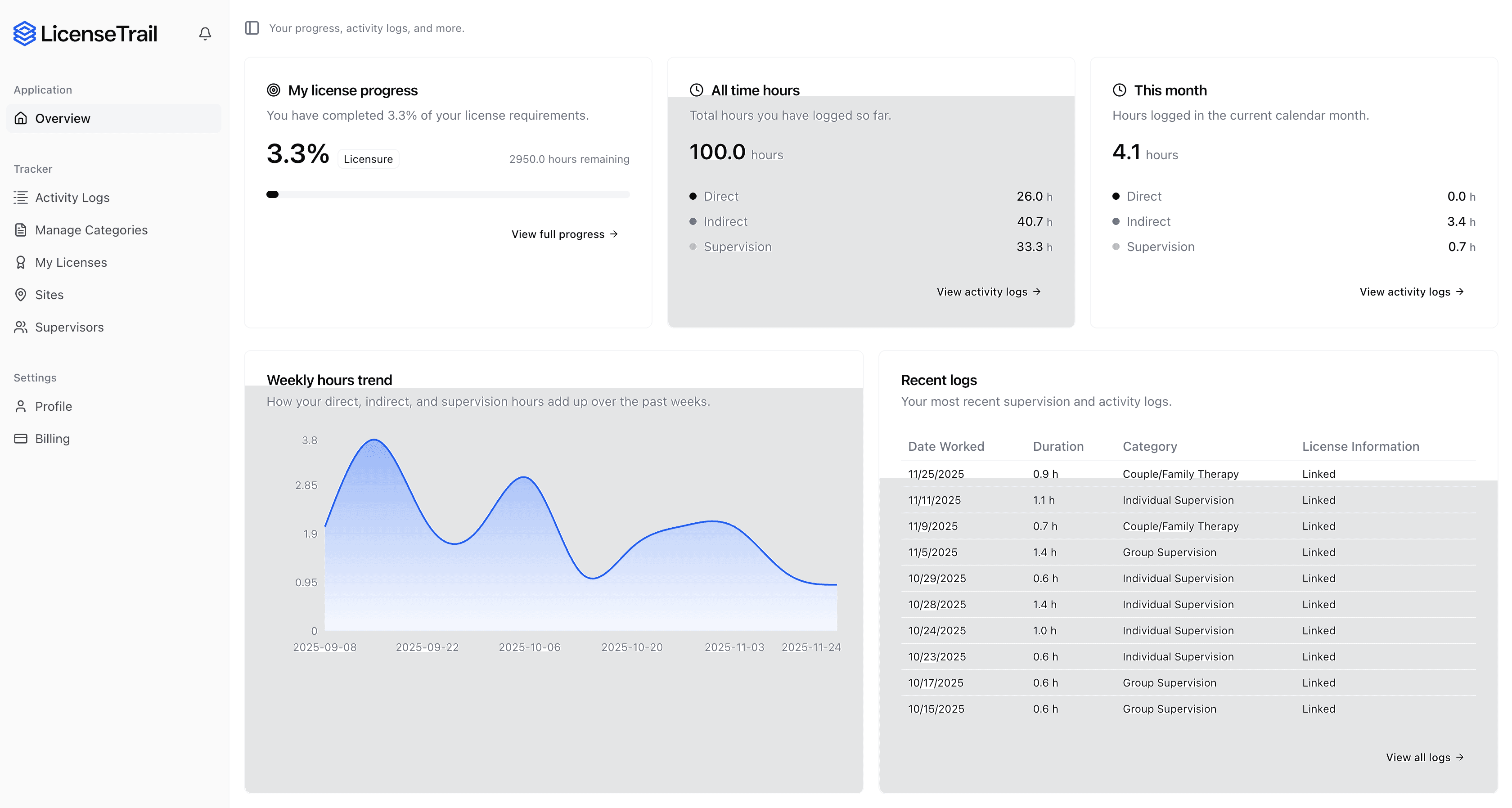
License Trail checks your direct, indirect, and supervision hours against Wyoming LMFT requirements continuously and flags mismatches before you submit.
 Start Tracking for Free
No credit card required · Free plan available
Is your spreadsheet hiding Wyoming LMFT risks?
Stop guessing if your categories match Wyoming Mental Health Professions Licensing Board requirements. License Trail checks your direct, indirect, and supervision hours continuously and flags mismatches before you submit.
Import or log
Bring your spreadsheet or start fresh
Upload your existing tracking spreadsheet and we'll map every hour into the right Wyoming Mental Health Professions Licensing Board categories automatically.
Verify against Wyoming
Catch mismatches before the board does
License Trail checks your direct, indirect, and supervision hours against Wyoming LMFT requirements continuously.
Export board-ready
One-click clean reports
Generate professional, board-ready reports for supervision meetings and Wyoming Mental Health Professions Licensing Board submissions in seconds.
No credit card required · Free plan available