
Wyoming LAT Requirements: Hours, Exams & Step-by-Step Guide
Stop guessing if your categories match Wyoming requirements. License Trail checks your direct, indirect, and supervision hours against LAT requirements continuously and flags mismatches before you submit.
No credit card required · Free plan available
Quick Requirements Overview
- License/Scope: WY Licensed Addictions Therapist (LAT) — highest independent addictions license; practice without admin/clinical supervision
- General eligibility: Age of majority; U.S. legal status; no disqualifying felony/misdemeanor history
- Education: Graduate degree with addictionology/chemical dependency/substance abuse concentration or related graduate degree + required addictions coursework
- If degree not addiction-specific: 22 semester credits (incl. 4 specified 3-credit courses + 10 credits covering 5 addictions content areas) + 6 contact hours communicable-diseases training
- Provisional path: Typically earn hours under Provisional Addictions Therapist (PAT) with a Designated Qualified Clinical Supervisor (DQCS); PAT generally valid 36 months (extensions possible)
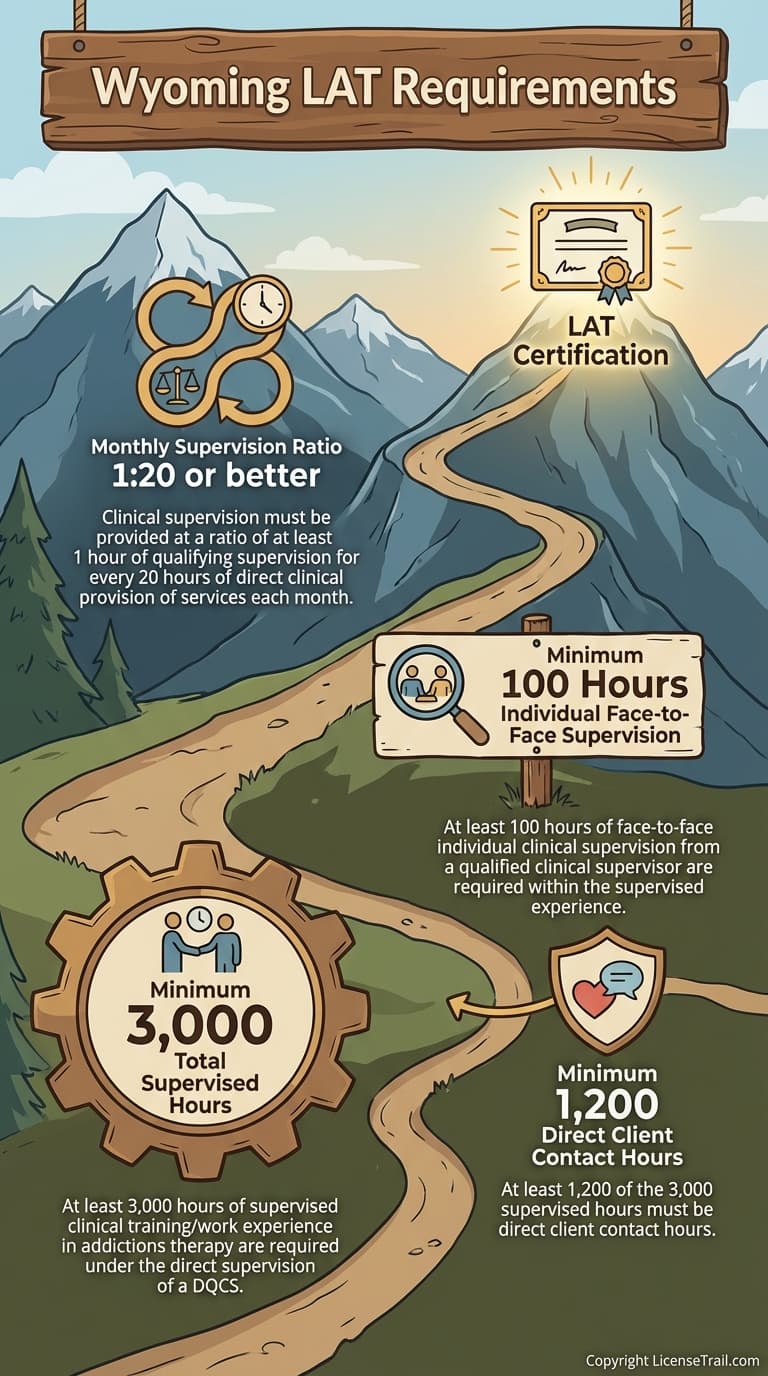
- Supervised experience: 3,000 post-grad supervised clinical training/work hours in addictions therapy over 18–36 months (extensions possible)
- Direct client contact: Within the 3,000 hours, ≥1,200 must be direct client contact; remaining hours may be indirect clinical support work
- Supervision & exam: ≥100 hours post-grad face-to-face individual clinical supervision with DQCS; pass one approved advanced addictions exam (NAADAC MAC, NBCC MAC, IC&RC AADC, or Board-approved) generally within 5 years of application
License Details
Procedures
Wyoming’s Licensed Addictions Therapist (LAT) credential is the state’s highest independent license for addiction counseling. It is issued by the Wyoming Mental Health Professions Licensing Board under the Professional Counselors, Marriage and Family Therapists, Social Workers and Chemical Dependency Specialists Practice Act. The license allows you to practice addictions therapy independently, without administrative or clinical supervision. (law.justia.com)
Below is a step‑by‑step guide grounded in the Board’s statutes and rules, with a focus on the exact hours and terminology Wyoming uses.
1. Understand what an LAT is allowed to do
The Board defines the practice of a Licensed Addictions Therapist as providing services “based on theory and methods of counseling, psychotherapy, and addictionology” to people with cognitive, emotional, or behavioral dysfunction directly or indirectly related to addiction, chemical dependency, or abuse of chemical substances. This includes prevention, crisis intervention, assessment, diagnosis, referral, direct treatment, and follow‑up, provided to “individuals, families, groups, organizations, schools, and communities” affected by addictions. (regulations.justia.com)
An LAT practices “independent of administrative or clinical supervision.” (law.cornell.edu)
2. Meet the general eligibility requirements
Under Chapter 8 of the Board’s rules, you must show: (regulations.justia.com)
- You are of the age of majority.
- You have no felony convictions and no misdemeanor convictions that relate adversely to the practice of addictions therapy or to your ability to practice it (the Board may grant exceptions if consistent with the public interest).
- You are a legal inhabitant of the United States.
- You satisfy the educational, supervised experience, and exam requirements set out in the rules.
The statute that governs all four independent licenses (LPC, LMFT, LCSW, LAT) uses similar language on age, criminal history, degree, exam, and supervised hours. (codes.findlaw.com)
3. Complete a qualifying graduate degree and addictions‑specific coursework
Degree requirement
The Board’s education requirement for LAT is set out in Chapter 8, Section 8‑3: (regulations.justia.com)
- You must complete a graduate degree program with a concentration in:
- addictionology, chemical dependency, or substance abuse, or
- “healing arts or related field” from an institution accredited by a regional or national accrediting body recognized by the Council for Higher Education Accreditation (CHEA).
Applicants with graduate degrees in other mental health disciplines (e.g., counseling, social work, psychology) from a regionally accredited institution are “generally accepted” if they also complete 22 semester hours of specific coursework (graduate or undergraduate) in the areas listed below.
Required coursework (for non‑addiction‑specific degrees)
For applicants whose graduate degree is not explicitly in addictionology/chemical dependency, the Board requires the following courses (totaling 22 semester credits): (regulations.justia.com)
-
Four specific 3‑credit courses (12 semester credits):
- Counseling Theories – 3 credits
- Counseling Skills (methods and techniques of individual and group counseling) – 3 credits
- Practicum in Addictions/Chemical Dependency Counseling – 3 credits
- Counseling Ethics – 3 credits
-
At least 10 semester credits across five subject areas (courses must cover each area):
- Alcoholism (biochemical, socio‑cultural, psychological factors)
- Drugs and Behavior (survey of drugs with abuse potential other than alcohol; psychopharmacology)
- Addictions and Special Populations (e.g., adolescents, women, ethnic groups, older adults, impaired professionals, etc.)
- Addictive Behaviors (e.g., gambling, eating disorders, sexual addictions, compulsive non‑ingestive behaviors)
- Addictions Assessment (appraisal, assessment, testing, diagnosis/dual diagnosis; can be met via specialty training)
-
Communicable diseases training:
- At least six contact hours of “specialty training” in communicable diseases, via coursework or workshops.
The Board equates 3 semester credits to 4 quarter credits for calculating these requirements. (regulations.justia.com)
4. Obtain a Provisional Addictions Therapist (PAT) license to earn your hours
Wyoming expects you to complete your supervised clinical experience under a Provisional Addictions Therapist (PAT) license.
- A PAT is defined as a person “provisionally licensed under the Act to practice addictions therapy… under the supervision of a designated qualified clinical supervisor licensed in the state of Wyoming.” (regulations.justia.com)
- Provisional licensure is specifically described as “a means to continue progress towards satisfactory completion of all licensure requirements.” (law.justia.com)
Key points about provisional licensure:
- You must hold a qualifying master’s or doctorate degree (or be otherwise educationally eligible) to receive a PAT license. (law.justia.com)
- As a PAT you may practice only under the supervision of a qualified clinical supervisor (called a Designated Qualified Clinical Supervisor, or DQCS). (law.justia.com)
- The provisional license generally expires 36 months after issuance, unless extended, or when full licensure is granted, whichever comes first. (law.justia.com)
- You must clearly disclose the supervised nature of your work in your professional disclosure statement and on advertising, including your DQCS’s name and contact information. (regulations.justia.com)
Application forms for Provisional Addictions Therapist and for later conversion to full LAT (“Provisional to Full Licensure”) are on the Board’s “Application & Forms” page under Addictions Therapy Applications. (mentalhealth.wyo.gov)
5. Accrue the required supervised clinical training/work experience hours
This is where Wyoming is very specific. The supervised experience requirements for LAT are in Chapter 8, Section 8‑4 – Supervised Training/Work Experience Requirement for Licensure. (regulations.justia.com)
Total supervised hours
The Board’s rule states:
- You must complete “a minimum of three thousand (3,000) hours of supervised clinical training/work experience in addictions therapy under the direct supervision of a DQCS”.
This is echoed in the statute, which requires “three thousand (3,000) hours of supervised clinical experience including a minimum of one hundred (100) hours of face‑to‑face individual clinical supervision” for licensure as an addictions therapist (and the other independent licenses). (codes.findlaw.com)
Timeframe for accruing hours
- The 3,000 hours must be completed over at least 18 months and no more than 36 months, unless the Board grants an extension. (regulations.justia.com)
When the hours must occur
- All three thousand (3,000) hours must be completed after the award of the graduate degree. (regulations.justia.com)
Graduate practicum/internship hours (during your degree) do not count toward this 3,000‑hour requirement.
Breakdown of the 3,000 hours: direct vs. indirect work
Wyoming does not divide the hours into “3,000 supervised + separate 1,500 direct,” or similar. Instead, it treats the 3,000 hours as all supervised clinical training/work experience, and then specifies how many of those must be direct client contact:
-
At least 1,200 hours must be “direct client contact hours.” (regulations.justia.com)
In practice, this means:
- Face‑to‑face (in person) counseling/therapy with clients; or
- Synchronous electronic counseling that meets Board standards (telephone or video), consistent with the definition of addictions practice and telepractice rules. (regulations.justia.com)
-
The remaining 1,800 hours (or fewer, if you earn more than 1,200 direct) are indirect but still supervised clinical work. The Board states that:
- “The balance of the remaining indirect hours shall consist of work experience that supports the direct client contact hours, e.g. charting, preparation, meetings, trainings, or the other duties of addictions therapy.” (regulations.justia.com)
So in Board terms, your experience must look like this at minimum:
- 3,000 total supervised clinical training/work experience hours in addictions therapy,
- of which at least 1,200 are direct client contact hours, and
- the rest (up to ~1,800) may be indirect but clinically relevant, supervised tasks.
Required clinical supervision within those hours
In addition to the 3,000 supervised hours, there is a separate supervision requirement:
- The Board requires “a minimum of one hundred (100) post graduate hours of clinical supervision with a DQCS” for LAT applicants. (regulations.justia.com)
The governing statute describes this as “a minimum of one hundred (100) hours of face‑to‑face individual clinical supervision from a qualified clinical supervisor.” (codes.findlaw.com)
Key points about these 100 hours:
- They must occur after your graduate degree (they’re “post graduate”).
- They are counted separately within your 3,000 supervised hours (i.e., you need 3,000 total supervised clinical hours and, within those, at least 100 hours are formal clinical supervision sessions).
- Chapter 1 and Chapter 18 of the rules define “individual face‑to‑face clinical supervision” and allow certain distance supervision, but the statutory language emphasizes face‑to‑face individual supervision for at least those 100 hours. (law.cornell.edu)
In practical terms:
- All 3,000 hours are supervised experience.
- At least 1,200 of those 3,000 are direct client contact.
- At least 100 of those hours are dedicated, face‑to‑face (or otherwise Board‑compliant) supervision sessions with your DQCS focused on your clinical work.
6. Pass an approved advanced addictions exam
The LAT exam requirement is in Chapter 8, Section 8‑5 – Examination Requirement for Licensure. (regulations.justia.com)
The Board will accept a passing score (as set by the exam provider) on one of the following:
- NAADAC – NCAC Master Addiction Counselor (MAC) exam
- NBCC – Master Addiction Counselor (MAC) exam
- IC&RC – Advanced Alcohol and Drug Counselor (AADC) exam
- Any other examination approved by the Board.
Additional details:
- The exam must have been passed within the five (5) years immediately prior to submission of your LAT application, unless:
- You are applying under the Board’s reciprocity rules, or
- You are applying for full licensure after holding a provisional license (completing provisional). (regulations.justia.com)
The Board’s website confirms the same list of exams for Provisional Addictions Therapist and Licensed Addictions Therapist candidates. (mentalhealth.wyo.gov)
7. Apply for full LAT licensure
Once you have:
- Met general eligibility (age, legal status, background) (regulations.justia.com)
- Completed the qualifying graduate degree and required addictions coursework (regulations.justia.com)
- Accrued 3,000 supervised clinical training/work experience hours in addictions therapy, with:
- At least 1,200 direct client contact hours, and
- At least 100 hours of postgraduate clinical supervision with a DQCS (regulations.justia.com)
- Passed one of the approved MAC‑level exams within the applicable time frame (regulations.justia.com)
…you can apply to convert from Provisional Addictions Therapist to full Licensed Addictions Therapist (LAT) using the “Provisional to Full Licensure” application under Addictions Therapy on the Board’s forms page. (mentalhealth.wyo.gov)
For applicants who are not provisional licensees in Wyoming (for example, out‑of‑state clinicians with Wyoming‑qualifying supervised experience), the Board provides a “Licensed Addictions Therapist by Examination” route, but that route does not allow supervised practice in Wyoming while you are testing. (mentalhealth.wyo.gov)
8. Summary of Wyoming’s hour and supervision requirements for LAT
Using the Board’s own language and structure, the core requirements to become a Wyoming Licensed Addictions Therapist (LAT) are:
-
Supervised clinical training/work experience:
- “A minimum of three thousand (3,000) hours of supervised clinical training/work experience in addictions therapy under the direct supervision of a DQCS.”
- “All three thousand (3,000) hours… shall be completed after the award of the graduate degree.”
- Hours must be accrued over not less than 18 months and not more than 36 months, unless the Board grants an extension. (regulations.justia.com)
-
Within those 3,000 hours:
- “At least one thousand two hundred (1,200) hours shall be direct client contact hours.”
- “The balance of the remaining indirect hours shall consist of work experience that supports the direct client contact hours, e.g. charting, preparation, meetings, trainings, or the other duties of addictions therapy.” (regulations.justia.com)
-
Clinical supervision requirement (included within the 3,000 hours):
- The statute requires that you have “completed three thousand (3,000) hours of supervised clinical experience including a minimum of one hundred (100) hours of face‑to‑face individual clinical supervision from a qualified clinical supervisor.” (codes.findlaw.com)
- The LAT rule reiterates that “an applicant shall have a minimum of one hundred (100) post graduate hours of clinical supervision with a DQCS.” (regulations.justia.com)
Together, these provisions mean that Wyoming expects 3,000 post‑graduate supervised hours in addictions therapy, 1,200 or more of them in direct client contact, and at least 100 hours of formal, face‑to‑face individual clinical supervision under a qualified supervisor, earned within an 18–36‑month window while you are provisionally licensed as a PAT.
Track your LAT hours with confidence
License Trail checks your direct, indirect, and supervision hours against Wyoming LAT requirements continuously and flags mismatches before you submit.
 Start Tracking for Free
No credit card required · Free plan available
Is your spreadsheet hiding Wyoming LAT risks?
Stop guessing if your categories match Wyoming Mental Health Professions Licensing Board requirements. License Trail checks your direct, indirect, and supervision hours continuously and flags mismatches before you submit.
Import or log
Bring your spreadsheet or start fresh
Upload your existing tracking spreadsheet and we'll map every hour into the right Wyoming Mental Health Professions Licensing Board categories automatically.
Verify against Wyoming
Catch mismatches before the board does
License Trail checks your direct, indirect, and supervision hours against Wyoming LAT requirements continuously.
Export board-ready
One-click clean reports
Generate professional, board-ready reports for supervision meetings and Wyoming Mental Health Professions Licensing Board submissions in seconds.
No credit card required · Free plan available