
Arizona LACT Requirements: Hours, Exams & Step-by-Step Guide
Stop guessing if your categories match Arizona requirements. License Trail checks your direct, indirect, and supervision hours against LACT requirements continuously and flags mismatches before you submit.
No credit card required · Free plan available
Quick Requirements Overview
- Regulator: Arizona Board of Behavioral Health Examiners (AzBBHE); governed by A.R.S. § 32‑3321 and A.A.C. R4‑6‑701–707
- Pathway 1 (standard): Regionally accredited Associate (addiction counseling) or Bachelor (behavioral science w/ counseling emphasis); NASAC‑accredited/Board‑approved program or coursework with 3 semester credits in each of 7 core areas
- Core areas (7): psychopharmacology; treatment/relapse models; group work; diverse populations; co‑occurring disorders; ethics; SUD assessment/diagnosis/treatment planning
- Hours (standard pathway): 0 supervised work‑experience hours required by the Board for LACT if qualified under R4‑6‑701(A)
- Pathway 2 (education waiver—limited): Federal/tribal contract or grant (PL 93‑638 or PL 94‑437) + HS‑equivalency + cultural hardship; then 6,400 supervised hours (≥48 months; within past 7 years) incl. 3,200 direct client contact + 200 clinical supervision
- Exam: Must pass a Board‑approved addiction counseling exam (commonly IC&RC ADC via ABCAC or equivalent)
- Apply: Submit LACT application via BOARDAL with official transcripts, fees, and required background/fingerprint materials
- Practice limitation: Once licensed, LACT must practice under direct supervision and cannot practice independently (no solo private practice)
License Details
Procedures
Becoming a Licensed Addiction Technician (LACT) in Arizona
(Arizona Board of Behavioral Health Examiners – AzBBHE)
Arizona regulates entry‑level addiction counselors as Licensed Addiction Counselor Technicians (LACT) under A.R.S. § 32‑3321 and Arizona Administrative Code (A.A.C.) Title 4, Chapter 6, Article 7. (azleg.gov)
The Board historically used the term “licensed substance abuse technician” in its rules, but its FAQ now lists “Licensed Addiction Technician (LACT)” as the license type governed by rules R4‑6‑701 through R4‑6‑707. (bbhe.az.gov) Functionally, “substance abuse technician” in the rules is the LACT license.
Below is a step‑by‑step guide focused on what the Board actually requires, including hours and definitions.
1. Understand the Two Pathways to LACT
Under current law and rules, you can qualify for LACT in one of two broad ways:
- Standard, education‑based LACT (no supervised work‑experience hours required by the Board).
- Experience‑based / education‑waiver LACT (significant supervised hours required).
Both ultimately require you to pass a Board‑approved exam and be licensed by AzBBHE.
2. Pathway 1 – Standard Education‑Based LACT
(This is the route used by most applicants.)
2.1 Educational requirement
A.R.S. § 32‑3321(A)(1) requires that an applicant for licensed addiction technician show they have one of the following degrees from a regionally accredited college or university: (azleg.gov)
- An associate degree in addiction with an emphasis on counseling, or
- A bachelor’s degree in a behavioral science with an emphasis on counseling.
The Board’s rules flesh this out as a substance use/addiction counseling curriculum (still labeled “licensed substance abuse technician curriculum” in the code): (law.cornell.edu)
Under A.A.C. R4‑6‑701(A)–(B), an applicant for (LACT) must have:
- An associate’s or bachelor’s degree from a regionally accredited institution that is:
- In a program accredited by the National Addiction Studies Accreditation Commission (NASAC), or (law.cornell.edu)
- In a program previously approved by the Board, or
- In a behavioral health science program that includes at least 3 semester (or 4 quarter) credits in each of these seven “core content areas”:
- Psychopharmacology (effects of psychoactive substances on mood, behavior, cognition, physiology)
- Models of treatment and relapse prevention
- Group work (group dynamics and processes for addictions/SUD)
- Working with diverse populations (multicultural/diversity issues in SUD/addiction)
- Co‑occurring disorders
- Ethics (legal/ethical responsibilities, client rights, confidentiality, etc.)
- Assessment, diagnosis and treatment planning for substance use disorders/addictions (law.cornell.edu)
Key point: If you complete a NASAC‑accredited or AzBBHE‑approved LACT program (for example, the GCU BS in Counseling – Addiction emphasis, ASU’s Counseling and Applied Psychological Science – Substance Abuse and Addictions concentration, or SMCC’s BS in Behavioral Sciences approved for LACT), that degree is designed to meet these core content requirements. (bbhe.az.gov)
2.2 Supervised work‑experience hours for LACT (education route)
For this standard degree route, the Board does not require any post‑degree supervised work‑experience hours for LACT.
A.A.C. R4‑6‑705(F)(1) states that there is no supervised work‑experience requirement for an applicant for licensure as a substance abuse technician who qualifies under R4‑6‑701(A) (i.e., with the required associate’s or bachelor’s degree). (regulations.justia.com)
That means:
- 0 hours of “supervised work experience” are required by the Board for LACT if you have a qualifying degree.
- Any practica or internships you complete are dictated by your school and accreditation standards, not by a separate AzBBHE LACT hour mandate.
This is different from the LAAC/LIAC levels, where the Board clearly requires 3,200 hours of supervised work experience with at least 1,600 hours of direct client contact, not more than 400 in psychoeducation, and at least 100 hours of clinical supervision. (regulations.justia.com) Those numbers do not apply to LACT via the standard education route.
2.3 Examination requirement
A.R.S. § 32‑3321(A)(2) requires that an aspiring LACT “pass an examination approved by the board.” (azleg.gov)
In practice:
- The LACT license aligns with the IC&RC Alcohol and Drug Counselor (ADC) examination, administered in Arizona by the Arizona Board for the Certification of Addiction Counselors (ABCAC). (abcac.org)
- The Board’s own guidance and college partners indicate that acceptable LACT exams are national addiction counseling exams such as IC&RC’s ADC and NAADAC’s Level I/ADC‑level exam. (riosalado.edu)
AzBBHE will notify you when your application is ready for testing authorization and you then test through ABCAC/IC&RC (often now with remote proctoring). (bbhe.az.gov)
2.4 Application and Board process (high‑level)
On the Addiction Counseling page, the Board lists LACT under “License Type” and routes all new applications through its online system (BOARDAL). (bbhe.az.gov)
In practice, to complete LACT via this route you will:
- Complete a qualifying associate or bachelor’s degree that meets R4‑6‑701(A)–(B).
- Apply to AzBBHE (LACT) through BOARDAL, including:
- Official transcripts (sent directly from your school)
- Any Board‑specific application forms and fees
- Fingerprint clearance/background check, as required under Arizona law for behavioral health licensure.
- Obtain Board authorization to test and pass the Board‑approved addiction counseling exam (e.g., IC&RC ADC).
- Once exam and file review are complete, receive your LACT license.
3. Pathway 2 – Experience‑Based / Education‑Waiver LACT
(Only for a narrow group meeting federal contract/tribal conditions.)
Arizona law allows a waiver of the degree requirement for certain applicants providing addiction services under specified federal laws. This is codified in A.R.S. § 32‑3321(C), and implemented by A.A.C. R4‑6‑701(C) and R4‑6‑705(C). (azleg.gov)
3.1 Who qualifies for the waiver route?
Under R4‑6‑701(C), the Board must waive the associate/bachelor’s degree requirement if the applicant proves all of the following: (law.cornell.edu)
- The applicant provides services under a contract or grant with the federal government under:
- Public Law 93‑638 (25 U.S.C. § 5301 et seq.) or
- Public Law 94‑437 (25 U.S.C. §§ 1601‑1683).
- The applicant has at least the equivalent of a high school diploma.
- Because of cultural considerations, obtaining the required degree would be an extreme hardship for the applicant.
- The applicant has completed a qualifying block of supervised work experience in substance abuse counseling (see below).
This pathway is primarily aimed at tribal and Indian Health Service contexts where degree access may be a cultural/hardship issue.
3.2 Exact hour requirements under the waiver route
If you use this waiver route, the supervised work‑experience hours become central.
The rules require, for a substance abuse technician (i.e., LACT) under R4‑6‑701(C), that you complete at least 6,400 hours of supervised work experience in substance‑abuse/addiction counseling, as prescribed in R4‑6‑705(C). (law.cornell.edu)
The breakdown is:
-
Total supervised work‑experience hours:
- At least 6,400 hours, obtained in no less than 48 months, and all within the 7 years immediately before the application date. (law.cornell.edu)
-
Direct client contact requirement:
- At least 3,200 hours of direct client contact. (regulations.justia.com)
-
Nature of the direct hours:
- Those 3,200+ hours must involve using psychotherapy to assess, diagnose, and treat individuals, couples, families, or groups for issues relating to substance use disorder and addiction. (regulations.justia.com)
-
Clinical supervision hours:
- At least 200 hours of clinical supervision that meet the clinical‑supervision rules in A.A.C. R4‑6‑212 and R4‑6‑706. (regulations.justia.com)
The Board further clarifies:
- “Direct client contact” means performing therapeutic/clinical functions at your professional practice level—diagnosis, assessment, treatment—possibly including psychoeducation, in the presence of one or more clients (including via telehealth). (regulations.justia.com)
- “Supervised work experience” means practicing addiction counseling for pay or as a volunteer under direct supervision while also receiving clinical supervision that meets the Board’s requirements. (regulations.justia.com)
- “Clinical supervision” is formal direction/oversight—face‑to‑face, by video, or phone—by a qualified supervisor who evaluates, guides, and directs all behavioral health services to help you practice safely and competently. (regulations.justia.com)
There is no separate cap in R4‑6‑705(C) on indirect hours for the LACT waiver path; the rule simply requires that the 6,400‑hour block include at least 3,200 direct hours and 200 supervision hours.
3.3 Hours summary (waiver pathway only)
For an LACT applicant using the education‑waiver route:
- 6,400 total hours of supervised work experience in substance‑abuse/addiction counseling
- 3,200+ hours of direct client contact using psychotherapy for SUD/addiction
- Up to 3,200 remaining hours may be indirect services associated with treatment
- 200+ hours of clinical supervision focused on SUD/addiction
- All accumulated over at least 48 months and within 7 years preceding application.
4. Post‑Licensure Supervision: How LACT Must Practice
Even after you are licensed, LACT is a non‑independent credential.
4.1 Statutory limitation
A.R.S. § 32‑3321(B) provides that a licensed addiction technician “shall practice only under direct supervision as prescribed by the board.” (azleg.gov)
In the Board’s practice‑limitations rule, the older term “licensed substance abuse technician” appears in the list of licenses that must practice under direct supervision and may not practice independently. (regulations.justia.com)
4.2 What “direct supervision” means
Under A.A.C. R4‑6‑101 and R4‑6‑211: (regulations.justia.com)
- “Direct supervision” is defined as responsibility and oversight for all services provided by a supervisee.
- A licensee who is subject to practice limitations (which includes the LACT/“substance abuse technician”) must:
- Work within a behavioral health entity that provides responsibility and clinical oversight of their services; and
- Have a qualified clinical supervisor, typically an independently licensed behavioral health professional (for addiction work, usually a LIAC or equivalent).
In practical terms, as an LACT you:
- Cannot open an independent private practice.
- Must work under a supervising independently licensed clinician who is responsible for your clinical work and credentials your supervision hours (which can later support upgrading to LAAC/LIAC).
5. How LACT Hour Requirements Compare to Other AZ Addiction Licenses
To avoid confusion with other levels, this table summarizes the Board’s formal hour requirements by license level (from statute and A.A.C. Article 7): (regulations.justia.com)
| License | Supervised Work Experience Required by Board | Direct Client Contact Requirement | Clinical Supervision Requirement | Notes |
|---|---|---|---|---|
| LACT – Standard (education route) | None (0 hours of supervised work experience required under R4‑6‑705(F)(1) if you qualify under R4‑6‑701(A)) | N/A | N/A | Must have qualifying associate/bachelor’s degree + exam. Programs may have their own internships. |
| LACT – Education‑waiver route | 6,400 hours supervised work experience in substance‑abuse counseling, in ≥ 48 months and within 7 years before application | ≥ 3,200 hours direct client contact using psychotherapy for SUD/addiction | ≥ 200 hours clinical supervision | Only for applicants working under specified federal tribal/contract authority and meeting hardship criteria. |
| LAAC (bachelor’s route) | 3,200 hours supervised work experience in ≥ 24 months | ≥ 1,600 hours direct client contact; ≤ 400 hours psychoeducation | ≥ 100 hours clinical supervision | Plus bachelor’s in behavioral science with counseling emphasis and Board‑approved exam. |
| LIAC | 3,200 hours supervised work experience in ≥ 24 months | ≥ 1,600 hours direct client contact; ≤ 400 hours psychoeducation | ≥ 100 hours clinical supervision | Plus master’s or higher behavioral‑science degree with counseling emphasis and Board‑approved exam. |
As your question suggested, the Arizona rules do not use a “1,500 direct / 1,500 supervised” split for LACT. Instead:
- No Board‑mandated hours are required for LACT with a qualifying degree, and
- A 6,400 / 3,200 / 200 breakdown applies only in the special education‑waiver path.
6. Practical Checklist for an Aspiring LACT in Arizona
If you plan to qualify via the standard education route (most common):
-
Choose a qualifying program
- Preferably NASAC‑accredited or explicitly AzBBHE‑approved for LACT, so the curriculum clearly meets R4‑6‑701 core content. (bbhe.az.gov)
-
Complete the degree (associate or bachelor’s) with an addiction‑counseling emphasis.
-
Confirm that your coursework covers the seven core content areas in R4‑6‑701(B) if your program isn’t already on the Board’s approved list.
-
Apply to AzBBHE for LACT through BOARDAL, providing:
- Official transcripts
- Application forms and fee
- Fingerprint clearance/background documentation, as instructed by the Board.
-
Receive authorization and pass a Board‑approved addiction counseling exam, typically the IC&RC ADC exam administered by ABCAC (or an equivalent NAADAC exam). (abcac.org)
-
Obtain your LACT license, then practice only under direct supervision of a qualified independent clinician.
If you believe you qualify for the education‑waiver path (tribal/federal contract context):
- Confirm you meet the federal‑contract, high‑school, and cultural hardship criteria in R4‑6‑701(C) and A.R.S. § 32‑3321(C). (azleg.gov)
- Document 6,400 supervised hours in substance‑abuse counseling (with 3,200 direct client hours and 200 clinical‑supervision hours) across at least 48 months, all within the last 7 years, using the Board’s verification forms. (regulations.justia.com)
- Apply to the Board and sit for the same Board‑approved addiction counseling exam as other LACT applicants.
In summary, Arizona’s LACT pathway is degree‑and‑exam based for most applicants, with no state‑mandated pre‑licensure hour requirement under that route. The only time you see large supervised‑experience requirements for LACT (6,400 total / 3,200 direct / 200 supervision) is when using the special education‑waiver path, which is tightly limited to certain federally funded and culturally‑based circumstances.
Track your LACT hours with confidence
License Trail checks your direct, indirect, and supervision hours against Arizona LACT requirements continuously and flags mismatches before you submit.
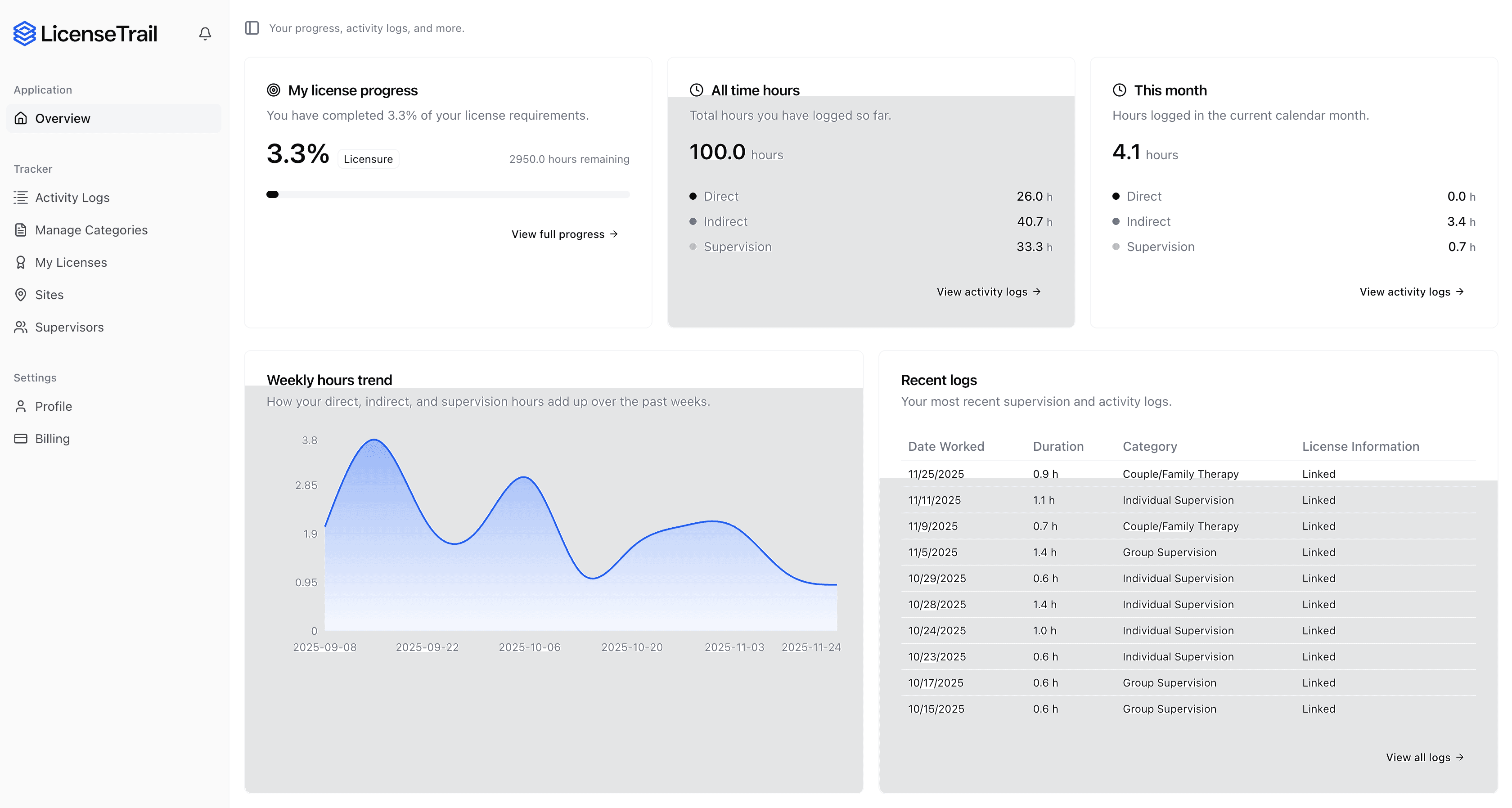 Start Tracking for Free
No credit card required · Free plan available
Is your spreadsheet hiding Arizona LACT risks?
Stop guessing if your categories match Arizona Board of Behavioral Health Examiners requirements. License Trail checks your direct, indirect, and supervision hours continuously and flags mismatches before you submit.
Import or log
Bring your spreadsheet or start fresh
Upload your existing tracking spreadsheet and we'll map every hour into the right Arizona Board of Behavioral Health Examiners categories automatically.
Verify against Arizona
Catch mismatches before the board does
License Trail checks your direct, indirect, and supervision hours against Arizona LACT requirements continuously.
Export board-ready
One-click clean reports
Generate professional, board-ready reports for supervision meetings and Arizona Board of Behavioral Health Examiners submissions in seconds.
No credit card required · Free plan available