
Arizona LAAC Requirements: Hours, Exams & Step-by-Step Guide
Stop guessing if your categories match Arizona requirements. License Trail checks your direct, indirect, and supervision hours against LAAC requirements continuously and flags mismatches before you submit.
No credit card required · Free plan available
Quick Requirements Overview
- Degree: Behavioral science degree with counseling emphasis (regionally accredited); BA/BS or MA+ pathways accepted
- Master’s pathway: Program must include ≥300 hours supervised practicum; no separate post-degree hour minimum specified for associate level
- Bachelor’s pathway work experience: ≥1,600 direct client contact hours in addiction counseling over ≥24 months
- Psychoeducation cap: ≤400 of the 1,600 direct hours may be psychoeducation
- Clinical supervision: ≥100 hours, including ≥1 hr/month during any month with direct client contact
- Supervisor qualifications/format rules: ≥50 supervision hrs by LIAC (or board-approved independent clinician with SUD expertise); ≥25 hrs individual; group hours capped (2 supervisees ≤75, 3–6 supervisees ≤50)
- Exam: Pass a Board-approved examination
- Documentation & oversight: Supervisor attestation of satisfactory competence/performance; direct supervision required while practicing as an associate; apply via Boardal with transcripts + fingerprint clearance and fees ($250 app; $40 fingerprint if using FD-258)
License Details
Procedures
Arizona has recently updated and renamed its substance‑use credentials. What used to be the “Licensed Associate Substance Abuse Counselor (LASAC)” is being converted to the Licensed Associate Addiction Counselor (LAAC) under the Arizona Board of Behavioral Health Examiners (AzBBHE). (legiscan.com)
Below is a structured guide focused on the current statutory and board‑level requirements for becoming an LAAC, with emphasis on the hours and definitions the Board actually uses.
1. License name and legal basis
Arizona Revised Statutes §32‑3321 now governs:
“Licensed addiction technician; licensed associate addiction counselor; licensed independent addiction counselor; qualifications; supervision.” (legiscan.com)
For the Licensed Associate Addiction Counselor (LAAC) (in statute, “licensed associate substance abuse addiction counselor”), the law requires: (legiscan.com)
- A qualifying behavioral science degree with an emphasis on counseling (bachelor’s or master’s) from a regionally accredited college or university, under rules set by the Board.
- For the bachelor’s route: a specified amount of supervised direct client contact work experience (see Section 3).
- Passing an examination approved by the Board.
- A supervisor attestation of satisfactory competency and overall performance on a Board‑approved form.
- Ongoing direct supervision while practicing as an associate.
2. Education: how you qualify academically
The details of acceptable degrees and practicum come from the Arizona Administrative Code, R4‑6‑702 (“Licensed Associate Substance Abuse Counselor Curriculum”). (azrules.elaws.us)
To qualify educationally for LAAC you must have one of these:
A. Bachelor’s degree path (requires post‑degree work experience)
- A bachelor’s degree from a regionally accredited college or university in:
- A program accredited by NASAC or
- A “behavioral health science” program that meets AzBBHE’s core content standards (R4‑6‑701(B)); or
- Another educational program previously approved by the Board under A.R.S. §32‑3253. (azrules.elaws.us)
- AND supervised work experience that meets R4‑6‑705(A) (see Section 3).
B. Master’s (or higher) degree path (no post‑degree hour minimum, but practicum is required)
- A master’s or higher degree from a regionally accredited college or university in:
- A program accredited by NASAC, including at least 300 hours of supervised practicum, or
- A behavioral health science program that meets core content standards and includes at least 300 hours of supervised practicum. (azrules.elaws.us)
Under R4‑6‑705(F), there is no separate “supervised work experience” hour requirement for an associate license if you qualify via a master’s or higher degree; the practicum is the structured clinical training requirement. (regulations.justia.com)
You still must pass the exam and obtain a supervisor’s attestation (see Sections 4 and 5).
3. Supervised work experience: bachelor’s‑degree route to LAAC
This is where the hours matter most. There are three overlapping sources: the statute, the Board’s current supervision guidance, and the Administrative Code.
3.1 Statutory minimum hours (A.R.S. §32‑3321(D))
For those with a bachelor’s degree, the statute now requires: (legiscan.com)
- At least 1,600 hours of direct client contact work experience
- Completed in no fewer than 24 months
- In substance abuse/addiction counseling under supervision that meets Board rules
- With no more than 400 of those hours in psychoeducation
There is no longer a statutory requirement that you accumulate a total of 3,200 hours; the focus is on 1,600 direct client hours.
3.2 Board’s “Addiction Counseling Supervision Requirements” (current practice)
The Board’s own supervision page for addiction counseling summarizes supervised work experience as: (bbhe.az.gov)
- Supervised work experience is gaining addiction‑counseling experience (paid or volunteer) under a direct supervisor and a clinical supervisor.
- Requirements:
- No less than 24 months of supervised work experience.
- 1,600 hours of direct client contact involving psychotherapy related to substance use disorder and addiction.
- No more than 400 hours of those direct hours may be psychoeducation.
Note that the Board’s public guidance now mirrors the updated 1,600 direct hours / 24‑month statutory standard and does not insist on an additional 1,600 hours of indirect service.
3.3 Older administrative rule (R4‑6‑705) & how it fits
The Administrative Code section R4‑6‑705 (“Supervised Work Experience for Substance Abuse Counselor Licensure”) still states that a bachelor’s‑level associate applicant shall complete at least 3,200 hours of supervised work experience in not less than 24 months, with: (regulations.justia.com)
- At least 1,600 hours of direct client contact using psychotherapy for substance‑use/addiction issues;
- No more than 400 hours of that direct contact in psychoeducation;
- No more than 1,600 hours of indirect client contact;
- At least 100 hours of clinical supervision; and
- At least one hour of clinical supervision in any month in which you provide direct client contact.
In practice, since the statute and Board’s own supervision page now emphasize the 1,600‑hour direct‑client minimum, you should plan for at least:
- 1,600 hours of direct client contact over ≥24 months (≤400 in psychoeducation), and
- 100 or more hours of clinical supervision meeting the distribution rules in Section 4. (bbhe.az.gov)
If you follow the 3,200‑hour structure in R4‑6‑705, you are clearly within both the older rule and the updated statute; most supervisors and agencies in Arizona still use that framework when tracking hours.
4. Clinical supervision: how many hours, and under whom?
“Supervised work experience” (your day‑to‑day counseling work) is not the same as clinical supervision (regular meetings where your cases and skills are formally reviewed).
4.1 Minimum clinical supervision hours
Under R4‑6‑705(A), during the required supervised work experience you must complete at least: (regulations.justia.com)
- 100 hours of clinical supervision, and
- At least 1 hour of clinical supervision in any month where you provide direct client contact.
4.2 Who can supervise, and how those hours must be structured
R4‑6‑706 and the Board’s supervision page specify how those 100+ hours must be supervised and distributed: (law.cornell.edu)
- At least 50 of your clinical supervision hours must be supervised by:
- A Licensed Independent Addiction Counselor (LIAC) (formerly LISAC), or
- Another independently licensed behavioral health professional who
- Demonstrates knowledge and experience in substance use disorder treatment, and
- Is approved by the Board’s Addiction and Recovery Committee (ARC) or its designee.
- The remaining supervision hours must be provided by:
- An individual qualified under R4‑6‑212(A) (qualified clinical supervisors in behavioral health), or
- A person granted a supervisor exemption under R4‑6‑212.01.
The Board also imposes format and group‑size limits: (bbhe.az.gov)
- Individual clinical supervision: at least 25 hours.
- Group supervision, 2 supervisees: no more than 75 hours may be counted.
- Group supervision, 3–6 supervisees: no more than 50 hours may be counted.
Group supervision beyond those caps or in groups larger than six supervisees will not fully count toward the required clinical supervision hours.
5. Exam requirement
Both statute and legislative summaries state that an associate addiction counselor applicant must “pass an examination approved by the board.” (legiscan.com)
AzBBHE does not name the exam on the face of the statute; it designates one or more qualifying national exams by rule or policy. At the application stage, the Board’s portal and instructions will specify which current exam you must take and how to have scores reported.
6. Supervisor attestation and competence requirement
In addition to logging hours and passing the exam, you must provide a supervisor attestation on a Board‑approved form. The law requires the supervisor to confirm that you: (legiscan.com)
- Were directly observed during supervised hours and demonstrated satisfactory competency in:
- Clinical documentation;
- Consultation;
- Collaboration; and
- Coordination of care for clients you directly served.
- Have an overall performance rating of at least “satisfactory.”
The AzBBHE “Addiction Counseling” page provides links to the forms you and your supervisor must use:
- Verification of Supervised Work Experience (employer/supervisor completes);
- Verification of Clinical Supervision;
- Clinical Supervisor Exemption Request (if applicable). (bbhe.az.gov)
These forms are submitted through the Board’s online Boardal portal.
7. Key Board definitions you will see
The updated statute and Board rules provide specific definitions for the terms they use in counting your hours. These are central to whether particular activities will count for LAAC licensure.
7.1 Direct client contact
“Direct client contact” is defined in A.R.S. §32‑3251 as therapeutic or clinical functions related to your practice level—such as diagnosis, assessment, and treatment—based primarily on interaction with the client, including through telehealth, and may include psychoeducation. (legiscan.com)
In practice, this includes:
- Individual, group, couple, or family psychotherapy focused on substance use and co‑occurring issues;
- Clinical assessment and diagnosis sessions;
- Documented treatment planning and counseling sessions;
- Psychoeducation sessions that meet Board criteria (but remember the 400‑hour cap for counting these toward your 1,600 hours).
7.2 Indirect client service
“Indirect client service” means functions done in preparation for, or on behalf of, a client for whom you also provide direct client contact, such as: (legiscan.com)
- Case consultation;
- Reviewing records;
- Receiving clinical supervision related to that client.
The law explicitly states that indirect client service does not include psychoeducation. (legiscan.com)
7.3 Psychoeducation
“Psychoeducation” is defined as educating a client about mental health, emotional disorders, or behavioral health as part of treatment. (legiscan.com)
For LAAC purposes:
- Psychoeducation can count as direct client contact,
- But no more than 400 hours of your 1,600 direct‑contact hours can be in psychoeducation. (legiscan.com)
7.4 Practice of substance abuse addiction counseling
The “practice of substance abuse addiction counseling” is defined in A.R.S. §32‑3251 as the professional use of counseling theories and techniques, tailored to individuals and families dealing with substance abuse, chemical dependency, and addiction (including behavioral/process addictions). It expressly includes: (legiscan.com)
- Assessment, appraisal, and diagnosis related to substance use/addiction; and
- Use of psychotherapy to evaluate, diagnose, and treat individuals, couples, families, and groups.
Your supervised hours must fall within this scope to count toward LAAC requirements.
8. Application logistics and fees
When you are ready to apply for LAAC licensure by examination, AzBBHE’s “Applying for Licensure” and “Addiction Counseling” pages outline the process: (bbhe.az.gov)
General application steps
- Create a Boardal account and select the Addiction Counseling – Licensed Associate Addiction Counselor (LAAC) application.
- Pay the application fee – currently $250.
- Provide either:
- Proof of an active Arizona DPS fingerprint clearance card, or
- A completed FD‑258 fingerprint card plus the $40 fingerprint fee.
- Arrange official transcripts sent directly from your school(s) to the Board.
- Submit:
- Verification of Supervised Work Experience (for the bachelor’s route);
- Verification of Clinical Supervision;
- Any Supervisor Exemption approvals, if applicable. (bbhe.az.gov)
- Have your exam scores sent according to Board instructions, if not already coordinated through the exam provider.
For existing LASACs or substance abuse technicians, the 2024 law provides a mechanism and timeline to re‑designate to LAAC/LACT/LIAC at renewal, but new applicants now enter directly under the addiction‑counseling titles. (legiscan.com)
9. Putting it together: what to plan for as an LAAC candidate
If you are planning your path, the concrete numbers used by the Arizona Board of Behavioral Health Examiners for Licensed Associate Addiction Counselor (LAAC) are:
If you qualify via a bachelor’s degree:
- 1,600 hours of direct client contact in addiction counseling,
- Over at least 24 months of supervised work experience,
- No more than 400 of those hours in psychoeducation,
- At least 100 hours of clinical supervision, with:
- ≥50 hours supervised by a LIAC or another approved independently licensed behavioral health professional with SUD expertise, and
- At least 25 hours of individual supervision; group supervision hours limited as described above. (bbhe.az.gov)
If you qualify via a master’s or higher degree:
- A qualifying degree that includes at least 300 hours of supervised practicum in an approved addiction/behavioral health counseling program,
- No additional minimum number of post‑degree supervised work hours is specified for the associate level, but you still need enough supervised experience for your supervisor to complete the required attestation of satisfactory competence. (azrules.elaws.us)
In both cases, you must:
- Work within the statutory scope of practice for addiction counseling;
- Be under direct supervision while licensed at the associate level;
- Pass a Board‑approved exam; and
- Obtain the supervisor attestation confirming satisfactory competency and overall performance. (legiscan.com)
Track your LAAC hours with confidence
License Trail checks your direct, indirect, and supervision hours against Arizona LAAC requirements continuously and flags mismatches before you submit.
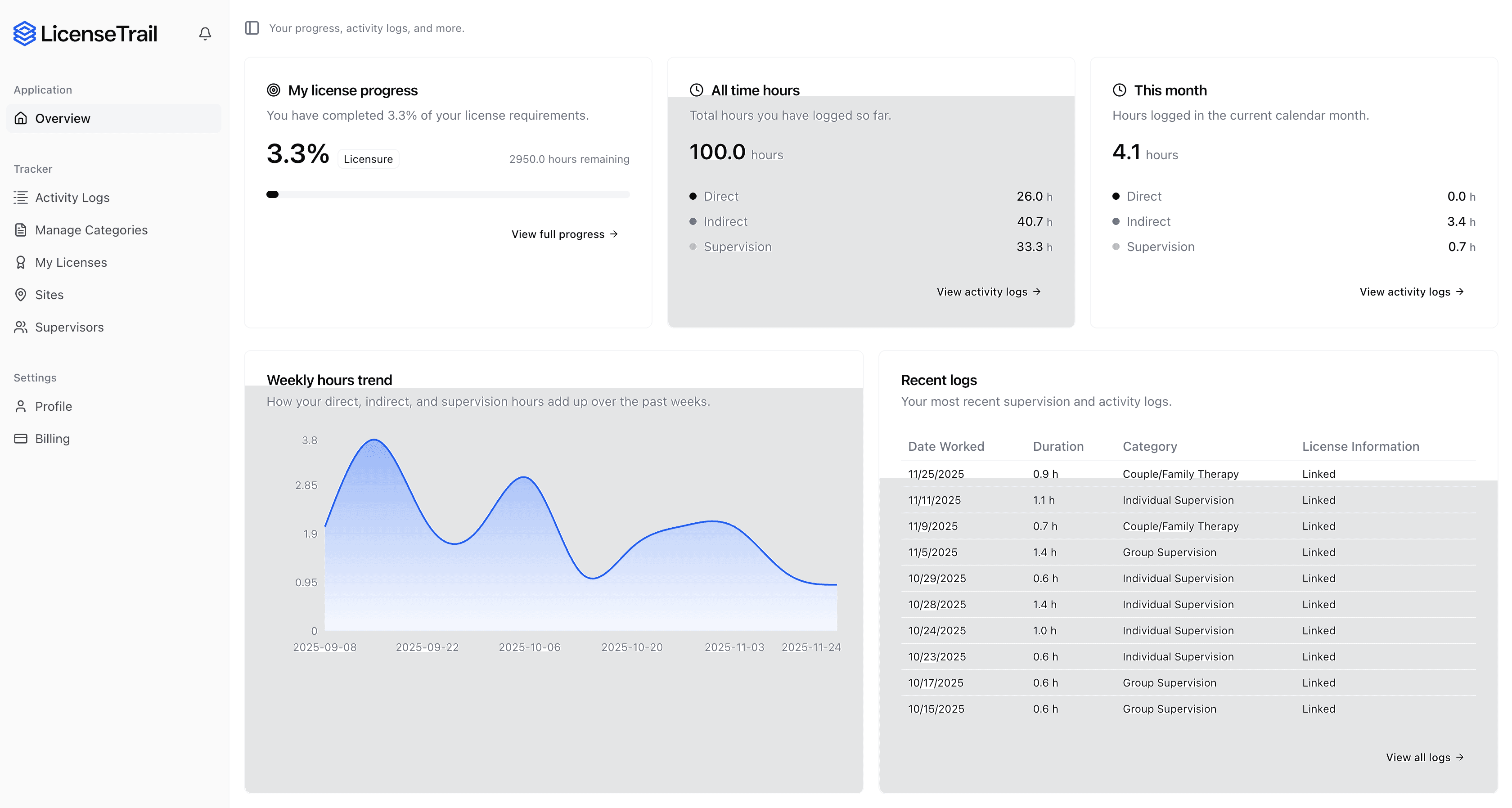 Start Tracking for Free
No credit card required · Free plan available
Is your spreadsheet hiding Arizona LAAC risks?
Stop guessing if your categories match Arizona Board of Behavioral Health Examiners requirements. License Trail checks your direct, indirect, and supervision hours continuously and flags mismatches before you submit.
Import or log
Bring your spreadsheet or start fresh
Upload your existing tracking spreadsheet and we'll map every hour into the right Arizona Board of Behavioral Health Examiners categories automatically.
Verify against Arizona
Catch mismatches before the board does
License Trail checks your direct, indirect, and supervision hours against Arizona LAAC requirements continuously.
Export board-ready
One-click clean reports
Generate professional, board-ready reports for supervision meetings and Arizona Board of Behavioral Health Examiners submissions in seconds.
No credit card required · Free plan available