
Arizona LAMFT Requirements: Hours, Exams & Step-by-Step Guide
Stop guessing if your categories match Arizona requirements. License Trail checks your direct, indirect, and supervision hours against LAMFT requirements continuously and flags mismatches before you submit.
No credit card required · Free plan available
Quick Requirements Overview
- Age/fitness/character: 21+, good moral character, physically/mentally able; submit application + fees; fingerprint/background check expected
- Degree: Master’s or higher in a behavioral health science (MFT-track acceptable) from a regionally accredited school; COAMFTE-accredited or Board-approved/meeting R4-6-601 core curriculum
- Practicum (pre-licensure): Minimum 2 semesters clinical practice with 300 direct client-contact hours, including 100 relational hours (couples/families/relational systems), all under direct supervision
- Practicum supervisor: AAMFT-approved supervisor or AZ LMFT (unless Board grants exemption)
- Exam: Pass AMFTRB MFT exam; must pass within 12 months of Board authorization; up to 3 attempts (otherwise reapply + repay fees)
- No post-master’s hours needed for LAMFT: 1,600 post-degree hours apply to LMFT, not LAMFT
- Practice restriction: LAMFT may only practice under direct supervision (no independent practice)
- LMFT pathway while LAMFT (later): 24+ months, 1,600 direct client-contact hours (incl. 1,000 couples/families) + 100 clinical supervision hours; at least 1 supervision hour in any month with client contact
License Details
Procedures
In Arizona, the Licensed Associate Marriage and Family Therapist (LAMFT) credential is the entry‑level, supervised license for marriage and family therapists. It allows you to practice while you complete the post‑degree hours required for independent licensure as a Licensed Marriage and Family Therapist (LMFT).
What follows is a step‑by‑step outline of what the Arizona Board of Behavioral Health Examiners (BBHE) and Arizona law currently require, with emphasis on the specific types and numbers of hours and the Board’s own terminology.
1. Understand the role of the LAMFT in Arizona
Arizona law creates a distinct associate-level license:
- A Licensed Associate Marriage and Family Therapist is someone who meets the education and exam requirements for marriage and family therapy but has not yet completed the post‑master’s supervised work experience needed for independent LMFT licensure.(azleg.gov)
- By statute, a LAMFT “shall only practice under direct supervision” as prescribed by the Board.(azleg.gov)
There is no separate post‑master’s hour requirement to obtain the LAMFT itself. Those supervised work‑experience hours are required later, for the LMFT license.
2. Meet the general licensure requirements
All behavioral health applicants must satisfy general requirements in Arizona’s licensure statutes, including:(azleg.gov)
- Submit a Board application and pay all applicable fees.
- Be at least 21 years of age.
- Be of good moral character.
- Have the physical and mental capability to safely and competently practice.
- Have no disqualifying disciplinary history or acts that would constitute grounds for discipline.
You should also expect to complete a fingerprint-based criminal background check, as part of Arizona’s general behavioral health licensing process (implemented via other sections of Title 32, Chapter 33).
3. Complete a qualifying graduate degree in marriage and family therapy
3.1 Degree level and type
For both LAMFT and LMFT, Arizona Revised Statutes § 32‑3311(A)(1) and rule R4‑6‑601 require that you:(azleg.gov)
- Earn a master’s or higher degree in a behavioral health science (e.g., marriage and family therapy, psychology, sociology, counseling, social work)
- From a regionally accredited college or university
- In a program that either:
- Is COAMFTE‑accredited, or(apps.azsos.gov)
- Was previously approved by the Board, or
- Meets specified core curriculum requirements in R4‑6‑601(B) or (C) (detailed lists of required MFT coursework).
Arizona’s rules spell out extensive curriculum expectations (family systems, human development, ethics and law, research, etc.). If your degree is not COAMFTE‑accredited, the Board will evaluate your transcript against those content requirements.(apps.azsos.gov)
3.2 Required practicum / internship hours (during the degree)
For LAMFT, the key “hours” requirement is in the supervised practicum that is part of your graduate program. Under R4‑6‑601(F), the MFT program’s practicum must:(apps.azsos.gov)
- Provide opportunities for you to deliver marriage and family therapy services to individuals, couples, families, or other systems under faculty or designated supervision.
- Occur over a minimum of two semesters of clinical practice.
- Include at least 300 client‑contact hours, and:
- At least 100 of those hours must be “relational hours”, meaning contact with couples, families, or other relational systems.
- All 300 client‑contact hours must be “provided under direct supervision.”
The Board’s rules define “direct client contact” and “direct supervision” as follows:
- “Direct client contact” is the performance of therapeutic or clinical functions (diagnosis, assessment, treatment, and psychoeducation) based primarily on verbal or nonverbal communication with, and in the presence of, one or more clients, including via telehealth.(apps.azsos.gov)
- “Direct supervision” means responsibility and oversight for all services provided by a supervisee in accordance with R4‑6‑211.(apps.azsos.gov)
Additionally, clinical supervision of the practicum must be provided by:(apps.azsos.gov)
- An AAMFT‑approved supervisor, or
- An LMFT licensed by the Board (unless the Board grants a specific exemption).
These practicum hours are pre‑licensure education hours, not post‑degree experience; they are required for LAMFT eligibility.
4. Pass the required national MFT exam
You must pass the exam required for marriage and family therapists:
- By statute, an applicant must have “passed an examination approved by the board.”(azleg.gov)
- By rule, R4‑6‑602(A) states that the Board approves the marriage and family therapy licensure examination offered by the Association of Marital and Family Therapy Regulatory Boards (AMFTRB).(apps.azsos.gov)
Key details from R4‑6‑602:(apps.azsos.gov)
- You must pass the exam within 12 months after the Board issues written exam authorization.
- You may attempt the exam up to three times in that 12‑month period.
- If you do not pass within that window, the Board will close your file; you must then reapply and repay fees to be reconsidered.
For LAMFT purposes, this exam is the same AMFTRB national MFT exam used later for LMFT licensure.
5. Satisfy the statutory requirements specific to LAMFT
Arizona Revised Statutes § 32‑3313 sets out the specific requirements for the associate license:(azleg.gov)
- § 32‑3313(A):
A person who wishes to be licensed as a licensed associate marriage and family therapist must “satisfy the requirements of section 32‑3311, subsection A, paragraphs 1 and 3 and subsection B.”
In plain terms, that means you must:- Meet the degree requirements in § 32‑3311(A)(1) (discussed in Section 3.1 above).
- Meet the curriculum requirements of § 32‑3311(B), which point directly to the Board’s detailed curriculum rules in R4‑6‑601.(azleg.gov)
- Pass the examination approved by the Board in § 32‑3311(A)(3) (the AMFTRB exam).
Importantly, § 32‑3313 does not incorporate § 32‑3311(A)(2) for LAMFT applicants. Paragraph (A)(2) is the provision that requires 1,600 hours of post‑master’s supervised experience in marriage and family therapy; that requirement applies to LMFT applicants, not to LAMFT applicants.(azleg.gov)
- § 32‑3313(B):
A licensed associate marriage and family therapist “shall only practice under direct supervision as prescribed by the board.”(azleg.gov)
This means that once licensed as a LAMFT, you are under the practice limitations in R4‑6‑210 and the supervised work‑experience framework in R4‑6‑211—you cannot practice independently.
6. Apply to the Arizona Board of Behavioral Health Examiners
Once you have:
- Completed the qualifying master’s or higher MFT degree (with required curriculum and practicum),
- Passed the AMFTRB exam, and
- Met the general licensure requirements (age, fitness, good moral character, fees, background checks),
you submit an application for licensure by examination as a LAMFT under the Board’s licensure rules (Article 3, including R4‑6‑301 and R4‑6‑302).(apps.azsos.gov)
Your application package will typically include (summarizing the content of the rules and standard Board practice):
- Completed application form.
- Official transcripts documenting:
- Degree conferral (master’s or higher in an approved behavioral health science program).
- Completion of the Board‑required MFT curriculum and practicum (including at least 300 client‑contact hours, with 100 relational hours under direct supervision).(apps.azsos.gov)
- Proof of passing the AMFTRB MFT exam within the allowed timeframe.(apps.azsos.gov)
- Verification of any other behavioral health licenses you hold (Arizona or other states).
- Fingerprint/background check materials, as directed by the Board.
- Applicable fees.
The Board’s Academic Review Committee (ARC) may request additional documentation—such as course syllabi or practicum verification—to confirm that your degree program and practicum meet R4‑6‑601 standards.
7. Practice limitations and supervision after you are licensed as a LAMFT
Once the Board issues your LAMFT license, you are a licensed behavioral health professional but must practice only under direct supervision.
7.1 Practice limitations
Under R4‑6‑210, the following licensees “shall not engage in the independent practice of behavioral health” and must practice under direct supervision as defined in R4‑6‑211:(regulations.justia.com)
- Licensed baccalaureate social worker
- Licensed master social worker
- Licensed associate counselor
- Licensed associate marriage and family therapist
- Licensed substance abuse technician
- Licensed associate substance abuse counselor
- Temporary licensees
R4‑6‑211 spells out what qualifies as supervised work experience, and defines constraints such as:(apps.azsos.gov)
- The experience must be in a behavioral health entity that provides clinical oversight.
- Supervised work experience for later independent licensure must:
- Be acquired after completing the qualifying degree and receiving licensure.
- Occur over at least 24 months.
- Be provided by supervisors who meet Board qualifications (and, for LMFT, the added conditions in R4‑6‑604).
7.2 What counts as “supervised work experience” toward LMFT
While you are working as a LAMFT, you will typically be accumulating supervised work experience toward LMFT licensure. Arizona uses specific terms:
- “Supervised work experience” means practicing clinical social work, marriage and family therapy, professional counseling, or addiction counseling for remuneration or on a volunteer basis under direct supervision while receiving clinical supervision as prescribed by R4‑6‑212 and Articles 4–7.(apps.azsos.gov)
For LMFT licensure, the supervised work‑experience requirement is defined in both statute (§ 32‑3311(A)(2)) and rule (R4‑6‑603). As of late 2025, the requirements are:(azleg.gov)
- At least 24 months of supervised work experience in marriage and family therapy.
- A total of 1,600 hours of post‑master’s degree experience that:
- Must consist entirely of direct client contact.
- Must include at least 1,000 hours of clinical experience with couples and families.
- Must include at least 100 hours of clinical supervision that meets R4‑6‑212 and R4‑6‑604.
- Within the 1,600 direct hours:
- No more than 400 hours may be in psychoeducation, and at least 60% of psychoeducation hours must be with couples or families.
- No more than 400 hours may be in crisis response, and at least 60% of crisis response hours must be with couples or families.
- For any month in which you provide direct client contact, you must receive at least one hour of clinical supervision.(apps.azsos.gov)
These are the post‑degree, supervised experience hours you work on after becoming a LAMFT. They are not required to obtain the LAMFT, but they are required later when you apply to upgrade to full LMFT licensure.
8. Summary of the key hour requirements for LAMFT in Arizona
Focusing specifically on what you need for the associate license:
-
Graduate practicum during your degree (required before LAMFT):
- At least 300 client‑contact hours, with
- At least 100 relational hours (couples/families/relational systems),
- All under direct supervision with an AAMFT‑approved supervisor or an Arizona LMFT, as part of your accredited or Board‑approved MFT program.(apps.azsos.gov)
-
No separate post‑master’s hour requirement to obtain LAMFT:
- The 1,600 hours of post‑master’s direct client contact, including 1,000 hours with couples and families and 100 hours of clinical supervision, apply to LMFT licensure, not to the associate license.(azleg.gov)
-
After you are licensed as a LAMFT:
- You must practice only under direct supervision as defined by the Board.(azleg.gov)
- Your work as a LAMFT can be structured to accumulate the 1,600 direct client‑contact hours and 100 clinical supervision hours needed later for LMFT licensure, provided all conditions in R4‑6‑603 and R4‑6‑604 are met.(apps.azsos.gov)
Together, these requirements define the educational, practicum, examination, and supervised‑practice pathway Arizona uses to move a candidate from graduate training to LAMFT and ultimately to fully independent LMFT practice.
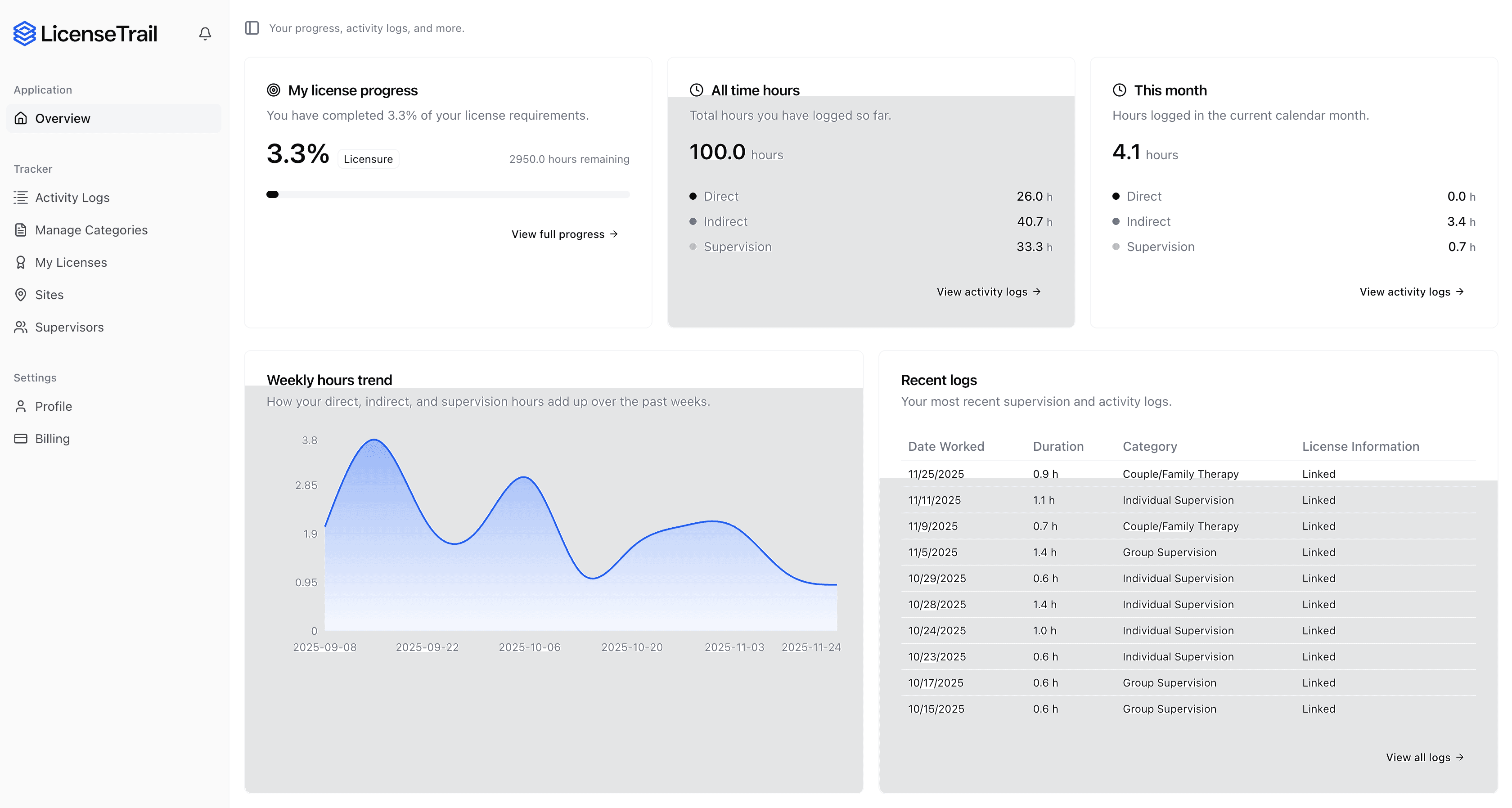
Track your LAMFT hours with confidence
License Trail checks your direct, indirect, and supervision hours against Arizona LAMFT requirements continuously and flags mismatches before you submit.
 Start Tracking for Free
No credit card required · Free plan available
Is your spreadsheet hiding Arizona LAMFT risks?
Stop guessing if your categories match Arizona Board of Behavioral Health Examiners requirements. License Trail checks your direct, indirect, and supervision hours continuously and flags mismatches before you submit.
Import or log
Bring your spreadsheet or start fresh
Upload your existing tracking spreadsheet and we'll map every hour into the right Arizona Board of Behavioral Health Examiners categories automatically.
Verify against Arizona
Catch mismatches before the board does
License Trail checks your direct, indirect, and supervision hours against Arizona LAMFT requirements continuously.
Export board-ready
One-click clean reports
Generate professional, board-ready reports for supervision meetings and Arizona Board of Behavioral Health Examiners submissions in seconds.
No credit card required · Free plan available