
California AMFT Requirements: Hours, Exams & Step-by-Step Guide
Stop guessing if your categories match California requirements. License Trail checks your direct, indirect, and supervision hours against AMFT requirements continuously and flags mismatches before you submit.
No credit card required · Free plan available
Quick Requirements Overview
- AMFT is required (BBS registration) to accrue most post-degree hours toward CA LMFT (limited 90‑day rule exception).
- AMFT application (in-state): qualifying MFT/related degree (BPC §4980.36/.37), $150 fee, Live Scan/fingerprints, official transcripts (+ transfer), Degree Program Certification, plus 6‑hr Suicide Risk and 3‑hr Telehealth law/ethics coursework (if completed).
- 90‑day rule: BBS must receive AMFT app within 90 days of degree award; for grads ≥1/1/2020, early hours count only if employer-required Live Scan before hours (keep processed Live Scan form for licensure).
- Experience requirement for LMFT: 3,000 supervised hours + 104 supervised weeks.
- Hour breakdown: min 1,750 direct clinical; within that, min 500 diagnosing/treating couples/families/children; max 1,250 non‑clinical.
- Pre-degree (trainee) limits: max 1,300 total; within that max 750 counseling + direct supervisor contact; no private practice until AMFT issued.
- Supervision rules (weeks/caps): 104 weeks with supervision (week requires 1 hr individual/triadic or 2 hrs group); at least 52 weeks must include individual/triadic; max 40 hrs/week experience and 6 hrs/week supervision credit; extra supervision if >10 direct hours/week in a setting.
- Time/registration limits & exams: hours generally must be ≤6 years old at licensure application (exception: up to 500 practicum hours); AMFT valid 6 years (subsequent AMFT numbers cannot work in private practice); must pass Law & Ethics then Clinical Exam for LMFT.
License Details
Procedures
In California, “Associate Marriage and Family Therapist” (AMFT) is a pre-licensure registration issued by the Board of Behavioral Sciences (BBS). You must first become an AMFT in order to accrue post‑degree hours toward licensure as a Licensed Marriage and Family Therapist (LMFT).
Below is a step‑by‑step guide, with the specific hour requirements and BBS terminology as of 2025.
1. Big picture: what you are working toward
To become an independently practicing LMFT in California, you must:
- Earn a qualifying master’s or doctoral degree in marriage and family therapy (or a related, BBS‑approved degree). (bbs.ca.gov)
- Register with the BBS as an Associate Marriage and Family Therapist (AMFT) before accruing most post‑degree hours in California (except under the limited “90‑day rule”). (bbs.ca.gov)
- Complete 3,000 hours of supervised professional experience, including 104 supervised weeks, within the categories and limits described below. (bbs.ca.gov)
- Pass the California Law and Ethics Exam and then the LMFT Clinical Exam. (bbs.ca.gov)
The “AMFT” itself is a registration; the actual license is LMFT.
2. Educational and registration requirements to become an AMFT
2.1 Qualifying degree
Your degree must meet California Business and Professions Code (BPC) § 4980.36 or § 4980.37, depending on when you began graduate study. The BBS site groups these as:
- Applicants who began graduate study on or after August 1, 2012 (must meet § 4980.36), and
- Applicants who began graduate study before August 1, 2012, with slightly different pathways depending on graduation date. (bbs.ca.gov)
Schools typically verify this via the Degree Program Certification forms that accompany your AMFT application. (bbs.ca.gov)
2.2 Application for AMFT registration (in‑state degree)
Key components of the Application for Associate Marriage and Family Therapist Registration – In‑State Applicant include: (bbs.ca.gov)
- Completed AMFT application form (form 37A‑590), using your legal name.
- Fee: $150, paid to the Behavioral Sciences Fund (non‑refundable).
- Criminal background check:
- Live Scan fingerprints (if in California) or “hard card” fingerprints plus a $49 processing fee if done out of state.
- Official transcripts:
- Official transcript showing degree title and date of conferral.
- Additional transcripts for any transfer units used toward the degree.
- Degree Program Certification (Form A or B), completed and sent by your school (sealed envelope or emailed directly to BBS).
- Suicide Risk Assessment and Intervention – 6 hours of coursework or applied experience, required prior to licensure (you may document it at the AMFT stage if completed).
- Telehealth law and ethics – 3 hours of coursework on provision of mental health services via telehealth, also required before licensure.
The BBS strongly advises using the checklist in the packet to avoid deficiencies. (bbs.ca.gov)
2.3 The “90‑day rule” for counting early post‑degree hours
If you want to start counting post‑degree hours immediately after graduation, you must meet the “90‑day rule” conditions: (bbs.ca.gov)
- The BBS must receive your AMFT application within 90 days of your degree award date; and
- You must later be issued an AMFT registration number.
For applicants who graduated on or after January 1, 2020, there is an added condition:
- Those post‑degree hours are only countable under the 90‑day rule if they were earned at a workplace that required Live Scan fingerprinting before you began gaining those hours, and
- You must submit a copy of the processed “State of California Request for Live Scan Service” form from that employer with your Application for Licensure.
Without meeting these conditions, your experience will only count from the date your AMFT registration is issued.
3. Pre‑degree experience as an MFT Trainee (what can count later)
Before graduation you are considered a Trainee, not an AMFT. Trainee hours can later apply toward the 3,000 hours of supervised experience, but within strict limits: (bbs.ca.gov)
- Maximum 1,300 hours of experience may be earned prior to the degree being awarded.
- Within that 1,300‑hour cap:
- Up to 750 hours may be counseling + direct supervisor contact (e.g., diagnosing and treating couples, families, children; individual or group psychotherapy).
- The remaining up to 550 hours may only be non‑clinical experience (e.g., notes, reports, client‑centered advocacy, approved workshops/trainings).
Later, when BBS evaluates your 3,000 hours, they will apply these pre‑degree caps in addition to the overall LMFT caps below.
Trainees are prohibited from working in private practice or a professional corporation until they have an AMFT registration. (bbs.ca.gov)
4. Required supervised experience for LMFT licensure (while you’re an AMFT)
4.1 Overall requirement
California law “currently requires 3,000 hours of supervised professional experience, including 104 supervised weeks” to qualify for LMFT licensure. Both the 3,000 hours and the 104 supervised weeks must be completed before you can be approved to sit for the clinical exam. (bbs.ca.gov)
4.2 Breakdown of the 3,000 hours of supervised experience
The BBS FAQ provides a table titled “3,000 HOURS OF SUPERVISED EXPERIENCE – BREAKDOWN OF REQUIREMENTS.” Paraphrased, the categories are:
-
Direct clinical counseling experience
- Minimum: 1,750 hours overall.
- This category includes direct clinical counseling such as individual, couple, family, and group psychotherapy.
-
Diagnosing and treating couples, families and children
- Minimum: 500 hours
- These 500 hours are a subset “of the above 1,750 hours” of direct clinical counseling experience. (bbs.ca.gov)
-
Non‑clinical experience
- Maximum: 1,250 hours overall
- BBS defines qualifying non‑clinical experience as including:
- Direct supervisor contact
- Administering and evaluating psychological tests
- Writing clinical reports
- Writing progress or process notes
- Client‑centered advocacy (see below)
- Certain workshops, seminars, training sessions, or conferences approved by your supervisor
- Any non‑clinical work beyond 1,250 hours will not count toward the 3,000‑hour total. (bbs.ca.gov)
-
Pre‑degree hours within the 3,000‑hour total
These limits apply when counting Trainee hours toward the 3,000: (bbs.ca.gov)- All hours obtained prior to the degree award date:
- Maximum: 1,300 hours (this is the same overall pre‑degree ceiling noted above).
- Hours of counseling plus direct supervisor contact obtained pre‑degree:
- Maximum: 750 hours (this 750 is part of the 1,300 pre‑degree maximum).
- All hours obtained prior to the degree award date:
-
Supervision by a Licensed Educational Psychologist (LEP)
- Maximum: 1,200 hours may be under LEP supervision, and only for “educationally related mental health services” consistent with the LEP scope of practice. (bbs.ca.gov)
-
Supervision by other qualified licensed mental health professionals
- No minimum or maximum; the rest of your supervision may be from LMFTs, LCSWs, LPCCs, clinical psychologists, psychiatrists, and other BBS‑qualified supervisors, subject to supervisor‑qualification rules. (bbs.ca.gov)
4.3 Required 104 “supervised weeks”
In addition to the 3,000 hours, you must document 104 supervised weeks. The BBS defines a “supervised week” as a week in which, in at least one setting, you meet with a supervisor for: (bbs.ca.gov)
- At least one (1) hour of individual or triadic supervision, or
- At least two (2) hours of group supervision.
The table “104 SUPERVISED WEEKS – BREAKDOWN OF REQUIREMENTS” adds:
-
Overall minimums:
- At least 52 weeks must include one hour of individual or triadic supervision (no maximum on these weeks).
- There is no minimum required number of weeks of group supervision.
-
Weekly minimums in each work setting (any week you claim hours):
- In each setting where you are claiming hours that week, you must receive at least:
- One hour of individual or triadic supervision, or
- Two hours of group supervision.
- In each setting where you are claiming hours that week, you must receive at least:
-
Supervision ratio when you do a lot of direct counseling in a week:
- If you provide more than 10 hours of “direct clinical counseling” in a given week in a single work setting, you must receive an additional:
- One hour of individual or triadic supervision, or
- Two hours of group supervision that same week in that setting. (bbs.ca.gov)
- If you provide more than 10 hours of “direct clinical counseling” in a given week in a single work setting, you must receive an additional:
-
Credit limits per week:
- You may credit a maximum of 40 hours of experience in any 7 consecutive days across all settings.
- You may credit a maximum of 6 hours of supervision (individual, triadic, or group) per week toward licensure. (bbs.ca.gov)
4.4 Special definitions you’ll see in BBS language
- Direct clinical counseling experience – direct psychotherapy or counseling services to individuals, couples, families, or groups.
- Client‑centered advocacy – activities such as researching and accessing resources or services on behalf of clients or client groups receiving psychotherapy/counseling; your supervisor must decide whether particular activities qualify. (bbs.ca.gov)
- Triadic supervision – face‑to‑face supervision with one supervisor and two supervisees, counted as equivalent to individual supervision in California law. (bbs.ca.gov)
- Telehealth counseling – delivering services via information and communication technologies; there is no limit on the number of telehealth hours that can count toward supervised experience, as long as all telehealth standards are met. (bbs.ca.gov)
5. Time limits on hours and registration
5.1 Six‑year limit on countable hours (“6‑year rule”)
BBS will not accept experience hours (including qualifying workshops, trainings, conferences) that are more than six (6) years old on the date the Board receives your Application for Licensure, with one exception: up to 500 hours of counseling and supervision obtained as a Trainee while enrolled in practicum may be older than six years. (bbs.ca.gov)
If your licensure file is closed and you must re‑apply, a new 6‑year window is calculated backward from the date of the new application, and older hours can be lost.
5.2 Six‑year life span of an AMFT registration
- An AMFT registration is valid for six years (five renewals). (bbs.ca.gov)
- Before the end of that period, you may apply for a subsequent AMFT registration number to continue accruing hours, but:
- Under a subsequent number, you cannot work in a private practice or professional corporation; only your first AMFT number allows private practice employment. (bbs.ca.gov)
6. Exams and final licensure
Once you have:
- A qualifying degree,
- An active or recently active AMFT registration (or acceptable equivalent),
- Completed 3,000 supervised hours including 104 supervised weeks, and
- Met all coursework requirements,
you submit an Application for LMFT Licensure. After BBS approves your education and experience, you must: (bbs.ca.gov)
- Pass the LMFT California Law and Ethics Exam (this must also be taken annually while you are an AMFT in order to renew).
- Pass the LMFT Clinical Exam administered by Pearson VUE.
- Request issuance of your LMFT license and pay the initial license fee within one year after passing the clinical exam.
Only after the LMFT license is issued may you practice independently (i.e., without required supervision).
7. Summary of the key hour numbers (LMFT path)
All numbers are California BBS requirements as of 2025: (bbs.ca.gov)
- 3,000 total hours of supervised professional experience, plus
- 104 supervised weeks.
- Within the 3,000 hours:
- At least 1,750 hours of direct clinical counseling experience.
- At least 500 hours specifically diagnosing and treating couples, families and children (within the 1,750 direct clinical hours).
- No more than 1,250 hours of non‑clinical experience (supervision, tests, reports/notes, client‑centered advocacy, workshops/seminars/trainings/conferences).
- No more than 1,300 hours may be pre‑degree.
- Of those pre‑degree hours, no more than 750 hours may be counseling + direct supervisor contact.
- No more than 1,200 hours may be under supervision by a Licensed Educational Psychologist.
These requirements, along with the 6‑year time limits and supervision ratios, form the core of what the California Board of Behavioral Sciences requires for an AMFT on the path to LMFT licensure.
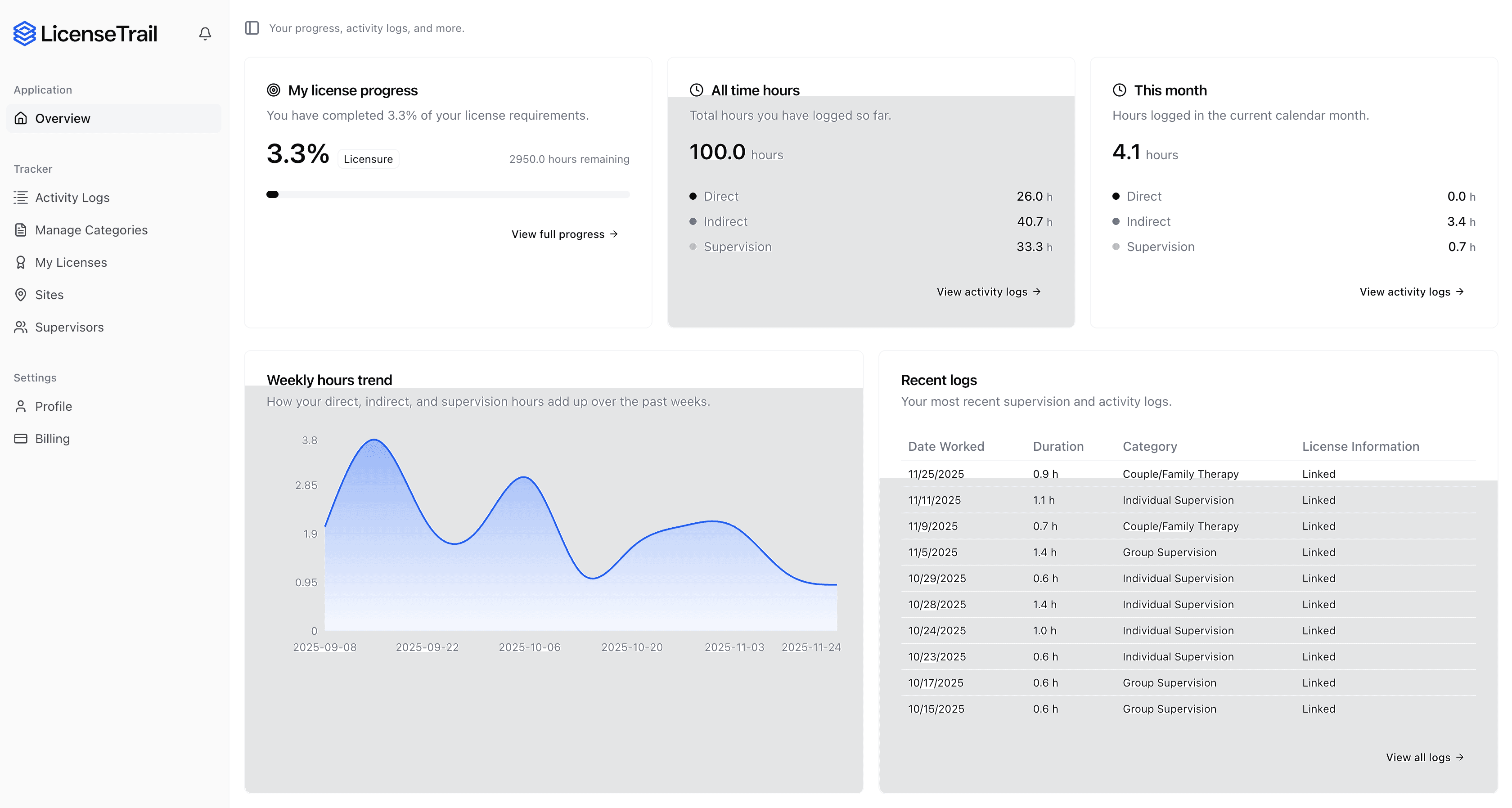
Track your AMFT hours with confidence
License Trail checks your direct, indirect, and supervision hours against California AMFT requirements continuously and flags mismatches before you submit.
 Start Tracking for Free
No credit card required · Free plan available
Is your spreadsheet hiding California AMFT risks?
Stop guessing if your categories match California Board of Behavioral Sciences requirements. License Trail checks your direct, indirect, and supervision hours continuously and flags mismatches before you submit.
Import or log
Bring your spreadsheet or start fresh
Upload your existing tracking spreadsheet and we'll map every hour into the right California Board of Behavioral Sciences categories automatically.
Verify against California
Catch mismatches before the board does
License Trail checks your direct, indirect, and supervision hours against California AMFT requirements continuously.
Export board-ready
One-click clean reports
Generate professional, board-ready reports for supervision meetings and California Board of Behavioral Sciences submissions in seconds.
No credit card required · Free plan available