
California APCC Requirements: Hours, Exams & Step-by-Step Guide
Stop guessing if your categories match California requirements. License Trail checks your direct, indirect, and supervision hours against APCC requirements continuously and flags mismatches before you submit.
No credit card required · Free plan available
Quick Requirements Overview
- Qualifying 60‑semester‑unit (90‑quarter) graduate degree incl. practicum: ≥6 semester/9 quarter units + ≥280 face‑to‑face counseling hours; trainee/practicum hours don’t count toward licensure hours
- Must obtain BBS APCC registration to accrue post‑degree hours in CA (limited 90‑day rule if apply/fee within 90 days of graduation + agency fingerprinting)
- Licensure path (LPCC) requires 3,000 post‑degree supervised hours + ≥104 supervised weeks; hours must be ≤6 years old at licensure application
- Hour mix: ≥1,750 direct clinical counseling; ≤1,250 nonclinical practice (e.g., notes/reports, testing, client advocacy, trainings); telehealth allowed with no cap
- Supervision structure: ≥52 weeks with 1 hr individual/triadic; to count hours in a setting/week need ≥1 “unit” (1 hr ind/triadic or 2 hrs group); if >10 direct hours/week/setting → 2 units
- Weekly caps: ≤40 experience hours/7 days total; ≤6 supervision hours/week credited
- Qualified supervisors: LPCC/LMFT/LCSW/Psychologist/LEP/Psychiatrist; supervisor must be active & unrestricted, licensed 2 of past 5 years; LEP‑supervised hours capped at 1,200 (educationally related)
- Employment/documentation/exams: must be W‑2 or volunteer employee (no direct client billing; 1099 only narrow exceptions), keep weekly logs + end‑of‑supervision verifications; take CA Law & Ethics exam annually until passed, then later pass NCMHCE for LPCC issuance
License Details
Procedures
In California, “Associate Professional Clinical Counselor” (APCC) is a registered pre‑license status with the Board of Behavioral Sciences (BBS). The full license you are ultimately working toward is “Licensed Professional Clinical Counselor” (LPCC). The APCC registration allows you to legally accrue the supervised experience required for LPCC licensure.
Below is a concise, step‑by‑step description of what the BBS currently requires, with emphasis on the exact hour types and how the Board defines them.
1. Educational foundation and practicum (before APCC)
To become an APCC, you must first complete a qualifying master’s or doctoral degree that meets the LPCC requirements in California law (Business and Professions Code §§ 4999.32–4999.33). The degree must:
- Be from a regionally or nationally accredited institution (or a BPPE‑approved school), and
- Include at least 60 semester units (90 quarter units) with specified LPCC coursework, and
- Include a minimum of six semester or nine quarter units of supervised practicum/field study, with at least 280 hours of face‑to‑face counseling experience with individuals, families, or groups. (bbs.ca.gov)
Important: Practicum/trainee hours do not count toward the 3,000 supervised hours required for licensure. The BBS explicitly states that “no hours earned as a Trainee may count toward the 3,000 hours of experience required for licensure.” (bbs.ca.gov)
2. Registering as an APCC
After graduating:
- You apply to the BBS for APCC registration (in‑state or out‑of‑state degree application, plus fee and fingerprints). (bbs.ca.gov)
- You cannot accrue supervised experience in California unless you are registered as an APCC, except under a very narrow “90‑day rule.” (bbs.ca.gov)
The 90‑day rule (post‑degree hours before APCC number)
You may be able to count post‑degree hours gained between your graduation date and the date your APCC number is issued if:
- You submit your APCC application and fee within 90 days of graduation, and
- You have been fingerprinted by the agency where you are accruing the hours and can document that. (bbs.ca.gov)
All other qualifying experience must be gained after your APCC registration is issued.
3. Total supervised experience required
3.1 Global requirement
California law requires:
- 3,000 hours of supervised post‑degree professional experience, and
- A minimum of 104 supervised weeks of experience. (bbs.ca.gov)
All 3,000 hours must:
- Be accrued while you hold a current APCC registration (or under the 90‑day rule window), and
- Meet strict supervision, setting, and documentation rules, and
- Be no more than six years old on the date the BBS receives your Application for Licensure (the “six‑year rule”). (bbs.ca.gov)
4. Breakdown of the 3,000 hours: types of experience
The BBS divides your 3,000 hours into two main content categories plus supervision structure requirements.
4.1 Direct clinical counseling experience (minimum 1,750 hours)
The Board’s table labels this category “Direct Clinical Counseling Experience” with individuals, groups, couples, and families. The requirement is:
- Minimum: 1,750 hours
- Maximum: none (in other words, all 3,000 hours could be direct clinical, but at least 1,750 must be). (bbs.ca.gov)
“Direct clinical counseling” here means actual psychotherapy/counseling services provided to clients—face‑to‑face or via telehealth—delivered under supervision within your scope of practice as an APCC.
Telehealth counseling is explicitly allowed, and there is no cap on the number of telehealth hours that may count toward the supervised experience requirement (provided all telehealth practice standards and supervision rules are met). (bbs.ca.gov)
4.2 Non‑clinical practice (maximum 1,250 hours)
The BBS uses the term “Nonclinical Practice” and allows up to:
- Maximum: 1,250 hours overall
- Minimum: none (you do not have to accrue any non‑clinical hours, but you may count up to 1,250) (bbs.ca.gov)
The Board lists this category as including:
- Direct supervisor contact
- Administering and evaluating psychological tests
- Writing clinical reports, progress notes, and process notes
- “Client‑centered advocacy”
- Participation in workshops, seminars, training sessions, or conferences related to clinical practice (bbs.ca.gov)
The BBS defines client‑centered advocacy as activities such as researching, identifying, or accessing resources or supports for clients or groups of clients who are receiving psychotherapy or counseling. The supervisor decides whether specific hours fall into this category. (bbs.ca.gov)
4.3 Supervision‑related caps and sub‑limits
Within the 3,000 hours and the two main content categories, additional rules apply:
- Supervision by a Licensed Educational Psychologist (LEP)
- You may count a maximum of 1,200 hours under an LEP supervisor, and
- Those hours must be educationally related mental health services within the LEP scope of practice. (bbs.ca.gov)
All other qualified supervisors (see below) have no specific minimum or maximum number of hours associated with them beyond the general 3,000‑hour requirement. (bbs.ca.gov)
5. Weekly supervision structure: “supervised weeks,” units, and ratios
The BBS regulates not just the total hours but how those hours are supervised week by week.
5.1 104 supervised weeks
You must complete at least 104 “supervised weeks”.
The BBS defines a “supervised week” as a week in which you meet with your supervisor for:
- At least one hour of individual or triadic supervision, or
- At least two hours of group supervision. (bbs.ca.gov)
Within those 104 supervised weeks:
- You must have at least 52 weeks where you receive one hour of individual or triadic supervision during the week. (No minimum number of weeks is specified for group supervision.) (bbs.ca.gov)
5.2 Definition of “one unit” of supervision and weekly minimum
The Board uses the concept of a “unit” of supervision:
- One unit of supervision =
- 1 hour of individual supervision or
- 1 hour of triadic supervision or
- 2 hours of group supervision. (bbs.ca.gov)
To count any experience in a given week in a given work setting, you must receive at least one unit of supervision that week in that setting. (bbs.ca.gov)
5.3 Supervision ratio when you provide >10 hours of direct counseling
If, in a single week at a particular work setting, you provide more than 10 hours of direct clinical counseling, then in that same week and setting you must receive a total of two units of supervision. For example:
- One hour of individual (or triadic) supervision plus two hours of group supervision; or
- Two separate hours of individual/triadic supervision; or
- Four hours of group supervision. (bbs.ca.gov)
5.4 Weekly maximums
The BBS sets explicit weekly ceilings:
- Experience hours credited: You may credit no more than 40 hours of experience in any 7 consecutive days across all settings.
- Supervision hours credited: You may credit no more than 6 hours of supervision (individual, triadic, or group combined) in any week. (bbs.ca.gov)
6. Who can supervise an APCC
The following California‑licensed professionals may supervise APCCs:
- Licensed Professional Clinical Counselor (LPCC)
- Licensed Marriage and Family Therapist (LMFT)
- Licensed Clinical Social Worker (LCSW)
- Licensed Psychologist
- Licensed Educational Psychologist (LEP), with a 1,200‑hour cap and educationally related scope restriction
- Licensed Physician certified in Psychiatry by the American Board of Psychiatry and Neurology (bbs.ca.gov)
Supervisors must also:
- Maintain an active, unrestricted California license,
- Have been licensed for at least two of the past five years, and
- Meet supervision‑training/continuing‑education requirements (except psychologists and psychiatrists, who are exempt from the training requirement). (bbs.ca.gov)
Certain relationships are prohibited: a supervisor cannot be your spouse/relative, cannot have provided you therapy, and cannot have a personal/professional relationship that undermines the supervision’s integrity. (bbs.ca.gov)
7. Employment status and documentation
While gaining hours:
- You must be either a W‑2 employee or a volunteer employee; you may not bill clients directly. (bbs.ca.gov)
- Payment via 1099 is only allowed in narrow circumstances (e.g., reimbursement of expenses, certain stipends or loan‑repayment programs); these may be audited. (bbs.ca.gov)
You are required to:
- Maintain weekly logs of experience hours (per setting), signed weekly by your supervisor.
- Obtain Experience Verification forms from each supervisor at the end of each supervisory relationship, summarizing hours by category. (bbs.ca.gov)
These documents must be retained and submitted with your Application for Licensure (experience verification forms) or provided upon request (weekly logs).
8. Time limits: the six‑year rule
All experience must be no more than six years old when your Application for Licensure is received by the BBS. Hours—including trainings/conferences—earned before that six‑year window cannot be counted. (bbs.ca.gov)
If your application is closed or considered abandoned, and you re‑apply, the six‑year window is recalculated based on the new application date, which can cause older hours to drop off. (bbs.ca.gov)
9. Exam requirements while you are an APCC
Throughout your APCC registration period:
- You must take the California LPCC Law & Ethics Exam at least once each year in order to renew your APCC registration until you pass it. (bbs.ca.gov)
- You must also complete required continuing education for each renewal. (bbs.ca.gov)
Passing the Law & Ethics exam is required before a “subsequent” APCC registration can be issued if you need more than six years to complete your hours. (bbs.ca.gov)
10. Transition from APCC to LPCC
Once you have:
-
Completed 3,000 hours of supervised post‑degree experience, including:
- At least 1,750 hours of direct clinical counseling experience, and
- No more than 1,250 hours of non‑clinical practice,
- At least 104 supervised weeks, including 52 weeks with individual/triadic supervision, and
-
Passed the California LPCC Law & Ethics Exam, (bbs.ca.gov)
you may:
- Submit your Application for LPCC Licensure to the BBS. (bbs.ca.gov)
- After your application is approved, register for and pass the National Clinical Mental Health Counseling Examination (NCMHCE), the LPCC clinical exam used by California. (bbs.ca.gov)
- Once you pass the NCMHCE, you must request issuance of your initial LPCC license and pay the initial license fee within one year. (bbs.ca.gov)
At that point, you are no longer an APCC; you are a Licensed Professional Clinical Counselor.
11. Quick numerical summary of experience requirements
To recap the core hour and supervision structure in the way you requested:
- 3,000 hours of supervised post‑degree experience total, accrued while registered as an APCC (subject to 90‑day rule exception).
- Within those 3,000 hours:
- At least 1,750 hours of direct clinical counseling experience (psychotherapy/counseling with individuals, couples, families, or groups, including telehealth).
- Up to 1,250 hours of non‑clinical practice, which may include supervisor contact, testing, documentation, client‑centered advocacy, and professional trainings/workshops. (bbs.ca.gov)
- At least 104 supervised weeks, with:
- At least 52 weeks containing one hour of individual or triadic supervision, and
- At least one unit of supervision in every week and setting where hours are claimed, with
- Two units of supervision required in any week/setting where you provide more than 10 hours of direct clinical counseling. (bbs.ca.gov)
- Weekly maximums:
- No more than 40 hours of experience credited in any 7‑day period,
- No more than 6 hours of supervision credited per week. (bbs.ca.gov)
These requirements, together with your qualifying degree and successful completion of the Law & Ethics Exam and NCMHCE, form the complete BBS‑mandated path from APCC registration to LPCC licensure in California.
Track your APCC hours with confidence
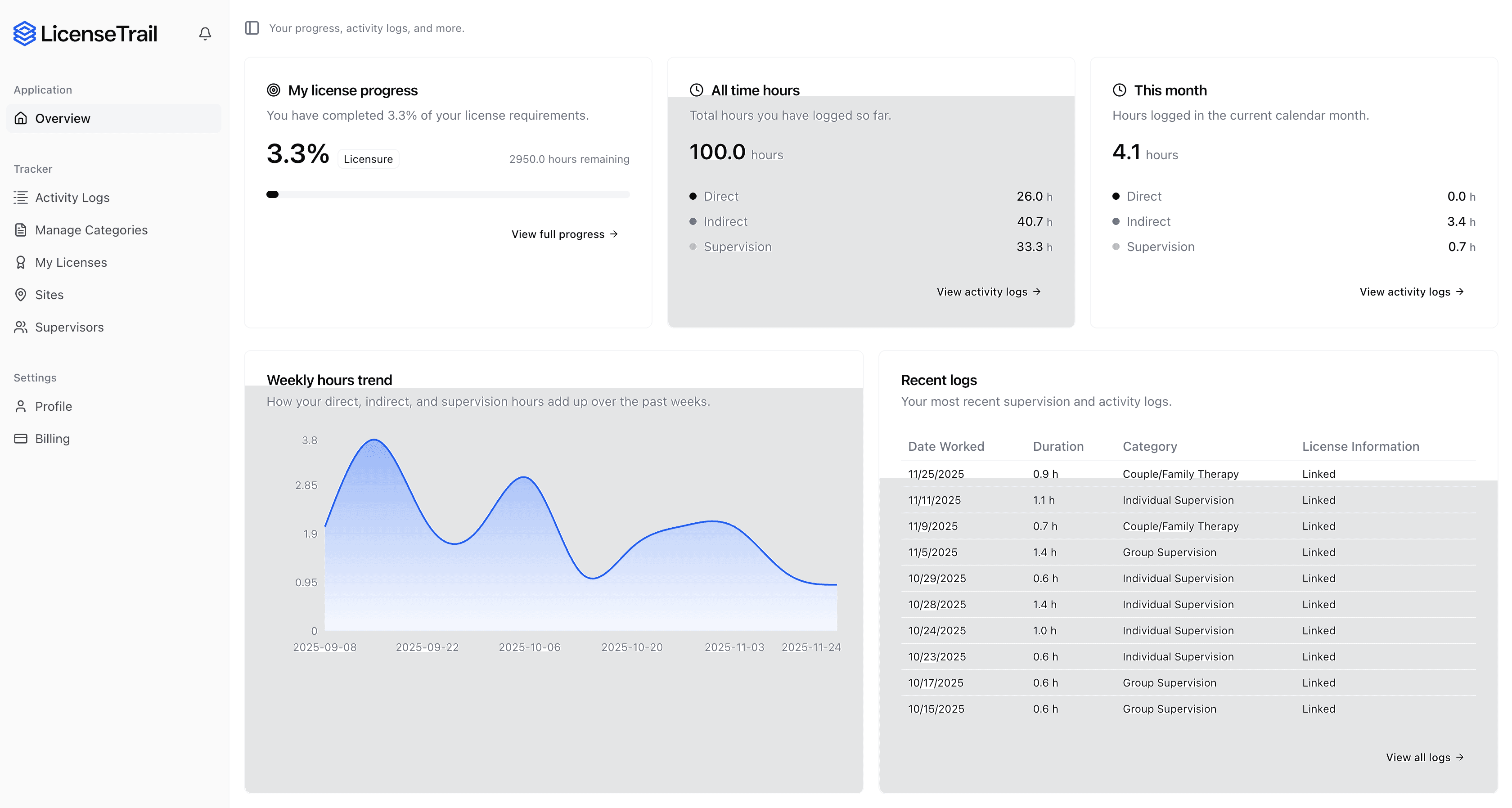
License Trail checks your direct, indirect, and supervision hours against California APCC requirements continuously and flags mismatches before you submit.
 Start Tracking for Free
No credit card required · Free plan available
Is your spreadsheet hiding California APCC risks?
Stop guessing if your categories match California Board of Behavioral Sciences requirements. License Trail checks your direct, indirect, and supervision hours continuously and flags mismatches before you submit.
Import or log
Bring your spreadsheet or start fresh
Upload your existing tracking spreadsheet and we'll map every hour into the right California Board of Behavioral Sciences categories automatically.
Verify against California
Catch mismatches before the board does
License Trail checks your direct, indirect, and supervision hours against California APCC requirements continuously.
Export board-ready
One-click clean reports
Generate professional, board-ready reports for supervision meetings and California Board of Behavioral Sciences submissions in seconds.
No credit card required · Free plan available