
Delaware LCDP Requirements: Hours, Exams & Step-by-Step Guide
Stop guessing if your categories match Delaware requirements. License Trail checks your direct, indirect, and supervision hours against LCDP requirements continuously and flags mismatches before you submit.
No credit card required · Free plan available
Quick Requirements Overview
- Master’s degree (regionally accredited) + 30 graduate semester hours in counseling/closely related subjects
- 3,200 hours post‑master’s chemical dependency counseling experience in a professional clinical setting, completed in ≥2 years
- Within the 3,200: 1,600 hours must be supervised by an approved clinical supervisor (LCDP; or LCSW/psychologist/LPCMH/MD specializing in chemical dependency, with additional attestations if not Board‑licensed)
- Supervised-hour composition: ≥1,500 hours must be direct face‑to‑face chemical dependency counseling (includes live video)
- Of those 1,500 direct hours: ≥750 hours must be individual face‑to‑face client sessions; remaining up to 750 may be individual/group/couple/family
- Supervision time: ≥100 hours face‑to‑face professional supervision; ≤40 hours may be group supervision (max 8 supervisees)
- Must hold an accepted national addictions certification: NAADAC NCAC/MAC, DCB CADC, or other Board‑approved equivalent (exam + comparable ethics)
- Apply via DELPROS with fee, official transcripts, experience/supervision verification forms, certification verification, and state/federal fingerprint background check (must meet character/discipline/criminal history standards)
License Details
Procedures
Delaware’s Licensed Chemical Dependency Professional (LCDP) credential is governed by the Delaware Board of Mental Health and Chemical Dependency Professionals under Title 24, Chapter 30 of the Delaware Code and the Board’s Administrative Code (24 Del. Admin. Code 3000).(delcode.delaware.gov)
Below is a structured guide focused on the exact hour requirements, how those hours must be composed, and how the Board itself defines the key terms.
1. Big‑picture summary of LCDP requirements
To qualify for an initial LCDP license in Delaware by certification (the standard route), you must:(delcode.delaware.gov)
-
Hold a qualifying master’s degree
- A master’s from a regionally accredited institution.
- At least 30 graduate semester hours in counseling or closely related subjects.
-
Complete 3,200 hours of post‑master’s counseling experience
- Defined as chemical dependency counseling in a professional clinical/substance abuse setting.
- Must be accumulated in no less than two years.
-
Complete 1,600 hours of supervised counseling experience within those 3,200 hours
- Under an “approved clinical supervisor” (LCDP, LCSW, psychologist, LPCMH, or physician specializing in chemical dependency, with some extra requirements if they’re not licensed by this Board).
-
Meet the Board’s detailed breakdown of those supervised hours
- Of the 1,600 supervised hours:
- At least 1,500 hours must be direct face‑to‑face chemical dependency counseling services.
- Of those 1,500 hours, at least 750 hours must be individual face‑to‑face client sessions providing direct chemical dependency counseling.
- The other 750 hours may be individual, group, couple, or family counseling (or a combination).
- At least 100 of the 1,600 hours must be face‑to‑face professional supervision between you and your supervisor.
- All 100 may be individual supervision.
- No more than 40 of these 100 hours may be group supervision; group supervision may include the supervisor and no more than eight supervisees.(law.cornell.edu)
- At least 1,500 hours must be direct face‑to‑face chemical dependency counseling services.
- Of the 1,600 supervised hours:
-
Hold and maintain an accepted national addictions certification
- NAADAC: NCAC or MAC; or
- Delaware Certification Board (DCB): CADC; or
- Another national certifying organization acceptable to the Board (must meet specific standards, including an exam and a code of ethics comparable to NAADAC’s).(delcode.delaware.gov)
-
Meet character, ethics, and criminal‑history requirements
- No disqualifying administrative penalties, substance‑related impairments, or substantially related criminal convictions (subject to a waiver process with specific limits).(delcode.delaware.gov)
-
Submit a complete application in DELPROS with the required forms and verifications
- Application fee.
- Official transcripts.
- Counseling Experience Verification form(s) documenting 3,200 hours.
- Supervision Reference form(s) documenting 1,600 supervised hours.
- Verification of national certification.(dpr.delaware.gov)
2. How Delaware defines the key experience terms
Delaware law and the Board’s website use specific definitions that matter for how your hours are counted. Under §3041 of Title 24 and the Board’s guidance:(delcode.delaware.gov)
-
“Chemical dependency professional”
A person who uses addiction counseling methods to help individuals or groups understand alcohol and drug dependency problems, define goals, and plan actions in light of those problems. -
“Counseling experience”
Defined as a formal, systematic process focusing on skill development and integration of knowledge related to addiction counseling, representing the accumulation of hours providing substance abuse counseling services under the supervision of an approved clinical supervisor.(delcode.delaware.gov) -
“Professional counseling experience”
The hours spent providing chemical dependency counseling services in a substance abuse counseling setting, including:- Face‑to‑face interaction with clients, and
- Other services directly related to treatment of clients.(delcode.delaware.gov)
-
“Supervised counseling experience”
The overseeing of a supervisee’s application of chemical dependency counseling principles, methods, or procedures to help clients achieve more effective personal and social adjustment.(delcode.delaware.gov) -
“Approved clinical supervisor”
For LCDP purposes, this can be:- A licensed chemical dependency professional, or when not available,
- A licensed clinical social worker, licensed psychologist, licensed professional counselor of mental health, or a licensed physician specializing in chemical dependency.(delcode.delaware.gov)
If the supervisor is not licensed by the Delaware Board of Professional Counselors of Mental Health and Chemical Dependency Professionals, the regulations require that the supervisor attest (on a Board form) that they:
- Understand Delaware’s LCDP licensure requirements.
- Are familiar with the DCB or NAADAC Code of Ethics.
- Have been a licensed professional in good standing for at least five years.
- Have been appropriately trained to provide clinical supervision.(law.cornell.edu)
3. The 3,200‑hour post‑master’s experience requirement
3,200 hours of “counseling experience” in at least two years
The Board’s regulation states:(law.cornell.edu)
- “Counseling experience shall be defined as the accumulation of 3,200 hours in no less than two years, providing chemical dependency services in a professional clinical setting, including face‑to‑face interaction with clients and other matters directly related to the treatment of clients.”
- “Face‑to‑face” includes both in‑person and live video conferencing.
The Division of Professional Regulation’s Post‑Masters Substance Abuse Counseling Experience page reiterates that applicants must have at least 3,200 hours of post‑Master’s substance abuse counseling experience, and it uses essentially the same definitions for “professional counseling experience,” “counseling experience,” and “supervised counseling experience.”(dpr.delaware.gov)
4. Detailed breakdown of the 1,600 supervised hours
Within the 3,200 total hours, 1,600 must be supervised counseling experience under an approved clinical supervisor.(delcode.delaware.gov)
The Board’s regulations add further detail:
-
At least 1,500 of the 1,600 supervised hours must be direct face‑to‑face counseling
- “At least 1500 of the 1600 hours required to be supervised must be in the actual provision of face‑to‑face direct chemical dependency counseling services.”(law.cornell.edu)
-
Within those 1,500 direct hours: at least 750 must be individual face‑to‑face client sessions
- “At least 750 of these 1500 hours must be individual face‑to‑face client sessions and must include the actual provision of direct chemical dependency counseling services.”(law.cornell.edu)
-
The remaining 750 of the 1,500 direct hours may be individual, group, couple, or family
- “The remaining 750 hours may be individual, group, couple, family counseling services, or some combination thereof.”(law.cornell.edu)
-
At least 100 of the 1,600 supervised hours must be supervision time with your supervisor
- “At least 100 of these 1600 hours must be face‑to‑face professional direct supervision with the applicant’s supervisor.”
- “Individual Direct Supervision” is one‑to‑one, face‑to‑face meetings between supervisor and supervisee, and the entire 100 hours may be satisfied this way.
- “Group Supervision” is face‑to‑face meetings between the supervisor and no more than eight supervisees; no more than 40 hours of group supervision may count toward the 100‑hour direct supervision requirement.(law.cornell.edu)
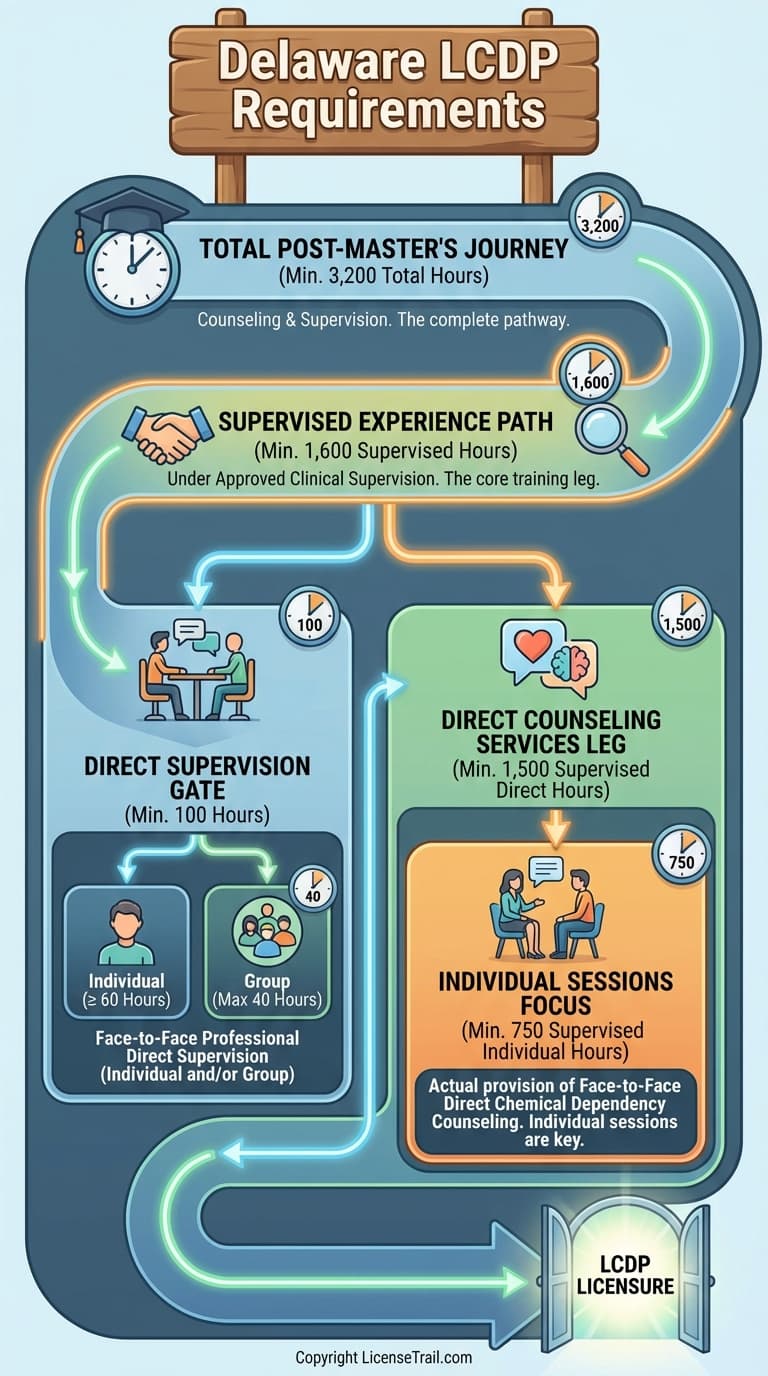
In short, the hours structure looks like this:
- 3,200 hours total post‑master’s counseling experience (≥2 years).
- Within that:
- 1,600 hours supervised counseling experience.
- Within that 1,600:
- 1,500 hours direct face‑to‑face counseling.
- At least 750 hours = individual sessions.
- Up to 750 hours = individual + group + couple + family.
- 100 hours = direct face‑to‑face supervision with the supervisor.
- Up to 40 hours of the 100 may be group supervision.
- 1,500 hours direct face‑to‑face counseling.
- Within that 1,600:
- 1,600 hours supervised counseling experience.
- Within that:
5. National certification requirement
By statute and regulation, applicants must hold a qualifying national certification when they apply:(delcode.delaware.gov)
-
Acceptable certifying organizations
- National Association for Addictions Professionals (NAADAC) as:
- National Certified Addictions Counselor (NCAC), or
- Master Addictions Counselor (MAC); or
- Delaware Certification Board (DCB Inc.) as:
- Certified Alcohol and Drug Counselor (CADC); or
- Another national chemical dependency certifying organization acceptable to the Board.
- National Association for Addictions Professionals (NAADAC) as:
-
What makes another organization “acceptable”?
The regulations require that any alternate certifying body:- Is a national professional chemical dependency organization recognized for setting national competency standards.
- Requires a standardized examination on chemical dependency principles.
- Has a code of ethics substantially equivalent to NAADAC’s.(law.cornell.edu)
At initial licensure, you must provide evidence of active certification in good standing from one of these organizations.(law.cornell.edu)
6. Education requirement
The minimum education standard is written directly into §3044(a)(1):(delcode.delaware.gov)
- You must have “a master’s degree from a regionally accredited institution of higher education with a minimum of 30 graduate semester hours in counseling or subjects closely related to counseling.”
The Board’s licensure instructions require official transcripts sent directly from the institution to the Board office for all relevant graduate degrees.(dpr.delaware.gov)
7. Ethics, fitness, and criminal‑history requirements
In addition to hours and education, §3044(a)(4)–(9) impose character and background conditions:(delcode.delaware.gov)
-
Disciplinary history
- You must not have received administrative penalties such as fines, formal reprimands, suspensions, or revocations (with some exceptions), and must not have entered into consent agreements with conditions on your professional conduct that the Board finds disqualifying.
-
Substance‑related or mental‑health–related impairment
- You must not have an impairment related to drugs, alcohol, or a finding of mental incompetence that would limit safe practice as a chemical dependency professional.
-
Criminal history
- You must not have a criminal conviction or pending charge for an offense substantially related to chemical dependency counseling, unless the Board grants a waiver under specified criteria.
- A waiver may not be granted for a felony sexual offense.
-
Ethics violations
- You must not have been penalized for willful violation of the Board’s code of ethics or the code of ethics of a chemical dependency professional organization.
-
Fingerprint‑based background check
- You must submit fingerprints and other information so the Board can obtain a full state and federal criminal history record.
- Licensure cannot be granted until these reports are received and reviewed.
8. Application process and documentation (DELPROS)
The Division of Professional Regulation requires you to apply through DELPROS, Delaware’s online licensing system. For an LCDP by certification, you must:(dpr.delaware.gov)
- Create or log into a DELPROS account and start a Chemical Dependency Professional application.
- Pay the application fee listed on the Board’s fee schedule.
- Upload/arrange for:
- Official master’s transcript(s) showing:
- Degree awarded, and
- At least 30 graduate counseling or closely related credits.
- Counseling Experience Verification form(s) from each administrative or clinical supervisor documenting your 3,200 hours of substance abuse counseling experience (if self‑employed, signed by an objective agent you designate).
- Supervision Reference form(s) from each approved clinical supervisor documenting your 1,600 hours of supervised counseling and attesting to the required supervision.
- Verification of your NAADAC, DCB, or other Board‑approved national certification (sent directly from the certifying body if not NAADAC or DCB).
- Official master’s transcript(s) showing:
- Complete any criminal‑history and fingerprinting steps as directed.
- Wait for Board review at a scheduled meeting once your application is deemed complete.
9. Reciprocity note (if already licensed elsewhere)
If you already hold a current LCDP‑equivalent license in another state, the District of Columbia, or a U.S. territory, Delaware offers licensure by reciprocity under §3045 and Board regulations, with requirements that your existing license be in good standing and that your jurisdiction’s standards be substantially similar—or, if not, that you meet additional experience and certification conditions.(delcode.delaware.gov)
In essence, Delaware’s LCDP pathway is built around a post‑master’s, 3,200‑hour clinical experience requirement, with 1,600 supervised hours that must include 1,500 direct counseling hours and 100 hours of face‑to‑face supervision, all under tight definitions of counseling, supervision, and acceptable supervisors, plus a national addictions certification and a full ethics/fitness review.
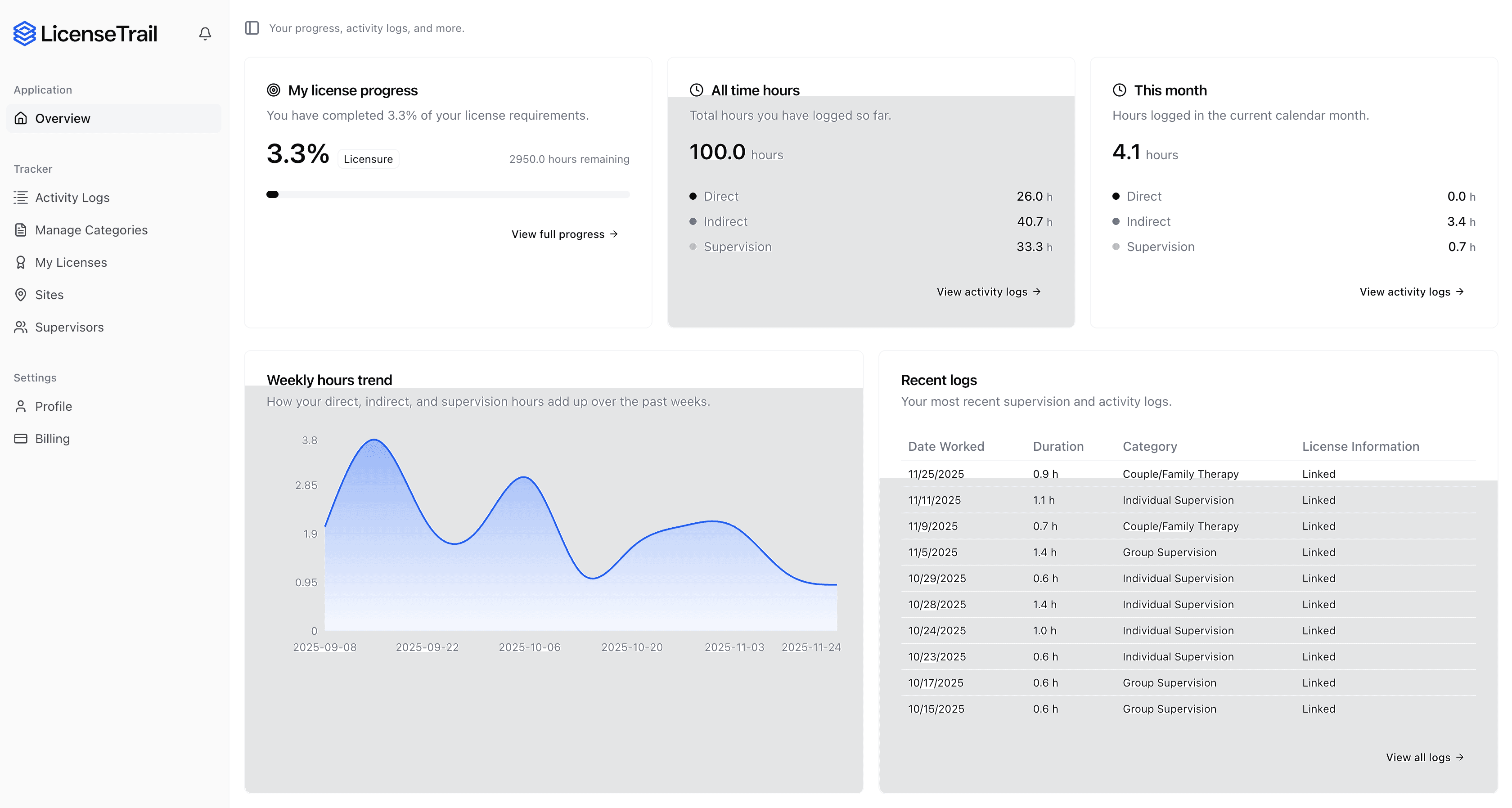
Track your LCDP hours with confidence
License Trail checks your direct, indirect, and supervision hours against Delaware LCDP requirements continuously and flags mismatches before you submit.
 Start Tracking for Free
No credit card required · Free plan available
Is your spreadsheet hiding Delaware LCDP risks?
Stop guessing if your categories match Delaware Board of Mental Health and Chemical Dependency Professionals requirements. License Trail checks your direct, indirect, and supervision hours continuously and flags mismatches before you submit.
Import or log
Bring your spreadsheet or start fresh
Upload your existing tracking spreadsheet and we'll map every hour into the right Delaware Board of Mental Health and Chemical Dependency Professionals categories automatically.
Verify against Delaware
Catch mismatches before the board does
License Trail checks your direct, indirect, and supervision hours against Delaware LCDP requirements continuously.
Export board-ready
One-click clean reports
Generate professional, board-ready reports for supervision meetings and Delaware Board of Mental Health and Chemical Dependency Professionals submissions in seconds.
No credit card required · Free plan available